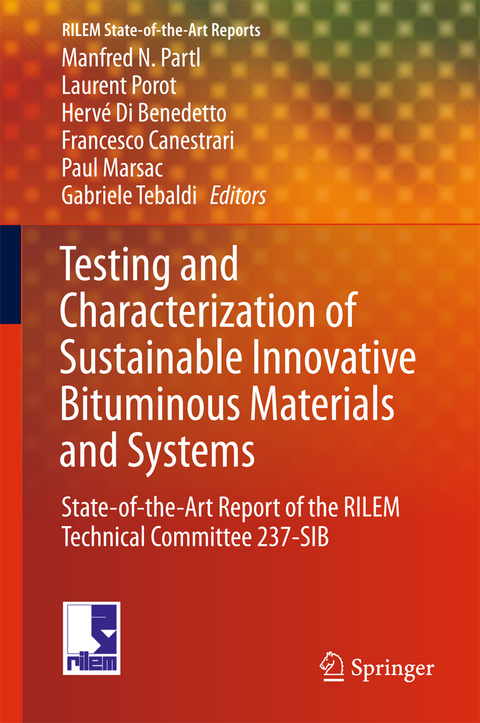
Testing and Characterization of Sustainable Innovative Bituminous Materials and Systems (eBook)
300 Seiten
Springer International Publishing (Verlag)
978-3-319-71023-5 (ISBN)
Preface 6
Acknowledgements 9
RILEM Publications 11
RILEM Proceedings (PRO) 11
RILEM REPORTS (REP) 19
Contents 22
1 Introduction 23
Abstract 23
1.1 Background and Motivation 24
1.1.1 Challenge and Role of Modern Bituminous Pavement Materials 24
1.1.2 Towards Green Asphalt Pavements 26
1.2 Testing and Characterization 29
1.2.1 General Aspects 29
1.2.2 Testing of Reinforced Asphalt 31
1.3 Scope of This Book 34
References 35
2 Bituminous Binder 37
Abstract 37
2.1 Introduction 38
2.2 State of the Art 39
2.3 Organisation of the Round Robin Test 43
2.3.1 Participating Laboratories 43
2.3.2 Bituminous Binder 43
2.3.3 Aggregates 45
2.3.4 Experimental Procedure 46
2.3.4.1 Rolling Bottle 46
2.3.4.2 Boiling Water Stripping Test 48
2.3.4.3 Bitumen Bond Strength 50
2.4 Results of the RRT for Aggregate, Bitumen Affinity 53
2.4.1 Rolling Bottle Test 53
2.4.2 Boiling Water Stripping Test 58
2.4.3 Bitumen Bond Strength 60
2.4.3.1 BBS Results with Dry Strength Measurements 60
2.4.3.2 Results of Moisture Damage Evaluation 62
2.4.3.3 Results of the New Pull-off Test 65
2.5 Surface and Adhesion Intrinsic Properties 66
2.5.1 Theoretical Background on Surface Properties 66
2.5.2 Methods 70
2.5.3 Results of Intrinsic Adhesion Properties 75
2.5.3.1 Binders Surface Tension 75
2.5.3.2 Aggregates Surface Energy 76
2.5.3.3 Adhesion Work Between Aggregates and Binders 77
2.5.3.4 Debonding Work, Compatibility Ratio 78
2.5.4 Outcomes of Surface Energy Measurements 79
2.6 Discussion and Recommendation 81
2.6.1 Discussion of the Rolling Bottle Test Results 81
2.6.2 Blind Test for Visual Interpretation 83
2.6.3 Discussion Bitumen Bond Strength Results 83
2.6.4 Comparison Between Test Methods 86
2.6.5 Recommendation 88
2.7 Conclusions 89
Chap2 90
Glossary 90
References 92
3 Three-Dimensional Characterisation of Linear Viscoelastic Properties of Bituminous Mixtures 97
Abstract 97
3.1 Introduction 100
3.1.1 Three-Dimensional Characterisation of Bituminous Mixtures 100
3.1.2 Presentation of the Chapter 102
3.2 Literature Review 102
3.2.1 Poisson’s Ratio 102
3.2.1.1 Poisson’s Ratio Definition in Linear Elasticity 102
3.2.1.2 Poisson’s Ratio Definition in Isotropic Linear Viscoelasticity 103
3.2.2 Poisson’s Ratio of Bituminous Mixes in the Linear Domain 103
3.2.2.1 General Considerations 103
3.2.2.2 Frequency-Domain Characterisation 104
3.2.2.3 Time-Domain Characterisation 109
3.3 Round Robin Test on Poisson’s Ratio Measurement 110
3.3.1 Introduction 110
3.3.1.1 Overview 110
3.3.1.2 Participating Laboratories 111
3.3.2 Experimental Program 111
3.3.2.1 Test Description 111
3.3.2.2 Materials 114
3.3.2.3 Sample Preparation 115
3.3.2.4 Complex Modulus Test on Binder 115
3.3.2.5 Test Equipment and Procedures for Tests on Bituminous Mixtures 116
Lab1 (France) 117
Lab2 (Italy) 120
Lab3 (Canada) 121
Lab 4 (Austria) 122
Lab 5 (Switzerland) 124
3.3.3 Results and Analysis 125
3.3.3.1 Complex Young’s Modulus 125
3.3.3.2 Complex Poisson’s Ratio 125
Qualitative Description of Measured Data 127
Dispersion of the Measured Data 132
Comparison Between Transverse Directions (Anisotropy) 133
3.3.3.3 Master Curves of Complex Young’s Modulus 134
3.3.3.4 Master Curves of Complex Poisson’s Ratio 136
3.3.3.5 Simulation and Comparison Using the 2S2P1D Model 138
Presentation of 2S2P1D Model and Calibration 139
Difference Between Experimental Results and 2S2P1D Simulated Values 140
3.4 Conclusion 143
References 144
4 Advanced Interface Testing of Grids in Asphalt Pavements 148
Abstract 148
4.1 Introduction 151
4.1.1 Reinforcement of Asphalt Layers 151
4.1.2 Interlayer Bonding of Reinforced Asphalt Interfaces 152
4.1.3 Mechanical Response of Reinforced Bituminous Pavements 153
4.2 Project Description 154
4.2.1 Objectives 154
4.2.2 Methodology 155
4.2.2.1 Interlaboratory Test 155
4.2.2.2 Real Scale Analysis 155
4.2.3 Participating Laboratories 156
4.3 Experimental Pavement Sections 156
4.3.1 Materials and Preliminary Tests 157
4.3.2 Inter laboratory Test Pavement (Section A) 161
4.3.2.1 Construction of Section A 161
4.3.3 Instrumented Pavement (Section B) 162
4.3.3.1 Sensors Characteristics, Signal Conditioning and Data Acquisition System 163
4.3.3.2 Construction of Section B 167
4.4 Interlayer Bonding Characterization of Reinforced Asphalt Interfaces 171
4.4.1 Test Methods 171
4.4.1.1 Shear Test Devices and Procedures 171
4.4.1.2 Pull-Off Test Device and Procedure 174
4.4.1.3 Experimental Program 174
4.4.2 Results and Analysis 177
4.4.2.1 Shear Tests 177
4.4.2.2 Pull-off Tests 183
4.4.3 Summary 184
4.5 Mechanical Characterization of Reinforced Asphalt Systems 185
4.5.1 Test Methods 185
4.5.1.1 Bending Tests 185
4.5.1.2 Modified Wheel Tracking Test 189
4.5.1.3 Tensile-Bending Test 189
4.5.2 Results and Analysis 190
4.5.2.1 Cyclic Bending Tests 190
4.5.2.2 Monotonic Bending Tests 194
4.5.2.3 Modified Wheel Tracking Test 198
4.5.2.4 Tensile-Bending Test 199
4.5.3 Summary 202
4.6 Structural Response of Reinforced Pavements 202
4.6.1 Falling Weight Deflectometer Tests 202
4.6.1.1 Deflection Measurements 203
4.6.1.2 Strain and Stress Measurements 204
4.6.1.3 Homogeneous Layered Elastic Theory Model 207
4.6.1.4 Homogeneous LET Model Calibration 207
4.6.2 Real-Scale Load Tests 209
4.6.2.1 Strain and Stress Measurements 211
4.6.2.2 Homogeneous LET Model Analysis 212
4.6.2.3 Two-Layer LET Model Analysis 214
4.6.3 Analysis of Pavement Distress Evolution 216
4.6.4 Summary 218
4.7 Synopsis of Main Outcomes 219
References 220
5 Recycling 224
Abstract 224
5.1 Introduction 225
5.2 Chemical Ageing Characterisation 226
5.2.1 Mechanism of Bitumen Ageing 226
5.2.2 Fourier Transform Infrared Spectroscopy (FTIR) 227
5.2.2.1 FTIR Theory 227
5.2.2.2 FTIR Measurement Modes 227
5.2.2.3 FTIR Index Calculation 228
5.2.2.4 Application of FTIR to Reclaimed Asphalt Characterisation 229
5.3 RILEM TC ATB TG5 Round Robin Test (RRT) 229
5.3.1 Different Index Calculation Methods Applied 230
5.3.1.1 RILEM Method (Ico) 230
5.3.1.2 BRRC Methods (A1700 and H1700) 231
5.3.1.3 Deconvolution Method (Decon) 233
5.3.2 Comparison of the Oxidation Indicators Obtained by 4 Different Methods of Calculation 234
5.3.3 Recommendations on the FTIR Ageing Indicators 237
5.4 Effect of Ageing on Basic Physical Properties 238
5.4.1 Relationship Between Ageing Indicators and the Basic Physical Properties 238
5.4.2 Conclusion on the Basic Physical Properties 239
5.5 Effect of Ageing on Rheological Properties 239
5.5.1 Choice of a Model 240
5.5.2 Evolution of the Model Parameters with Ageing 240
5.5.3 Discussion of the Trends Observed for the 6 Parameters 243
5.5.4 Conclusion on Rheological Properties 244
5.6 Attempt Toward a Detection of Colloidal Structure Changes 245
5.6.1 Relationship Between Rheological Data and Colloidal Structure 245
5.6.2 Application of the ?-Method to the DSR Database 245
5.6.3 Discussion on the Trends Observed for the AMWD 246
5.6.4 Sensitivity of the ?-Method to the Laboratory Effect 248
5.6.5 Confirmation of the ?-Method Results on Another Set of Data 249
5.6.5.1 Model Parameters from NTEC 249
5.6.5.2 AMWD Results for NTEC Data 249
5.6.5.3 Model Parameters from ENTPE 250
5.6.5.4 AMWD Results for ENTPE Data 250
5.6.6 Conclusion on the ?-Method 251
5.7 Relationship Between Chemical Ageing Indexes and Rheological Parameters 252
5.7.1 General Hypothesis 252
5.7.2 Relationship Obtained in Each Laboratory 252
5.7.3 Possible Prediction of G* from the Chemical Ageing Index Ico 252
5.7.4 Comment on the Relationship Between Chemical Index and Rheological Properties 256
5.8 General Conclusion 256
Chap5 257
Glossary 257
References 258
6 Cold Recycling of Reclaimed Asphalt Pavements 259
Abstract 259
6.1 General Introduction 262
6.2 Synthesis of Current Recycled Asphalt Classification, Specimen Preparation and Curing Processes for Cold Recycled Asphalt Mixes 263
6.2.1 RA Production Methods and Characterization 263
6.2.2 RA Cleanliness and Foreign Matter 264
6.2.2.1 Typical Foreign Matter to be Detected and/or Removed Prior to Milling (De Bock et al.) 264
6.2.2.2 European Standardization 265
6.2.3 RA Size Distribution (Grading) Evaluation 266
6.2.4 RA Bitumen Content and Characteristics 266
6.2.5 Aggregate Properties 267
6.2.6 RA Moisture Content 267
6.2.7 Terminology, Process Classification and Definitions for Specimen Preparation and Curing of Cold-Recycled Asphalt Mixes 269
6.2.8 French Procedure for Aggregate and Bitumen Emulsion Preparation for Making Lab Specimen 270
6.2.8.1 Preparation of Aggregates (Virgin and RAP) 270
6.2.8.2 Preparation of the Bitumen Emulsion 271
6.2.9 Laboratory Mixing and Mix Composition Methodologies for Cold Mixes 271
6.2.10 Pre-compaction Curing and Specimen Compaction Methodologies 276
6.2.11 Post Compaction Curing Processes for CRM 280
6.2.11.1 Austroads (2011) 280
6.2.11.2 Queensland Department of Transport and Main Roads (Kleyn 1984) 281
6.2.11.3 Asphalt Academy (TG 2) (EN 13108-8 2005) 281
6.2.11.4 Wirtgen Cold Recycling Manual (EN 932-1 1996) 284
6.2.11.5 University of California, Pavement Research Centre (Transportation Research Board 2011) 284
6.2.11.6 ANAS (Agenzia Nazionale Autonoma Delle Strade) Italian Road Authority (Hefer and Scullion 2002) 285
6.2.12 Test Procedures to Evaluate Curing 285
6.2.12.1 Background on Curing Evaluation of Cold-Recycled Mixtures 285
6.2.12.2 Use of Moisture Content 286
6.2.12.3 Use of Laboratory Measured Mechanical Properties 286
6.2.12.4 Summary of Post-compaction Curing Evaluation Methods 289
6.3 Description and Explanation of Test Protocol for RAP Classification Used During the Inter-laboratory Study 289
6.3.1 Introduction 289
6.3.2 Selection and Sampling 290
6.3.3 Testing 291
6.3.3.1 Particle Size Distribution 291
6.3.3.2 Fragmentation Test 293
6.3.3.3 Cohesion Test 294
6.3.3.4 Analysis on Extracted RAP Particles 296
6.3.3.5 Specific Gravity, Water Absorption and Aggregate Particle Shape 296
6.3.3.6 Analysis on Recovered Binder 297
6.3.3.7 Homogeneity of RAP 297
6.4 Analysis and Comment of Round Robin’s Test Results 298
6.4.1 Introduction 298
6.4.2 RAP Particle Size on the Material Before (Black Curve) and Following (White Curve) Bitumen Extraction 298
6.4.3 RAP Particles Characterization 298
6.4.4 Analysis of Recovered Binder 300
6.4.5 Fragmentation Test 300
6.4.5.1 Fragmentation Test Performed on Virgin Aggregates (VA) 303
6.4.5.2 Classification Attempt from Fragmentation Test Results 304
6.4.5.3 Categorization of RAPs Based on Their Fragmentation Potential 305
6.4.5.4 Categorization of RAPs Based on Their Agglomerate Potential 306
6.4.5.5 Conclusions 308
6.4.6 Cohesion Test 308
6.4.6.1 Evaluation of Indirect Tensile Strength Test to Characterize RAP 308
6.4.6.2 Remarks 311
6.4.6.3 Conclusions 311
6.5 Conclusion 311
Standard Test Procedures 312
References 314
Index 317
| Erscheint lt. Verlag | 1.2.2018 |
|---|---|
| Reihe/Serie | RILEM State-of-the-Art Reports | RILEM State-of-the-Art Reports |
| Zusatzinfo | XXIII, 300 p. 172 illus., 150 illus. in color. |
| Verlagsort | Cham |
| Sprache | englisch |
| Themenwelt | Technik ► Bauwesen |
| Technik ► Maschinenbau | |
| Schlagworte | Asphalt testing • Bitumen • Mechanical behavior of bitumen • Mixture testing • Recycling bituminous materials • RILEM • understanding bituminous materials |
| ISBN-10 | 3-319-71023-0 / 3319710230 |
| ISBN-13 | 978-3-319-71023-5 / 9783319710235 |
| Informationen gemäß Produktsicherheitsverordnung (GPSR) | |
| Haben Sie eine Frage zum Produkt? |
 PDF (Wasserzeichen)
DRM: Digitales Wasserzeichen
Dieses eBook enthält ein digitales Wasserzeichen und ist damit für Sie personalisiert. Bei einer missbräuchlichen Weitergabe des eBooks an Dritte ist eine Rückverfolgung an die Quelle möglich.
Dateiformat: PDF (Portable Document Format)
Mit einem festen Seitenlayout eignet sich die PDF besonders für Fachbücher mit Spalten, Tabellen und Abbildungen. Eine PDF kann auf fast allen Geräten angezeigt werden, ist aber für kleine Displays (Smartphone, eReader) nur eingeschränkt geeignet.
Systemvoraussetzungen:
PC/Mac: Mit einem PC oder Mac können Sie dieses eBook lesen. Sie benötigen dafür einen PDF-Viewer - z.B. den Adobe Reader oder Adobe Digital Editions.
eReader: Dieses eBook kann mit (fast) allen eBook-Readern gelesen werden. Mit dem amazon-Kindle ist es aber nicht kompatibel.
Smartphone/Tablet: Egal ob Apple oder Android, dieses eBook können Sie lesen. Sie benötigen dafür einen PDF-Viewer - z.B. die kostenlose Adobe Digital Editions-App.
Buying eBooks from abroad
For tax law reasons we can sell eBooks just within Germany and Switzerland. Regrettably we cannot fulfill eBook-orders from other countries.
aus dem Bereich