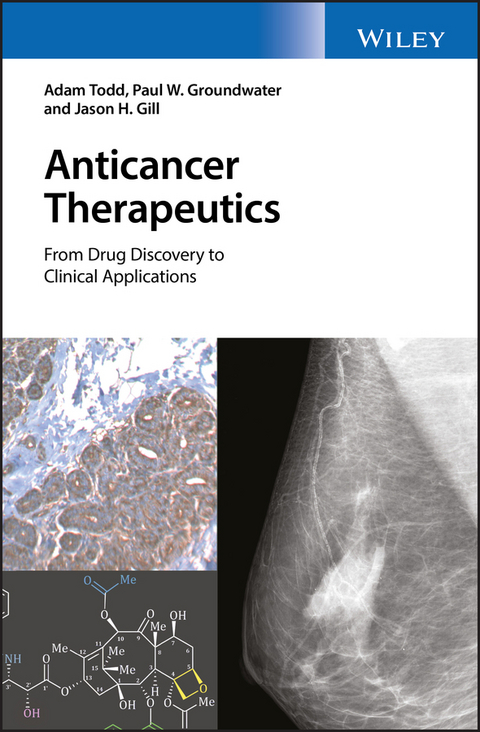
Anticancer Therapeutics (eBook)
John Wiley & Sons (Verlag)
978-1-118-69620-0 (ISBN)
An integrated presentation of the basic science and clinical applications of anticancer agents
Aimed at both undergraduate and postgraduate readers, this unique text provides readers with a fully-integrated presentation of all aspects of the science of anticancer drugs, including their chemistry, pharmacology, and clinical applications.
After heart disease, cancer is the number one killer worldwide, and the tumor microenvironment is forever changing, creating an ever-greater demand for safer, more effective anticancer agents. In response to that demand, the $100 billion cancer drug market continues to grow, with our increased understanding of cancer leading to new drugs being used clinically almost every year.
Anticancer Therapeutics is divided into three sections. Section 1 is an introduction to cancer and therapeutics, and covers the etiology and cellular and molecular basis of cancer. In Section 2, the authors focus on the anticancer agents - their discovery, synthesis, mode of action, mechanisms of resistance, and adverse reactions. Section 3 focuses on specific cancers, explaining how and why the various agents discussed in Section 2 are used, both individually and in combination, to treat different cancers.
- Integrates aspects of basic science, including chemistry and pharmacology and clinical medicine in relation to cancer therapeutics
- Written by an author team comprising specialists in medicinal chemistry, pharmacology, and oncology
- Features full-color images throughout illustrating how drugs bind to cellular targets and exert their pharmacological effect
- Divided into three sections, covering the etiology and cellular and molecular basis of cancer, anticancer agents, and drug applications for different cancers.
Providing the reader with an integrated understanding of all aspects of the science of anticancer agents, this is an ideal textbook for undergraduates studying medicine, nursing, medicinal chemistry, pharmacy, pharmacology and other allied heath / life sciences. It is also a valuable bench reference for pharmacists, medics, and pharmaceutical researchers working in both academia and industry.
An integrated presentation of the basic science and clinical applications of anticancer agents Aimed at both undergraduate and postgraduate readers, this unique text provides readers with a fully-integrated presentation of all aspects of the science of anticancer drugs, including their chemistry, pharmacology, and clinical applications. After heart disease, cancer is the number one killer worldwide, and the tumor microenvironment is forever changing, creating an ever-greater demand for safer, more effective anticancer agents. In response to that demand, the $100 billion cancer drug market continues to grow, with our increased understanding of cancer leading to new drugs being used clinically almost every year. Anticancer Therapeutics is divided into three sections. Section 1 is an introduction to cancer and therapeutics, and covers the etiology and cellular and molecular basis of cancer. In Section 2, the authors focus on the anticancer agents their discovery, synthesis, mode of action, mechanisms of resistance, and adverse reactions. Section 3 focuses on specific cancers, explaining how and why the various agents discussed in Section 2 are used, both individually and in combination, to treat different cancers. Integrates aspects of basic science, including chemistry and pharmacology and clinical medicine in relation to cancer therapeutics Written by an author team comprising specialists in medicinal chemistry, pharmacology, and oncology Features full-color images throughout illustrating how drugs bind to cellular targets and exert their pharmacological effect Divided into three sections, covering the etiology and cellular and molecular basis of cancer, anticancer agents, and drug applications for different cancers. Providing the reader with an integrated understanding of all aspects of the science of anticancer agents, this is an ideal textbook for undergraduates studying medicine, nursing, medicinal chemistry, pharmacy, pharmacology and other allied heath / life sciences. It is also a valuable bench reference for pharmacists, medics, and pharmaceutical researchers working in both academia and industry.
Adam Todd, PhD is Senior Lecturer in Pharmaceutical Public Health in the School of Pharmacy, Faculty of Medical Sciences, at Newcastle University, UK. He is registered pharmacist, and specializes in oncology and palliative care. Paul W. Groundwater, PhD is Professor of Medicinal Chemistry in the Faculty of Pharmacy at The University of Sydney, Sydney, Australia. Jason H. Gill, PhD is a Reader in Molecular Therapeutics in the School of Pharmacy, Faculty of Medical Sciences, at Newcastle University, UK.
Preface
Section1: Introduction
1.1 The global burden of cancer
1.2 Cancer Staging and Classification
1.3 Cellular and molecular basis of cancer
Section 2: The Anticancer Agents
2.1 Agents which act directly on DNA
2.2 Antimetabolites
2.3 Antimicrotubule agents
2.4 Anti-hormonal agents
2.5 Kinase inhibitors
Section 3: The Cancers
3.1 Breast Cancer
3.2 Colorectal Cancer
3.3 Leukaemia
3.4 Lung Cancer
3.5 Oesophageal Cancer
3.6 Ovarian Cancer
3.7 Pancreatic Cancer
3.8 Prostate Cancer
3.9 Skin Cancers
3.10 Testicular Cancer
Index
1.1
The Global Burden of Cancer
In order for us to understand cancer and its treatment it is obviously important to define what is meant by the term ‘cancer’. The word is credited to Hippocrates, the Greek physician (460–370 BC), who used the words carcinos and carcinoma to describe non‐ulcer and ulcer‐forming growths. These words in Greek derive from the word for crab, and their use is believed to be due to the fact that the spreading nature and cellular projections of the growths observed were reminiscent of the shape of a crab. Later changes resulted in the use of the words cancer (Latin for crab) and oncos (Greek for swelling) to describe tumours, terms attributed to the Roman physicians, Celsus (28–50 BC) and Galen (130–200 AD), respectively. Interestingly, we still use all of these words to define malignancy, to discuss a tumour’s histological appearance, and as a description for medical specialists in this area (oncologists).
Although described as a single condition, cancer is actually a family of hundreds of different diseases. The distinction between the different types of cancer is extremely important since their treatment, management, and outcomes for the patient are very diverse (as we shall see in the later sections). Additionally, even within a single cancer ‘type’ there are significant issues with regards to treatment options and patient prognosis, as individual cancers of the same type can behave very differently from one another. The same can be said for the global distribution of cancer; there are different profiles of cancer types in different geographical regions, with different causative factors, different treatment options and successes, and different prognostic and survival rates. Invariably, across the globe, some cancer types and some patients will achieve some degree of remission, and some will be cured, but others will not, with treatment in their case focusing on extending life expectancy.
Cancer is a major worldwide public health problem, as indicated by the World Health Organization (WHO) identifying cancer as one of four leading threats to human health and development (the others being cardiovascular disease, chronic respiratory diseases, and diabetes) in 2008 [1]. In 2012, cancer incidence1 was estimated at 14.1 million people, cancer mortality2 was predicted at 8.2 million deaths, and cancer prevalence3 was estimated at 32.6 million people [2]. When we just consider these numbers it is difficult to appreciate the scale of the problem, and it is therefore important to put this into context. For instance, in 2012 the estimated population of the world was 7.05 billion people, and the risk of dying4 from cancer before age 75 was 10.5% [2].
Cancer is not a modern disease, being first identified and described around 5,000 years ago. What may be unexpected is that the frequency and occurrence of cancer are higher nowadays than about a century ago despite significant advances in cancer diagnosis, treatment, and management over this period. So how can that be? Are we seeing an increase in cancer cases? Are we really making progress with the treatment of these diseases? The answers to these questions relate to the way we consider and view cancer, and have a direct relationship to factors and successes outside of the cancer field. A major contributory factor in cancer appearing to become an increasing cause of mortality over the past century is our achievements in the treatment of other life‐threatening diseases. In the early 1900s cancer accounted for a small proportion of deaths, with the majority of deaths being due to infectious diseases such as pneumonia, tuberculosis, and polio. Since this time, medical progress and improvements in public health and hygiene have led to the significant reduction and elimination of infection as a major cause of death. This effect can be observed if we compare differences in cancer incidence and mortality in different regions of the world, particularly developed versus developing countries. In the developed countries of Europe, treatment for infectious diseases is highly successful and cancer appears to be a major mortality factor, for example mortality rates are greater than 150 per 100,000 and incidence rates are greater than 300 per 100,000 in Northern and Western Europe. We can compare this to the developing countries of Middle and Northern Africa, where infectious diseases are a major factor and treatment success is poor; here cancer mortality rates are below 90 per 100,000 and incidence rates are below 130 per 100,000 (Figure 1.1.1).
Figure 1.1.1 Estimated age‐standardised (a) cancer incidence and (b) cancer‐related mortality rates per 100,000 population in regions of the world in 2012 [3]. Northern Europe incorporates the UK and Scandinavia; South‐Central Asia incorporates Iran, Iraq, Afghanistan, Pakistan, and India; Eastern Asia incorporates China, Taiwan, Japan, North Korea, South Korea, and Mongolia; South‐eastern Asia incorporates Laos, Myanmar, Philippines, Thailand, Vietnam, Malaysia, Singapore, and Indonesia.
Source: Torre 2012 [3].
As we can clearly see from Figure 1.1.1, the incidence of cancer is highest in Australia/New Zealand, but is also higher than the global rate (World) in Europe and North America. The mortality rates (which are dictated by the most prevalent cancers found in each of the regions) partly reflect the incidence rates, but notable exceptions are Melanesia (Western Pacific), which has an incidence rate below the global average, but a mortality rate near the top, and its near neighbours Australia/New Zealand, which have the highest incidence per 100,000 but are below global average mortality. The most common cancer‐related death in Australia is lung cancer (19%), followed by bowel cancer (11%); in Melanesia, cervical, breast, liver and lip/oral cavity cancers are the most common causes of cancer‐related death (10%). Another significant factor which is related to the apparent increase in the rates of cancer in modern times is the fact that, as a population, we are living longer, with a subsequent steady increase in the global population; better lifestyles and disease management have resulted in improved life expectancy. In 1970 the median age5 of the global population was 22 years, which increased to 29 years by 2010 and is predicted to reach 38 years by 2050. Additionally, the number of people aged 60 years and over in 2050 is predicted to increase threefold, to 2 billion. With respect to cancer, by 2030 it is predicted that, annually, there could be 27 million new cancer cases and 17 million cancer‐related deaths worldwide. Our extended life expectancy and improved cancer survival prevalence rates are thus an indirect consequence of the elimination of other life‐threatening diseases, which has propelled cancer into the top four major health concerns.
But why are the number of cancer cases apparently rising? If we accept that the increased percentage of deaths attributable to cancer is due to a shift in the dynamic balance because of significantly reduced figures for other diseases, such as infection, then should we not just see a reduced number of total deaths reported, but with approximately the same number of cancer‐related deaths? Although in principle this point should be true, what it fails to account for is the fact that, as a population, we are living longer. We know that there is a significant correlation between increasing age and the number of cancer cases, for which the underlying principles will be discussed later. Put simply, the continued growth and ageing of the World population means that people are around longer and so there is a greater opportunity for cancer to develop. Taken together, we can appreciate that these underlying factors have propelled cancer to become a major health concern globally. Nevertheless, recent studies have begun to indicate improvements in combating cancer as a consequence of improved lifestyle, earlier detection, or better treatments. For instance, the overall risk in Europe for being diagnosed with cancer has now reportedly stabilised relative to previous years (estimated at an age‐standardised rate of 356 people per 100,000), and the overall risk of dying from cancer has shown a decline (estimated to be 168 per 100,000, with variations dependent on tumour type and country) [4].
We now know that cancer is a major disease, with clear global differences in terms of incidence, survival, and related‐deaths. However, it is worthwhile at this point to fly a flag of caution in relation to this data, with particular reference to evaluation and interpretation. In the previous section it was identified that cancer incidence is stabilising and cancer deaths are declining in Europe, which is true based on the data presented. While this overarching change is positive, it does not identify data for specific cancers or European countries, and does not report the degree by which the risk of cancer‐related mortality varies between these factors. This highlights a major consideration when evaluating or analysing cancer data, particularly in the extraction of the specific information you require. As with all things, the quality and utility of the information gained is only as good as the data entered into the system. We are by no means suggesting that this data is uninformative, misleading, or indeed incorrect, but merely indicating the caution that should be adopted when considering this task. Careful thought and consideration must be...
| Erscheint lt. Verlag | 11.12.2017 |
|---|---|
| Sprache | englisch |
| Themenwelt | Medizin / Pharmazie ► Medizinische Fachgebiete |
| Naturwissenschaften ► Biologie | |
| Naturwissenschaften ► Chemie ► Technische Chemie | |
| Technik | |
| Schlagworte | Anticancer agents • anticancer drugs medicinal chemistry • anticancer pharmacology • anticancer pharmacology textbook • anticancer therapeutics basic science • anticancer therapeutics chemistry • anticancer therapeutics clinical medicine • anticancer therapeutics medicinal chemistry • Biowissenschaften • brain cancer drugs • cancer drug bench reference • cancer drug chemistry • cancer drug clinical applications • cancer drug discover • cancer drug pharmacochemistry • cancer drug pharmacokinetics • cancer drug pharmacopeia • cancer drugs • Cancer Therapeutics • cancer therapeutics clinical studies • cancer therapeutics discovery • cancer therapeutics safety • Cell & Molecular Biology • Chemie • Chemistry • endocrine cancer drugs • exocrine cancer drugs • leukemia drugs • Life Sciences • lung cancer drugs • lymphatic cancer drugs • Medical Science • Medizin • Medizinische Chemie • neuroblastoma drugs • ovarian cancer drugs • pancreatic cancer drugs • Pharmaceutical & Medicinal Chemistry • pharmacist guide to cancer drugs • Pharmacology & Pharmaceutical Medicine • Pharmakologie • Pharmakologie u. Pharmazeutische Medizin • Pharmazeutische Chemie • Pharmazeutische u. Medizinische Chemie • skin cancer drugs • small tumor drugs • testicular cancer drugs • Zell- u. Molekularbiologie |
| ISBN-10 | 1-118-69620-4 / 1118696204 |
| ISBN-13 | 978-1-118-69620-0 / 9781118696200 |
| Informationen gemäß Produktsicherheitsverordnung (GPSR) | |
| Haben Sie eine Frage zum Produkt? |
 EPUB (Adobe DRM)
Kopierschutz: Adobe-DRM
Adobe-DRM ist ein Kopierschutz, der das eBook vor Mißbrauch schützen soll. Dabei wird das eBook bereits beim Download auf Ihre persönliche Adobe-ID autorisiert. Lesen können Sie das eBook dann nur auf den Geräten, welche ebenfalls auf Ihre Adobe-ID registriert sind.
Details zum Adobe-DRM
Dateiformat: EPUB (Electronic Publication)
EPUB ist ein offener Standard für eBooks und eignet sich besonders zur Darstellung von Belletristik und Sachbüchern. Der Fließtext wird dynamisch an die Display- und Schriftgröße angepasst. Auch für mobile Lesegeräte ist EPUB daher gut geeignet.
Systemvoraussetzungen:
PC/Mac: Mit einem PC oder Mac können Sie dieses eBook lesen. Sie benötigen eine
eReader: Dieses eBook kann mit (fast) allen eBook-Readern gelesen werden. Mit dem amazon-Kindle ist es aber nicht kompatibel.
Smartphone/Tablet: Egal ob Apple oder Android, dieses eBook können Sie lesen. Sie benötigen eine
Geräteliste und zusätzliche Hinweise
Buying eBooks from abroad
For tax law reasons we can sell eBooks just within Germany and Switzerland. Regrettably we cannot fulfill eBook-orders from other countries.
aus dem Bereich