Electric Powertrain (eBook)
John Wiley & Sons (Verlag)
978-1-119-06367-4 (ISBN)
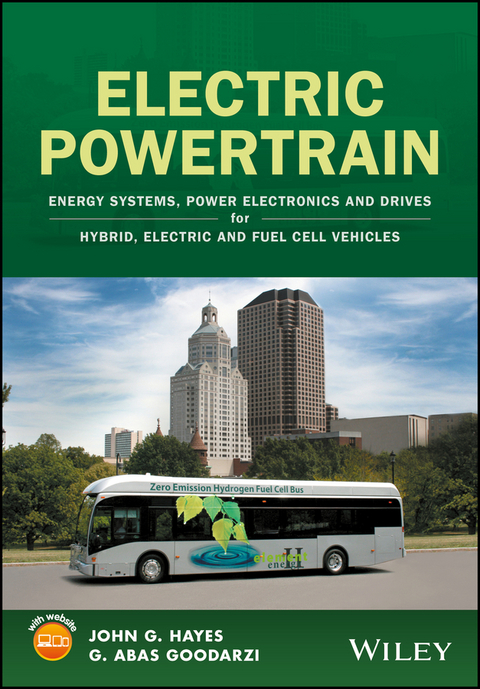
Empowers engineering professionals and students with the knowledge and skills required to engineer electric vehicle powertrain architectures, energy storage systems, power electronics converters and electric drives.
The modern electric powertrain is relatively new for the automotive industry, and engineers are challenged with designing affordable, efficient and high-performance electric powertrains as the industry undergoes a technological evolution. Co-authored by two electric vehicle (EV) engineers with decades of experience designing and putting into production all of the powertrain technologies presented, this book provides readers with the hands-on knowledge, skills and expertise they need to rise to that challenge.
This four-part practical guide provides a comprehensive review of battery, hybrid and fuel cell EV systems and the associated energy sources, power electronics, machines, and drives. The first part of the book begins with a historical overview of electromobility and the related environmental impacts motivating the development of the electric powertrain. Vehicular requirements for electromechanical propulsion are then presented. Battery electric vehicles (BEV), fuel cell electric vehicles (FCEV), and conventional and hybrid electric vehicles (HEV) are then described, contrasted and compared for vehicle propulsion. The second part of the book features in-depth analysis of the electric powertrain traction machines, with a particular focus on the induction machine and the surface- and interior-permanent magnet ac machines. The brushed dc machine is also considered due to its ease of operation and understanding, and its historical place, especially as the traction machine on NASA's Mars rovers. The third part of the book features the theory and applications for the propulsion, charging, accessory, and auxiliary power electronics converters. Chapters are presented on isolated and non-isolated dc-dc converters, traction inverters, and battery charging. The fourth part presents the introductory and applied electromagnetism required as a foundation throughout the book.
• Introduces and holistically integrates the key EV powertrain technologies.
• Provides a comprehensive overview of existing and emerging automotive solutions.
• Provides experience-based expertise for vehicular and powertrain system and sub-system level study, design, and optimization.
• Presents many examples of powertrain technologies from leading manufacturers.
• Discusses the dc traction machines of the Mars rovers, the ultimate EVs from NASA.
• Investigates the environmental motivating factors and impacts of electromobility.
• Presents a structured university teaching stream from introductory undergraduate to postgraduate.
• Includes real-world problems and assignments of use to design engineers, researchers, and students alike.
• Features a companion website with numerous references, problems, solutions, and practical assignments.
• Includes introductory material throughout the book for the general scientific reader.
• Contains essential reading for government regulators and policy makers.
Electric Powertrain: Energy Systems, Power Electronics and Drives for Hybrid, Electric and Fuel Cell Vehicles is an important professional resource for practitioners and researchers in the battery, hybrid, and fuel cell EV transportation industry. The book is a structured holistic textbook for the teaching of the fundamental theories and applications of energy sources, power electronics, and electric machines and drives to engineering undergraduate and postgraduate students.
Textbook Structure and Suggested Teaching Curriculum
This is primarily an engineering textbook covering the automotive
John G. Hayes, PhD, MSEE, MBA, lectures at University College Cork, Ireland, and specialises in automotive, industrial and renewable energy systems and related power electronics, machines and electromagnetism. He previously worked in Southern California for ten years at General Motors' Hughes Aircraft subsidiary developing EV propulsion and inductive charging systems for the General Motors EV1, the first modern production EV. John's recent focus has been on the development of integrated and holistic EV teaching materials for the engineering student and the automotive professional.
G. Abas Goodarzi, PhD, P.E., is the Chief Executive Officer and President of US Hybrid Corporation, Torrance, California, which he founded in 1999. He is also the President of US FuelCell, a company formed with the acquisition by US Hybrid of the United Technologies PEM fuel cell transportation division. He served as Senior Scientist at General Motors' Hughes Aircraft subsidiary, and as Technical Director for the General Motors EV1. He has designed various EV, HEV, and FCEV powertrain systems for light, medium, and heavy-duty, on-road, off-road, and special-purpose vehicles.
The why, what and how of the electric vehicle powertrain Empowers engineering professionals and students with the knowledge and skills required to engineer electric vehicle powertrain architectures, energy storage systems, power electronics converters and electric drives. The modern electric powertrain is relatively new for the automotive industry, and engineers are challenged with designing affordable, efficient and high-performance electric powertrains as the industry undergoes a technological evolution. Co-authored by two electric vehicle (EV) engineers with decades of experience designing and putting into production all of the powertrain technologies presented, this book provides readers with the hands-on knowledge, skills and expertise they need to rise to that challenge. This four-part practical guide provides a comprehensive review of battery, hybrid and fuel cell EV systems and the associated energy sources, power electronics, machines, and drives. Introduces and holistically integrates the key EV powertrain technologies. Provides a comprehensive overview of existing and emerging automotive solutions. Provides experience-based expertise for vehicular and powertrain system and sub-system level study, design, and optimization. Presents many examples of powertrain technologies from leading manufacturers. Discusses the dc traction machines of the Mars rovers, the ultimate EVs from NASA. Investigates the environmental motivating factors and impacts of electromobility. Presents a structured university teaching stream from introductory undergraduate to postgraduate. Includes real-world problems and assignments of use to design engineers, researchers, and students alike. Features a companion website with numerous references, problems, solutions, and practical assignments. Includes introductory material throughout the book for the general scientific reader. Contains essential reading for government regulators and policy makers. Electric Powertrain: Energy Systems, Power Electronics and Drives for Hybrid, Electric and Fuel Cell Vehicles is an important professional resource for practitioners and researchers in the battery, hybrid, and fuel cell EV transportation industry. The resource is a structured, holistic textbook for the teaching of the fundamental theories and applications of energy sources, power electronics, and electric machines and drives to engineering undergraduate and postgraduate students.
John G. Hayes, PhD, MSEE, MBA, lectures at University College Cork, Ireland, and specialises in automotive, industrial and renewable energy systems and related power electronics, machines and electromagnetism. He previously worked in Southern California for ten years at General Motors' Hughes Aircraft subsidiary developing EV propulsion and inductive charging systems for the General Motors EV1, the first modern production EV. John's recent focus has been on the development of integrated and holistic EV teaching materials for the engineering student and the automotive professional. G. Abas Goodarzi, PhD, P.E., is the Chief Executive Officer and President of US Hybrid Corporation, Torrance, California, which he founded in 1999. He is also the President of US FuelCell, a company formed with the acquisition by US Hybrid of the United Technologies PEM fuel cell transportation division. He served as Senior Scientist at General Motors' Hughes Aircraft subsidiary, and as Technical Director for the General Motors EV1. He has designed various EV, HEV, and FCEV powertrain systems for light, medium, and heavy-duty, on-road, off-road, and special-purpose vehicles.
Hayes and Goodarzi have focused their considerable talent and experience to teaching the inner workings of the electric car. Readers, whether engineers, students, or the interested public will find this book a treasure trove of knowledge on modern automotive technology. In conclusion, what a great book! --John M Miller, J-N-J Miller Design Services PLLC, Longview, Texas, USA
I highly recommend 'Electric Powertrain: Energy Systems, Power Electronics and Drives for Hybrid, Electric and Fuel Cell Vehicles' by Dr John G. Hayes and Dr G. Abas Goodarzi. I use this book as my core teaching text on my module Transportation Power and Systems 3, which I teach to third year BEng and MEng Mechanical Engineering undergraduates in Queen's University Belfast. This book captures the fundamentals and in-depth aspects of the key elements of the course I teach including drive cycles, power trains for hybrids, vehicle dynamics, batteries and machines. The worked examples are excellent. The text book is very well laid out with superb well thought-out practical problems at the end of each chapter. This book is very relevant to those who wish to expand their knowledge of hybrid vehicles. It seamlessly integrates the electrical, civil and mechanical disciplines in this growing and multidisciplinary area. This is especially important considering the sustainable direction of land-based transport will take over the next decade as we strive to combat global warming and reduce greenhouse gas emissions. --Dr Aoife Foley, School of Mechanical and Aerospace Engineering, Queen's University Belfast, United Kingdom
Hayes and Goodarzi have focused their considerable talent and experience to teaching the inner workings of the electric car. Readers, whether engineers, students, or the interested public will find this book a treasure trove of knowledge on modern automotive technology. In conclusion, what a great book!
-- John M Miller, J-N-J Miller Design Services PLLC, Longview, Texas, USA
I highly recommend Electric Powertrain: Energy Systems, Power Electronics and Drives for Hybrid, Electric and Fuel Cell Vehicles by Dr John G. Hayes and Dr G. Abas Goodarzi. I use this book as my core teaching text on my module Transportation Power and Systems 3, which I teach to third year BEng and MEng Mechanical Engineering undergraduates in Queen s University Belfast. This book captures the fundamentals and in-depth aspects of the key elements of the course I teach including drive cycles, power trains for hybrids, vehicle dynamics, batteries and machines. The worked examples are excellent. The text book is very well laid out with superb well thought-out practical problems at the end of each chapter. This book is very relevant to those who wish to expand their knowledge of hybrid vehicles. It seamlessly integrates the electrical, civil and mechanical disciplines in this growing and multidisciplinary area. This is especially important considering the sustainable direction of land-based transport will take over the next decade as we strive to combat global warming and reduce greenhouse gas emissions. Dr Aoife Foley, School of Mechanical and Aerospace Engineering, Queen s University Belfast, United Kingdom
1
Electromobility and the Environment
“My first customer was a lunatic. My second had a death wish.” Karl Friedrich Benz (1844–1929) is generally credited with pioneering the modern vehicle.
“Practically no one had the remotest notion of the future of the internal‐combustion engine, while we were just on the edge of the great electrical development. As with every comparatively new idea, electricity was expected to do much more than we even now have any indication that it can do. I did not see the use of experimenting with electricity for my purposes. A road car could not run on a trolley even if trolley wires had been less expensive; no storage battery was in sight of a weight that was practical … That is not to say that I held or now hold electricity cheaply; we have not yet begun to use electricity. But it has its place, and the internal‐combustion engine has its place. Neither can substitute for the other – which is exceedingly fortunate.” Henry Ford in 1923, reflecting on 1899.
“Any customer can have a car painted any color that he wants so long as it is black.” Henry Ford (1863–1947) was influenced by slaughterhouse practices when he developed his assembly line for the mass production of the automobile.
“The world hates change, yet it is the only thing that has brought progress.” Charles Kettering (1876–1958) invented the electric starter and effectively killed the electric car of that era.
“The spread of civilization may be likened to a fire: first, a feeble spark, next a flickering flame, then a mighty blaze, ever increasing in speed and power.” Nikola Tesla (1856–1943).
“Dum spiro, spero.” (Latin for “As long as I breathe, I hope.”) Marcus Cicero (106–43 BC). A noble aspiration from ancient times … but what if we can’t breathe the air?
“It was during that period that I made public my findings on the nature of the eye‐irritating, plant‐damaging smog. I attributed it to the petrochemical oxidation of organic materials originating with the petroleum industry and automobiles.” Aries Jan Haagen‐Smit (1900–1977), a pioneer of air‐quality control, reflecting in 1970 on his pioneering work from 1952 to explain the Los Angeles smog.
“Tesla’s mission is to accelerate the world’s transition to sustainable energy.” The 2016 mission statement of Tesla, Inc.
In this chapter, the reader is introduced to the factors motivating the development of the electric powertrain. The chapter begins with a brief history of the automobile from an electric vehicle perspective, the various energy sources, and the resulting emissions. Standardized vehicle drive cycles are discussed as drive cycles are used to provide a uniform testing approach to measure the emissions and the fuel economy of a vehicle, both of which are related to the efficiency of the energy conversion from the stored energy to kinetic energy. Government regulations and the marketplace have resulted in strong global trends to reduce these potentially harmful emissions and to increase the fuel economy. These factors of reduced emissions and improved efficiency combine with a greater consumer market appreciation for green technology to motivate the development of the electric powertrain. The competing automotive powertrains are briefly reviewed and discussed in terms of efficiency. The chapter concludes with a brief look at heavy‐duty commercial vehicles and other modes of transport.
1.1 A Brief History of the Electric Powertrain
There are three evolutionary eras of electric cars, and we shall now discuss the bigger historical picture.
1.1.1 Part I – The Birth of the Electric Car
The first self‐propelled vehicles were powered by steam. Steam vehicles were fueled by coal and wood and took a relatively long time to generate the steam to power the pistons by heating the furnace of an external combustion engine. The modern vehicle, first developed by Karl Benz in the 1880s, is based on the internal‐combustion (IC) engine. The early vehicles were unreliable, noisy, polluting, and difficult to start. Meanwhile, modern electrical technologies were being invented as Nikola Tesla, partnering with George Westinghouse, and Thomas Edison battled to invent and establish supremacy for their respective alternating‐current (ac) and direct‐current (dc) power systems. Battery electric vehicles (BEVs), energized by lead‐acid batteries and using a dc power system, competed with IC engine vehicles in the 1890s. Electric vehicles (EVs) did not have the starting problems of the IC engine and had no tailpipe emissions. The low range of the BEVs was not necessarily a problem at the time as the road system was not developed, and so comfortable roads were not available for long driving. In 1900, the sales of gasoline vehicles and EVs in the United States were comparable in quantity, but EV sales were to collapse over the next decade [1–4]. Interestingly, EV sales were poor in the Europe of this period as the French and German auto manufacturers, such as Renault, Peugeot, Daimler, and Benz, were leading the world in the development of the IC engine.
The dominance of the IC engine was to be established with two major developments. First, Henry Ford mass‐produced the Model T and drove down the sales price of the gasoline vehicle to significantly below that of both his competitors and of the EVs [5]. However, the gasoline vehicle still needed a manual crank in order to start the engine.
The second major development was the elimination of the manual crank by Charles Kettering’s invention of the electric ignition and start. These electric technologies were introduced by Cadillac in 1912 and, ironically, effectively consigned the BEV to history. As the electrically started gasoline cars proliferated, so did road systems. The mobility delivered by the car fostered the development of modern society as it stimulated individualized transportation and suburbanization. California became the poster child for these trends, which have spread globally. Given their low range and high costs, BEVs could no longer compete and the market died, expect for niche applications such as delivery trucks.
1.1.2 Part II – The Resurgent Electric Powertrain
The diesel engine was introduced for vehicles in 1922, 32 years after it was invented by Rudolf Diesel in 1890 as a more efficient compression‐ignition (CI) IC engine compared to the spark‐ignition (SI) IC engine fueled by gasoline. The first commercial diesel engines were actually developed by a spin‐off company of the US brewer Anheuser Busch. The high‐torque‐at‐low‐speed characteristic has made the diesel engine the engine of choice for medium and heavy‐duty vehicles worldwide. In recent times, the diesel engine became a choice for light vehicles, especially in Europe, due to its reduced carbon emissions compared to gasoline.
Of course, burning fossil fuels in the engine does not come without an environmental cost. A Dutch scientist, Aries Jan Haagen‐Smit, had moved to California and was perplexed by the pollution and smog in rapidly urbanizing Southern California. Smog is a portmanteau word combining smoke and fog to describe the hazy air pollution common in urban areas. London‐type smog is a term commonly used to describe the smog due to coal, while Los Angeles–type smog is used to describe the smog due to vehicle emissions. Haagen‐Smit demonstrated that California smog is the product of a photochemical reaction between IC engine emissions and sunlight to create ozone [6,7]. He is now known as the father of air pollution control and mitigation. The geography of Southern California features valleys, which tend to trap the pollutants for much of the year until the winds from the desert blow through the valleys in the fall. Similar geographic issues worsen the smog situations in other cities, such as Beijing – where the Gobi winds bring dust from the desert to combine with the city’s smog.
In the late 1980s, General Motors (GM) decided to develop an all‐electric car. The motivations were many. For example, urban pollution in American cities, especially Los Angeles, was severe. An additional significant motivating factor was the success of the solar‐powered Sunraycer electric car in the Solar Challenge, a 3000 km race across Australia in 1987. The Sunraycer was engineered by AeroVironment, General Motors‚ and Hughes Aircraft, who pushed the boundaries to develop the lightweight, low‐drag, solar‐powered electric car.
The initial GM prototype BEV, known as the Impact, was developed in Southern California, and GM committed to mass‐producing the car. The production vehicle, which was to become known as the GM EV1, was developed and produced at GM facilities in Michigan and Southern California, and made its debut in 1996. The vehicle was revolutionary as it featured many of the technologies which we regard as commonplace today. The improved traction motor was a high‐power ac induction motor based on the inventions of Nikola Tesla. The car body was built of aluminum in order to reduce vehicle weight. The vehicle aerodynamics were lower than any production vehicle of the day. The vehicle featured advanced silicon technology to control all the electronics in the vehicle and the new IGBT silicon switch to ensure efficient and fast...
| Erscheint lt. Verlag | 13.11.2017 |
|---|---|
| Sprache | englisch |
| Themenwelt | Technik ► Elektrotechnik / Energietechnik |
| Technik ► Fahrzeugbau / Schiffbau | |
| Schlagworte | automotive electric powertrain designs • automotive engineering • battery charging • Boost Converter • boost power-factor correction • Brake specific fuel consumption • Brushed dc motor • Buck Converter • carbon emissions • Electrical & Electronics Engineering • electric drives • Electric Machines • electric powertrain energy systems • electric powertrains • electric powertrain structural mechanics • electric powertrain technologies • Electric Propulsion • Electric Vehicle • electric vehicle batteries • electric vehicle on-vehicle energy-storage systems • electric vehicle powertrain electronics • electric vehicle powertrain modeling • electric vehicle powertrains • electric vehicle powertrain spec sheets • electric vehicle powertrain subsystems • electromagnetism • electromechanical energy conversion • Electro Mobility • Elektrotechnik u. Elektronik • ev powertrains • Fahrzeugtechnik • ferromagnetism • forward converter • Fuel cells • fuel cell vehicle powertrain modeling • fuel cell vehicle principles • full-bridge converter • hybrid-electric vehicle powertrain modeling • hybrid electric vehicles principles • hybrid vehicle powertrains • Induction Motors • inductive charging • interior-permanent-magnet motors • Isolated DC-DC Converters • Leistungselektronik • Li-ion battery • li-ion battery-electric vehicle • Maschinenbau • mechanical engineering • Non-isolated dc-dc converters • permanent-magnet motors • Power Electronics • power-factor correction • powertrain drives for all-electric vehicles • powertrain drives for fuel cell vehicles • powertrain drives for hybrid electric vehicles • Resonant Converters • series hybrid-electric vehicle • series-parallel hybrid-electric vehicle • surface-permanent-magnet motors • three-phase inverters • traction drives • Vehicle Dynamics • Wireless charging |
| ISBN-10 | 1-119-06367-1 / 1119063671 |
| ISBN-13 | 978-1-119-06367-4 / 9781119063674 |
| Informationen gemäß Produktsicherheitsverordnung (GPSR) | |
| Haben Sie eine Frage zum Produkt? |
 EPUB (Adobe DRM)
Kopierschutz: Adobe-DRM
Adobe-DRM ist ein Kopierschutz, der das eBook vor Mißbrauch schützen soll. Dabei wird das eBook bereits beim Download auf Ihre persönliche Adobe-ID autorisiert. Lesen können Sie das eBook dann nur auf den Geräten, welche ebenfalls auf Ihre Adobe-ID registriert sind.
Details zum Adobe-DRM
Dateiformat: EPUB (Electronic Publication)
EPUB ist ein offener Standard für eBooks und eignet sich besonders zur Darstellung von Belletristik und Sachbüchern. Der Fließtext wird dynamisch an die Display- und Schriftgröße angepasst. Auch für mobile Lesegeräte ist EPUB daher gut geeignet.
Systemvoraussetzungen:
PC/Mac: Mit einem PC oder Mac können Sie dieses eBook lesen. Sie benötigen eine
eReader: Dieses eBook kann mit (fast) allen eBook-Readern gelesen werden. Mit dem amazon-Kindle ist es aber nicht kompatibel.
Smartphone/Tablet: Egal ob Apple oder Android, dieses eBook können Sie lesen. Sie benötigen eine
Geräteliste und zusätzliche Hinweise
Buying eBooks from abroad
For tax law reasons we can sell eBooks just within Germany and Switzerland. Regrettably we cannot fulfill eBook-orders from other countries.
aus dem Bereich