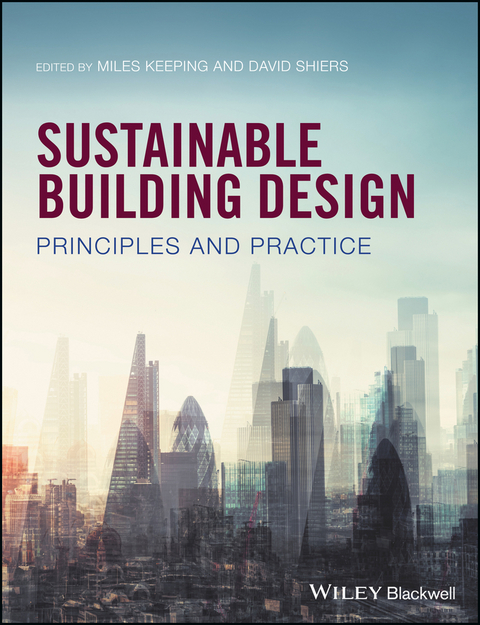
Sustainable Building Design (eBook)
John Wiley & Sons (Verlag)
978-1-119-06376-6 (ISBN)
An inside view of how one of the world's leading architecture and engineering practice does business
Sustainable Built Environments: Principles and Practice offers detailed, environmentally sound design solutions to a wide range of building engineering challenges. The text uses case examples and project data provided by engineers and designers at Arup Associates. It covers a broad range of relevant issues, with focused commentaries and explanations presented in an accessible format for use by students, busy practitioners and informed clients.
Whilst this book stresses the importance of a unified approach to design, the text is divided into six principal chapters, each addressing an important aspect of sustainable architecture and engineering. These chapters (Master Planning, Transport, Energy, The Building Envelope, Environmental Services, and Materials) may be read on their own or in sequence as part of a narrative. Throughout the book, photographs, architectural and engineering drawings and diagrams, examples, and other data illustrate the case studies. Numerous web links are provided to additional information. This inspirational book:
- Focuses on the work of Arup Associates, the award winning architectural and engineering practice
- Uses real-life examples of functioning buildings and structures to provide information and guidance on the development of sustainable solutions
- Is packed with informative illustrations
Sustainable Built Environments: Principles and Practice is a unique text that will inform and inspire architects and engineers, as well as students of those disciplines, around the globe.
Miles Keeping is a Chartered Surveyor and Chartered Environmentalist working in professional practice. He co-founded the Hillbreak consultancy in 2015 and is Visiting Professor in Sustainable Real Estate at Oxford Brookes University.
David Shiers trained as an Architect and is currently Reader in Sustainable Architecture in the School of the Built Environment at Oxford Brookes University.
An inside view of how one of the world's leading architecture and engineering practice does business Sustainable Built Environments: Principles and Practice offers detailed, environmentally sound design solutions to a wide range of building engineering challenges. The text uses case examples and project data provided by engineers and designers at Arup Associates. It covers a broad range of relevant issues, with focused commentaries and explanations presented in an accessible format for use by students, busy practitioners and informed clients. Whilst this book stresses the importance of a unified approach to design, the text is divided into six principal chapters, each addressing an important aspect of sustainable architecture and engineering. These chapters (Master Planning, Transport, Energy, The Building Envelope, Environmental Services, and Materials) may be read on their own or in sequence as part of a narrative. Throughout the book, photographs, architectural and engineering drawings and diagrams, examples, and other data illustrate the case studies. Numerous web links are provided to additional information. This inspirational book: Focuses on the work of Arup Associates, the award winning architectural and engineering practice Uses real-life examples of functioning buildings and structures to provide information and guidance on the development of sustainable solutions Is packed with informative illustrations Sustainable Built Environments: Principles and Practice is a unique text that will inform and inspire architects and engineers, as well as students of those disciplines, around the globe.
Miles Keeping is a Chartered Surveyor and Chartered Environmentalist working in professional practice. He co-founded the Hillbreak consultancy in 2015 and is Visiting Professor in Sustainable Real Estate at Oxford Brookes University. David Shiers trained as an Architect and is currently Reader in Sustainable Architecture in the School of the Built Environment at Oxford Brookes University.
List of Contributors ix
Foreword by Dave King: Architect and Founder of Shed-KM xi
Acknowledgements xiii
1 Introduction 1
Miles Keeping, David Shiers, Ann-Marie Aguilar and Michael Beavan
Environmental Assessment 2
EPCs and DECs 5
Materials and Components 6
Life Cycle Assessment (LCA) 7
Environmental Legislation 7
Corporate Social Responsibility - CSR/ESG 9
'Green Value' 10
The Design Process 12
Bibliography 22
2 Master Planning 23
Miles Keeping, David Shiers and Malcolm Smith
Regeneration - Master Planning in the Existing City 25
Urban Renewal in History 27
A 'New Urbanism' 31
New Settlements and Large-Scale Urban Growth 34
Bicester Eco-town 39
Preston Beach, Western Australia 40
The Business Park 45
Bibliography 46
3 Transport 47
Tim Chatterton, Mark Fisher, Miles Keeping and David Shiers
Alternative Fuelled Vehicles 50
Alternative Fuels 51
Ebbsfleet International 56
Stratford International 56
Bibliography 65
4 Energy 69
Hugo Hodgson, Miles Keeping, Katharine Marsden, David Pearce and David Shiers
Renewable Energy Options 70
Photovoltaic Panels 70
Combined Heat and Power (CHP) 73
Ground Source 75
Biomass Boilers 75
Wind Turbines 77
Wave and Hydropower 77
Anaerobic Digestion 78
Conclusion 78
Bibliography 78
5 The Building Envelope 83
Michael Beaven, Mick Brundle, Paul Dickenson, Miles Keeping, Robert Pugh and David Shiers
Pitched Roofs 85
Flat Roofs 85
Ground Floor Construction 86
Framed Construction 87
Ground Floor and Upper Level Plans 98
Structural Design Strategy 102
Enabling Works 108
Substructure Design 109
Stability Core Design 110
Steel Superstructure Design 111
The Façade Design 113
Projecting Windows 114
Spandrel Panels 117
Product Design: The Wave-Form Ceiling at Ropemaker 121
Completion 124
Bibliography 124
6 Environmental Services 125
Michael Beaven, Miles Keeping, David Pearce and David Shiers
Sustainable Drainage Systems (SUDS) 130
Environmental Services Case Examples 130
Chiller Units 140
Equipment Room 'Free Cooling' 141
'No Gas' Supply 141
Mixed Mode Ventilation 141
Bibliography 143
7 Materials 145
Jane Anderson, Michael Beavan, Francesca Galeazzi, Miles Keeping, David Shiers and Kristian Steele
Hazardous and Deleterious Materials 149
Bibliography 157
Conclusions 158
Appendix A The Arup Story 159
Appendix B Arup Guidance Note on GLA Requirements for Renewables 169
Appendix C Arup Team Members 175
Index 177
Chapter 2
Master Planning
Miles Keeping1, David Shiers2 and Malcolm Smith3
1Hillbreak Ltd, Buckinghamshire, HP18 9TH, UK
2Oxford Brookes University,, School of the Built Environment, Oxford, OX3 0BP, UK
3Arup Associates, London, W1T 4BQ, UK
Master planning is the generation of an overall development concept which incorporates the present and future use of land and buildings in a particular location. A master plan can be required for almost any scheme, ranging in scale from entire cities and ‘New Towns’ to development zones, business parks, city blocks or even a single site.
Master planning is needed for projects where:
- regeneration or urban growth is required
- new settlements are proposed
- there are multiple developers or landowners who require a coordinated, integrated development strategy
- a future major event is to take place which can be a catalyst for regeneration (such as the 2012 London Olympics)
- there is a need to protect assets such as Conservation Areas, National Parks, Environmentally Sensitive sites or Areas of Outstanding Natural Beauty
- there are complex issues between developers or landowners
- neighbourhood development has to be carefully managed for economic, social, conservation or community infrastructure reasons
An understanding of place is critical in the development of a successful master plan if it is to create a clear, consistent and sustainable framework for development and one which can respond to future changes in use requirements and the local environment.
See PAN 83; Planning Advice Note on Master Planning:
Master plans can be devised by Urban Designers, Town and Transport Planners and Architects; usually in collaboration with a developer and in consultation with Local, Regional or National government, local businesses, community groups and other stakeholders.
The key stages in the development of a master plan normally include:
- Inception – establishing a clear brief of what is required, based on the needs and expectations of the stakeholders (the eventual users and the fundraisers of the project).
- Feasibility – following the appointment of a multi-disciplinary team to ensure that the requirements of the stakeholders are achievable, financially, practically and within the anticipated time frame.
- Design – based on thorough appraisal of the physical, social, environmental and economic constraints and opportunities of the site and through consultation with Local Planning Authorities, communities and business organisations. Detailed proposals are developed which can deliver the necessary architectural, transport, amenity and utility requirements of the project:
- The physical aspects and constraints of the site including the topography, orientation, geographical and features or barriers such as rivers, rail and road networks and existing buildings must be taken into account in the initial phases of the design alongside any legal or planning restrictions.
- Existing and possible proposed routes giving access to and from the development area are often the first master-planning issues to be addressed. Whether the context is urban or rural, pedestrian and road traffic access and circulation is of critical importance. It is the location of these routes which will provide the framework for development. In many schemes, it is along the principal routes to, from and across the site that the most significant buildings or features of the scheme are located. In some projects, the most important access roads are also given special visual importance by the creation of significant vistas and architectural or landscaping features.
In the typical master plan shown on the website below, the existing physical features of the site have informed the master planning of the scheme. Adopting formal, rectilinear road patterns on those parts of the site near existing city blocks (top left), the proposed road layout changes to respond to the curve of river and the existing main road at the bottom of the plan and to give a softer, more ‘organic’ edge to the river frontage, park, and landscaped lake.
The route leading to the footbridge across the river has been given special significance by making it tree-lined and running it across the entire site to link the town, the new development, the riverside path, river view and an existing park. The main access road to the scheme is at the bottom of the plan, designed to take the visitor directly to the main public realm features of this project – the ornamental lake, parkland and stream.
- In parallel with the development of an access and circulation strategy, ‘zoning’ and architectural design issues are normally addressed. Building use types (i.e. residential, commercial, industrial, etc.) are strategically located within the scheme and such issues as building heights, densities, massing and architectural style and types of materials are considered.
Regeneration – Master Planning in the Existing City
An example of how areas within an existing city are zoned for specific uses can be seen in the spatial master plan developed by the City of Bath as it sought to develop its Western Riverside area – a site with significant architectural heritage and conservation challenges and constraints (http://www.bathnes.gov.uk/sites/default/files/sitedocuments/Planning-and-Building-Control/Planning-Policy/SPDs/BWRSPD-Part2SpatialMasterplanPlan2-1to2-4.pdf).
On the plan 2.3, page 21, in the City of Bath, Western Riverside Area Summary Masterplan, the relationship between key pedestrian routes (shown by red dots), the three main vehicle access points (red circle/white arrow) public realm leisure/cultural activity areas (blue dotted circles), architectural landmarks (white star on purple background), proposed uses on the site (residential, retail/offices/leisure mixed use and the new offices for Wessex Water) are shown on this zoning diagram. Note how the proposed landmarks and public realm areas are located on the access and transit points and along the ‘prime’ river frontage in order to draw people to the site.
Property developers are always keen to get the most out of the land and buildings they own and measure this in terms of financial return. In order to maximise this, they will seek to ensure that any emerging local planning policy is favourable to development potential they may perceive and work with local planning authorities to try to achieve as successful a planning approval as possible. Within that context, developers will seek to derive as much utility from their sites as possible whilst recognising that providing a mixture of property uses and high-quality public realm is often likely to improve overall performance of a development scheme. It is for this reason that leading developers have policies which seek to provide for the amenity of residents and local workforces, a good example being British Land’s “Places People Prefer” approach (http://www.britishland.com/; https://www.youtube.com/watch?v=CbgGVLrcdqs):
High-quality schemes such as British Land’s Regents Place and Paddington Basin provide excellent examples of a mix of office, retail and leisure uses on urban sites.
On the City Core master plan for the Curzon Street neighbourhood of the City of Birmingham (http://bigcityplan.birmingham.gov.uk/wp-content/uploads/2010/08/Big-City-Plan-Part-2.pdf – pages 36 & 37):
- the designers propose new public realm open spaces for theatre and exhibitions etc. at the edges of the site (see plan at locations 7, 9, 10, 15–17) and improved public squares to provide retail and restaurants within the existing city blocks at the heart of the scheme (at 1, 4, 5, 11–13). Both devices are intended to attract visitors and to generate vibrant and commercially viable neighbourhoods.
Primary and local walking routes (shown in green and black dotted lines) are also identified on this plan, showing main access ways to and across the site as well as linking important transport hubs (Metro stops and rail stations). Identifying principle walking routes is important in identifying potential retail use along thoroughfares with good footfall and well-known retailers and restaurateurs can also be used as a magnet to draw people to parts of a scheme which might otherwise remain peripheral. The existing city blocks are shown in white and whilst others have been earmarked for regeneration (orange) or new development (pale blue). Improvements to some of the surrounding roads including making them less of a barrier to pedestrian access are shown in red.
Throughout the master plan, architectural massing, height, style and materials of proposed buildings as well as the design of public squares and thoroughfares, landscaping and street furniture are shown using CGI and...
| Erscheint lt. Verlag | 17.10.2017 |
|---|---|
| Sprache | englisch |
| Themenwelt | Technik ► Architektur |
| Technik ► Bauwesen | |
| Schlagworte | Architecture • Architektur • Arup Associates • Bauentwurf • Bauingenieur- u. Bauwesen • Building Design • Civil Engineering & Construction • Construction: Sustainability • developing green buildings • energy efficiency • Energy-efficient Buildings • energy efficient structures • environmental impact of property • Green Building • green building construction • Green Building Materials • Green Built Environment • Green Design • green property • Massivbau • Nachhaltiges Bauen • principles of sustainable built environments • Structural & Building Engineering • sustainability • Sustainable Architecture • sustainable building materials • sustainable built environments • sustainable built environments practice • Sustainable Built Environments: Principles and Practice • Sustainable construction • Sustainable design • Sustainable Project Management • sustainable property • sustainable property development • Tief- u. Hochbau / Massivbau • Urbanism |
| ISBN-10 | 1-119-06376-0 / 1119063760 |
| ISBN-13 | 978-1-119-06376-6 / 9781119063766 |
| Informationen gemäß Produktsicherheitsverordnung (GPSR) | |
| Haben Sie eine Frage zum Produkt? |
 EPUB (Adobe DRM)
Kopierschutz: Adobe-DRM
Adobe-DRM ist ein Kopierschutz, der das eBook vor Mißbrauch schützen soll. Dabei wird das eBook bereits beim Download auf Ihre persönliche Adobe-ID autorisiert. Lesen können Sie das eBook dann nur auf den Geräten, welche ebenfalls auf Ihre Adobe-ID registriert sind.
Details zum Adobe-DRM
Dateiformat: EPUB (Electronic Publication)
EPUB ist ein offener Standard für eBooks und eignet sich besonders zur Darstellung von Belletristik und Sachbüchern. Der Fließtext wird dynamisch an die Display- und Schriftgröße angepasst. Auch für mobile Lesegeräte ist EPUB daher gut geeignet.
Systemvoraussetzungen:
PC/Mac: Mit einem PC oder Mac können Sie dieses eBook lesen. Sie benötigen eine
eReader: Dieses eBook kann mit (fast) allen eBook-Readern gelesen werden. Mit dem amazon-Kindle ist es aber nicht kompatibel.
Smartphone/Tablet: Egal ob Apple oder Android, dieses eBook können Sie lesen. Sie benötigen eine
Geräteliste und zusätzliche Hinweise
Buying eBooks from abroad
For tax law reasons we can sell eBooks just within Germany and Switzerland. Regrettably we cannot fulfill eBook-orders from other countries.
aus dem Bereich