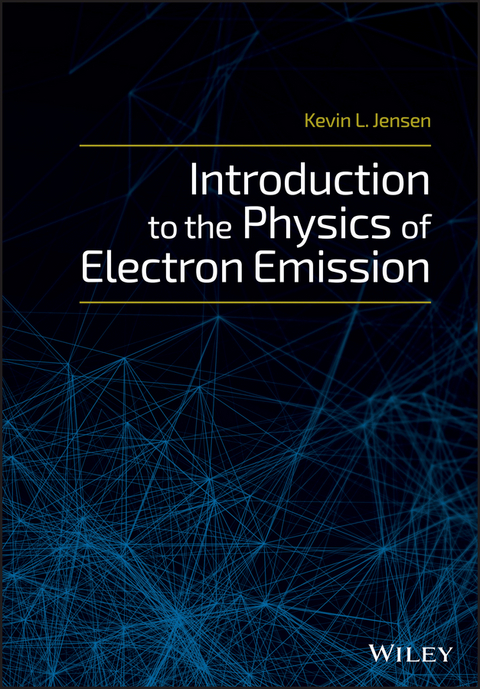
Introduction to the Physics of Electron Emission (eBook)
John Wiley & Sons (Verlag)
978-1-119-05176-3 (ISBN)
A practical, in-depth description of the physics behind electron emission physics and its usage in science and technology
Electron emission is both a fundamental phenomenon and an enabling component that lies at the very heart of modern science and technology. Written by a recognized authority in the field, with expertise in both electron emission physics and electron beam physics, An Introduction to Electron Emission provides an in-depth look at the physics behind thermal, field, photo, and secondary electron emission mechanisms, how that physics affects the beams that result through space charge and emittance growth, and explores the physics behind their utilization in an array of applications.
The book addresses mathematical and numerical methods underlying electron emission, describing where the equations originated, how they are related, and how they may be correctly used to model actual sources for devices using electron beams. Writing for the beam physics and solid state communities, the author explores applications of electron emission methodology to solid state, statistical, and quantum mechanical ideas and concepts related to simulations of electron beams to condensed matter, solid state and fabrication communities.
- Provides an extensive description of the physics behind four electron emission mechanisms-field, photo, and secondary, and how that physics relates to factors such as space charge and emittance that affect electron beams.
- Introduces readers to mathematical and numerical methods, their origins, and how they may be correctly used to model actual sources for devices using electron beams
- Demonstrates applications of electron methodology as well as quantum mechanical concepts related to simulations of electron beams to solid state design and manufacture
- Designed to function as both a graduate-level text and a reference for research professionals
Introduction to the Physics of Electron Emission is a valuable learning tool for postgraduates studying quantum mechanics, statistical mechanics, solid state physics, electron transport, and beam physics. It is also an indispensable resource for academic researchers and professionals who use electron sources, model electron emission, develop cathode technologies, or utilize electron beams.
Kevin Jensen, PhD is a research physicist in the Materials and Systems Branch, Materials Science and Technology Division, at the Naval Research Laboratory. Since 2001, he has been a visiting senior research scientist at the University of Maryland's Institute for Research in Electronics and Applied Physics (IREAP). Dr. Jensen joined the theory section of the Vacuum Electronics Branch at NRL in 1990. He earned a doctorate in physics from New York University in 1987. He has been and is Principal Investigator for several research programs investigating the application of electron sources (particularly field and photoemission sources) to microwave devices and Free Electron Lasers. Over the years, he has authored or coauthored over 150 articles and conference proceedings. He became a Fellow of the American Physical Society in 2009 for his contributions to the theory and modeling of electron emission sources for particle accelerators and microwave tubes. He presently serves on the Editorial Board of Journal of Applied Physics.
Kevin Jensen, PhD is a research physicist in the Materials and Systems Branch, Materials Science and Technology Division, at the Naval Research Laboratory. Since 2001, he has been a visiting senior research scientist at the University of Maryland's Institute for Research in Electronics and Applied Physics (IREAP). Dr. Jensen joined the theory section of the Vacuum Electronics Branch at NRL in 1990. He earned a doctorate in physics from New York University in 1987. He has been and is Principal Investigator for several research programs investigating the application of electron sources (particularly field and photoemission sources) to microwave devices and Free Electron Lasers. Over the years, he has authored or coauthored over 150 articles and conference proceedings. He became a Fellow of the American Physical Society in 2009 for his contributions to the theory and modeling of electron emission sources for particle accelerators and microwave tubes. He presently serves on the Editorial Board of Journal of Applied Physics.
Chapter 1
Prelude
Then this new kind of knowledge must have an additional quality?
What quality?
Usefulness in war.
– Plato1
Ever since the invention of aerial bombing, military strategists have had to assume that “the bomber will always get through”. Every technological advance since then has made this more certain – with one exception.– R.J. James [1]
In late August of 1940, during the Battle of Britain, Sir Henry Tizard led a mission to the USA at the direction of Prime Minister Winston Churchill. Tizard flew, but the rest of his mission traveled on the Duchess of Richmond across the Atlantic, carefully conveying a black box holding Britain's most sensitive military technical secrets [2], an account of which figures prominently in the historical review by James [1]. Tizard's mission was just shy of a year after the famed Einstein–Szilard letter to President F.D. Roosevelt urging the USA to initiate a program developing atomic weapons. Surely it is no surprise, then, what the secret documents concerned.
Radar.
The importance of radar (an acronym of RAdio Detecting And Ranging) was (and is) great, and that importance was starkly revealed in the Battle of Britain (1940), the defeat of the Italian Navy in the Cape of Matapan (1940), the US Navy's defeat of the Japanese aircraft carriers in the Battle of Midway (1942) that marked the turning point of the war in the Pacific, and the elimination of the German U-boat threat in the Atlantic that enabled supplies to reach the British (1943), all of which testified to the pivotal and game-changing role that radar played. A summary by Skolnik [3] is to the point:
There were many factors that allowed the Allies to defeat the Axis forces in Wold War II, but the introduction of radar was one of the most important. There is no way to know whether the Allies would have lost the war if they did not have radar, but it is quite clear that there would have been more losses and a longer time needed to win the war if there were no radar.
An Allied victory was not a sure thing: both Germany and Japan in those years were formidable in military strength and scientific capability, and the edge that radar provided mattered. Ironically, radar's actual importance during World War II, compared to its public perception in the USA, is perhaps inverted from that bequeathed to atomic weapons.2
After the war, spinoff peacetime applications and descendent technology from microwave ovens, television, cell phone networks, satellite communications, and weather imaging have caused an immense change in how people work, play, and know whether to take an umbrella.
Why is all that important here? Radio wave and microwave amplifiers are made possible by extracting power from energetic bunches of electrons. Electrons are not by nature feral: they are yanked from their host material by violently ripping them out (using scorching heat, electric fields thousands of times stronger than those associated with lightening, intense lasers brighter than the surface of the sun, and even accelerated beams of other high energy electrons). Improving the efficiency of doing so made radar better, and so it and the many technologies indebted to it served as the impetus to drive a great deal of cathode research up to the present. The physics is at its most interesting when the conditions the electron sources are subjected to are the most punishing, and so those conditions are the ones gleefully considered here.
As to the technologies that benefit, there are many. Microwave ovens are perhaps the most obvious vacuum device, the guts being not much more than a version of the pivotal magnetron behind early radar, but in a shiny box with a fancy timer (an unkind but reasonably accurate characterization). Field emission microscopy [5], flash X-ray sources [6], and microwave devices using metallic wires [7] received intense investigation beginning in the late 1950s as possible alternates to thermionic cathodes (the ability of field emission to be to be strongly modulated being the driver). For microwave devices, using the fields that existed in cavity resonators, the field emission cathodes produced electron beams of high current density in bunches with high harmonic content from tungsten needles. Modern incarnations of high-power microwave (HPM) devices [8] use tufted carbon fiber cathodes, in which the individual fiber bundles coated with cesium iodide (CsI) salt can produce currents in excess of 1 kiloamp [9].
Vacuum electronics [10, 11], and after the 1980s vacuum microelectronics, were behind much cathode development for microwave amplifiers and “tubes” [12]. These applications encompass the class of vacuum devices that operate at microwave frequencies, for either generation or amplification. The microwave frequency range encompasses UHF (0.3–3 GHz), SHF (3–30 GHz), EHF (30–300 GHz), and, most recently, pushing into the sub millimeter (or terahertz) regime. Although “tubes” evokes images of glass-enclosed triodes and pentodes, modern tubes are rather more akin to particle accelerators, albeit small ones.
The most common microwave tubes are klystrons, traveling-wave tubes (TWTs), magnetrons, crossed field amplifiers, gyrotrons, and free electron lasers, and these are widely used in radar, communications, electronic countermeasures, directed energy devices, and particle accelerators. Depending on the frequency band, radar is used for long-range surveillance, long-range weather forecasting, airborne weather forecasting, missile tracking and guidance, marine radar, air and ballistic missile defense, high-resolution mapping and satellite altimetry, and airport surveillance, among others [3], with most modern radars at the higher frequencies. FM and television occupy VHF, microwave ovens and mobile phones occupy UHF, and radio astronomy and directed energy applications such as active denial operate in the EHF. The progress in the metric of the product of average power and frequency squared, or , has been remarkably steady over decades of development, as shown in Figure 1.1 – indeed, for high values of that metric, the playing field belongs to the “tubes”, with solid-state devices dominating the lower power, lower frequency regimes [13].
Figure 1.1 Growth in the metric. Shown for various vacuum electronic devices, based on Figure 1 in ref. [11].
Many other devices reliant on electron beams have proliferated. Most people, at least those post-Hobbit and pre-Harry Potter, remember the cathode ray tubes (CRTs) that were the basis of all televisions, computer monitor displays, and oscilloscopes for decades. The heart of the CRT was a thermionic cathode that generated a beam of electrons that were accelerated towards a phosphor screen such that the beam scanned back and forth (“raster”). Before being overtaken by liquid crystal and plasma displays, flat panel field emission displays (FEDs) were developed in the 1990s using small clusters of microfabricated field emitters to individually address pixel elements on the display [14, 15]. Electron beam lithography [16], an analog of photolithography using particles instead of light, is a method of creating very small structure circuits and nanotechnology by using an electron beam to expose a resist, which can then be selectively removed. Similarly, field emission scanning electron microscopy (FESEM) images secondary electrons emitted from the surface of a sample that are created by primaries emitted from a field emission source and accelerated through a high-gradient potential (generally in the kilovolts range) [17], an improvement on the typically thermionic tungsten source that required long scan times. A higher brightness field emission source enables a modern field emission scanning electron microscope to achieve resolution of feature sizes on the order of 4 nm. Various cathode technologies are behind particle accelerators, radio frequency injectors [18], free electron lasers (FELs) [19, 20], energy recovery LINACs (ERL) [21–23], and X-ray FELs [24]. Other uses include charge neutralization cathodes for ion and Hall thrusters used for satellite propulsion [25], and thermionic and non-thermionic cathode alternatives for electrodynamic tethers [26] for propellentless propulsion for satellites passing through the Earth's magnetic field [27, 28].
Field and secondary emission are not always opportunities: they can cause dark current on the surface of multialkali antimonide photocathodes used in photoinjectors [29] or lead to breakdown on metal surfaces subject to high fields. Copper surfaces of particle accelerators (e.g., the Stanford linear accelerator (SLAC)) exhibit regions of melting and protrusion formation that ultimately give rise to undesirable emission off the copper cavity walls [30–32] are a precursor to seriously undesirable breakdown phenomena.
In that rather rapid summary, four emission mechanisms were identified:
- 1. thermal: emission by heating [33]
- 2. photo: emission by absorption of photons [34]
- 3. secondary: emission by scattering with primary electrons [35]
- 4. field: extraction by intense electric fields [36].
By the late 1920s, predictive equations for all of these had been developed. An introduction to the theory of the four mechanisms – and space charge – should start at a level accessible to those without prior exposure, but who nevertheless are familiar with basic methods in...
| Erscheint lt. Verlag | 27.9.2017 |
|---|---|
| Sprache | englisch |
| Themenwelt | Naturwissenschaften ► Physik / Astronomie ► Atom- / Kern- / Molekularphysik |
| Naturwissenschaften ► Physik / Astronomie ► Festkörperphysik | |
| Naturwissenschaften ► Physik / Astronomie ► Hochenergiephysik / Teilchenphysik | |
| Technik ► Maschinenbau | |
| Schlagworte | Chemie • Chemistry • electron beam physics • electron beams • electron beam simulations • electron emission cathode gun • electron emission concepts • electron emission equations • electron emission industrial applications • electron emission in electron microscopy • electron emission lithography • electron emission mathematics • electron emission mechanisms • electron emission physics • electron emission physics of holography • electron emission physics of spectroscopy • electron emission quantum mechanics • electron emission statistics • electron emission technologies • Festkörperphysik • field electron emission physics • <p>electron emission theory • photo electron emission physics • Physics • physics of free electron lasers • Physik • resonant tunneling physics, electron emission textbooks • secondary electron emission mechanisms • solid state electron emission • solid state electron emission physics • Solid state physics • spectroscopy • Spektroskopie • thermal electron emissions physics • Thermal Physics & Statistical Mechanics • vacuum electronics electron emission physical principles, space charge limited emission</p> • Wärmelehre • Wärmelehre u. Statistische Mechanik |
| ISBN-10 | 1-119-05176-2 / 1119051762 |
| ISBN-13 | 978-1-119-05176-3 / 9781119051763 |
| Informationen gemäß Produktsicherheitsverordnung (GPSR) | |
| Haben Sie eine Frage zum Produkt? |
 EPUB (Adobe DRM)
Kopierschutz: Adobe-DRM
Adobe-DRM ist ein Kopierschutz, der das eBook vor Mißbrauch schützen soll. Dabei wird das eBook bereits beim Download auf Ihre persönliche Adobe-ID autorisiert. Lesen können Sie das eBook dann nur auf den Geräten, welche ebenfalls auf Ihre Adobe-ID registriert sind.
Details zum Adobe-DRM
Dateiformat: EPUB (Electronic Publication)
EPUB ist ein offener Standard für eBooks und eignet sich besonders zur Darstellung von Belletristik und Sachbüchern. Der Fließtext wird dynamisch an die Display- und Schriftgröße angepasst. Auch für mobile Lesegeräte ist EPUB daher gut geeignet.
Systemvoraussetzungen:
PC/Mac: Mit einem PC oder Mac können Sie dieses eBook lesen. Sie benötigen eine
eReader: Dieses eBook kann mit (fast) allen eBook-Readern gelesen werden. Mit dem amazon-Kindle ist es aber nicht kompatibel.
Smartphone/Tablet: Egal ob Apple oder Android, dieses eBook können Sie lesen. Sie benötigen eine
Geräteliste und zusätzliche Hinweise
Buying eBooks from abroad
For tax law reasons we can sell eBooks just within Germany and Switzerland. Regrettably we cannot fulfill eBook-orders from other countries.
aus dem Bereich