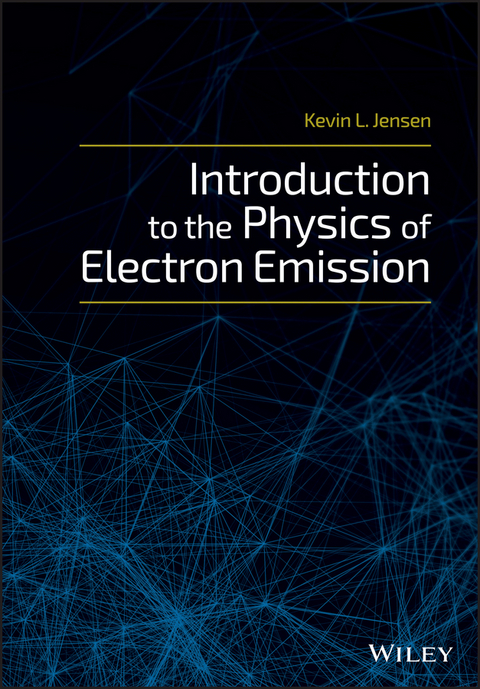
Introduction to the Physics of Electron Emission (eBook)
John Wiley & Sons (Verlag)
978-1-119-05175-6 (ISBN)
A practical, in-depth description of the physics behind electron emission physics and its usage in science and technology
Electron emission is both a fundamental phenomenon and an enabling component that lies at the very heart of modern science and technology. Written by a recognized authority in the field, with expertise in both electron emission physics and electron beam physics, An Introduction to Electron Emission provides an in-depth look at the physics behind thermal, field, photo, and secondary electron emission mechanisms, how that physics affects the beams that result through space charge and emittance growth, and explores the physics behind their utilization in an array of applications.
The book addresses mathematical and numerical methods underlying electron emission, describing where the equations originated, how they are related, and how they may be correctly used to model actual sources for devices using electron beams. Writing for the beam physics and solid state communities, the author explores applications of electron emission methodology to solid state, statistical, and quantum mechanical ideas and concepts related to simulations of electron beams to condensed matter, solid state and fabrication communities.
- Provides an extensive description of the physics behind four electron emission mechanisms-field, photo, and secondary, and how that physics relates to factors such as space charge and emittance that affect electron beams.
- Introduces readers to mathematical and numerical methods, their origins, and how they may be correctly used to model actual sources for devices using electron beams
- Demonstrates applications of electron methodology as well as quantum mechanical concepts related to simulations of electron beams to solid state design and manufacture
- Designed to function as both a graduate-level text and a reference for research professionals
Introduction to the Physics of Electron Emission is a valuable learning tool for postgraduates studying quantum mechanics, statistical mechanics, solid state physics, electron transport, and beam physics. It is also an indispensable resource for academic researchers and professionals who use electron sources, model electron emission, develop cathode technologies, or utilize electron beams.
Kevin Jensen, PhD is a research physicist in the Materials and Systems Branch, Materials Science and Technology Division, at the Naval Research Laboratory. Since 2001, he has been a visiting senior research scientist at the University of Maryland's Institute for Research in Electronics and Applied Physics (IREAP). Dr. Jensen joined the theory section of the Vacuum Electronics Branch at NRL in 1990. He earned a doctorate in physics from New York University in 1987. He has been and is Principal Investigator for several research programs investigating the application of electron sources (particularly field and photoemission sources) to microwave devices and Free Electron Lasers. Over the years, he has authored or coauthored over 150 articles and conference proceedings. He became a Fellow of the American Physical Society in 2009 for his contributions to the theory and modeling of electron emission sources for particle accelerators and microwave tubes. He presently serves on the Editorial Board of Journal of Applied Physics.
A practical, in-depth description of the physics behind electron emission physics and its usage in science and technology Electron emission is both a fundamental phenomenon and an enabling component that lies at the very heart of modern science and technology. Written by a recognized authority in the field, with expertise in both electron emission physics and electron beam physics, An Introduction to Electron Emission provides an in-depth look at the physics behind thermal, field, photo, and secondary electron emission mechanisms, how that physics affects the beams that result through space charge and emittance growth, and explores the physics behind their utilization in an array of applications. The book addresses mathematical and numerical methods underlying electron emission, describing where the equations originated, how they are related, and how they may be correctly used to model actual sources for devices using electron beams. Writing for the beam physics and solid state communities, the author explores applications of electron emission methodology to solid state, statistical, and quantum mechanical ideas and concepts related to simulations of electron beams to condensed matter, solid state and fabrication communities. Provides an extensive description of the physics behind four electron emission mechanisms field, photo, and secondary, and how that physics relates to factors such as space charge and emittance that affect electron beams. Introduces readers to mathematical and numerical methods, their origins, and how they may be correctly used to model actual sources for devices using electron beams Demonstrates applications of electron methodology as well as quantum mechanical concepts related to simulations of electron beams to solid state design and manufacture Designed to function as both a graduate-level text and a reference for research professionals Introduction to the Physics of Electron Emission is a valuable learning tool for postgraduates studying quantum mechanics, statistical mechanics, solid state physics, electron transport, and beam physics. It is also an indispensable resource for academic researchers and professionals who use electron sources, model electron emission, develop cathode technologies, or utilize electron beams.
Kevin Jensen, PhD is a research physicist in the Materials and Systems Branch, Materials Science and Technology Division, at the Naval Research Laboratory. Since 2001, he has been a visiting senior research scientist at the University of Maryland's Institute for Research in Electronics and Applied Physics (IREAP). Dr. Jensen joined the theory section of the Vacuum Electronics Branch at NRL in 1990. He earned a doctorate in physics from New York University in 1987. He has been and is Principal Investigator for several research programs investigating the application of electron sources (particularly field and photoemission sources) to microwave devices and Free Electron Lasers. Over the years, he has authored or coauthored over 150 articles and conference proceedings. He became a Fellow of the American Physical Society in 2009 for his contributions to the theory and modeling of electron emission sources for particle accelerators and microwave tubes. He presently serves on the Editorial Board of Journal of Applied Physics.
Cover 1
Title Page 5
Copyright 6
Dedication 7
Contents 9
Acknowledgements 15
Part I Foundations 17
Chapter 1 Prelude 19
Chapter 2 Units and evaluation 23
2.1 Numerical accuracy 23
2.2 Atomic-sized units 24
2.3 Units based on emission 27
Chapter 3 Pre-quantum models 29
3.1 Discovery of electron emission 29
3.2 The Drude model and Maxwell–Boltzmann statistics 29
3.3 The challenge of photoemission 35
Chapter 4 Statistics 41
4.1 Distinguishable particles 41
4.2 Probability and states 44
4.3 Probability and entropy 46
4.4 Combinatorics and products of probability 49
Chapter 5 Maxwell–Boltzmann distribution 53
5.1 Classical phase space 53
5.2 Most probable distribution 55
5.3 Energy and entropy 57
5.4 The Gibbs paradox 58
5.5 Ideal Gas in a potential gradient 60
5.6 The grand partition function 61
5.7 A nascent model of electron emission 62
Chapter 6 Quantum distributions 65
6.1 Bose–Einstein distribution 65
6.2 Fermi–Dirac distribution 66
6.3 The Riemann zeta function 66
6.4 Chemical potential 68
6.5 Classical to quantum statistics 72
6.6 Electrons and white dwarf stars 73
Chapter 7 A box of electrons 77
7.1 Scattering 77
7.2 From classical to quantum mechanics 77
7.3 Moments and distributions 79
7.4 Boltzmann's transport equation 80
Chapter 8 Quantum mechanics methods 89
8.1 A simple model: the prisoner's dilemma 89
8.2 Matrices and wave functions 94
Chapter 9 Quintessential problems 107
9.1 The hydrogen atom 108
9.2 Transport past barriers 118
9.3 The harmonic oscillator 126
Part II The canonical equations 135
Chapter 10 A brief history 137
10.1 Thermal emission 137
10.2 Field emission 138
10.3 Photoemission 139
10.4 Secondary emission 140
10.5 Space-charge limited emission 140
10.6 Resources and further reading 140
Chapter 11 Anatomy of current density 143
11.1 Supply function 144
11.2 Gamow factor 144
11.3 Image charge potential 147
Chapter 12 Richardson–Laue–Dushman equation 151
12.1 Approximations 151
12.2 Analysis of thermal emission data 152
Chapter 13 Fowler–Nordheim equation 155
13.1 Triangular barrier approximation 156
13.2 Image charge approximation 157
13.3 Analysis of field emission data 161
13.4 The Millikan–Lauritsen hypothesis 162
Chapter 14 Fowler–Dubridge equation 165
14.1 Approximations 165
14.2 Analysis of photoemission data 169
Chapter 15 Baroody equation 171
15.1 Approximations 171
15.2 Analysis of secondary emission data 176
15.3 Subsequent approximations 177
Chapter 16 Child–Langmuir law 179
16.1 Constant density approximation 180
16.2 Constant current approximation 181
16.3 Transit time approximation 184
Chapter 17 A General thermal–field–photoemission equation 189
17.1 Experimental thermal–field energy distributions 191
17.2 Theoretical thermal–field energy distributions 192
17.3 The N(n,s,u) function 197
17.4 Brute force evaluation 205
17.5 A computationally kind model 209
17.6 General thermal–field emission code 214
Part III Exact tunneling and transmission evaluation 223
Chapter 18 Simple barriers 225
18.1 Rectangular barrier 225
18.2 Triangular barrier: general method 229
18.3 Triangular barrier: numerical 238
Chapter 19 Transfer matrix approach 243
19.1 Plane wave transfer matrix 243
19.2 Airy function transfer matrix 249
Chapter 20 Ion enhanced emission and breakdown 261
20.1 Paschen's curve 261
20.2 Modified Paschen's curve 263
20.3 Ions and the emission barrier 266
Part IV The complexity of materials 271
Chapter 21 Metals 273
21.1 Density of states, again 273
21.2 Spheres in d dimensions 275
21.3 The Kronig Penny model 277
21.4 Atomic orbitals 280
21.5 Electronegativity 282
21.6 Sinusoidal potential and band gap 285
21.7 Ion potentials and screening 288
Chapter 22 Semiconductors 293
22.1 Resistivity 293
22.2 Electrons and holes 295
22.3 Band gap and temperature 297
22.4 Doping of semiconductors 297
22.5 Semiconductor image charge potential 302
22.6 Dielectric constant and screening 303
Chapter 23 Effective mass 307
23.1 Dispersion relations 307
23.2 The k·p method 309
23.3 Hyperbolic relations 312
23.4 The alpha semiconductor model 315
23.5 Current and effective mass 317
Chapter 24 Interfaces 319
24.1 Metal–insulator–metal current density 319
24.2 Band bending 326
24.3 Accumulation layers 327
24.4 Depletion layers 335
24.5 Modifications due to non-linear potential barriers 340
Chapter 25 Contacts, conduction, and current 345
25.1 Zener breakdown 345
25.2 Poole–Frenkel transport 345
25.3 Tunneling conduction 349
25.4 Resonant tunneling in field emission 352
Chapter 26 Electron density near barriers 357
26.1 An infinite barrier 357
26.2 Two infinite barriers 360
26.3 A triangular well 362
26.4 Density and dipole component 364
Chapter 27 Many-body effects and image charge 369
27.1 Kinetic energy 369
27.2 Exchange energy 370
27.3 Correlation term 372
27.4 Core term 373
27.5 Exchange-correlation and a barrier model 376
Chapter 28 An analytic image charge potential 379
28.1 Work function and temperature 379
28.2 Work function and field 379
28.3 Changes to current density 382
Part V Application physics 385
Chapter 29 Dispenser cathodes 387
29.1 Miram curves and the Longo equation 387
29.2 Diffusion of coatings 391
29.3 Evaporation of coatings 407
29.4 Knudsen flow through pores 409
29.5 Lifetime of a sintered wire controlled porosity dispenser cathode 415
Chapter 30 Field emitters 419
30.1 Field enhancement 419
30.2 Hemispheres and notional emission area 422
30.3 Point charge model 424
30.4 Schottky's conjecture 428
30.5 Assessment of the tip current models 431
30.6 Line charge models 433
30.7 Prolate spheroidal representation 436
30.8 A hybrid analytic-numerical model 441
30.9 Shielding 449
30.10 Statistical variation 454
Chapter 31 Photoemitters 459
31.1 Scattering consequences 462
31.2 Basic theory 464
31.3 Three-step model 465
31.4 Moments model 467
31.5 Reflectivity and penetration factors 473
31.6 Lorentz–Drude model of the dielectric constant 474
31.7 Scattering contributions 482
31.8 Low work function coatings 494
31.9 Quantum efficiency of a cesiated surface 501
Chapter 32 Secondary emission cathodes 503
32.1 Diamond amplifier concept 503
32.2 Monte Carlo methods 510
32.3 Relaxation time 515
32.4 Monte Carlo and diamond amplifier response time 532
Chapter 33 Electron beam physics 541
33.1 Electron orbits and cathode area 542
33.2 Beam envelope equation 544
33.3 Emittance for flat and uniform surfaces 549
33.4 Emittance for a bump 561
33.5 Emittance and realistic surfaces 579
Part VI Appendices 583
Appendix 1 Summation, integration, and differentiation 585
A1.1 Series 585
A1.2 Integration 585
A1.3 Differentiation 593
A1.4 Numerical solution of an ordinary differential equation 598
Appendix 2 Functions 601
A2.1 Trigonometric functions 601
A2.2 Gamma function 601
A2.3 Riemann zeta function 601
A2.4 Error function 603
A2.5 Legendre polynomials 603
A2.6 Airy functions 604
A2.7 Lorentzian functions 606
Appendix 3 Algorithms 607
A3.1 Permutation algorithm 607
A3.2 Birthday algorithm 608
A3.3 Least squares fitting of data 609
A3.4 Monty hall algorithm 611
A3.5 Wave function and density algorithm 612
A3.6 Hydrogen atom algorithms 614
A3.7 Root-finding Methods 617
A3.8 Thermal–field algorithm 620
A3.9 Gamow factor algorithm 622
A3.10 Triangular barrier D(E) 623
A3.11 Evaluation of Hc(u) 624
A3.12 Transfer matrix algorithm 626
A3.13 Semiconductors and doping density 632
A3.14 Band bending: accumulation layer 634
A3.15 Simple ODE solvers 635
A3.16 Current through a metal–insulator–metal diode 638
A3.17 Field emission from semiconductors 640
A3.18 Roots of the quadratic image charge barrier 642
A3.19 Zeros of the airy function 643
A3.20 Atomic sphere radius rs 645
A3.21 Sodium exchange-correlation potential 647
A3.22 Field-dependent work function 648
A3.23 Digitizing an image file 648
A3.24 Lattice gas algorithm 649
A3.25 Evaluation of the point charge model functions 652
A3.26 Modeling of Field emitter I(V) data 654
A3.27 Modeling a log-normal distribution of field emitters 656
A3.28 Simple shell and sphere algorithm 659
A3.29 Gyftopoulos–Levine work function algorithm 661
A3.30 Poisson distributions 664
A3.31 Electron–electron relaxation time 666
A3.32 Resistivity and the Debye temperature 667
A3.33 Orbits in a magnetic field 671
A3.34 Trajectory of a harmonic oscillator 673
A3.35 Trajectories for emission from a hemisphere 674
A3.36 Monte Carlo and integration 676
References 679
Index 699
EULA 715
| Erscheint lt. Verlag | 15.9.2017 |
|---|---|
| Sprache | englisch |
| Themenwelt | Naturwissenschaften ► Physik / Astronomie ► Atom- / Kern- / Molekularphysik |
| Naturwissenschaften ► Physik / Astronomie ► Festkörperphysik | |
| Naturwissenschaften ► Physik / Astronomie ► Hochenergiephysik / Teilchenphysik | |
| Technik ► Maschinenbau | |
| Schlagworte | Chemie • Chemistry • electron beam physics • electron beams • electron beam simulations • electron emission cathode gun • electron emission concepts • electron emission equations • electron emission industrial applications • electron emission in electron microscopy • electron emission lithography • electron emission mathematics • electron emission mechanisms • electron emission physics • electron emission physics of holography • electron emission physics of spectroscopy • electron emission quantum mechanics • electron emission statistics • electron emission technologies • Festkörperphysik • field electron emission physics • <p>electron emission theory • photo electron emission physics • Physics • physics of free electron lasers • Physik • resonant tunneling physics, electron emission textbooks • secondary electron emission mechanisms • solid state electron emission • solid state electron emission physics • Solid state physics • spectroscopy • Spektroskopie • thermal electron emissions physics • Thermal Physics & Statistical Mechanics • vacuum electronics electron emission physical principles, space charge limited emission</p> • Wärmelehre • Wärmelehre u. Statistische Mechanik |
| ISBN-10 | 1-119-05175-4 / 1119051754 |
| ISBN-13 | 978-1-119-05175-6 / 9781119051756 |
| Informationen gemäß Produktsicherheitsverordnung (GPSR) | |
| Haben Sie eine Frage zum Produkt? |
 PDF (Adobe DRM)
Kopierschutz: Adobe-DRM
Adobe-DRM ist ein Kopierschutz, der das eBook vor Mißbrauch schützen soll. Dabei wird das eBook bereits beim Download auf Ihre persönliche Adobe-ID autorisiert. Lesen können Sie das eBook dann nur auf den Geräten, welche ebenfalls auf Ihre Adobe-ID registriert sind.
Details zum Adobe-DRM
Dateiformat: PDF (Portable Document Format)
Mit einem festen Seitenlayout eignet sich die PDF besonders für Fachbücher mit Spalten, Tabellen und Abbildungen. Eine PDF kann auf fast allen Geräten angezeigt werden, ist aber für kleine Displays (Smartphone, eReader) nur eingeschränkt geeignet.
Systemvoraussetzungen:
PC/Mac: Mit einem PC oder Mac können Sie dieses eBook lesen. Sie benötigen eine
eReader: Dieses eBook kann mit (fast) allen eBook-Readern gelesen werden. Mit dem amazon-Kindle ist es aber nicht kompatibel.
Smartphone/Tablet: Egal ob Apple oder Android, dieses eBook können Sie lesen. Sie benötigen eine
Geräteliste und zusätzliche Hinweise
Buying eBooks from abroad
For tax law reasons we can sell eBooks just within Germany and Switzerland. Regrettably we cannot fulfill eBook-orders from other countries.
aus dem Bereich