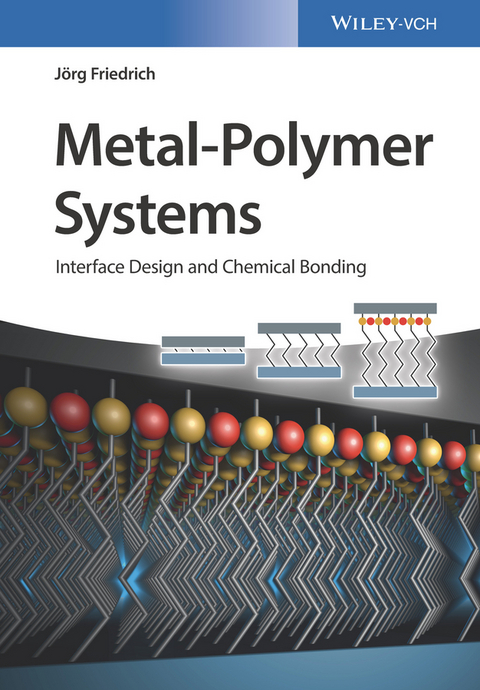
Metal-Polymer Systems (eBook)
Wiley-VCH Verlag GmbH & Co. KGaA
978-3-527-67991-1 (ISBN)

Covering both the academic and practical aspects, the author focuses on the chemistry of interfaces between metals and polymers with a particular emphasis on the chemical bonding between the different materials. He elucidates the various approaches to obtaining a stable interface, including, but not limited to, thermodynamically driven redox reactions, bond protection to prevent hydrolysis, the introduction of barrier layers, and stabilization by spacer molecules. Throughout, chemical bonding is promoted as a simple and economically viable alternative to adhesion based on reversible weak physical interaction.
Consequently, the text equips readers with the practical tools necessary for designing high-strength metal-polymer composites with such desired properties as resilience, flexibility, rigidity or degradation resistance.
Jorg Friedrich was the Department Head of Polymer Surfaces at the Federal Institute of Materials Research and Testing (BAM) in Berlin, Germany. He has obtained his academic degrees from Humboldt University Berlin, Academy of Sciences Berlin (AdW) and the Technical University of Berlin. He spent most of his career working for AdW before taking up his present appointment at BAM. Professor Friedrich has authored more than 300 scientific publications and has received numerous scientific awards. He is member of the editorial boards of four international journals.
Jörg Friedrich was the Department Head of Polymer Surfaces at the Federal Institute of Materials Research and Testing (BAM) in Berlin, Germany. He has obtained his academic degrees from Humboldt University Berlin, Academy of Sciences Berlin (AdW) and the Technical University of Berlin. He spent most of his career working for AdW before taking up his present appointment at BAM. Professor Friedrich has authored more than 300 scientific publications and has received numerous scientific awards. He is member of the editorial boards of four international journals.
Adhesion and Diffusion
Description of Main Theories of Adhesion
Chemical Reactions at Interfaces
Design of Ideal Interfaces
Interactions at the Interface and at the Near-Interface Region
Realization of New Interface Designs
Particularities of Polyolefin Surfaces
Methods for Introducing Functional Groups onto Polyolefin Surfaces
Principal Problems with Functionalization of Polyolefins
Differences between Metals and Polymers as Substrate Materials
Characterization by Surface Energy
Thermodynamics
Work of Adhesion
Surface Modification
Preferred Functional Groups for Maximal Adhesion
Acid-Base Interactions and Use of Silanes
Introduction of Spacers
Fluoropolymers
Strongest and Most Durable Metal-Polymer Bonds
Adhesion Results of High-Strength and High Durable Composites
Adhesion Promotion for Carbon Fibres and Graphene
Electrospray Deposition of Adhesion Promoting Layers
Corrosion Inhibition
Chapter 1
High-Performance Metal–Polymer Composites: Chemical Bonding, Adhesion, and Interface Design
1.1 Introduction
Most published books on adhesion are focused on the discussion of reversible physical interactions along the interface of polymers and coatings. Such adhesion can be described fairly well in terms of thermodynamics. In contrast, mechanical anchoring due to rough surfaces and mechanical interhooking is determined by mechanics. Chemical interactions or chemisorptions may be caused by hydrogen bonds produced by polar groups containing a covalently bonded H atom and an atom with a free pair of electrons. Oxygen and nitrogen groups are often involved in hydrogen bonds. Chemical bonds are often in focus of speculation but seldom clearly detected. Only in a few cases, chemical bonds between polymers and coatings were consciously prepared. This book will present some examples for systematic introduction of covalent bonds between polymers and coatings along the interface. The efficiency to form chemical bonds instead of physical interactions is high because of higher binding energies; thus, a strong adhesion promotion by dense chemical bonds is expected.
Sticking two solids together using vegetable resins is one of the oldest examples for adhesion in the history of mankind, at least in the period as Homo sapiens were arriving in Europe (about 40 000 years ago) [1]. It is also found that the foregoing species, the Homo neanderthalensis (180 000–30 000 years ago), may also be Homo erectus (1 000 000–180 000 years), invented glue as essential to produce their most formidable hunting weapon using bitumen or asphalt and heated it for better gluing. The finding in 1963 in Königsaue is at least 40 000 years old, that in Campitello is 200 000 years old, and that in Inden-Altdorf about 128 000–115 000 years old (Figure 1.1) [2–4].
Figure 1.1 Model of a more than 10 000 years old spearhead made of flint stone and fixed by bitumen and bowstring.
The base of this development of weapons was the found in the lances in Schöningen (Germany), more than 300 000 years old, hardened at the top by fire [5].
Now, let us consider the basics of adhesion in a composite or laminate. Two different solids with almost different chemical compositions, structures, reactivities, surface properties, and mechanical strengths collide in one atomic layer, and the transition from one to another solid takes place in one atomic layer. This transition from solid A to solid B is called interface (Figure 1.2).
Figure 1.2 Example for the principal structure of a polymer–metal laminate.
This atomic gap between solid A and solid B has to be bridged by physical, chemical, or mechanical forces to achieve proper adhesion. Often, a clear transition from solid A to solid B in one atomic layer is not found. Adjacent to the interface, polymers often show a new molecular orientation caused by the interaction with the coating material. Such an example is the “trans-crystalline” orientation of polymers in coatings caused by the texturing action of the metal substrate [6]. This behavior is similar to that of the well-known epitaxy. Thus, the interface region of a composite or laminate consists of the ultimate interface, transition zones in the two neighboring solids (interphases), and the intact original morphology of the two solids (bulk) (Figure 1.3).
Figure 1.3 Examples of the schematic design of metal–polymer interfaces with interphases and the original bulk materials.
Often, contaminations and additives accumulated at the polymer surface, metal oxide skin, and aged and/or oxidized polymer species at the surface/interface hinder the direct interaction of the two solids in a laminate.
Another problem is the contact area between two solids. The greater the contact area, the higher is the concentration of interactions and the stronger is the adhesion. Thus, roughness can increase the contact area, when one solid can wet and, therefore, adapt the rough surface topography of the other solid (Figure 1.4). Such adaptation occurs when the coating is evaporated, molded, or is a dip- or spin-coating film.
Figure 1.4 Problems with minimum contact area in case of laminating rough surfaces.
Now, let us have a look at the binding energies of interactions between two solid phases. The energy of interactions grows moderately from physical interactions to hydrogen bonds. Nevertheless, such van der Waals interactions and hydrogen bonds have low binding energies in comparison to those of chemical bonds. However, such low binding energies can be compensated partially by a high concentration of such interactions, that is, the addition of such many very weak interactions results in a great sum, also in strong adhesion in comparison to rare strong chemical bonds (Figure 1.5). The conclusion is that a great number of strong chemical bonds are needed to achieve a maximum in adhesion.
Figure 1.5 Schematic comparison of the strength of interactions (bond dissociation energy) and the measured total adhesion between a polymer and a coating, depending on the type of interaction and the density of these interactions along the polymer–coating interface.
It will be shown in the following chapters that a high density in chemical bonds across the interface can be realized. However, in such a case, two new difficulties appear. First, the chemical bonding across the interface is equal to or even stronger than the bonds in the polymer represented by the cohesive strength of the polymer in laminate materials; thus, the failure at mechanical loading shifts from the interface to the polymer bulk, termed as cohesive failure (Figure 1.5).
And, secondly, the chemical bonding makes the interface inflexible, and at mechanical loading, adjacent material layers fail (near-interface failing). To avoid such failing by stiffened near-interface layers, flexibilization of the interface is needed as realized by long-chain aliphatic spacers or viscoelastic polymer adhesion-promoting layers (Figure 1.6).
Figure 1.6 Locus of failure in metal–polymer laminates.
Chemical bonds across the interface between two polymers are most often covalent bonds, such as C−C, C−O−C, CO−O, CNH2−O, etc. bonds. Their formation is possible by chemical reactions of different functional groups of the two laminated polymers, by graft reactions or by use of peroxide for linking. The bond strengths of such covalent bonds are in the range of 350–400 kJ mol−1 or more, greater than the physical interactions by a factor of at least 100.
If the polymers are compatible in a thermodynamic sense, that is, have similar structure or equal chain segments, interdiffusion may also occur [7]. The compatible chain segments of polymer A and polymer B interpenetrate in a small interface layer. Solvent-induced swelling or heating supports interdiffusion. In such a case, the relating polymers A1 and A2 can coil in the interdiffusion zone as the macromolecules of a homopolymer. This molecular entanglement provides adhesion strength along the (former) interface similar to the cohesive strengths of polymers A1 and A2.
Functional groups on polymer surfaces or introduced on polyolefin surfaces can react with metal atoms or with its hydroxy groups at the surface of the oxide coating of the metal to chemical bonds (Figure 1.7).
Figure 1.7 Variants of covalent bonds across the interface between polymer and coating.
The aim of this book is to overcome simple physical interactions in composites and to establish, in the adhesion community, new polymer pretreatment processes, new interface design by more chemical processing.
The higher binding energy, at least one order of magnitude, achieved by chemical (covalent) bonds compared to physical interactions between polymer and coating molecules should increase the adhesion in laminates and composites considerably. Thus, if covalent bonds are more densely distributed across the interface, a significantly higher adhesion in laminates or composites should be achieved. It can be compared with the cross-linking of polyolefins by peroxides producing a harder but more brittle polymer bulk with all its advantages and disadvantages.
Now, two solids are strongly bonded together by covalent bonding; however, the interface is simultaneously made more stiff and inflexible. Thus, the mechanical loading is redistributed from the interface in the (often) weaker solid, and the failure is relocated to the vicinity of interface as determined by interfacial thermodynamics and formation of internal stress [8]. Strong interfacial covalent bonds weaken the adjacent covalent bonds in the solid. For example, in polymers, the failure propagation changes from the interface to such weaker near-interface layer, which is associated with a considerably lower adhesion. It was shown that peeling is always assisted by internal stress, here, caused by strong covalent bonds along the interface and by different thermal expansion, whether tensile or compressive, because the stored elastic energy released by mechanical separation of the joint can drive the crack through the weakened near-interface layer of the polymer [9]. Such simple dislocation of failure to near-interface weakened polymer layers is not the optimum solution of the adhesion...
| Erscheint lt. Verlag | 18.9.2017 |
|---|---|
| Sprache | englisch |
| Themenwelt | Naturwissenschaften ► Chemie |
| Technik ► Maschinenbau | |
| Schlagworte | Adhesion • anchoring • Chemie • Chemistry • Composites • Dünne Schichten, Oberflächen u. Grenzflächen • highperformance • interlocking • Interpretation • Introduction • Macroscopic • Materials Science • Materialwissenschaften • Mechanical • Metall-Polymer • metalpolymer • microscale • molecular • Oberflächen- u. Kolloidchemie • phenomena review • Polymer Science & Technology • Polymersynthese • polymer synthesis • Polymerwissenschaft u. -technologie • References • scale • Surface & Colloid Chemistry • Thin Films, Surfaces & Interfaces |
| ISBN-10 | 3-527-67991-X / 352767991X |
| ISBN-13 | 978-3-527-67991-1 / 9783527679911 |
| Informationen gemäß Produktsicherheitsverordnung (GPSR) | |
| Haben Sie eine Frage zum Produkt? |
 EPUB (Adobe DRM)
Kopierschutz: Adobe-DRM
Adobe-DRM ist ein Kopierschutz, der das eBook vor Mißbrauch schützen soll. Dabei wird das eBook bereits beim Download auf Ihre persönliche Adobe-ID autorisiert. Lesen können Sie das eBook dann nur auf den Geräten, welche ebenfalls auf Ihre Adobe-ID registriert sind.
Details zum Adobe-DRM
Dateiformat: EPUB (Electronic Publication)
EPUB ist ein offener Standard für eBooks und eignet sich besonders zur Darstellung von Belletristik und Sachbüchern. Der Fließtext wird dynamisch an die Display- und Schriftgröße angepasst. Auch für mobile Lesegeräte ist EPUB daher gut geeignet.
Systemvoraussetzungen:
PC/Mac: Mit einem PC oder Mac können Sie dieses eBook lesen. Sie benötigen eine
eReader: Dieses eBook kann mit (fast) allen eBook-Readern gelesen werden. Mit dem amazon-Kindle ist es aber nicht kompatibel.
Smartphone/Tablet: Egal ob Apple oder Android, dieses eBook können Sie lesen. Sie benötigen eine
Geräteliste und zusätzliche Hinweise
Buying eBooks from abroad
For tax law reasons we can sell eBooks just within Germany and Switzerland. Regrettably we cannot fulfill eBook-orders from other countries.
aus dem Bereich