Nanoporous Catalysts for Biomass Conversion (eBook)
John Wiley & Sons (Verlag)
978-1-119-12810-6 (ISBN)
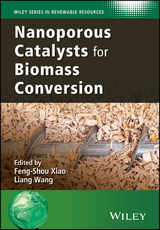
A comprehensive introduction to the design, synthesis, characterization, and catalytic properties of nanoporous catalysts for the biomass conversion
With the specter of peak oil demand looming on the horizon, and mounting concerns over the environmental impact of greenhouse gas emissions, biomass has taken on a prominent role as a sustainable alternative fuel source. One critical aspect of the biomass challenge is the development of novel catalytic materials for effective and controllable biomass conversion. Edited by two scientists recognized internationally for their pioneering work in the field, this book focuses on nanoporous catalysts, the most promising class of catalytic materials for the conversion of biomass into fuel and other products.
Although various catalysts have been used in the conversion of biomass-derived feedstocks, nanoporous catalysts exhibit high catalytic activities and/or unique product selectivities due to their large surface area, open nanopores, and highly dispersed active sites. This book covers an array of nanoporous catalysts currently in use for biomass conversion, including resins, metal oxides, carbons, mesoporous silicates, polydivinylbenzene, and zeolites. The authors summarize the design, synthesis, characterization and catalytic properties of these nanoporous catalysts for biomass conversions, discussing the features of these catalysts and considering future opportunities for developing more efficient catalysts. Topics covered include:
- Resins for biomass conversion
- Supported metal oxides/sulfides for biomass oxidation and hydrogenation
- Nanoporous metal oxides
- Ordered mesoporous silica-based catalysts
- Sulfonated carbon catalysts
- Porous polydivinylbenzene
- Aluminosilicate zeolites for bio-oil upgrading
- Rice straw Hydrogenation for sugar conversion
- Lignin depolymerization
Timely, authoritative, and comprehensive, Nanoporous Catalysts for Biomass Conversion is a valuable working resource for academic researchers, industrial scientists and graduate students working in the fields of biomass conversion, catalysis, materials science, green and sustainable chemistry, and chemical/process engineering.
Edited by
Feng-Shou Xiao, Zhejiang University, Hangzhou, China
Liang Wang, Zhejiang University, Hangzhou, China
Series Editor
Christian Stevens, Faculty of Bioscience Engineering, Ghent University, Belgium
A comprehensive introduction to the design, synthesis, characterization, and catalytic properties of nanoporous catalysts for the biomass conversion With the specter of peak oil demand looming on the horizon, and mounting concerns over the environmental impact of greenhouse gas emissions, biomass has taken on a prominent role as a sustainable alternative fuel source. One critical aspect of the biomass challenge is the development of novel catalytic materials for effective and controllable biomass conversion. Edited by two scientists recognized internationally for their pioneering work in the field, this book focuses on nanoporous catalysts, the most promising class of catalytic materials for the conversion of biomass into fuel and other products. Although various catalysts have been used in the conversion of biomass-derived feedstocks, nanoporous catalysts exhibit high catalytic activities and/or unique product selectivities due to their large surface area, open nanopores, and highly dispersed active sites. This book covers an array of nanoporous catalysts currently in use for biomass conversion, including resins, metal oxides, carbons, mesoporous silicates, polydivinylbenzene, and zeolites. The authors summarize the design, synthesis, characterization and catalytic properties of these nanoporous catalysts for biomass conversions, discussing the features of these catalysts and considering future opportunities for developing more efficient catalysts. Topics covered include: Resins for biomass conversion Supported metal oxides/sulfides for biomass oxidation and hydrogenation Nanoporous metal oxides Ordered mesoporous silica-based catalysts Sulfonated carbon catalysts Porous polydivinylbenzene Aluminosilicate zeolites for bio-oil upgrading Rice straw Hydrogenation for sugar conversion Lignin depolymerization Timely, authoritative, and comprehensive, Nanoporous Catalysts for Biomass Conversion is a valuable working resource for academic researchers, industrial scientists and graduate students working in the fields of biomass conversion, catalysis, materials science, green and sustainable chemistry, and chemical/process engineering.
Edited by Feng-Shou Xiao, Zhejiang University, Hangzhou, China Liang Wang, Zhejiang University, Hangzhou, China Series Editor Christian Stevens, Faculty of Bioscience Engineering, Ghent University, Belgium
Chapter 1
Nanoporous Organic Frameworks for Biomass Conversion
Xiang Zhu, Chi-Linh Do-Thanh and Sheng Dai
Department of Chemistry, The University of Tennessee, USA
1.1 Introduction
Porosity, a profound concept that helps to understand Nature and create novel fascinating architectures, is inherent to natural processes, as seen in hollow bamboo, hexagonal honeycomb, and the alveoli in the lungs (Figure 1.1) [1, 2]. These advanced natural porous frameworks and their promising applications have widely inspired scientists with the idea of mimicking them in artificial structures down to the micro- and nanoscale range [1, 2]. The rational design and synthesis of advanced nanoporous materials, which play a crucial role in established processes such as catalysis and gas storage and separations and catalysis [3–12], have long been an important science subject and attracted tremendous attention. During the past two decades, the linking of molecular scaffolds by covalent bonds to create crystalline extended structures has afforded a broad family of novel nanoporous crystalline structures [13] such as like metal–organic frameworks (MOFs) [14] and covalent organic frameworks (COFs) [15]. The key advance in this regard has been the versatility of covalent chemistry and organic synthesis techniques, which give rise to a wide variety of target applications for these extended organic frameworks, for example, the use of MOFs and COFs in the context of biomass conversion. In addition to crystalline frameworks, nanoporous organic resins have long been extensively studied as heterogeneous catalysts for the conversion of biomass because of their commercial synthesis [16].
Figure 1.1 Illustration of porosity existing in Nature and synthesized frameworks with a decreasing pore size. (a) Bamboo; (b) honeycomb; (c) scanning electron microscopy (SEM) image of alveolar tissue in mouse lung; (d) SEM image of an ordered macroporous polymer; (e) SEM image of an ordered mesoporous polymer from self-assembly of block copolymers; (f) structural representation of the COF structure.
Upgrading biomass into fuel and fine chemicals has been considered a promising renewable and sustainable solution to replacing petroleum feedstocks, owing to the rich family of biomass raw materials, which mainly includes cellulose, hemicellulose, and lignin [17, 18]. For example, the carbohydrates, present in the cellulosic and hemicellulosic parts of biomass, can be converted into renewable platform chemicals such as 5-hydroxymethylfurfural (HMF), via acid-catalyzed dehydration for the production of a wide variety of fuels and chemical intermediates [19]. Despite great progress, including unprecedented yields and selectivities, having been made in biomass conversion using conventional homogeneous catalysts, the cycling abilities have long been the main drawbacks that inhibit their large-scale applications. As a result, heterogeneous nanoporous solid catalysts hold great promise in these diverse reactions [16]. High porosities of nanoporous catalysts may help to access reactants, mass transfer, and functionalization of task-specific active sites, such that the product selectivities can be easily controlled. To this end, nanoporous materials with high surface areas, tunable pore sizes and controllable surface functionalities have been extensively prepared and studied. Significantly, nanoporous crystalline organic frameworks, with well-defined spatial arrangements where their properties are influenced by the intricacies of the pores and ordered patterns onto which functional groups can be covalently attached to produce chemical complexity, exhibit distinct advantages over other porous catalysts. For instance, post-synthetic modification (PSM) techniques [20] provide a means of designing the intrinsic pore environment without losing their long-range order to improve the biomass conversion performance. The inherent ‘organic effect’ enables the architectures to function with task-specific moieties such as the acidic sulfonic acid (–SO3H) group. The desired microenvironment can also be generated by rationally modifying the organic building units or metal nodes. In addition, the attractive large porosity allows the frameworks to become robust solid supports to immobilize active units such as polyoxometalates and polymers [21]. In essence, nanoporous crystalline organic frameworks including MOFs and COFs have demonstrated strong potential as heterogeneous catalysts for biomass conversion [21]. The ability to reticulate task-specific functions into frameworks not only allows catalysis to be performed in a high-yield manner but also provides a means of facile control of product selectivity.
HMF, as a major scaffold for the preparation of furanic polyamides, polyesters, and polyurethane analogs, exhibits great promise in fuel and solvent applications [19, 22]. The efficient synthesis of HMF from biomass raw materials has recently attracted major research efforts [23–29]. Via a two-step acyclic mechanism, HMF can be prepared from the dehydration of C-6 sugars such as glucose and fructose. First, glucose undergoes an isomerization to form fructose in the presence of either base catalysts or Lewis acid catalysts by means of an intramolecular hydride shift [30]. Subsequently, Brønsted acid-catalyzed dehydration of the resultant fructose affords the successful formation of HMF with the loss of three molecules of H2O (Scheme 1.2) [31]. The development of novel nanoporous acidic catalysts for the catalytic dehydration of sugars to HMF is of great interest, and is highly desirable. Hence, design strategies for the construction of nanoporous crystalline organic frameworks that are capable of the efficient transformation of sugars to HMF are discussed in this chapter, and some nanoporous organic resins for the conversion of raw biomass materials are highlighted. By examining the common principles that govern catalysis for dehydration reactions, a systematic framework can be described that clarifies trends in developing nanoporous organic frameworks as new heterogeneous catalysts while highlighting any key gaps that need to be addressed.
Scheme 1.1 Possible valuable chemicals based on carbohydrate feedstock.
1.2 Nanoporous Crystalline Organic Frameworks
1.2.1 Metal–Organic Frameworks
The Brønsted acidity of nanoporous catalysts is very essential for the dehydration of carbohydrates towards the formation of HMF [32–34]. One significant advantage of metal–organic frameworks (MOFs) is their highly designable framework, which gives rise to a versatility of surface features within porous backbones. Whereas, a wide variety of functional groups has been incorporated into MOF frameworks, exploring the Brønsted acidity of MOFs [14], the introduction of sulfonic acid groups in the framework remains a challenge and less explored, mainly because of the weakened framework stability. In this regard, several different synthetic techniques have been developed and adopted to introduce sulfonic acid (–SO3H) groups for MOF-catalyzed dehydration processes: (i) de-novo synthesis using organic linkers with –SO3H moiety; (ii) pore wall engineering by the covalently postsynthetic modification [20] (PSM) route; and (iii) modification of the pore microenvironment through the introduction of additional active sites. These novel MOF materials featuring strong Brønsted acidity show great promise as solid nanoporous acid catalysts in biomass conversion.
1.2.1.1 De-Novo Synthesis
Inspired by the framework MIL-101 [35], which possesses strong stability in aqueous acidic solutions and is fabricated from a chromium oxide cluster and terephthalate ligands in hydrofluoric acid media, Kitagawa et al. for the first time reported the rational design and synthesis of a MIL-like MOF material for cellulose hydrolysis [36]. By, adopting the MIL-101 framework as a platform, these authors created a novel nanoporous acid catalyst with highly acidic –SO3H functions along the pore walls by the innovative use of 2-sulfoterephthalate instead of the unsubstituted terephthalate in MIL-101 (Figure 1.2). The resultant Cr-based MOF MIL-101-SO3H was shown to exhibit a clean catalytic activity for the cellulose hydrolysis reaction, thus opening a new window on the preparation of novel nanoporous catalysts for biomass conversion. On account of the unsatisfactory yields of mono- and disaccharides from cellulose hydrolysis being caused by the poor solubility of crystalline cellulose in water, the same group further studied isomerization reactions from glucose to fructose in aqueous media, where MIL-101-SO3H not only shows a high conversion of glucose but also selectively produces fructose [37]. A catalytic one-pot conversion of amylose to fructose was also achieved because of the high stability of the framework in an acidic solution, which suggests promising applications of compound in the biomass field.
Figure 1.2 Schematic representation of the structure of MIL-101-SO3H.
On account of the HMF formation mechanism, the Lewis acid featuring metal center – for example, chromium (II) – allows for a high-yield isomerization because of the coordinate effect between the Lewis acidic metal sites and glucose [24]. In addition to strong Brønsted acidity caused by the –SO3H moieties, MIL-101-SO3H also bears Cr(III) sites within the structure, which is similar to CrCl2 and may act as active sites for the isomerization of glucose to fructose, whereas the fructose...
| Erscheint lt. Verlag | 7.9.2017 |
|---|---|
| Reihe/Serie | Wiley Series in Renewable Resource |
| Wiley Series in Renewable Resources | Wiley Series in Renewable Resources |
| Mitarbeit |
Herausgeber (Serie): Christian V. Stevens |
| Sprache | englisch |
| Themenwelt | Naturwissenschaften ► Chemie ► Technische Chemie |
| Technik ► Elektrotechnik / Energietechnik | |
| Schlagworte | activated carbon for biomass conversion • Alternative energy sources • biomass conversion into fuels • biomass fuels • catalysis • catalysts for biomass conversion • catalytic depolymerization of lignin to fuels and chemicals • Chemie • Chemistry • direct synthesis from bio-syngas • Katalyse • lignin depolymerization for biomass conversion • Materials Science • Materialwissenschaften • mesoporous silica-based catalysts for biomass conversion • mixed oxide catalysts in supercritical ethanol • Nachhaltige u. Grüne Chemie • nanoporous carbon for biomass conversion • nanoporous carbon for cellulose conversion • nitrogen materials and their hybrids for biomass conversion • ordered mesoporous carbon-based catalysts for biomass conversion • Poröse Materialien • porous copper based catalysts for biomass conversion • Porous Materials • porous polydivinylbenzene based solid catalysts for biomass transformation reactions • rice straw and for bio-gasoline • Sustainable Chemistry & Green Chemistry • zeolite catalysts to convert glycerol |
| ISBN-10 | 1-119-12810-2 / 1119128102 |
| ISBN-13 | 978-1-119-12810-6 / 9781119128106 |
| Informationen gemäß Produktsicherheitsverordnung (GPSR) | |
| Haben Sie eine Frage zum Produkt? |
 EPUB (Adobe DRM)
Kopierschutz: Adobe-DRM
Adobe-DRM ist ein Kopierschutz, der das eBook vor Mißbrauch schützen soll. Dabei wird das eBook bereits beim Download auf Ihre persönliche Adobe-ID autorisiert. Lesen können Sie das eBook dann nur auf den Geräten, welche ebenfalls auf Ihre Adobe-ID registriert sind.
Details zum Adobe-DRM
Dateiformat: EPUB (Electronic Publication)
EPUB ist ein offener Standard für eBooks und eignet sich besonders zur Darstellung von Belletristik und Sachbüchern. Der Fließtext wird dynamisch an die Display- und Schriftgröße angepasst. Auch für mobile Lesegeräte ist EPUB daher gut geeignet.
Systemvoraussetzungen:
PC/Mac: Mit einem PC oder Mac können Sie dieses eBook lesen. Sie benötigen eine
eReader: Dieses eBook kann mit (fast) allen eBook-Readern gelesen werden. Mit dem amazon-Kindle ist es aber nicht kompatibel.
Smartphone/Tablet: Egal ob Apple oder Android, dieses eBook können Sie lesen. Sie benötigen eine
Geräteliste und zusätzliche Hinweise
Buying eBooks from abroad
For tax law reasons we can sell eBooks just within Germany and Switzerland. Regrettably we cannot fulfill eBook-orders from other countries.
aus dem Bereich