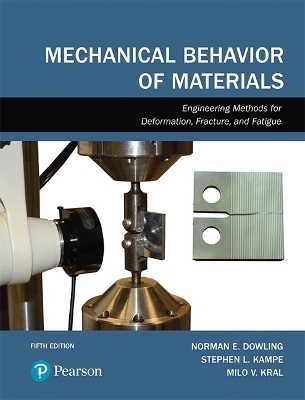
Mechanical Behavior of Materials
Pearson (Verlag)
978-0-13-460654-5 (ISBN)
Predicting the mechanical behavior of materials
Mechanical Behavior of Materials,5th Edition introduces the spectrum of mechanical behavior of materials and covers the topics of deformation, fracture, and fatigue. The text emphasizes practical engineering methods for testing structural materials to obtain their properties, predicting their strength and life, and avoiding structural failure when used for machines, vehicles, and structures. With its logical treatment and ready-to-use format, the text is ideal for upper-level undergraduate students who have completed an elementary mechanics of materials course. The 5th Edition features many improvements and updates throughout including new or revised problems and questions, and a new chapter on Environmentally Assisted Cracking.
About our authors Norman E. Dowling earned his BS in civil engineering (structures) from Clemson University in Clemson, SC, and his MS and PhD in theoretical and applied mechanics from the University of Illinois in Urbana. He is a registered Professional Engineer. From 1972 to 1982, he was employed at Westinghouse Research Laboratories, Pittsburgh, PA. Since 1983, he has been at Virginia Polytechnic Institute and State University. In 2015, Professor Dowling retired from full employment and remains professionally active as Professor Emeritus. An ASTM International member since 1972, Dowling has served on several subcommittees and other activities of Committee E08 on Fatigue and Fracture. He has also been active in the Fatigue Design and Evaluation Committee of SAE International. Stephen L. Kampe received BS, MS and PhD degrees in Metallurgical Engineering from Michigan Technological University. He has held positions with Martin Marietta Corporation, and with Virginia Tech on the Materials Science and Engineering faculty. In 2008, he returned to Michigan Tech and is currently the St. John Professor and Chair of the Materials Science and Engineering Department. He is a member of TMS and ASEE, and a Fellow of ASM and Alpha Sigma Mu. Milo V. Kral earned his BE in mechanical engineering, and his MS and PhD in Materials Science & Engineering from Vanderbilt University. After an ASEE post-doctoral fellowship in 1996 to 1998 at the US Naval Research Laboratory in Washington, DC, Kral joined the engineering faculty at University of Canterbury in Christchurch New Zealand. He is a member of TMS, ASM, a fellow of Professional Engineers NZ and Alpha Sigma Mu.
Introduction
1.1 Introduction
1.2 Types of Material Failure
1.3 Design and Materials Selection
1.4 Technological Challenge
1.5 Economic Importance of Fracture
1.6 Summary
References
Problems and Questions
Structure, Defects, and Deformation in Materials
2.1 Introduction
2.2 Bonding in Solids
2.3 Structure in Crystalline Materials
2.4 Defects in Materials
2.5 Elastic Deformation and Theoretical Strength
2.6 Inelastic Deformation
2.7 Summary
References
Problems and Questions
Mechanical Testing: Tension Test and Stress–Strain Mechanisms
3.1 Introduction
3.2 Introduction to Tension Test
3.3 Engineering Stress–Strain Properties
3.4 Materials Science Description of Tensile Behavior
3.5 Trends in Tensile Behavior
3.6 True Stress–Strain Interpretation of Tension Test
3.7 Materials Selection for Engineering Components
3.8 Summary
References
Problems and Questions
Mechanical Testing: Additional Basic Tests
4.1 Introduction
4.2 Compression Test
4.3 Hardness Tests
4.4 Notch-Impact Tests
4.5 Bending and Torsion Tests
4.6 Summary
References
Problems and Questions
Stress–Strain Relationships and Behavior
5.1 Introduction
5.2 Models for Deformation Behavior
5.3 Elastic Deformation
5.4 Anisotropic Materials
5.5 Summary
References
Problems and Questions
Review of Complex and Principal States of Stress and Strain
6.1 Introduction
6.2 Plane Stress
6.3 Principal Stresses and the Maximum Shear Stress
6.4 Three-Dimensional States of Stress
6.5 Stresses on the Octahedral Planes
6.6 Complex States of Strain
6.7 Summary
References
Problems and Questions
Yielding and Fracture under Combined Stresses
7.1 Introduction
7.2 General Form of Failure Criteria
7.3 Maximum Normal Stress Fracture Criterion
7.4 Maximum Shear Stress Yield Criterion
7.5 Octahedral Shear Stress Yield Criterion
7.6 Discussion of the Basic Failure Criteria
7.7 Coulomb–Mohr Fracture Criterion
7.8 Modified Mohr Fracture Criterion
7.9 Additional Comments on Failure Criteria
7.10 Summary
References
Problems and Questions
Fracture of Cracked Members
8.1 Introduction
8.2 Preliminary Discussion
8.3 Mathematical Concepts
8.4 Application of K to Design and Analysis
8.5 Additional Topics on Application of K
8.6 Fracture Toughness Values and Trends
8.7 Plastic Zone Size, and Plasticity Limitations on LEFM
8.8 Discussion of Fracture Toughness Testing
8.9 Extensions of Fracture Mechanics Beyond Linear Elasticity
8.10 Summary
References
Problems and Questions
Fatigue of Materials: Introduction and Stress-Based Approach
9.1 Introduction
9.2 Definitions and Concepts
9.3 Sources of Cyclic Loading
9.4 Fatigue Testing
9.5 The Physical Nature of Fatigue Damage
9.6 Trends in S-N Curves
9.7 Mean Stresses
9.8 Multiaxial Stresses
9.9 Variable Amplitude Loading
9.10 Summary
References
Problems and Questions
Stress-Based Approach to Fatigue: Notched Members
10.1 Introduction
10.2 Notch Effects
10.3 Notch Sensitivity and Empirical Estimates of kf
10.4 Estimating Long-Life Fatigue Strengths (Fatigue Limits)
10.5 Notch Effects at Intermediate and Short Lives
10.6 Combined Effects of Notches and Mean Stress
10.7 Estimating S-N Curves
10.8 Use of Component S-N Data
10.9 Designing to Avoid Fatigue Failure
10.10 Discussion
10.11 Summary
References
Problems and Questions
Fatigue Crack Growth
11.1 Introduction
11.2 Preliminary Discussion
11.3 Fatigue Crack Growth Rate Testing
11.4 Effects of R = Smin/Smax on Fatigue Crack Growth
11.5 Trends in Fatigue Crack Growth Behavior
11.6 Life Estimates for Constant Amplitude Loading
11.7 Life Estimates for Variable Amplitude Loading
11.8 Design Considerations
11.9 Plasticity Aspects and Limitations of LEFM for Fatigue Crack Growth
11.10 Summary
References
Problems and Questions
Environmentally Assisted Cracking
12.1 Introduction
12.2 Definitions, Concepts, and Analysis
12.3 EAC in Metals: Basic Mechanisms
12.4 Hydrogen-Induced Embrittlement
12.5 Liquid Metal Embrittlement
12.6 EAC of Polymers
12.7 EAC of Glasses and Ceramics
12.8 Additional Comments and Preventative Measures
References
Problems and Questions
Plastic Deformation Behavior and Models for Materials
13.1 Introduction
13.2 Stress–Strain Curves
13.3 Three-Dimensional Stress–Strain Relationships
13.4 Unloading and Cyclic Loading Behavior from Rheological Models
13.5 Cyclic Stress–Strain Behavior of Real Materials
13.6 Summary
References
Problems and Questions
Stress–Strain Analysis of Plastically Deforming Members
14.1 Introduction
14.2 Plasticity in Bending
14.3 Residual Stresses and Strains for Bending
14.4 Plasticity of Circular Shafts in Torsion
14.5 Notched Members
14.6 Cyclic Loading
14.7 Summary
References
Problems and Questions
Strain-Based Approach to Fatigue
15.1 Introduction
15.2 Strain Versus Life Curves
15.3 Mean Stress Effects
15.4 Multiaxial Stress Effects
15.5 Life Estimates for Structural Components
15.6 Additional Discussion
15.7 Summary
References
Problems and Questions
Time-Dependent Behavior: Creep and Damping
16.1 Introduction
16.2 Creep Testing
16.3 Physical Mechanisms of Creep
16.4 Time–Temperature Parameters and Life Estimates
16.5 Creep Failure under Varying Stress
16.6 Stress–Strain–Time Relationships
16.7 Creep Deformation under Varying Stress
16.8 Creep Deformation under Multiaxial Stress
16.9 Component Stress–Strain Analysis
16.10 Energy Dissipation (Damping) in Materials
16.11 Summary
References
Problems and Questions
Appendix A Review of Selected Topics from Mechanics of Materials
A.1 Introduction
A.2 Basic Formulas for Stresses and Deflections
A.3 Properties of Areas
A.4 Shears, Moments, and Deflections in Beams
A.5 Stresses in Pressure Vessels, Tubes, and Discs
A.6 Elastic Stress Concentration Factors for Notches
A.7 Fully Plastic Yielding Loads
References
Appendix B Statistical Variation in Materials Properties
B.1 Introduction
B.2 Mean and Standard Deviation
B.3 Normal or Gaussian Distribution
B.4 Typical Variation in Materials Properties
B.5 One-Sided Tolerance Limits
B.6 Discussion
References
Appendix C A Survey of Engineering Materials
C.1 Introduction
C.2 Alloying and Processing of Metals
C.3 Irons and Steels
C.4 Nonferrous Metals
C.5 Polymers
C.6 Ceramics and Glasses
C.7 Composite Materials
C.8 Summary
| Erscheinungsdatum | 07.01.2018 |
|---|---|
| Sprache | englisch |
| Maße | 184 x 238 mm |
| Gewicht | 1420 g |
| Themenwelt | Technik ► Maschinenbau |
| ISBN-10 | 0-13-460654-X / 013460654X |
| ISBN-13 | 978-0-13-460654-5 / 9780134606545 |
| Zustand | Neuware |
| Informationen gemäß Produktsicherheitsverordnung (GPSR) | |
| Haben Sie eine Frage zum Produkt? |
aus dem Bereich