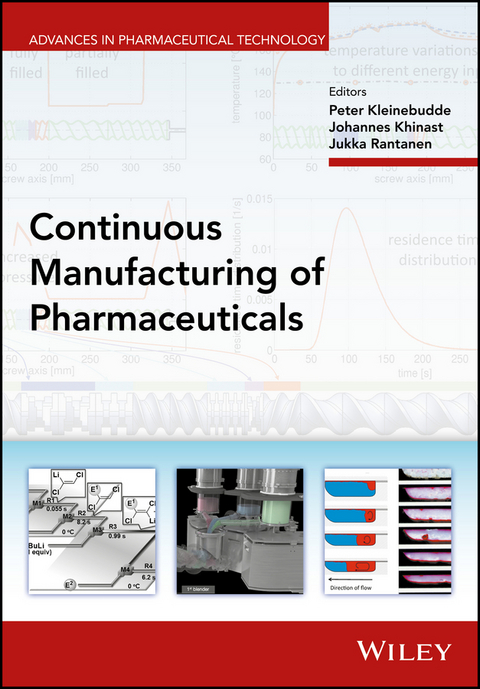
Continuous Manufacturing of Pharmaceuticals (eBook)
John Wiley & Sons (Verlag)
978-1-119-00135-5 (ISBN)
A comprehensive look at existing technologies and processes for continuous manufacturing of pharmaceuticals
As rising costs outpace new drug development, the pharmaceutical industry has come under intense pressure to improve the efficiency of its manufacturing processes. Continuous process manufacturing provides a proven solution. Among its many benefits are: minimized waste, energy consumption, and raw material use; the accelerated introduction of new drugs; the use of smaller production facilities with lower building and capital costs; the ability to monitor drug quality on a continuous basis; and enhanced process reliability and flexibility. Continuous Manufacturing of Pharmaceuticals prepares professionals to take advantage of that exciting new approach to improving drug manufacturing efficiency.
This book covers key aspects of the continuous manufacturing of pharmaceuticals. The first part provides an overview of key chemical engineering principles and the current regulatory environment. The second covers existing technologies for manufacturing both small-molecule-based products and protein/peptide products. The following section is devoted to process analytical tools for continuously operating manufacturing environments. The final two sections treat the integration of several individual parts of processing into fully operating continuous process systems and summarize state-of-art approaches for innovative new manufacturing principles.
- Brings together the essential know-how for anyone working in drug manufacturing, as well as chemical, food, and pharmaceutical scientists working on continuous processing
- Covers chemical engineering principles, regulatory aspects, primary and secondary manufacturing, process analytical technology and quality-by-design
- Contains contributions from researchers in leading pharmaceutical companies, the FDA, and academic institutions
- Offers an extremely well-informed look at the most promising future approaches to continuous manufacturing of innovative pharmaceutical products
Timely, comprehensive, and authoritative, Continuous Manufacturing of Pharmaceuticals is an important professional resource for researchers in industry and academe working in the fields of pharmaceuticals development and manufacturing.
Editors
Peter Kleinebudde is Professor for Pharmaceutical Technology at Heinrich-Heine-University Duesseldorf, Germany, and Vice-Dean of the Faculty of Mathematics and Natural Sciences. His main research area is development, production and characterization of solid dosage forms.
Johannes Khinast is Professor of Chemical and Pharmaceutical Engineering and Head of the Institute of Process and Particle Engineering at the Graz University of Technology, Austria.
Jukka Rantanen is Professor of Pharmaceutical Technology and Engineering at the Department of Pharmacy, University of Copenhagen, Denmark.
A comprehensive look at existing technologies and processes for continuous manufacturing of pharmaceuticals As rising costs outpace new drug development, the pharmaceutical industry has come under intense pressure to improve the efficiency of its manufacturing processes. Continuous process manufacturing provides a proven solution. Among its many benefits are: minimized waste, energy consumption, and raw material use; the accelerated introduction of new drugs; the use of smaller production facilities with lower building and capital costs; the ability to monitor drug quality on a continuous basis; and enhanced process reliability and flexibility. Continuous Manufacturing of Pharmaceuticals prepares professionals to take advantage of that exciting new approach to improving drug manufacturing efficiency. This book covers key aspects of the continuous manufacturing of pharmaceuticals. The first part provides an overview of key chemical engineering principles and the current regulatory environment. The second covers existing technologies for manufacturing both small-molecule-based products and protein/peptide products. The following section is devoted to process analytical tools for continuously operating manufacturing environments. The final two sections treat the integration of several individual parts of processing into fully operating continuous process systems and summarize state-of-art approaches for innovative new manufacturing principles. Brings together the essential know-how for anyone working in drug manufacturing, as well as chemical, food, and pharmaceutical scientists working on continuous processing Covers chemical engineering principles, regulatory aspects, primary and secondary manufacturing, process analytical technology and quality-by-design Contains contributions from researchers in leading pharmaceutical companies, the FDA, and academic institutions Offers an extremely well-informed look at the most promising future approaches to continuous manufacturing of innovative pharmaceutical products Timely, comprehensive, and authoritative, Continuous Manufacturing of Pharmaceuticals is an important professional resource for researchers in industry and academe working in the fields of pharmaceuticals development and manufacturing.
Editors Peter Kleinebudde is Professor for Pharmaceutical Technology at Heinrich-Heine-University Duesseldorf, Germany, and Vice-Dean of the Faculty of Mathematics and Natural Sciences. His main research area is development, production and characterization of solid dosage forms. Johannes Khinast is Professor of Chemical and Pharmaceutical Engineering and Head of the Institute of Process and Particle Engineering at the Graz University of Technology, Austria. Jukka Rantanen is Professor of Pharmaceutical Technology and Engineering at the Department of Pharmacy, University of Copenhagen, Denmark.
Chapter 1
Continuous Manufacturing: Definitions and Engineering Principles
Johannes Khinast1,2 and Massimo Bresciani2
1Institute of Process and Particle Engineering, Graz University of Technology, Austria
2Research Center for Pharmaceutical Engineering, Graz, Austria
1.1 Introduction
1.1.1 Definition of Continuous Manufacturing
In chemical engineering, manufacturing processes can be categorized in different ways, one being the mode of operation with respect to the strategy of feeding and removing materials from a process unit. Specifically, one distinguishes between:
- Batch manufacturing: All materials are charged before processing and are discharged at the end of processing (example: batch crystallization).
- Semi-batch manufacturing: Some materials may be continuously added during processing and discharged at the end (example: air feed during batch fermentation).
- Continuous manufacturing: Material is simultaneously charged and discharged from the process (example: flow-through reactor cell).
- Quasi-continuous manufacturing: Material is treated in batches, yet removed in defined intervals (example: fluid-batch drying of intermediate batches).
- Semi-continuous manufacturing: Like continuous manufacturing, but for a defined time period (example: continuous manufacturing on a campaign basis).
Thus, continuous manufacturing (CM) is a method of manufacturing products and processing materials without interruption and with constant material feed and removal. Also tableting, which actually is a batch operation on the scale of a single die, can be viewed as a continuous process. In contrast to batch manufacturing, in a continuous process materials remain constantly in motion, undergo chemical transformations, or are subject to mechanical or heat treatment. Continuous processing on a large scale generally means operating 24 h/day, 7 days/week (often called 24/7) with infrequent (weekly, monthly, semi-annual, or annual) planned maintenance shutdowns. However, continuous manufacturing can also be carried out on a campaign basis, that is, semi-continuous manufacturing of an intermediate chemical compound for a few weeks in a continuous plant.
The concept of continuous processing is not new. It has widely been used across the industry, including oil refining and the production of chemicals, fertilizers, paper, and foods. One of the earliest continuous processes relates to the paper industry (Fourdrinier paper machine, patented in 1799). Automotive manufacturing (at least the assembly part) can also be viewed as a continuous process. Here, the first assembly lines were installed at the beginning of the twentieth century by Olds (Oldsmobile) and, with more publicity, several years later by Ford (Ford model T).
1.1.2 Continuous Manufacturing in the Pharmaceutical Industry
Although not used on a broad basis, continuous manufacturing is not new to the pharmaceurical sector. Some pharmaceutical manufacturing processes (e.g., separations) have operated continuously for decades [1]. Furthermore, many pharmaceutical unit operations, such as plug-flow reactors, roller compaction, tablet compression, extrusion, and capsule filling, are inherently continuous process steps. Yet, since continuous quality assurance was not integrated in these processes in the past, they remain continuous processes operated in a batch way and will only become truly continuous when real-time quality assurance is fully implemented in the process control.The first publication by ICI, clearly outlining the advantages of continuous manufacturing (as they are cited today), dates back to 1984 [2].
On the academic side, continuous manufacturing of pharmaceuticals has been studied for more than two decades. In the early 1990s, Muzzio at Rutgers University launched the first research program for the continuous manufacturing of pharmaceuticals. In addition, Leuenberger (University of Basel) early on pointed out the advantages of continuous manufacturing in the pharmaceutical industry [3]. Since then, significant efforts have been made in this field, and several focused research programs are currently underway. For example, the Novartis-MIT center for continuous manufacturing (USA) focuses on primary active pharmaceutical ingredient (API) manufacturing and integrating drug synthesis into a continuous production line [4]. Continuous manufacturing and crystallisation (CMAC) at Strathclyde University (UK) investigates related topics that range from synthesis to crystallization. A series of white papers from the International Symposium on Continuous Manufacturing of Pharmaceuticals [5], organized jointly by MIT and CMAC, highlights the current view on CM. In the field of secondary manufacturing (drug product), together with its partners at Purdue University, NJIT, and University of Puerto Rico, Rutgers University developed a continuous manufacturing plant based on blending and direct compaction within their NSF-funded research center C-SOPS [6]. The Research Center for Pharmaceutical Engineering (RCPE) currently leads the European Consortium for Continuous Manufacturing, fearuring three continuous lines. Its partners are the groups of Ketolainen at University of Eastern Finland (roller-compaction based granulation), Remon and De Beer at Ghent University (wet granulation lines), Kleinebudde at Heinrich-Heine University (roller compaction), and Graz University of Technology (hot-melt extrusion and down-streaming).
Several system suppliers have developed GMP-certified continuous manufacturing lines. One approach to integrating multiple continuous unit operations into a continuous downstream line is the Consigma system by GEA. It is an integrated tableting line with continuous wet granulation via co-rotating twin-screw extrusion, semi-continuous drying in a segmented fluid bed and tableting with state of the art online monitoring systems [7]. Recently, GLATT introduced the “MODCOS” system, which is a continuous rotary chamber insert for converting Glatt's GPCG drying batch system into a continuous fluidized bed drying system. In combination with various associated continuous process equipment from other companies [e.g., feeders, process analytical technology (PAT), and continuous granulation systems] it makes an integrated continuous wet granulation line possible. Moreover, other advanced industrial systems are under development, such as the continuous manufacturing line(s) by Bohle for blending, dry and wet granulation, tableting, and coating. Bosch is another equipment company developing downstream continuous manufacturing systems in cooperation with RCPE. Continuus Pharmaceuticals, a spin-off from MIT is offering equipment for continuous synthesis and dosage-form manufacturing. Similarly, suppliers of continuous flow chemistry systems are increasingly active on the market (Thalesnano, Syrris, Ehrfeld, AM Technology, Uniqsis, Chemtrix, Future Chemistry, Vapourtec and others).
In addition, several pharmaceutical companies have started significant programs on continuous manufacturing, such as Novartis, Pfizer (recently in a joint effort with GEA), AstraZeneca, GSK, Bayer, UCB and many others. In fact, in 2015 the FDA approved a continuous manufacturing plant by Vertex in the USA (for Orkambi, a drug treating cystic fibrosis) and in 2016 a continuous line by Jannsen (for Darunavir, a drug for treating HIV infections) in Puerto Rico. At time of the writing of this book, also other approvals are in the pipeline, not only in the United States, but also in Europe and other regulatory regions.
1.1.3 Our View of Continuous Manufacturing
Traditional batch manufacturing follows a sequential approach. Before processing, the materials are introduced into a specific unit operation, then transformed into a processed intermediate product and finally discharged at the end of processing. After each production step the intermediate products are collected and analyzed, if required, and physically transported in various containers (IBCs) to the next process step. Typically, the intermediate and final products are extensively tested off-line in a quality assurance laboratory. Frequently, intermediates are shipped across the globe from one production site to the next one that has suitable equipment using cold-chain systems or freeze containers, which may lead to segregation or instability. Depending on the number and nature of the unit operations (typically 10–30), a batch manufacturing process on a commercial scale may last from several weeks to a year (or longer).
In contrast, it only takes a few hours or days to make the final product via a CM process that consists of the same unit operations as the batch process. Simultaneously introduced into and discharged from the process, the material is automatically transferred and monitored and controlled in-line along the manufacturing path. Based on the implemented control strategy, the process can be adjusted by means of in-process measurements. The quality is assured (QA) in real-time, and – in theory – real-time release is possible.
Figure 1.1 General overview of a CM process chain.
Pharmaceutical manufacturing is typically divided into primary and secondary. Primary manufacturing is the production of an API and excipient materials. Secondary manufacturing is the production of a final dosage form. In oral dosage form production, crystallization, filtration, washing, and drying steps are considered primary steps, and dry API is made at primary manufacturing plants. Lyophilization of proteins,...
| Erscheint lt. Verlag | 14.7.2017 |
|---|---|
| Reihe/Serie | Advances in Pharmaceutical Technology |
| Advances in Pharmaceutical Technology | Advances in Pharmaceutical Technology |
| Sprache | englisch |
| Themenwelt | Naturwissenschaften ► Chemie ► Technische Chemie |
| Technik | |
| Schlagworte | Arzneimittel • Arzneimittelproduktion • Biochemie • biochemistry • Biowissenschaften • chemical engineering • Chemie • Chemische Verfahrenstechnik • Chemistry • Grundoperationen d. Pharmazeutischen Verfahrenstechnik • Life Sciences • pharmaceuticals manufacturing continuous technologies industry drugs process design management examples case studies green • Pharmaceutical Unit Operations (Pharmaceutical Engineering) • Process Engineering • Prozesssteuerung |
| ISBN-10 | 1-119-00135-8 / 1119001358 |
| ISBN-13 | 978-1-119-00135-5 / 9781119001355 |
| Informationen gemäß Produktsicherheitsverordnung (GPSR) | |
| Haben Sie eine Frage zum Produkt? |
 EPUB (Adobe DRM)
Kopierschutz: Adobe-DRM
Adobe-DRM ist ein Kopierschutz, der das eBook vor Mißbrauch schützen soll. Dabei wird das eBook bereits beim Download auf Ihre persönliche Adobe-ID autorisiert. Lesen können Sie das eBook dann nur auf den Geräten, welche ebenfalls auf Ihre Adobe-ID registriert sind.
Details zum Adobe-DRM
Dateiformat: EPUB (Electronic Publication)
EPUB ist ein offener Standard für eBooks und eignet sich besonders zur Darstellung von Belletristik und Sachbüchern. Der Fließtext wird dynamisch an die Display- und Schriftgröße angepasst. Auch für mobile Lesegeräte ist EPUB daher gut geeignet.
Systemvoraussetzungen:
PC/Mac: Mit einem PC oder Mac können Sie dieses eBook lesen. Sie benötigen eine
eReader: Dieses eBook kann mit (fast) allen eBook-Readern gelesen werden. Mit dem amazon-Kindle ist es aber nicht kompatibel.
Smartphone/Tablet: Egal ob Apple oder Android, dieses eBook können Sie lesen. Sie benötigen eine
Geräteliste und zusätzliche Hinweise
Buying eBooks from abroad
For tax law reasons we can sell eBooks just within Germany and Switzerland. Regrettably we cannot fulfill eBook-orders from other countries.
aus dem Bereich