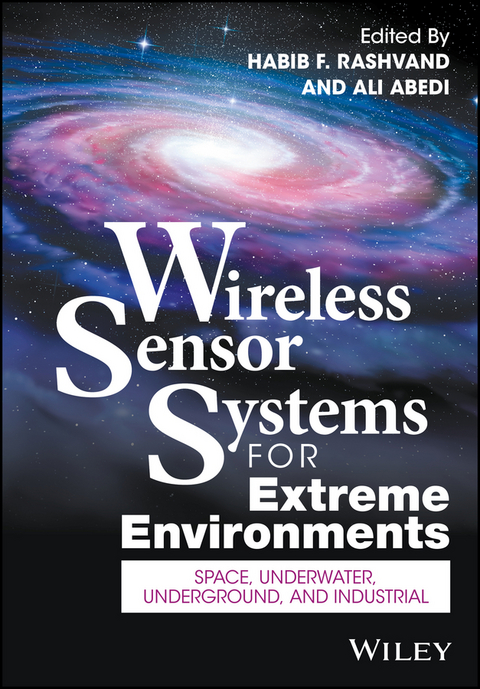
Wireless Sensor Systems for Extreme Environments (eBook)
John Wiley & Sons (Verlag)
978-1-119-12648-5 (ISBN)
Provides unique coverage of wireless sensor system applications in space, underwater, underground, and extreme industrial environments in one volume
This book covers the challenging aspects of wireless sensor systems and the problems and conditions encountered when applying them in outer space, under the water, below the ground, and in extreme industrial environments. It explores the unique aspects of designs and solutions that address those problems and challenges, and illuminates the connections, similarities, and differences between the challenges and solutions in those various environments.
The creation of Wireless Sensor Systems for Extreme Environments is a response to the spread of wireless sensor technology into fields of health, safety, manufacturing, space, environmental, smart cities, advanced robotics, surveillance, and agriculture. It is the first of its kind to present, in a single reference, the unique aspects of wireless sensor system design, development, and deployment in such extreme environments-and to explore the similarities and possible synergies between them. The application of wireless sensor systems in these varied environments has been lagging dramatically behind their application in more conventional environments, making this an especially relevant book for investigators and practitioners in all of these areas.
Wireless Sensor Systems for Extreme Environments is presented in five parts that cover:
- Wireless Sensor Systems for Extreme Environments-Generic Solutions
- Space WSS Solutions and Applications
- Underwater and Submerged WSS Solutions
- Underground and Confined Environments WSS Solutions
- Industrial and Other WSS Solutions
This book is a welcome guide for researchers, post-graduate students, engineers and scientists who design and build operational and environmental control systems, emergency response systems, and situational awareness systems for unconventional environments.
Habib F. Rashvand is Professor of Networks, Systems & Protocols and Director of Advanced Communication Systems, University of Warwick, School of Engineering, UK.
Dr. Ali Abedi is Professor of Electrical and Computer Engineering and Director of Center Undergraduate Research (CUGR) at University of Maine. He has a joint appointment at the School of Computing and Information Sciences.
Provides unique coverage of wireless sensor system applications in space, underwater, underground, and extreme industrial environments in one volume This book covers the challenging aspects of wireless sensor systems and the problems and conditions encountered when applying them in outer space, under the water, below the ground, and in extreme industrial environments. It explores the unique aspects of designs and solutions that address those problems and challenges, and illuminates the connections, similarities, and differences between the challenges and solutions in those various environments. The creation of Wireless Sensor Systems for Extreme Environments is a response to the spread of wireless sensor technology into fields of health, safety, manufacturing, space, environmental, smart cities, advanced robotics, surveillance, and agriculture. It is the first of its kind to present, in a single reference, the unique aspects of wireless sensor system design, development, and deployment in such extreme environments and to explore the similarities and possible synergies between them. The application of wireless sensor systems in these varied environments has been lagging dramatically behind their application in more conventional environments, making this an especially relevant book for investigators and practitioners in all of these areas. Wireless Sensor Systems for Extreme Environments is presented in five parts that cover: Wireless Sensor Systems for Extreme Environments Generic Solutions Space WSS Solutions and Applications Underwater and Submerged WSS Solutions Underground and Confined Environments WSS Solutions Industrial and Other WSS Solutions This book is a welcome guide for researchers, post-graduate students, engineers and scientists who design and build operational and environmental control systems, emergency response systems, and situational awareness systems for unconventional environments.
Habib F. Rashvand is Professor of Networks, Systems & Protocols and Director of Advanced Communication Systems, University of Warwick, School of Engineering, UK. Dr. Ali Abedi is Professor of Electrical and Computer Engineering and Director of Center Undergraduate Research (CUGR) at University of Maine. He has a joint appointment at the School of Computing and Information Sciences.
Chapter 1
Wireless Sensor Systems for Extreme Environments
Habib F. Rashvand1 and Ali Abedi2
1Advanced Communication Systems, University of Warwick, UK
2Department of Electrical and Computer Engineering, University of Maine, Orono, USA
Taking a new step, uttering a new word, is what people fear mostFyodor Dostoyevsky
1.1 Introduction
The last 40 years of economic and political unrest has wrought a series of drastic changes throughout the world. Many technological trends have come to a halt as new developments have taken over, surprising the experts. Amongst the successful ones are smart sensing, flourishing as a result of promises of a higher quality of life and worries about the deterioration of the climate.
Although there have been many projects throughout the world and many successful civil and industrial applications, we are still awaiting to see a real paradigm shift. As increasing resources have expanded and increased research activity, too many research reports have somehow failed to demonstrate the eye-catching industrial applications required to justify the resources being expended. To this end, we have to judge on a global scale the performance of sensors in the last 20 years; we have looked at earlier surveys [1] and analysed the economic effectiveness of the projects described. One of the main conclusions is that too many young researchers try to make their work publishable rather than practical and useful for real applications that to help improve the quality of life. As well as the few useful research activities – such as energy conservation, optimized performance, cross layering, efficient sampling, and data management – we see many trivial patterns of common networking manipulation: routing, scheduling, node replacement, mobility, and coverage under oversimplified working conditions, where simple computer simulations can generate huge volumes of inaccurate data; they are simply creating a new black hole for consuming computer resources.
Following our series of conferences on wireless technologies for space and extreme environments (WiSEE) and the associated sensor workshops we have decided that we need to direct research towards the environments that need sensors most: space and other harsh, industrial or unconventional environments.
Following Edison's problem-solving attitude when demonstrating the use of electricity to create the light to brighten our nights, we need to encourage our youth to have strong belief and true dedication. They need to enjoy creativity and achieving their objectives so that they can engineer a better quality of life. They should be solving problems, breaking the old boundaries, opening new windows of opportunity and creating new paradigms. Applying new technologies, such as wireless and ever-improving smart sensors and actuators, gives us many possibilities for creating new and much smarter technological systems and services.
To be successfully deployed, a new technology must meet four basic measures: trust, objectivity, security, and sustainability. Here, objectivity is the demand for a product or service, which in our case means overcoming unconventional working conditions, to that the working product or a system enables new services, whether in the vacuum of space, in the oceans, underground or in places with very high, very low, and highly variable temperature, humidity, winds and pressure.
The rest of this chapter is devoted to two main summary sections. Section 1.2 describes our earlier work on wireless sensor systems (WSSs) for space and other extreme environments, while Section 1.3 provides an extended summary of the remaining twenty-one chapters of the book.
1.2 Wireless Sensor Systems for Space and other Extreme Environments
This section summarises our earlier review of our work on WSSs for space and extreme environments [1]. This was based on our WSS workshop at WiSEE 2013. Our main message is this section is to analyse how to break away from conventional wireless sensor networks (WSNs) by adopting an agile heterogeneous unconventional wireless sensing (UWS) deployment system.
1.2.1 Definitions
A comparative analysis is better than a simple definition of the terms, which often can vary upon application scenarios and its working environment.
Wireless sensor networks (WSNs) are normally complex networks of large numbers of interconnected sensor nodes and clusters. A wireless sensor system (WSS), however, is a smaller-scale system of data-oriented interconnected sensing devices for extracting well-defined sensing information. The sensor nodes in WSSs are expected to be less constrained and more flexible, and therefore more adaptive and autonomous. In WSSs, use of terms such as wireless sensor and actuator networks, wireless smart intelligent sensing, wirelessly connected distributed smart sensing, and unmanaged aerial vehicle sensor networks makes sense. However, wireless underground sensor networks, underwater wireless sensor networks, wireless body-sensor mesh networks and industrial wireless sensor networks are normally more complex, and are therefore more applicable to WSNs by definition.
As heterogeneous sensing services require UWS solutions, one way to compare WSSs and WSNs is to look objectively at the purpose for which they are designed. WSS-based solutions for self-managed heterogeneous sensing services are more dynamic and practical if kept small. This is due to our basic service principles:
- conventional WSNs, normally deployed for homogenous sensing services using generic smart sensors
- unconventional WSSs, designed for dynamic, heterogeneous, UWS services using specific sensors.
UWS solutions therefore require to be kept simple and they therefore suit smaller and less complex WSSs.
1.2.2 Networking in Space and Extreme Environments
In many WSNs, the simplicity of the data collection can allow deployment of sensors on multi-service networks, in which densely distributed sensors and actuators are used for a wide range of applications. In space and extreme environments (SEEs) smart networking is needed to make this process more efficient, and so it can benefit from the low-cost, low-power operation of networks. For example, a multi-timescale adaptation routing protocol can use multi-timescale estimation to minimize variation of packet transmission times by calculating the mean and variance. Another example is the deployment of distributed radar sensor networks (RSNs), grouped together in an intelligent cluster network in an ad hoc fashion. These can then provide spatial resilience for target detection and tracking. Such RSNs may be used for tactical combat systems deployed on airborne, surface, and subsurface unmanned vehicles in order to protect critical infrastructure.
1.2.3 Node Synchronization in SEEs
Management aspects of WSNs for time synchronization and cooperative collaboration of the nodes is important in SEEs. Techniques such as the sliding clock synchronization protocol is used for time synchronization under extreme temperatures. The key aspect of this protocol is a central node that periodically sends time synchronization signals. Then, the node measures the time between two consecutive signals as well as the locally measured time, from which it can determine and rectify any possible errors.
Another good example is creation of an ultra-reliable WSN that will never stop monitoring, even in extreme conditions, and does not require maintenance. Such a system can detect a failing sensor node through a dynamic routing protocol, enabling other nodes to take over the function being carried out by the dead node.
1.2.4 Spectrum Sharing in SEEs
In space, the demand for spectrum is huge, particularly where the safety of personnel and the reliability of control systems are heavily dependent on wireless sensors such as:
- structural health
- impact detection and location
- leak detection and localization.
Robust and reliable dynamic spectrum-sharing schemes are needed. In order to make use of spectrum-sharing in space, we need to make modify systems used in terrestrial networks, in which, for example, errors in spectrum sensing are unavoidable but which often lack incentives for primary users to allow network access to secondary users.
1.2.5 Energy Aspects in SEE
Medium access control (MAC) plays a crucial role in providing energy-efficient and low-delay communications for WSNs. Sensing systems designed for operation in space or underwater face additional challenges, notably long and potentially variable propagation delays, which severely inhibit the throughput capability and delay performance of conventional MAC schemes. Outages due to energy shortages and adverse propagation conditions also pose significant problems. We now examine similar challenges associated with reliable and efficient multiple access in SEEs, focusing on underwater sensing systems.
The use of energy-harvesting technology has important implications for medium access, since uncertainty surrounding the future availability of energy makes it difficult to arrange reliable duty-cycles, schedules or back-off times in the traditional way. The challenges associated with long propagation delays are well understood for satellite systems. Demand assignment multiple access is commonly employed as a means of achieving high channel utilization, since capacity can be allocated to nodes in response to time-varying requirements.
1.3 Chapter Abstracts
The chapters for...
| Erscheint lt. Verlag | 9.6.2017 |
|---|---|
| Sprache | englisch |
| Themenwelt | Technik ► Elektrotechnik / Energietechnik |
| Technik ► Nachrichtentechnik | |
| Schlagworte | Ali Abedi • Communication Technology - Networks • confined environments WSS solutions • Drahtlose Kommunikation • Electrical & Electronics Engineering • Elektrotechnik u. Elektronik • Habib F. Rashvand • industrial wireless sensor systems • industrial WSS solutions • Kommunikationsnetz • Kommunikationsnetze • Mobile & Wireless Communications • Sensor • Sensoren, Instrumente u. Messung • Sensors, Instrumentation & Measurement • Sensortechnik • space WSS solutions • submerged WSS solutions • telecommunications • Underground and Industrial • underground wireless sensor systems • underground WSS solutions • underwater • underwater wireless sensor systems • underwater WSS solutions • wireless sensor applications • wireless sensor networks • wireless sensors • wireless sensor systems • wireless sensor systems for extreme environments • Wireless Sensor Systems for Extreme Environments: Space • wireless sensor systems in space • wireless sensor technology • Wireless systems • WSS for extreme environments • WSS space applications |
| ISBN-10 | 1-119-12648-7 / 1119126487 |
| ISBN-13 | 978-1-119-12648-5 / 9781119126485 |
| Informationen gemäß Produktsicherheitsverordnung (GPSR) | |
| Haben Sie eine Frage zum Produkt? |
 EPUB (Adobe DRM)
Kopierschutz: Adobe-DRM
Adobe-DRM ist ein Kopierschutz, der das eBook vor Mißbrauch schützen soll. Dabei wird das eBook bereits beim Download auf Ihre persönliche Adobe-ID autorisiert. Lesen können Sie das eBook dann nur auf den Geräten, welche ebenfalls auf Ihre Adobe-ID registriert sind.
Details zum Adobe-DRM
Dateiformat: EPUB (Electronic Publication)
EPUB ist ein offener Standard für eBooks und eignet sich besonders zur Darstellung von Belletristik und Sachbüchern. Der Fließtext wird dynamisch an die Display- und Schriftgröße angepasst. Auch für mobile Lesegeräte ist EPUB daher gut geeignet.
Systemvoraussetzungen:
PC/Mac: Mit einem PC oder Mac können Sie dieses eBook lesen. Sie benötigen eine
eReader: Dieses eBook kann mit (fast) allen eBook-Readern gelesen werden. Mit dem amazon-Kindle ist es aber nicht kompatibel.
Smartphone/Tablet: Egal ob Apple oder Android, dieses eBook können Sie lesen. Sie benötigen eine
Geräteliste und zusätzliche Hinweise
Buying eBooks from abroad
For tax law reasons we can sell eBooks just within Germany and Switzerland. Regrettably we cannot fulfill eBook-orders from other countries.
aus dem Bereich