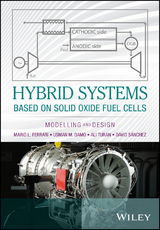
A comprehensive guide to the modelling and design of solid oxide fuel cell hybrid power plants
This book explores all technical aspects of solid oxide fuel cell (SOFC) hybrid systems and proposes solutions to a range of technical problems that can arise from component integration. Following a general introduction to the state-of-the-art in SOFC hybrid systems, the authors focus on fuel cell technology, including the components required to operate with standard fuels. Micro-gas turbine (mGT) technology for hybrid systems is discussed, with special attention given to issues related to the coupling of SOFCs with mGTs. Throughout the book emphasis is placed on dynamic issues, including control systems used to avoid risk conditions.
With an eye to mitigating the high costs and risks incurred with the building and use of prototype hybrid systems, the authors demonstrate a proven, economically feasible approach to obtaining important experimental results using simplified plants that simulate both generic and detailed system-level behaviour using emulators. Computational models and experimental plants are developed to support the analysis of SOFC hybrid systems, including models appropriate for design, development and performance analysis at both component and system levels.
- Presents models for a range of size units, technology variations, unit coupling dynamics and start-up and shutdown behaviours
- Focuses on SOFCs integration with mGTs in light of key constraints and risk avoidance issues under steady-state conditions and during transient operations
- Identifies interaction and coupling problems within the GT/SOFC environment, including exergy analysis and optimization
- Demonstrates an economical approach to obtaining important experimental results while avoiding high-cost components and risk conditions
- Presents analytical/computational and experimental tools for the efficient design and development of hardware and software systems
Hybrid Systems Based on Solid Oxide Fuel Cells: Modelling and Design is a valuable resource for researchers and practicing engineers involved in fuel cell fundamentals, design and development. It is also an excellent reference for academic researchers and advanced-level students exploring fuel cell technology.
MARIO L. FERRARI is Associate Professor in the Dipartimento di Ingeneria Meccanica, Energetica, Gestionale ed dei Trasporti (DIME) of the University of Genova, Italy.
USMAN M. DAMO is at the School of Mechanical, Aerospace and Civil Engineering, The University of Manchester, UK, as a Research Associate.
ALI TURAN is a Professor and chair holder in the thermodynamics of power generation and propulsion at the University of Manchester, UK.
DAVID SÁNCHEZ is currently a Professor in Energy Systems and Turbomachinery in the Department of Energy Engineering at the University of Seville, Spain.
A comprehensive guide to the modelling and design of solid oxide fuel cell hybrid power plants This book explores all technical aspects of solid oxide fuel cell (SOFC) hybrid systems and proposes solutions to a range of technical problems that can arise from component integration. Following a general introduction to the state-of-the-art in SOFC hybrid systems, the authors focus on fuel cell technology, including the components required to operate with standard fuels. Micro-gas turbine (mGT) technology for hybrid systems is discussed, with special attention given to issues related to the coupling of SOFCs with mGTs. Throughout the book emphasis is placed on dynamic issues, including control systems used to avoid risk conditions. With an eye to mitigating the high costs and risks incurred with the building and use of prototype hybrid systems, the authors demonstrate a proven, economically feasible approach to obtaining important experimental results using simplified plants that simulate both generic and detailed system-level behaviour using emulators. Computational models and experimental plants are developed to support the analysis of SOFC hybrid systems, including models appropriate for design, development and performance analysis at both component and system levels. Presents models for a range of size units, technology variations, unit coupling dynamics and start-up and shutdown behaviours Focuses on SOFCs integration with mGTs in light of key constraints and risk avoidance issues under steady-state conditions and during transient operations Identifies interaction and coupling problems within the GT/SOFC environment, including exergy analysis and optimization Demonstrates an economical approach to obtaining important experimental results while avoiding high-cost components and risk conditions Presents analytical/computational and experimental tools for the efficient design and development of hardware and software systems Hybrid Systems Based on Solid Oxide Fuel Cells: Modelling and Design is a valuable resource for researchers and practicing engineers involved in fuel cell fundamentals, design and development. It is also an excellent reference for academic researchers and advanced-level students exploring fuel cell technology.
MARIO L. FERRARI is Associate Professor in the Dipartimento di Ingeneria Meccanica, Energetica, Gestionale ed dei Trasporti (DIME) of the University of Genova, Italy. USMAN M. DAMO is at the School of Mechanical, Aerospace and Civil Engineering, The University of Manchester, UK, as a Research Associate. ALI TURAN is a Professor and chair holder in the thermodynamics of power generation and propulsion at the University of Manchester, UK. DAVID SÁNCHEZ is currently a Professor in Energy Systems and Turbomachinery in the Department of Energy Engineering at the University of Seville, Spain.
Cover 1
Title Page 5
Copyright 6
Contents 7
Preface 13
Acknowledgements 17
Chapter 1 Introduction 19
1.1 World Population Growth, Energy Demand and its Future 19
1.2 World Energy Future 21
1.3 Introduction to Fuel Cells and Associated Terms 24
1.3.1 Background for Fuel Cells and Thermodynamic Principles 24
1.3.2 Solid Oxide Fuel Cells (SOFCs) 29
1.3.2.1 Electrolyte 31
1.3.2.2 Anode 31
1.3.2.3 Cathode 32
1.3.2.4 Interconnector 32
1.3.3 Fuel Cell Reactions 33
1.3.4 Fuel Cell Performance 33
1.3.5 Pressure and Concentration Effects 36
1.3.6 Irreversibilities in Fuel Cells 37
1.3.7 Fuel Cell Applications 41
1.3.7.1 Transportation Applications 41
1.3.7.2 Portable Electronic Equipment 42
1.4 Gas Turbines 42
1.4.1 Background of Gas Turbines 42
1.5 Coupling of Microturbines with Fuel Cells to Obtain 'Hybrid Systems' 43
1.5.1 Active Hybrid Systems Research Groups 47
1.6 Conclusions 47
References 47
Chapter 2 SOFC Technology 51
2.1 Basic Aspects of Solid Oxide Fuel Cells 51
2.2 SOFC Types 53
2.2.1 High-temperature SOFCs 53
2.2.2 Intermediate/Low-temperature SOFCs 53
2.3 Materials for SOFCs 54
2.4 Different SOFC Geometries 56
2.4.1 Tubular SOFCs 57
2.4.1.1 Electrical Conduction Around the Tube 58
2.4.1.2 Electrical Conduction Along the Tube 58
2.4.1.3 Segmented-in-series Tubular SOFCs 58
2.4.2 Planar SOFCs 59
2.5 SOFC Stacks 61
2.6 Effect of Pressurization for SOFCs 62
2.7 Fuel Processing for SOFCs 63
2.7.1 Processing for Gas and Liquid Fuels 64
2.7.1.1 Steam Reforming 64
2.7.1.2 Partial Oxidation 65
2.7.1.3 Autothermal Reforming 65
2.7.2 Processing for Solid Fuels 66
2.7.2.1 Syngas Treatment 67
2.8 SOFC Applications in Hybrid Systems 67
2.8.1 Atmospheric SOFC Hybrid Systems 68
2.8.2 Pressurized SOFC Hybrid Systems 69
2.9 Aspects Related to SOFC Reliability, Degradation and Costs 70
2.10 Conclusions 72
2.11 Questions 72
References 73
Chapter 3 Micro Gas Turbine Technology 77
3.1 Fundamentals of the Brayton Cycle 77
3.1.1 The Simple Cycle 77
3.1.2 The Simple Recuperative Cycle 86
3.1.3 The Intercooled and Reheat Brayton Cycles 92
3.1.4 The Intercooled and Reheat, Recuperative Brayton Cycle 97
3.1.5 Cycle Layouts used by Contemporary Micro Gas Turbines 102
3.2 Turbomachinery 103
3.2.1 General Considerations on the Selection of Turbomachinery for Micro Gas Turbines 103
3.2.2 Fundamentals of Radial Compressor Design and Performance 107
3.2.3 Some Notes on Compressor Surge 119
3.2.4 Fundamentals of Radial Turbine Design and Performance 123
3.2.5 Scaling of Radial Turbomachinery 131
3.3 Recuperative Heat Exchanger 133
3.4 Bearings 142
3.5 Conclusions: Commercial Status and Areas of Research 149
3.6 Questions and Exercises 152
References 153
Chapter 4 SOFC/mGT Coupling 159
4.1 Basic Aspects of SOFC Hybridization 159
4.2 SOFC Coupling with Traditional Power Plants 161
4.2.1 Coupling with Steam Power Plants 161
4.2.2 Coupling with Gas Turbines 162
4.2.3 Coupling with Combined Cycle-based Plants 164
4.3 Beneficial Attributes Related to SOFC/mGT Coupling 165
4.4 Constraints Related to SOFC/mGT Coupling 168
4.4.1 Turbine System Constraints 170
4.4.2 SOFC System Constraints 174
4.4.3 Control System Constraints 176
4.5 Design and Off-design Aspects 177
4.5.1 Design Aspects 177
4.5.2 Off-design Aspects 179
4.6 Issues Related to Dynamic Aspects 181
4.7 Main Prototypes Developed for SOFC Hybrid Systems 184
4.7.1 Prototype by Siemens-Westinghouse 185
4.7.2 Prototype by Mitsubishi Heavy Industries 187
4.7.3 Prototype by Rolls-Royce Fuel Cell Systems 188
4.8 Conclusions 189
4.9 Questions and Exercises 191
References 192
Chapter 5 Computational Models for Hybrid Systems 201
5.1 Introduction 201
5.2 Steady-state Models for Hybrid Systems 203
5.3 Computational Models for Hybrid Systems: Modelling Steps 204
5.3.1 Computational Models for Hybrid Systems at the Component Level 208
5.3.2 Prediction of Performance of Gas Turbines 209
5.3.3 Off-design Operation of the Single-shaft Gas Turbine 210
5.3.4 Off-design Calculation with 'Complex' Layout Turbines 214
5.3.4.1 Equilibrium Running of a Gas Generator 214
5.3.4.2 Off-design Operation of a Free Turbine Engine 215
5.4 System Modelling 218
5.4.1 Reformer 219
5.4.2 SOFC Module 223
5.4.3 Overpotentials 225
5.4.4 Fuel and Air Supply Calculations 226
5.4.5 Combustor 227
5.4.6 Turbine 228
5.4.7 Compressor 229
5.4.8 Recuperator 229
5.5 Results and Discussion 230
5.6 Dynamic Models 231
5.7 Model Validation 234
5.8 Conclusion 235
5.9 Questions and Exercises 236
References 236
Chapter 6 Experimental Emulation Facilities 243
6.1 Experimental Emulation Facilities 243
6.2 Reduced-scale Test Facilities 244
6.2.1 Anodic Recirculation Test Rig 245
6.2.2 Cathodic Loop Test Rig 247
6.3 Actual-scale Test Facilities 250
6.3.1 Low-temperature Rigs 251
6.3.1.1 Surge Test Rig 251
6.3.1.2 Emulation Rig for Tests on Control Components 253
6.3.2 High-temperature Rigs 254
6.3.2.1 Emulator by the US Department of Energy - NETL 254
6.3.2.2 Emulator by the University of Genoa - TPG 256
6.3.2.3 Emulator by the DLR 262
6.4 Conclusions 265
6.5 Questions and Exercises 265
References 267
Chapter 7 Problems and Solutions for Future Hybrid Systems 273
7.1 The Future of Micro Power Generation Systems 274
7.2 The Future of Hybrid Systems: Hydrogen as an Energy Carrier 276
7.2.1 Hydro-methane and Hydrogen-rich Fuel Mixtures 277
7.3 Future Hybrid Systems: Design, Optimization and Sizing 278
7.3.1 Hybrid Systems Sizing Techniques 279
7.3.2 Hybrid System Sizing Simulation Tools 280
7.4 Cost Analysis of Hybrid Systems for Power Generation Applications 282
7.5 Performance Degradation Problems in Solid Oxide Fuel Cells 286
7.6 Turbomachinery Problems 287
7.7 Dynamic and Control System Aspects 289
7.8 CO2 Separation Technologies for SOFC Hybrid Plants 290
7.9 Coal and Biofuel for Hybrid Systems 291
7.10 Conclusions 293
References 293
Glossary 303
Index 325
EULA 344
In summary, this book provides comprehensive information and guidelines on the design and modeling of hybrid SOFC and gas turbine systems. Researchers, scientists, and engineers who are interested in developing such a hybrid system or carrying out new research in the area of integrated fuel cell systems will definitely get valuable information from this book. This book could also be effectively used as a reference book in some graduate level courses in energy conversion and fuel cell technology. There are also very interesting questions and exercises found at the end of the chapters, which could be given as assignments to students. In conclusion, I recommend this book as a unique source of information on the hybrid SOFC and gas turbine systems.
-Dr. Can Ozgur Colpan, Dokuz Eylul University, Izmir, Turkey
| Erscheint lt. Verlag | 12.6.2017 |
|---|---|
| Sprache | englisch |
| Themenwelt | Naturwissenschaften ► Physik / Astronomie |
| Technik ► Elektrotechnik / Energietechnik | |
| Schlagworte | Batterien u. Brennstoffzellen • Batteries & Fuel Cells • Brennstoffzelle • Chemie • Chemistry • Energie • Energietechnik • Energy • fuel cells for hybrid systems • Fuel Cell Technology • hybrid systems based on solid oxide fuel cells analysis • hybrid systems using solid oxide fuel cells • Hydrogen, Batteries & Fuel Cells • <p>fuel cells • micro-gas turbine technology for hybrid systems • modelling hybrid systems based on solid oxide fuel cells • Power Technology & Power Engineering • problems with solid oxide fuel cell hybrids</p> • sofc design • sofc hybrid systems • sofc modelling • solid oxide fuel cell analysis • solid oxide fuel cell computational analysis • solid oxide fuel cell design • solid oxide fuel cell hybrid system prototyping • solid oxide fuel cell hybrid systems • solid oxide fuel cell/micro-gas turbine coupling in hybrid systems • solid oxide fuel cell modelling • Solid Oxide Fuel Cells • Wasserstoff, Batterien u. Brennstoffzellen |
| ISBN-10 | 1-119-03906-1 / 1119039061 |
| ISBN-13 | 978-1-119-03906-8 / 9781119039068 |
| Informationen gemäß Produktsicherheitsverordnung (GPSR) | |
| Haben Sie eine Frage zum Produkt? |
 PDF (Adobe DRM)
Kopierschutz: Adobe-DRM
Adobe-DRM ist ein Kopierschutz, der das eBook vor Mißbrauch schützen soll. Dabei wird das eBook bereits beim Download auf Ihre persönliche Adobe-ID autorisiert. Lesen können Sie das eBook dann nur auf den Geräten, welche ebenfalls auf Ihre Adobe-ID registriert sind.
Details zum Adobe-DRM
Dateiformat: PDF (Portable Document Format)
Mit einem festen Seitenlayout eignet sich die PDF besonders für Fachbücher mit Spalten, Tabellen und Abbildungen. Eine PDF kann auf fast allen Geräten angezeigt werden, ist aber für kleine Displays (Smartphone, eReader) nur eingeschränkt geeignet.
Systemvoraussetzungen:
PC/Mac: Mit einem PC oder Mac können Sie dieses eBook lesen. Sie benötigen eine
eReader: Dieses eBook kann mit (fast) allen eBook-Readern gelesen werden. Mit dem amazon-Kindle ist es aber nicht kompatibel.
Smartphone/Tablet: Egal ob Apple oder Android, dieses eBook können Sie lesen. Sie benötigen eine
Geräteliste und zusätzliche Hinweise
Buying eBooks from abroad
For tax law reasons we can sell eBooks just within Germany and Switzerland. Regrettably we cannot fulfill eBook-orders from other countries.
aus dem Bereich