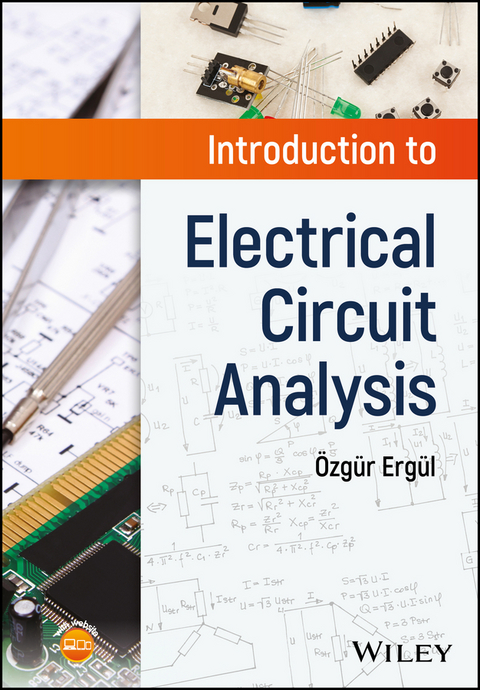
Introduction to Electrical Circuit Analysis (eBook)
John Wiley & Sons (Verlag)
978-1-119-28491-8 (ISBN)
A concise and original presentation of the fundamentals for 'new to the subject' electrical engineers
This book has been written for students on electrical engineering courses who don't necessarily possess prior knowledge of electrical circuits. Based on the author's own teaching experience, it covers the analysis of simple electrical circuits consisting of a few essential components using fundamental and well-known methods and techniques. Although the above content has been included in other circuit analysis books, this one aims at teaching young engineers not only from electrical and electronics engineering, but also from other areas, such as mechanical engineering, aerospace engineering, mining engineering, and chemical engineering, with unique pedagogical features such as a puzzle-like approach and negative-case examples (such as the unique 'When Things Go Wrong...' section at the end of each chapter). Believing that the traditional texts in this area can be overwhelming for beginners, the author approaches his subject by providing numerous examples for the student to solve and practice before learning more complicated components and circuits. These exercises and problems will provide instructors with in-class activities and tutorials, thus establishing this book as the perfect complement to the more traditional texts.
- All examples and problems contain detailed analysis of various circuits, and are solved using a 'recipe' approach, providing a code that motivates students to decode and apply to real-life engineering scenarios
- Covers the basic topics of resistors, voltage and current sources, capacitors and inductors, Ohm's and Kirchhoff's Laws, nodal and mesh analysis, black-box approach, and Thevenin/Norton equivalent circuits for both DC and AC cases in transient and steady states
- Aims to stimulate interest and discussion in the basics, before moving on to more modern circuits with higher-level components
- Includes more than 130 solved examples and 120 detailed exercises with supplementary solutions
- Accompanying website to provide supplementary materials www.wiley.com/go/ergul4412
By Özgür Ergül, Associate Professor, Middle East Technical University, Ankara, Turkey
A concise and original presentation of the fundamentals for new to the subject electrical engineers This book has been written for students on electrical engineering courses who don t necessarily possess prior knowledge of electrical circuits. Based on the author s own teaching experience, it covers the analysis of simple electrical circuits consisting of a few essential components using fundamental and well-known methods and techniques. Although the above content has been included in other circuit analysis books, this one aims at teaching young engineers not only from electrical and electronics engineering, but also from other areas, such as mechanical engineering, aerospace engineering, mining engineering, and chemical engineering, with unique pedagogical features such as a puzzle-like approach and negative-case examples (such as the unique When Things Go Wrong section at the end of each chapter). Believing that the traditional texts in this area can be overwhelming for beginners, the author approaches his subject by providing numerous examples for the student to solve and practice before learning more complicated components and circuits. These exercises and problems will provide instructors with in-class activities and tutorials, thus establishing this book as the perfect complement to the more traditional texts. All examples and problems contain detailed analysis of various circuits, and are solved using a recipe approach, providing a code that motivates students to decode and apply to real-life engineering scenarios Covers the basic topics of resistors, voltage and current sources, capacitors and inductors, Ohm s and Kirchhoff s Laws, nodal and mesh analysis, black-box approach, and Thevenin/Norton equivalent circuits for both DC and AC cases in transient and steady states Aims to stimulate interest and discussion in the basics, before moving on to more modern circuits with higher-level components Includes more than 130 solved examples and 120 detailed exercises with supplementary solutions Accompanying website to provide supplementary materials www.wiley.com/go/ergul4412
By Özgür Ergül, Associate Professor, Middle East Technical University, Ankara, Turkey
Cover 1
Title Page 5
Copyright 6
Dedication 7
Contents 9
Important Units 13
Conventions with Examples 15
Preface 17
About the Companion Website 21
Chapter 1 Introduction 23
1.1 Circuits and Important Quantities 23
1.1.1 Electric Charge 23
1.1.2 Electric Potential (Voltage) 25
1.1.3 Electric Current 26
1.1.4 Electric Voltage and Current in Electrical Circuits 27
1.1.5 Electric Energy and Power of a Component 28
1.1.6 DC and AC Signals 29
1.1.7 Transient State and Steady State 30
1.1.8 Frequency in Circuits 31
1.2 Resistance and Resistors 31
1.2.1 Current Types, Conductance, and Ohm's Law 32
1.2.2 Good Conductors and Insulators 32
1.2.3 Semiconductors 33
1.2.4 Superconductivity and Perfect Conductivity 33
1.2.5 Resistors as Circuit Components 34
1.3 Independent Sources 35
1.4 Dependent Sources 36
1.5 Basic Connections of Components 37
1.6 Limitations in Circuit Analysis 41
1.7 What You Need to Know before You Continue 42
Chapter 2 Basic Tools: Kirchhoff's Laws 45
2.1 Kirchhoff's Current Law 45
2.2 Kirchhoff's Voltage Law 46
2.3 When Things Go Wrong with KCL and KVL 58
2.4 Series and Parallel Connections of Resistors 62
2.4.1 Series Connection 62
2.4.2 Parallel Connection 63
2.5 When Things Go Wrong with Series/Parallel Resistors 67
2.6 What You Need to Know before You Continue 68
Chapter 3 Analysis of Resistive Networks: Nodal Analysis 69
3.1 Application of Nodal Analysis 69
3.2 Concept of Supernode 81
3.3 Circuits with Multiple Independent Voltage Sources 94
3.4 Solving Challenging Problems Using Nodal Analysis 96
3.5 When Things Go Wrong with Nodal Analysis 108
3.6 What You Need to Know before You Continue 112
Chapter 4 Analysis of Resistive Networks: Mesh Analysis 115
4.1 Application of Mesh Analysis 115
4.2 Concept of Supermesh 129
4.3 Circuits with Multiple Independent Current Sources 143
4.4 Solving Challenging Problems Using the Mesh Analysis 144
4.5 When Things Go Wrong with Mesh Analysis 157
4.6 What You Need to Know before You Continue 159
Chapter 5 Black-Box Concept 161
5.1 Thévenin and Norton Equivalent Circuits 161
5.2 Maximum Power Transfer 180
5.3 Shortcuts in Equivalent Circuits 195
5.4 When Things Go Wrong with Equivalent Circuits 198
5.5 What You Need to Know before You Continue 200
Chapter 6 Transient Analysis 203
6.1 Capacitance and Capacitors 203
6.2 Inductance and Inductors 213
6.3 Time-Dependent Analysis of Circuits in Transient State 217
6.3.1 Time-Dependent Analysis of RC Circuits 217
6.3.2 Time-Dependent Analysis of RL Circuits 226
6.3.3 Impossible Cases 229
6.4 Switching and Fixed-Time Analysis 230
6.5 Parallel and Series Connections of Capacitors and Inductors 240
6.5.1 Connections of Capacitors 240
6.5.2 Connections of Inductors 242
6.6 When Things Go Wrong in Transient Analysis 244
6.7 What You Need to Know before You Continue 246
Chapter 7 Steady-State Analysis of Time-Harmonic Circuits 249
7.1 Steady-State Concept 249
7.2 Time-Harmonic Circuits with Sinusoidal Sources 250
7.2.1 Resistors Connected to Sinusoidal Sources 251
7.2.2 Capacitors Connected to Sinusoidal Sources 252
7.2.3 Inductors Connected to Sinusoidal Sources 253
7.2.4 Root-Mean-Square Concept 254
7.3 Concept of Phasor Domain and Component Transformation 256
7.3.1 Resistors in Phasor Domain 258
7.3.2 Capacitors in Phasor Domain 258
7.3.3 Inductors in Phasor Domain 259
7.3.4 Impedance Concept 260
7.4 Special Circuits in Phasor Domain 265
7.4.1 RC Circuits in Phasor Domain 265
7.4.2 RL Circuits in Phasor Domain 266
7.4.3 RLC Circuits in Phasor Domain 268
7.4.4 Other Combinations 269
7.5 Analysis of Complex Circuits at Fixed Frequencies 270
7.6 Power in Steady State 281
7.6.1 Instantaneous and Average Power 281
7.6.2 Complex Power 282
7.6.3 Impedance Matching 288
7.7 When Things Go Wrong in Steady-State Analysis 293
7.8 What You Need to Know before You Continue 296
Chapter 8 Selected Components of Modern Circuits 297
8.1 When Connections Are via Magnetic Fields: Transformers 297
8.2 When Components Behave Differently from Two Sides: Diodes 300
8.3 When Components Involve Many Connections: OP-AMPs 306
8.4 When Circuits Become Modern: Transistors 310
8.5 When Components Generate Light: LEDs 315
8.6 Conclusion 316
Chapter 9 Practical Technologies in Modern Circuits 317
9.1 Measurement Instruments 317
9.2 Three-Phase Power Delivery 319
9.3 AD and DA Converters 322
9.4 Logic Gates 325
9.5 Memory Units 329
9.6 Conclusion 331
Chapter 10 Next Steps 333
10.1 Energy Is Conserved, Always! 333
10.2 Divide and Conquer Complex Circuits 335
10.3 Appreciate the Package 336
10.4 Consider Yourself as a Circuit Element 338
10.5 Safety First 339
Chapter 11 Photographs of Some Circuit Elements 343
Appendix A 347
A.1 Basic Algebra Identities 347
A.2 Trigonometry 347
A.3 Complex Numbers 347
Appendix B Solutions to Exercises 349
Chapter 1 349
Chapter 2 349
Chapter 3 353
Chapter 4 368
Chapter 5 382
Chapter 6 400
Chapter 7 407
Chapter 8 416
Index 423
EULA 425
| Erscheint lt. Verlag | 3.5.2017 |
|---|---|
| Sprache | englisch |
| Themenwelt | Naturwissenschaften ► Physik / Astronomie |
| Technik ► Elektrotechnik / Energietechnik | |
| Schlagworte | basic circuit analysis<br />electrical circuits for beginners<br />introduction to electrical circuit analysis • Circuit Theory & Design • Electrical & Electronics Engineering • Electric Power Electronics • Elektrotechnik • Elektrotechnik u. Elektronik • Energie • Energy • Leistungselektronik • Schaltkreise - Theorie u. Entwurf • Schaltkreistechnik |
| ISBN-10 | 1-119-28491-0 / 1119284910 |
| ISBN-13 | 978-1-119-28491-8 / 9781119284918 |
| Informationen gemäß Produktsicherheitsverordnung (GPSR) | |
| Haben Sie eine Frage zum Produkt? |
 PDF (Adobe DRM)
Kopierschutz: Adobe-DRM
Adobe-DRM ist ein Kopierschutz, der das eBook vor Mißbrauch schützen soll. Dabei wird das eBook bereits beim Download auf Ihre persönliche Adobe-ID autorisiert. Lesen können Sie das eBook dann nur auf den Geräten, welche ebenfalls auf Ihre Adobe-ID registriert sind.
Details zum Adobe-DRM
Dateiformat: PDF (Portable Document Format)
Mit einem festen Seitenlayout eignet sich die PDF besonders für Fachbücher mit Spalten, Tabellen und Abbildungen. Eine PDF kann auf fast allen Geräten angezeigt werden, ist aber für kleine Displays (Smartphone, eReader) nur eingeschränkt geeignet.
Systemvoraussetzungen:
PC/Mac: Mit einem PC oder Mac können Sie dieses eBook lesen. Sie benötigen eine
eReader: Dieses eBook kann mit (fast) allen eBook-Readern gelesen werden. Mit dem amazon-Kindle ist es aber nicht kompatibel.
Smartphone/Tablet: Egal ob Apple oder Android, dieses eBook können Sie lesen. Sie benötigen eine
Geräteliste und zusätzliche Hinweise
Buying eBooks from abroad
For tax law reasons we can sell eBooks just within Germany and Switzerland. Regrettably we cannot fulfill eBook-orders from other countries.
aus dem Bereich