Submerged Landscapes of the European Continental Shelf (eBook)
John Wiley & Sons (Verlag)
978-1-118-92771-7 (ISBN)
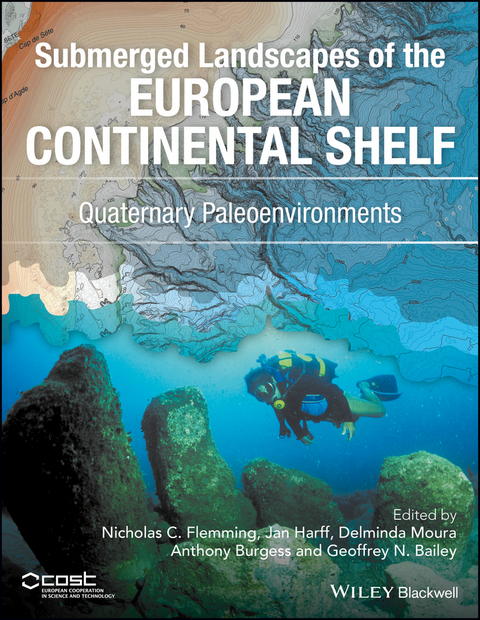
Quaternary Paleoenvironments examines the drowned landscapes exposed as extensive and attractive territory for prehistoric human settlement during the Ice Ages of the Pleistocene, when sea levels dropped to 120m-135m below their current levels. This volume provides an overview of the geological, geomorphological, climatic and sea-level history of the European continental shelf as a whole, as well as a series of detailed regional reviews for each of the major sea basins. The nature and variable attractions of the landscapes and resources available for human exploitation are examined, as are the conditions under which archaeological sites and landscape features are likely to have been preserved, destroyed or buried by sediment during sea-level rise. The authors also discuss the extent to which we can predict where to look for drowned landscapes with the greatest chance of success, with frequent reference to examples of preserved prehistoric sites in different submerged environments.
Quaternary Paleoenvironments will be of interest to archaeologists, geologists, marine scientists, palaeoanthropologists, cultural heritage managers, geographers, and all those with an interest in the drowned landscapes of the continental shelf.Nicholas C. Flemming has studied submerged terrestrial archaeological sites and changes of sea level for more than 50 years, and is the author of several books and papers on the subject. He is a Visiting Research Fellow at the National Oceanography Centre, Southampton, a Fellow of the Society of Antiquaries of London, a Fellow of the Society for Underwater Technology, and a Vice-President of the Nautical Archaeology Society.
Jan Harff is Professor of Geosciences and Seafloor Geology at the University of Szczecin, Poland. He collaborates with marine research institutes in the Baltic area and Scandinavia, Russia, the United States and China. He coordinated (together with Friedrich Lüth) the research project SINCOS (Sinking Coasts - Geosphere, Ecosphere and Anthroposphere of the Holocene Southern Baltic Sea), and chaired Working Group 2 ('Environmental Data and Reconstruction') of the COST Action TD0902: SPLASHCOS.
Delminda Moura is a geologist at the Universidade do Algarve- Centre for Marine and Environmental Research (CIMA), Portugal, conducting research on landscape evolution during the Quaternary, as forced by climatic and sea-level changes. She devotes particular attention to the use of morphological, sedimentological and biological proxies to reconstruct past sea levels.
Anthony Burgess graduated in 1996 from the University of Wales (Swansea), and then joined the Home Office, working as a crime analyst until 2008. After leaving the Home Office and enjoying an extended period of travel, he completed his masters in maritime archaeology at the University of Southampton, and is currently a PhD candidate in Archaeology at the University of Malta.
Geoffrey N. Bailey is Anniversary Professor of Archaeology in the University of York, and Chairman of the EU-funded SPLASHCOS programme. His research interests are in coastal prehistory, submerged landscapes and Quaternary-scale environmental change, and he has engaged in major projects on these themes in Australia, Africa, Greece, Saudi Arabia and the UK, most recently as Principal Investigator of the European Research Council DISPERSE Project, concerned with the role of geologically unstable landscapes and coastal environments in patterns of early human dispersal in Africa, the Red Sea and the Arabian Peninsula. He is a Fellow of the Society of Antiquaries of London, a member of Academia Europaea, and President of the UISPP Commission on Coastal Prehistory and Submerged Landscapes.
Quaternary Paleoenvironments examines the drowned landscapes exposed as extensive and attractive territory for prehistoric human settlement during the Ice Ages of the Pleistocene, when sea levels dropped to 120m-135m below their current levels. This volume provides an overview of the geological, geomorphological, climatic and sea-level history of the European continental shelf as a whole, as well as a series of detailed regional reviews for each of the major sea basins. The nature and variable attractions of the landscapes and resources available for human exploitation are examined, as are the conditions under which archaeological sites and landscape features are likely to have been preserved, destroyed or buried by sediment during sea-level rise. The authors also discuss the extent to which we can predict where to look for drowned landscapes with the greatest chance of success, with frequent reference to examples of preserved prehistoric sites in different submerged environments. Quaternary Paleoenvironments will be of interest to archaeologists, geologists, marine scientists, palaeoanthropologists, cultural heritage managers, geographers, and all those with an interest in the drowned landscapes of the continental shelf.
Nicholas C. Flemming has studied submerged terrestrial archaeological sites and changes of sea level for more than 50 years, and is the author of several books and papers on the subject. He is a Visiting Research Fellow at the National Oceanography Centre, Southampton, a Fellow of the Society of Antiquaries of London, a Fellow of the Society for Underwater Technology, and a Vice-President of the Nautical Archaeology Society. Jan Harff is Professor of Geosciences and Seafloor Geology at the University of Szczecin, Poland. He collaborates with marine research institutes in the Baltic area and Scandinavia, Russia, the United States and China. He coordinated (together with Friedrich Lüth) the research project SINCOS (Sinking Coasts - Geosphere, Ecosphere and Anthroposphere of the Holocene Southern Baltic Sea), and chaired Working Group 2 ("Environmental Data and Reconstruction") of the COST Action TD0902: SPLASHCOS. Delminda Moura is a geologist at the Universidade do Algarve- Centre for Marine and Environmental Research (CIMA), Portugal, conducting research on landscape evolution during the Quaternary, as forced by climatic and sea-level changes. She devotes particular attention to the use of morphological, sedimentological and biological proxies to reconstruct past sea levels. Anthony Burgess graduated in 1996 from the University of Wales (Swansea), and then joined the Home Office, working as a crime analyst until 2008. After leaving the Home Office and enjoying an extended period of travel, he completed his masters in maritime archaeology at the University of Southampton, and is currently a PhD candidate in Archaeology at the University of Malta. Geoffrey N. Bailey is Anniversary Professor of Archaeology in the University of York, and Chairman of the EU-funded SPLASHCOS programme. His research interests are in coastal prehistory, submerged landscapes and Quaternary-scale environmental change, and he has engaged in major projects on these themes in Australia, Africa, Greece, Saudi Arabia and the UK, most recently as Principal Investigator of the European Research Council DISPERSE Project, concerned with the role of geologically unstable landscapes and coastal environments in patterns of early human dispersal in Africa, the Red Sea and the Arabian Peninsula. He is a Fellow of the Society of Antiquaries of London, a member of Academia Europaea, and President of the UISPP Commission on Coastal Prehistory and Submerged Landscapes.
Contributors vii
Foreword xi
Preface xv
Acknowledgement xvii
Chapter 1: Introduction: Prehistoric Remains on the Continental Shelf - Why do Sites and Landscapes Survive Inundation? 1
Nic Flemming, Jan Harff, Delminda Moura and Anthony Burgess
Chapter 2: Sea Level and Climate 11
J. Harff, N. Flemming, A. Groh, B. Hünicke, G. Lericolais, M. Meschede, A. Rosentau, D. Sakellariou, S. Uscinowicz, W. Zhang, E. Zorita
Chapter 3: Non-Cultural Processes of Site Formation, Preservation and Destruction 51
Nic Flemming, Jan Harff and Delminda Moura
Chapter 4: Standard Core Variables for Continental Shelf Prehistoric Research and Their Availability 83
Nic Flemming
Chapter 5: The Baltic Sea Basin 103
Alar Rosentau, Ole Bennike, Szymon U?cinowicz and Gra?yna Miotk-Szpiganowicz
Chapter 6: The Northwest Shelf 135
Kieran Westley
Chapter 7: The North Sea 147
Kim M. Cohen, Kieran Westley, Gilles Erkens, Marc P. Hijma, and Henk J.T. Weerts
Chapter 8: Northern North Sea and Atlantic Northwest Approaches 187
Sue Dawson, Richard Bates, Caroline Wickham-Jones and Alastair Dawson
Chapter 9: Paleolandscapes of the Celtic Sea and the Channel/La Manche 211
R. Helen Farr, Garry Momber, Julie Satchell and Nic Flemming
Chapter 10: Irish Sea and Atlantic Margin 241
Kieran Westley and Robin Edwards
Chapter 11: The Iberian Atlantic Margin 281
Delminda Moura, Ana Gomes and João Horta
Chapter 12: The Western Mediterranean Sea 301
Miquel Canals, Isabel Cacho, Laurent Carozza, José Luis Casamor, Galderic Lastras, and Anna Sànchez
Chapter 12 - Western Mediterranean: Annex 1
Submerged Karst Structures of the French Mediterranean Coast: An Assessment 333
Yves Billaud
Chapter 13: The Central Mediterranean 341
Fabrizio Antonioli, Francesco L. Chiocci, Marco Anzidei, Lucilla Capotondi, Daniele Casalbore, Donatella Magri and Sergio Silenzi
Chapter 14: Physical Characteristics of the Continental Shelves of the East Mediterranean Basin, Submerged Settlements and Landscapes - Actual Finds and Potential Discoveries 377
Ehud Galili, Yaacov Nir, Dina Vachtman and Yossi Mart
Chapter 15: Late Pleistocene Environmental Factors of the Aegean Region (Aegean Sea Including the Hellenic Arc) and the Identification of Potential Areas for Seabed Prehistoric Sites and Landscapes 405
D. Sakellariou, V. Lykousis, M. Geraga, G. Rousakis and T. Soukisian
Chapter 16: Geological and Geomorphological Factors and Marine Conditions of the Azov-Black Sea Basin and Coastal Characteristics as They Determine Prospecting for Seabed Prehistoric Sites on the Continental Shelf 431
Valentina Yanko-Hombach, Evgeny Schnyukov, Anatoly Pasynkov, Valentin Sorokin, Pavel Kuprin, Nikolay Maslakov, Irena Motnenko and Olena Smyntyna
Chapter 17: Late Pleistocene Environmental Factors defining the Black Sea, and Submerged Landscapes on the Western Continental Shelf 479
Gilles Lericolais
Chapter 18: Submerged Prehistoric Heritage Potential of the Romanian Black Sea Shelf 497
Glicherie Caraivan, Valentina Voinea, Corneliu Cerchia
Glossary
Index
"[The book's] importance transcends academic boundaries. It would be at home on the shelves of the marine geologist, as it would be in the library of the underwater archaeologist." Underwater Technology
"This is a well-written, well-organized volume that provides the reader with an unparalleled collection of data sources and references used in the study of submerged landscapes." International Journal of Nautical Archaeology
"An impressive volume, offering a useful reference to all those working or interested in the European continental shelves." Geoscientist
Foreword
As little as ten years ago, the idea of producing a systematic and comprehensive examination of the glacial-maximum geomorphology and terrestrial environment of Europe's continental shelf at a pan-continental scale would have seemed either hopelessly fanciful or impossibly ambitious.
For archaeologists, the existence of a vast and now submerged prehistoric territory exposed at lowered sea level had barely entered the professional and academic consciousness. Traditionally, this underwater realm has been regarded as too inaccessible and difficult to deal with, and too ravaged by destructive processes to preserve more than a vestigial record of archaeological sites or landscape features, a record, moreover, considered unlikely to make any difference to the understanding of world prehistory. Such pioneering studies as exist have been focused mainly at local or national level, and sometimes at a regional level, for example in relation to particular sea basins such as the North Sea or the Baltic.
For earth scientists, more familiar with large-scale collaboration at a continental or global scale, the continental shelf has been extensively studied in the context of plate tectonics, the extension of continental geology under the sea, national resources, coastal zone management, the exploitation of minerals and hydrocarbons, cable and pipeline route surveys and, to a certain extent, Pleistocene Ice Age sea-level change. It has also been surveyed and mapped topographically at a resolution sufficient for safe navigation. However, analysis and interpretation of seabed data as evidence of a former terrestrial landscape that has been repeatedly exposed and then submerged by sea-level change has remained somewhat peripheral to their concerns.
The idea that the techniques already developed and the large quantities of data obtained piece-meal for many different applications could by synthesized and interpreted to reconstruct and understand the prehistoric occupation of the continental shelf during the various phases of low sea level was not on anybody's agenda until very recently.
Such is the fate of research questions that fall outside the scope of pre-existing research agendas. Despite boldly expressed aspirations and much protestation of good faith about the virtue of ‘interdisciplinarity’, successful integration of ideas and methods drawn from many different disciplines remains a formidable challenge; by definition such endeavors lie at the boundaries between more established disciplines and are discounted in consequence, typically falling into the gaps between different conceptual structures, administrative organizations and funding bodies. In turn, the new ideas and agendas required to give momentum to the study of unfamiliar research questions are liable to slow and fitful development. The continental shelf, viewed as a submerged landscape and a former terrestrial environment, is no exception, and has long remained a marginal zone in both a literal and a conceptual sense.
An important recent spur to changing research agendas is the growing importance of understanding sea-level change in a world of climate warming and impending sea-level rise, and the threat this poses to human life and livelihoods on a global scale. The study of Quaternary ice caps, the crustal impact of redistributed masses of ice and water, and the changes of sea level on the continental shelf have been studied in several large global collaborations. But even here, difficulties in the efficient application of standard marine geophysical techniques, compounded by stratigraphic discontinuities and disturbances of seabed sediments, have hampered the study of submerged shoreline features, and more accessible proxy data has often been preferred such as deep-sea sediment cores, shoreline features above modern sea level, or the outputs of Earth-geophysical and climatic modeling. Yet, interpretations based on proxy data and theoretical modeling are only as good as the assumptions that underpin them, and in need of continuous testing and refinement against field data. Since sea level has been lower than present for most of human history on this Earth and in most regions, it follows that most of the relevant data of past shorelines is likely to be now submerged on the seabed. Moreover, sea-level change is only one part of the history of the continental shelf, being inextricably bound up with the geological history of the Earth's crust and the geomorphological transformations at its surface, as the chapters in this volume make clear.
It was precisely this challenge – the need to bring together a multi-national group of individuals with very different scientific and archaeological skills and interests, but a shared interest in the terrestrial environment of the continental shelf and its potential for the preservation of archaeological data relating to human settlements – that brought into being the idea of “Project Deukalion”, conceived in 2008 by Nic Flemming and Dimitris Sakellariou. This rapidly led to the formation of the Deukalion planning group with 16 experts from eight European countries and the goal of drafting the outlines of a multidisciplinary project.
The Deukalion initiative was subsequently expanded and incorporated into the SPLASHCOS network in 2009. SPLASHCOS (Submerged Prehistoric Archaeology and Landscapes of the Continental Shelf) is the outcome of a proposal to the EU COST (Cooperation in Science and Technology) program, designed to stimulate international and interdisciplinary collaboration. As COST Trans-Domain Action TD09020, SPLASHCOS provided sustained support and funding over a four-year period to bring together in regular meetings archaeologists, geoscientists, geophysicists, paleoclimatologists, oceanographers, sea-level experts and representatives of government organizations and offshore industries from 25 European States and over 100 research institutions and agencies in a concerted effort to develop a new research agenda. Funds also included encouragement and training of early-career researchers, and other dissemination activities (see www.splaschos.org for further details). The momentum created by that initiative continues.
This volume is the first major collaborative publication to result directly from the sustained activities of the SPLASHCOS initiative. It is in fact the first of a pair of volumes, each reflecting the outcome of the two Working Groups that formed the central pillars of the SPLASHCOS Action: Working Group 1, Archaeological Data and Interpretations, led by Anders Fischer; and Working Group 2, Environmental Data and Reconstructions, led by Jan Harff. In the event, we have assigned the results of Working Group 2 to Volume 1 in the series, both because that work has proceeded on a faster timetable, and because an understanding of the geological and palaeoenvironmental history of the continental shelf logically precedes an elaboration and evaluation of the archaeological remains recovered from the seabed. The second volume will follow and examine in detail the evidence of prehistoric archaeology.
In keeping with the nature and aspirations of the SPLASHCOS action, the authorship of this volume is collaborative, multi-national and multi-disciplinary, and the geographical scope pan-European, dealing with all the major European sea basins, ranging from the Atlantic Ocean and North Sea in the north-west, through the Baltic and the Mediterranean, to the Black Sea in the south-east.
The primary focus is the nature of the continental shelf as it would have existed during periods of lowered sea level as a terrestrial landscape – its variable geographical configuration, topography, sedimentary depositional processes, stratigraphy, climate, ice limits, river drainage, flora and fauna, and its potential and history as a zone of human habitation and a repository of archaeological data. Reconstructing these features is no simple matter, the biggest problem being the multiple ways in which successive cycles of sea-level rise and fall have variously buried, obscured, exposed, eroded or destroyed the material traces of past human activities and their original landscape setting. Hence, a major theme of research and interpretation must be the ways in which sub-sea processes, including commercial activities, have affected the preservation and visibility of formerly terrestrial deposits and their associated archaeological remains.
The problems posed by differential preservation and visibility are not insuperable, nor are they problems unique to the study of submerged land surfaces. Terrestrial archaeologists, too, have increasingly come to realize that the distribution of archaeological sites on land does not reflect in any simple way the distribution of past human activities or past human populations. Rather, such distributions represent a complex interaction between the locations where past peoples left the material traces of their existence, the nature of the activities carried out in these different locations, the manner in which material was discarded, and the various natural and human processes that acted subsequently to transform the land surface.
The term ‘landscape taphonomy’ is sometimes used to describe this field of research, referring to the variable ways in which the physical features of a past land surface, including land forms, soils and sediments, and the archaeological materials deposited on or in them by successive human generations, have been variously buried, exposed, preserved, mixed,...
| Erscheint lt. Verlag | 3.5.2017 |
|---|---|
| Sprache | englisch |
| Themenwelt | Naturwissenschaften ► Geowissenschaften ► Geologie |
| Naturwissenschaften ► Geowissenschaften ► Hydrologie / Ozeanografie | |
| Naturwissenschaften ► Geowissenschaften ► Mineralogie / Paläontologie | |
| Technik | |
| Schlagworte | archaeological sites preserved or destroyed by sea-level rise • archaeology • Archäologie • Archäologie Europas • coastal prehistory • drowned landscape discovery • drowned landscapes of the continental shelf • earth sciences • Europa /Geologie • European Archaeology • European continental shelf climatic and sea-level history • European continental shelf geological overview • European continental shelf geomorphological overview • European continental shelf major sea basins reviews • examples of preserved prehistoric sites in submerged environments • Geowissenschaften • human settlement during the Ice Ages of the Pleistocene • Ice Ages of the Pleistocene landscapes • landscape evolution research • landscape features preserved by sea-level rise • landscapes destroyed or buried during sea-level rise • Plattentektonik • Quartärforschung • Quartärforschung, Glaziologie • quaternary paleoenvironments • quaternary-scale environmental change • Quaternary Science & Glaciology • sea level change impacts on environment • Sea level changes • Sedimentologie u. Stratigraphie • Sedimentology & Stratigraphy • submerged landscapes • submerged terrestrial archaeological sites |
| ISBN-10 | 1-118-92771-0 / 1118927710 |
| ISBN-13 | 978-1-118-92771-7 / 9781118927717 |
| Informationen gemäß Produktsicherheitsverordnung (GPSR) | |
| Haben Sie eine Frage zum Produkt? |
 EPUB (Adobe DRM)
Kopierschutz: Adobe-DRM
Adobe-DRM ist ein Kopierschutz, der das eBook vor Mißbrauch schützen soll. Dabei wird das eBook bereits beim Download auf Ihre persönliche Adobe-ID autorisiert. Lesen können Sie das eBook dann nur auf den Geräten, welche ebenfalls auf Ihre Adobe-ID registriert sind.
Details zum Adobe-DRM
Dateiformat: EPUB (Electronic Publication)
EPUB ist ein offener Standard für eBooks und eignet sich besonders zur Darstellung von Belletristik und Sachbüchern. Der Fließtext wird dynamisch an die Display- und Schriftgröße angepasst. Auch für mobile Lesegeräte ist EPUB daher gut geeignet.
Systemvoraussetzungen:
PC/Mac: Mit einem PC oder Mac können Sie dieses eBook lesen. Sie benötigen eine
eReader: Dieses eBook kann mit (fast) allen eBook-Readern gelesen werden. Mit dem amazon-Kindle ist es aber nicht kompatibel.
Smartphone/Tablet: Egal ob Apple oder Android, dieses eBook können Sie lesen. Sie benötigen eine
Geräteliste und zusätzliche Hinweise
Buying eBooks from abroad
For tax law reasons we can sell eBooks just within Germany and Switzerland. Regrettably we cannot fulfill eBook-orders from other countries.
aus dem Bereich