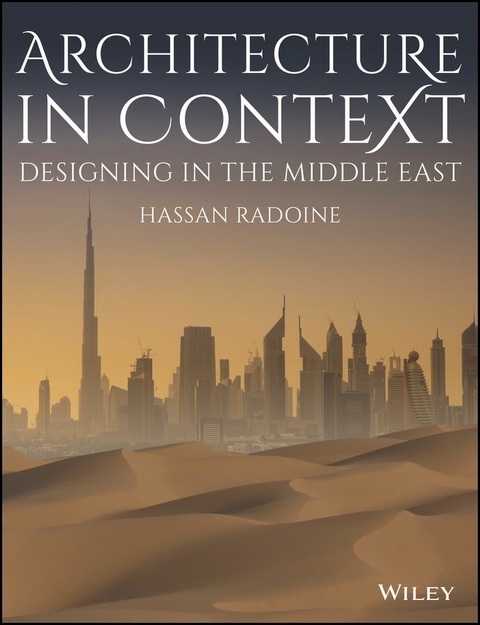
Architecture in Context (eBook)
John Wiley & Sons (Verlag)
978-1-118-71985-5 (ISBN)

Architecture in Context: Designing in the Middle East provides a foundation for understanding the critical context of architecture and design in this region. It does this by:
- presenting a practical overview of architectural know-how in the Middle East, and its potential for cultivating a sense of place
- introducing local architectural vocabularies and styles, and how they can still be reactivated in contemporary design
- exploring the cultural and contextual meaning of forms as references that may influence contemporary architecture
- discussing important discourses and trends in architecture that allow a rethinking of the current global/local dichotomy.
Highly illustrated, the book covers architecture and design in North Africa, the Levant, the Gulf, and Turkey, Iran and Iraq.
Hassan Radoine is an architecture curator, critic, educator, author and consultant. He is currently the Director of the École Nationale d'Architecture (Morocco), and was previously the Head of the Architecture Department at the University of Sharjah (UAE). He received his first Architect Professional Diploma from the École Nationale d'Architecture. A Fulbright Scholar, he completed his MSc and PhD in Architecture at the University of Pennsylvania, USA, and as a Prince of Wales Scholar he also earned a second Master's degree from the University of Wales, UK. He has taught at the University of Pennsylvania, Dartmouth College, University of Sharjah, American University of Sharjah, and Al Akhawayn University, and worked as an international expert for UNESCO, UN, UN-Habitat, ICCROM, MCC, and the Aga Khan Award for Architecture. A contributor to several journals and books, his research and practice explores architecture and urbanism in the Middle East and North Africa region.
Architecture in Context: Designing in the Middle East provides a foundation for understanding the critical context of architecture and design in this region. It does this by: presenting a practical overview of architectural know-how in the Middle East, and its potential for cultivating a sense of place introducing local architectural vocabularies and styles, and how they can still be reactivated in contemporary design exploring the cultural and contextual meaning of forms as references that may influence contemporary architecture discussing important discourses and trends in architecture that allow a rethinking of the current global/local dichotomy. Highly illustrated, the book covers architecture and design in North Africa, the Levant, the Gulf, and Turkey, Iran and Iraq.
Hassan Radoine is an architecture curator, critic, educator, author and consultant. He is currently the Director of the École Nationale d'Architecture (Morocco), and was previously the Head of the Architecture Department at the University of Sharjah (UAE). He received his first Architect Professional Diploma from the École Nationale d'Architecture. A Fulbright Scholar, he completed his MSc and PhD in Architecture at the University of Pennsylvania, USA, and as a Prince of Wales Scholar he also earned a second Master's degree from the University of Wales, UK. He has taught at the University of Pennsylvania, Dartmouth College, University of Sharjah, American University of Sharjah, and Al Akhawayn University, and worked as an international expert for UNESCO, UN, UN-Habitat, ICCROM, MCC, and the Aga Khan Award for Architecture. A contributor to several journals and books, his research and practice explores architecture and urbanism in the Middle East and North Africa region.
INTRODUCTION 1
CHAPTER 1: ARCHITECTURE IN THE MIDDLE EAST: A BACKGROUND 9
Geopolitical and Environmental Characteristics 10
Cultural and Religious Influences 17
Architectural and Urban Classical Local Antecedents 31
Colonial Architecture, East-West Encounters 43
Decolonising Architecture: Nation Building 49
Architecture of Development: An Urban and Housing Quest 52
Contemporary Architecture: Faster and Higher 54
Conclusion 56
References 57
CHAPTER 2: ARCHITECTURAL VOCABULARY: ELEMENTS OF LOCAL STYLES 59
Site Typologies 62
Biological Layer 65
Cultural Layer 72
Physical Layer 75
Social and Communal Layer 92
Environmental Layer 94
Massing and Volumetric Composition 97
Compactness 102
Connectedness 104
Transition 104
Fragmentation 106
Skyline 108
Function and Space 110
Space/Function versus Place 110
Space as a Process 112
Space Configurationality 113
Scale and Proportion 115
Human Scale and Proportion 117
Materials and Scale 118
Size and Scale 119
Light and Form 123
Light as Energy 125
Light as Space 127
Light as Form 129
Light as Metaphor 131
Order and Geometry 134
Geometry and Order as Design 135
Geometry and Order as Structure 138
Geometry and Order as Allegory 139
Ornament and Symbolism 142
Ornament as Motif 143
Ornament as Symbolism 146
Building as Digital Ornament 149
Patterns, Textures and Colours 151
Architectural Patterns versus Decorative Patterns 152
Local versus Imported Patterns 156
Composition of Patterns, Textures, and Colours 157
Conclusion 162
References 163
CHAPTER 3: CULTURAL AND CONTEXTUAL MEANING 165
Cultural Value Judgment and Symbolic Codes (Cognitive Schemata, Transmission) 167
Representation and Expression of Cultural Meaning 171
Representation/Expression 171
IDENTIFICATION/COMMUNICATION/TRANSMISSION 174
INTEGRATION/DEVELOPMENT 176
Spatial-Cultural Arrangement (Transformation and Experience) 177
Climate and Environment (Adaptive and Creative Sustainability) 181
Building Know-How and Processes of Production 189
Local/Global Building Know-How 189
Technology-Based Culture 191
Morality, Ethics and Responsibility 193
Conclusion 195
References 196
CHAPTER 4: TRENDS AND DISCOURSES OF CONTEXTUAL ARCHITECTURE 199
Regionalism and Internationalism: A Design Reference 204
A Paradoxical Design: Reactivating or Mimicking 'Islamic'/'Arabic' Architecture 207
Reinvention of Tradition or Heritage in Design: Continuity or Discontinuity 211
Designing with Nature 215
Nationalist, Post-Orientalist and Fantasist Design 220
'Theme Parks' and Megaprojects: Designing in the Gulf 225
Sustainability-Based Design 227
Conclusion 230
References 231
APPENDIX: ORIENTATION: TOWARDS A MODEL OF CONTEXTUAL ENQUIRY-BASED DESIGN 233
CONCLUSION 239
ILLUSTRATION CREDITS 241
INDEX 242
INTRODUCTION
There is a vast amount of architectural activity taking place in the Gulf and other countries of the Middle East, including Turkey, Lebanon, Egypt and Morocco. In various places throughout this region, high-rise structures made possible by the freedom from structural limitations of materials such as concrete, steel and glass are taking the art of design to heights never reached before. Some embody the new ‘global’ approach that relies heavily on imported forms, while others reflect the ‘local’, pursuing a rather postmodern form of romantic aestheticism. Consequently, contemporary architecture in the Middle East and the north of Africa is at a critical crossroads with regard to the limits of global and local design practices.
However, the striking conceptual framework that underlies the new approaches to designing in this particular area never takes into consideration its entrenched rich architectural tradition and sense of place. Indeed, modern local and international architects have designed most of the new buildings as if there were no context. What is meant by context here is not the ordinary emotional forms but the intrinsic memory and prophecy of a locality to engender an innovative project centred on a sustainable genius loci, or spirit of place. Architects currently designing in this area are instead pursuing an iconic-abstract architecture that is once again dominating worldwide architectural discourse and practice.
Very few local or international architects are trained to capture grassroots contextual elements, and therefore most are unable to creatively translate these into their projects, particularly in those located on sites with high natural, cultural and environmental potential. This is due firstly to decades of modernist ideologies which influenced a whole generation of architects to take a negative position towards any historical or contextual reference, and secondly to the loss of empirical knowledge regarding local building know-how beyond dramatic and superficial pastiche.
‘Monopolio’ building, Tangier, Morocco, 1884
A historic tobacco factory in Tangier is overwhelmed by the standardised international style of the tall buildings around it as they take over the existing urban heritage cityscape.
The current new generation of students and young architects seem to be at a loss about what to do with this discordant state that the previous generation inherited at the beginning of the 20th century, when any contextual form was considered a hindrance to architectural avant-gardism. Even today, students of architecture in the Middle East region are being exclusively taught Eurocentric historical surveys with insufficient focus on those closely relevant to their own context. They are unfortunately not offered the opportunity to grasp local architectural vocabularies and their embedded environmental and cultural signifiers.
Consequently, the redundant internationalist standardised vocabularies and forms of architecture plague all cities in the region, with no consideration for their environmental, ecological, cultural, geographical or social settings. The rich architectural diversity and uniqueness of the region, which once offered the world architectural wonders, has frequently been substituted with monotonous and repetitious forms by designers seeking international fame at the expense of the human factor and its environment that ought to be its raison d’être.
However, if we consider that such criticism or rejection of context is based on resentment or alienation for mere polemical or ideological ends, we will not find a straightforward answer to the question of contemporary design in today’s Middle East. Hence the urgent need for a new orientation to cultivate responsible design practice geared towards a more responsive architecture that communicates with its place while being concomitant with its time. This need echoes a voice that seeks to raise awareness among the architectural community all over the world about the risks of the fast-spreading ego-centred designs that exempt the act of designing from any relevance to its milieu.
Cityscape of Cairo, Egypt
A monotonous cityscape similar to those of most Middle Eastern cities, with conventional forms.
Transparent House design agency, Crescent Moon Tower proposal, Dubai, United Arab Emirates, 2012
A metaphorical and fantasist ego-centred design with an Orientalist ‘Islamic’ form – the crescent.
Therefore, this book is intended to be a guiding tool and an eye-opener on the long-overdue revalidation of context in current design processes that have been deprived of the quintessence of their locality due to the common alibi of constraining architects’ creativity. Stressing this concern among architects, this book serves as a reminder of the importance of reaching a balance between embracing a creative regionalism that anchors architecture in its site and culture, and adopting an effective globalism without utterly surrendering to an ultra-technological form devoid of any sense of place. This cannot be attained without first training students and young architects in the region to grasp contextual parameters as not limitations, but rather opportunities that can be translated through architectural innovation in order to boost the overall quality and comprehensiveness of the design process. Secondly, the book sets out to provide them with efficient methods and techniques for a judicious exploration of contextual realms. Thirdly, it gives them pointers to explore universal design with its innovative mechanisms, acquiring its scope while embracing the spirit of places.
IM Pei, Museum of Islamic Art, Doha, Qatar, 2008
Pei’s successful attempt at dismantling the local architectural vocabulary and redesigning it in a contemporary style without falling into pastiche.
Accordingly, this book’s main message for architects is, first, to approach architectural design with more subtlety and responsibility, in order to heighten the vivacity and originality of the region’s buildings – not only for the decades to come, but also to set a referential value for future architectural masterpieces. And second, it is a plea to all architects to re-centre design and creativity around the vital human living condition rather than be satisfied with an ephemeral aestheticism. This will hopefully alert students and future architects to the possibilities of designing a more responsive and sensitive architecture.
Several new terms have recently been coined to voice these contextual concerns in different disciplines, such as sustainability, resilience and smartness. To avoid any confusion in students’ and young architects’ minds, it is imperative to note that this book does not seek to propose a historicist or a nationalist architecture or one that advocates an emotional regionalism. However, it does pursue a programmatic approach that seeks to holistically integrate the genius loci of different places through a responsible process of designing. While taking care first not to fall into ready-made recipes of one of these terms, and second not to blindly surrender to the pressure of sheer consumerist architecture that satisfies only the demands of competitive developers – market rules, monotonous commercial building materials, regulations and fast production – architects, particularly young ones, are indeed called upon to endure the struggle of keeping the profession sustainable and noble. Subsequently, the approach pursued in this book can be applied to any other region in the world while exploring the proposed elements, taking into consideration their own local characteristics and peculiarities.
X Architects, Wasit Natural Reserve Visitor Centre, Sharjah, United Arab Emirates, 2016
An example of designing with the demands of the site in order to generate a living landscape where architecture is a balanced environmental ensemble.
The key questions to be raised are the following: How should the background of architectural tradition in the Middle East and the north of Africa be comprehended? How can architecture in the Middle East be designed in a way that observes contextual qualities without falling into emotional pastiche? How can context be grasped in order to design responsibly? How can a sense of judgment regarding a responsive contextual design be cultivated? How can contextual elements be explored in an innovative way? What are the different contextual and cultural meanings to be considered in design? How should the practice of a contextual design be situated within the current architectural trends and discourses in the region? How can local anchorage be achieved without discarding positive global input?
Map of the regions and countries covered by this book
This book is thus an attempt to address these questions by critically exploring four fundamental aspects:
- the historical background of architecture in the Middle East, presenting the key knowledge elements that need to be mastered so as to situate the content of this book in time and in place, and recall what is essential to design in contemporary theory and practice
- the local architectural vocabulary and its elements of local styles, to...
| Erscheint lt. Verlag | 2.5.2017 |
|---|---|
| Sprache | englisch |
| Themenwelt | Technik ► Architektur |
| Schlagworte | across • Architects • Architectural • Architectural History & Styles • architectural theory • Architecture • Architektur • Architektur / Theorie • Architektur- u. Stilgeschichte • ConText • Countries • Current • Design, Drawing & Presentation • discourse • dominates • East • Entwurf, Zeichnung u. Präsentation • foreign • Gulf • historicist • iconic abstract • Landscapes • Middle • Practice • practising • Rich • Surveys • taught • Urban • Worldwide |
| ISBN-10 | 1-118-71985-9 / 1118719859 |
| ISBN-13 | 978-1-118-71985-5 / 9781118719855 |
| Informationen gemäß Produktsicherheitsverordnung (GPSR) | |
| Haben Sie eine Frage zum Produkt? |
 EPUB (Adobe DRM)
Kopierschutz: Adobe-DRM
Adobe-DRM ist ein Kopierschutz, der das eBook vor Mißbrauch schützen soll. Dabei wird das eBook bereits beim Download auf Ihre persönliche Adobe-ID autorisiert. Lesen können Sie das eBook dann nur auf den Geräten, welche ebenfalls auf Ihre Adobe-ID registriert sind.
Details zum Adobe-DRM
Dateiformat: EPUB (Electronic Publication)
EPUB ist ein offener Standard für eBooks und eignet sich besonders zur Darstellung von Belletristik und Sachbüchern. Der Fließtext wird dynamisch an die Display- und Schriftgröße angepasst. Auch für mobile Lesegeräte ist EPUB daher gut geeignet.
Systemvoraussetzungen:
PC/Mac: Mit einem PC oder Mac können Sie dieses eBook lesen. Sie benötigen eine
eReader: Dieses eBook kann mit (fast) allen eBook-Readern gelesen werden. Mit dem amazon-Kindle ist es aber nicht kompatibel.
Smartphone/Tablet: Egal ob Apple oder Android, dieses eBook können Sie lesen. Sie benötigen eine
Geräteliste und zusätzliche Hinweise
Buying eBooks from abroad
For tax law reasons we can sell eBooks just within Germany and Switzerland. Regrettably we cannot fulfill eBook-orders from other countries.
aus dem Bereich