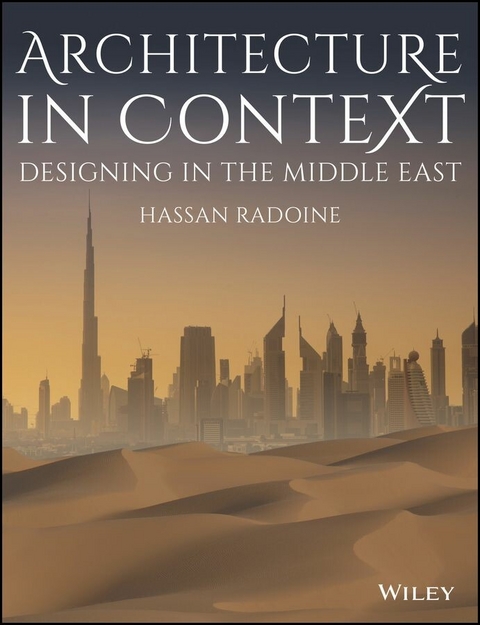
Architecture in Context (eBook)
John Wiley & Sons (Verlag)
978-1-118-71984-8 (ISBN)
Architecture in Context: Designing in the Middle East provides a foundation for understanding the critical context of architecture and design in this region. It does this by:
- presenting a practical overview of architectural know-how in the Middle East, and its potential for cultivating a sense of place
- introducing local architectural vocabularies and styles, and how they can still be reactivated in contemporary design
- exploring the cultural and contextual meaning of forms as references that may influence contemporary architecture
- discussing important discourses and trends in architecture that allow a rethinking of the current global/local dichotomy.
Highly illustrated, the book covers architecture and design in North Africa, the Levant, the Gulf, and Turkey, Iran and Iraq.
Hassan Radoine is an architecture curator, critic, educator, author and consultant. He is currently the Director of the École Nationale d'Architecture (Morocco), and was previously the Head of the Architecture Department at the University of Sharjah (UAE). He received his first Architect Professional Diploma from the École Nationale d'Architecture. A Fulbright Scholar, he completed his MSc and PhD in Architecture at the University of Pennsylvania, USA, and as a Prince of Wales Scholar he also earned a second Master's degree from the University of Wales, UK. He has taught at the University of Pennsylvania, Dartmouth College, University of Sharjah, American University of Sharjah, and Al Akhawayn University, and worked as an international expert for UNESCO, UN, UN-Habitat, ICCROM, MCC, and the Aga Khan Award for Architecture. A contributor to several journals and books, his research and practice explores architecture and urbanism in the Middle East and North Africa region.
Architecture in Context: Designing in the Middle East provides a foundation for understanding the critical context of architecture and design in this region. It does this by: presenting a practical overview of architectural know-how in the Middle East, and its potential for cultivating a sense of place introducing local architectural vocabularies and styles, and how they can still be reactivated in contemporary design exploring the cultural and contextual meaning of forms as references that may influence contemporary architecture discussing important discourses and trends in architecture that allow a rethinking of the current global/local dichotomy. Highly illustrated, the book covers architecture and design in North Africa, the Levant, the Gulf, and Turkey, Iran and Iraq.
Hassan Radoine is an architecture curator, critic, educator, author and consultant. He is currently the Director of the École Nationale d'Architecture (Morocco), and was previously the Head of the Architecture Department at the University of Sharjah (UAE). He received his first Architect Professional Diploma from the École Nationale d'Architecture. A Fulbright Scholar, he completed his MSc and PhD in Architecture at the University of Pennsylvania, USA, and as a Prince of Wales Scholar he also earned a second Master's degree from the University of Wales, UK. He has taught at the University of Pennsylvania, Dartmouth College, University of Sharjah, American University of Sharjah, and Al Akhawayn University, and worked as an international expert for UNESCO, UN, UN-Habitat, ICCROM, MCC, and the Aga Khan Award for Architecture. A contributor to several journals and books, his research and practice explores architecture and urbanism in the Middle East and North Africa region.
ARCHITECTURE IN CONTEXT DESIGNING IN THE MIDDLE EAST 3
ACKNOWLEDGEMENTS 7
CONTENTS 8
INTRODUCTION 11
CHAPTER 1: ARCHITECTURE IN THE MIDDLE EAST: A BACKGROUND 19
Geopolitical and Environmental Characteristics 20
Cultural and Religious Influences 27
Architectural and Urban Classical Local Antecedents 41
Colonial Architecture, East-West Encounters 53
Decolonising Architecture: Nation Building 59
Architecture of Development: An Urban and Housing Quest 62
Contemporary Architecture: Faster and Higher 64
Conclusion 66
References 67
CHAPTER 2: ARCHITECTURAL VOCABULARY: ELEMENTS OF LOCAL STYLES 69
Site Typologies 72
Biological Layer 75
Cultural Layer 82
Physical Layer 85
Social and Communal Layer 102
Environmental Layer 104
Massing and Volumetric Composition 107
Compactness 112
Connectedness 114
Transition 114
Fragmentation 116
Skyline 118
Function and Space 120
Space/Function versus Place 120
Space as a Process 122
Space Configurationality 123
Scale and Proportion 125
Human Scale and Proportion 127
Materials and Scale 128
Size and Scale 129
Light and Form 133
Light as Energy 135
Light as Space 137
Light as Form 139
Light as Metaphor 141
Order and Geometry 144
Geometry and Order as Design 145
Geometry and Order as Structure 148
Geometry and Order as Allegory 149
Ornament and Symbolism 152
Ornament as Motif 153
Ornament as Symbolism 156
Building as Digital Ornament 159
Patterns, Textures and Colours 161
Architectural Patterns versus Decorative Patterns 162
Local versus Imported Patterns 166
Composition of Patterns, Textures, and Colours 167
Conclusion 172
References 173
CHAPTER 3: CULTURAL AND CONTEXTUAL MEANING 175
Cultural Value Judgment and Symbolic Codes (Cognitive Schemata, Transmission) 177
Representation and Expression of Cultural Meaning 181
Representation/Expression 181
Identification/Communication/Transmission 184
Integration/Development 186
Spatial-Cultural Arrangement (Transformation and Experience) 187
Climate and Environment (Adaptive and Creative Sustainability) 191
Building Know-How and Processes of Production 199
Local/Global Building Know-How 199
Technology-Based Culture 201
Morality, Ethics and Responsibility 203
Conclusion 205
References 206
CHAPTER 4: TRENDS AND DISCOURSES OF CONTEXTUAL ARCHITECTURE 209
Regionalism and Internationalism: A Design Reference 214
A Paradoxical Design: Reactivating or Mimicking ‘Islamic’/‘Arabic’ Architecture 217
Reinvention of Tradition or Heritage in Design: Continuity or Discontinuity 221
Designing with Nature 225
Nationalist, Post-Orientalist and Fantasist Design 230
‘Theme Parks’ and Megaprojects: Designing in the Gulf 235
Sustainability-Based Design 237
Conclusion 240
References 241
APPENDIX: ORIENTATION: TOWARDS A MODEL OF CONTEXTUAL ENQUIRY-BASED DESIGN 243
CONCLUSION 249
ILLUSTRATION CREDITS 251
INDEX 252
EULA 259
| Erscheint lt. Verlag | 26.4.2017 |
|---|---|
| Sprache | englisch |
| Themenwelt | Technik ► Architektur |
| Schlagworte | across • Architects • Architectural • Architectural History & Styles • architectural theory • Architecture • Architektur • Architektur / Theorie • Architektur- u. Stilgeschichte • ConText • Countries • Current • Design, Drawing & Presentation • discourse • dominates • East • Entwurf, Zeichnung u. Präsentation • foreign • Gulf • historicist • iconic abstract • Landscapes • Middle • Practice • practising • Rich • Surveys • taught • Urban • Worldwide |
| ISBN-10 | 1-118-71984-0 / 1118719840 |
| ISBN-13 | 978-1-118-71984-8 / 9781118719848 |
| Informationen gemäß Produktsicherheitsverordnung (GPSR) | |
| Haben Sie eine Frage zum Produkt? |
 PDF (Adobe DRM)
Kopierschutz: Adobe-DRM
Adobe-DRM ist ein Kopierschutz, der das eBook vor Mißbrauch schützen soll. Dabei wird das eBook bereits beim Download auf Ihre persönliche Adobe-ID autorisiert. Lesen können Sie das eBook dann nur auf den Geräten, welche ebenfalls auf Ihre Adobe-ID registriert sind.
Details zum Adobe-DRM
Dateiformat: PDF (Portable Document Format)
Mit einem festen Seitenlayout eignet sich die PDF besonders für Fachbücher mit Spalten, Tabellen und Abbildungen. Eine PDF kann auf fast allen Geräten angezeigt werden, ist aber für kleine Displays (Smartphone, eReader) nur eingeschränkt geeignet.
Systemvoraussetzungen:
PC/Mac: Mit einem PC oder Mac können Sie dieses eBook lesen. Sie benötigen eine
eReader: Dieses eBook kann mit (fast) allen eBook-Readern gelesen werden. Mit dem amazon-Kindle ist es aber nicht kompatibel.
Smartphone/Tablet: Egal ob Apple oder Android, dieses eBook können Sie lesen. Sie benötigen eine
Geräteliste und zusätzliche Hinweise
Buying eBooks from abroad
For tax law reasons we can sell eBooks just within Germany and Switzerland. Regrettably we cannot fulfill eBook-orders from other countries.
aus dem Bereich