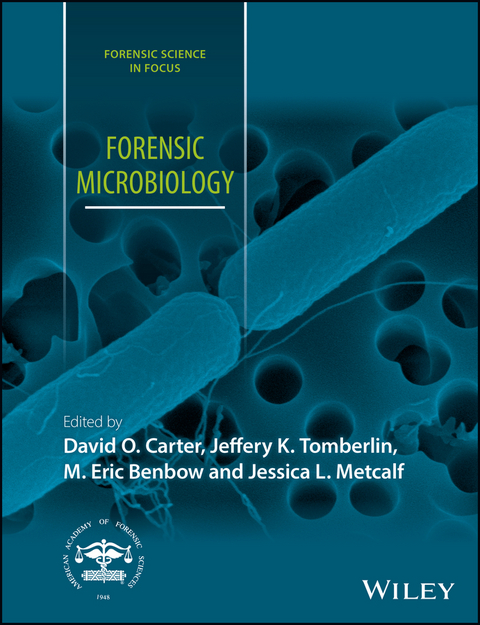
Forensic Microbiology (eBook)
John Wiley & Sons (Verlag)
978-1-119-06256-1 (ISBN)
Forensic Microbiology focuses on newly emerging areas of microbiology relevant to medicolegal and criminal investigations: postmortem changes, establishing cause of death, estimating postmortem interval, and trace evidence analysis. Recent developments in sequencing technology allow researchers, and potentially practitioners, to examine microbial communities at unprecedented resolution and in multidisciplinary contexts. This detailed study of microbes facilitates the development of new forensic tools that use the structure and function of microbial communities as physical evidence.
Chapters cover:
- Experiment design
- Data analysis
- Sample preservation
- The influence of microbes on results from autopsy, toxicology, and histology
- Decomposition ecology
- Trace evidence
This diverse, rapidly evolving field of study has the potential to provide high quality microbial evidence which can be replicated across laboratories, providing spatial and temporal evidence which could be crucial in a broad range of investigative contexts. This book is intended as a resource for students, microbiologists, investigators, pathologists, and other forensic science professionals.
Edited by
David O. Carter
Forensic Sciences Unit, Chaminade University of Honolulu, USA
Jeffery K. Tomberlin
Department of Entomology, Texas A&M University, USA
M. Eric Benbow
Department of Entomology, Michigan State University, USA
Jessica L. Metcalf
Department of Animal Sciences, Colorado State University, USA
Forensic Microbiology focuses on newly emerging areas of microbiology relevant to medicolegal and criminal investigations: postmortem changes, establishing cause of death, estimating postmortem interval, and trace evidence analysis. Recent developments in sequencing technology allow researchers, and potentially practitioners, to examine microbial communities at unprecedented resolution and in multidisciplinary contexts. This detailed study of microbes facilitates the development of new forensic tools that use the structure and function of microbial communities as physical evidence. Chapters cover: Experiment design Data analysis Sample preservation The influence of microbes on results from autopsy, toxicology, and histology Decomposition ecology Trace evidence This diverse, rapidly evolving field of study has the potential to provide high quality microbial evidence which can be replicated across laboratories, providing spatial and temporal evidence which could be crucial in a broad range of investigative contexts. This book is intended as a resource for students, microbiologists, investigators, pathologists, and other forensic science professionals.
Edited by David O. Carter Forensic Sciences Unit, Chaminade University of Honolulu, USA Jeffery K. Tomberlin Department of Entomology, Texas A&M University, USA M. Eric Benbow Department of Entomology, Michigan State University, USA Jessica L. Metcalf Department of Animal Sciences, Colorado State University, USA
Title Page 5
Copyright Page 6
Contents 9
About the editors 18
List of contributors 21
Foreword 24
Series preface 26
Preface 27
Chapter 1 A primer on microbiology 29
1.1 Introduction 29
1.2 Microbial characteristics 30
1.2.1 Microbial taxonomy and function 30
1.2.2 Enzyme activity 33
1.3 Microorganisms and their habitats 35
1.3.1 Oxygen and moisture 36
1.3.2 Temperature 37
1.4 Competition for resources 38
1.5 The ecology of some forensically relevant bacteria 39
1.5.1 Actinobacteria 39
1.5.2 Firmicutes 41
1.5.3 Proteobacteria 44
1.6 Archaea and microbial eukaryotes 48
1.7 Conclusions 49
Acknowledgments 49
References 49
Chapter 2 History, current, and future use of microorganisms as physical evidence 53
2.1 Introduction 53
2.1.1 Why and how are microorganisms used in forensic science? 53
2.2 Methods for identification 54
2.2.1 Classical microbiology 54
2.2.2 Genomics and strain typing 55
2.3 Estimating PMI 58
2.3.1 Microbial succession 60
2.4 Cause of death 64
2.4.1 Natural causes 64
2.4.2 Biocrimes 66
2.5 Trace evidence 68
2.5.1 Human 68
2.5.2 Nonhuman animals and food 70
2.6 Other medicolegal aspects 71
2.6.1 Sexual assault 71
2.6.2 Medical malpractice 71
2.6.3 Nosocomial infections and antibiotic resistance 72
2.6.4 Food safety and environmental contamination 72
2.7 Needs that must be met for use in chain of custody 76
2.8 Summary 77
Acknowledgments 78
References 78
Chapter 3 Approaches and considerations for forensic microbiology decomposition research 84
3.1 Introduction 84
3.2 Challenges of human remains research 85
3.3 Human remains research during death investigations 86
3.4 Human surrogates in research 88
3.5 Considerations for field studies 89
3.6 Descriptive and hypothesis?driven research 90
3.7 Experiment design 93
3.8 Validation studies 97
Acknowledgments 98
References 98
Chapter 4 Sampling methods and data generation 100
4.1 Introduction 100
4.2 Materials 101
4.2.1 Financial considerations 101
4.2.2 Terrestrial settings 102
4.2.3 Aquatic settings 105
4.3 Sample collection techniques 107
4.4 Sample preservation, storage, and handling techniques 108
4.5 Data considerations 114
4.6 Conclusions 118
Acknowledgments 118
References 119
Chapter 5 An introduction to metagenomic data generation, analysis, visualization, and interpretation 122
5.1 Introduction 122
5.2 DNA extraction 124
5.2.1 Sample collection and storage 124
5.2.2 Extraction methods 125
5.3 DNA sequencing 127
5.3.1 Amplicon sequencing of marker (16S rDNA/18S rDNA/ITS) loci 127
5.3.2 Multi-omics sequencing: metagenomic, metatranscriptomic, metaproteomic, and metametabolomic approaches 130
5.3.3 Next-generation sequencing platforms 133
5.4 Marker gene data analysis, visualization, and interpretation 135
5.4.1 Data analysis pipelines 135
5.4.2 Preprocessing of sequence data 136
5.4.3 Sequence clustering approaches 139
5.4.4 Microbial diversity estimations 140
5.5 Multi-omics data analysis, visualization, and interpretation 142
5.5.1 Sequence preprocessing 143
5.5.2 Sequence assembly 143
5.5.3 Taxonomic profiling 144
5.5.4 Gene prediction and metabolic profiling 144
5.6 Statistical analysis 145
5.7 Major challenges and future directions 146
References 147
Chapter 6 Culture and long-term storage of microorganisms for forensic science 155
6.1 Introduction 155
6.2 The value of culturing microorganisms 156
6.3 Collection and handling of samples 160
6.4 Protocols 162
6.4.1 Aerobic culture 162
6.4.2 Sterile technique 162
6.4.3 Sample collection, transport, and culture 162
6.4.4 Anaerobic culture 166
6.4.5 Preparing freezer stocks of pure culture 170
6.4.6 Reculturing stored microorganisms 171
6.5 Conclusions 171
Acknowledgments 171
References 171
Chapter 7 Clinical microbiology and virology in the context of the autopsy 174
7.1 Introduction 174
7.2 The historical view of autopsy microbiology 175
7.3 Which samples should you collect and how? 177
7.3.1 Blood 179
7.3.2 Cerebrospinal fluid 180
7.3.3 Tissue, pus, and fluids 181
7.3.4 Urine and bowel contents/feces 182
7.4 Which methods are available for the diagnosis of infection? 182
7.5 How do you put the results into context? 184
7.5.1 Culture 184
7.5.2 Serology and molecular tests 188
7.5.3 Biochemical markers 189
7.6 What are the risks of transmission of infection in the postmortem room? 191
7.7 How does autopsy microbiology contribute to the diagnosis of specific conditions? 192
7.7.1 Pneumonia 192
7.7.2 Mycobacterial infection 196
7.7.3 Fungal infections 198
7.7.4 Infective endocarditis 199
7.7.5 Gastrointestinal infection 200
7.7.6 Meningitis and central nervous system infections 201
7.7.7 Septicemia 202
7.7.8 Neonates and sudden unexplained death in infancy 203
7.7.9 Emerging infectious diseases and bioterrorism agents 206
7.8 Conclusion 210
References 210
Chapter 8 Postmortem bacterial translocation 220
8.1 Introduction 220
8.1.1 The intestinal microbiota in health 220
8.2 Bacterial translocation in health and disease 223
8.2.1 Pathophysiological mechanisms 224
8.2.2 Factors responsible for an increase in the bacterial translocation 225
8.3 Bacterial translocation in humans 226
8.3.1 Bacterial translocation after death 227
8.3.2 Identification of bacterial metabolites around the corpse 228
8.4 Physiological changes after death influencing the selection of commensal bacteria 228
8.4.1 Variations of available substrates for bacterial proliferation 228
8.4.2 Temperature 229
8.4.3 Anaerobic conditions 230
8.5 Consequences of bacterial translocation 232
8.5.1 Clinical interest 232
8.5.2 Identification of infectious agents at autopsy 232
8.5.3 Postmortem interval estimation 232
8.5.4 Infectious risk for postmortem organ transplantation 233
8.5.5 Postmortem toxicological analysis 233
8.5.6 Prevention of biological risk at autopsy 234
8.5.7 Environmental consequences 234
8.6 Conclusion 234
References 235
Chapter 9 Microbial impacts in postmortem toxicology 240
9.1 Introduction 240
9.2 Microbial factors complicating postmortem toxicological analyses 241
9.2.1 Cadaver decomposition and specimen contamination 241
9.2.2 Postmortem drug and metabolite degradation 242
9.3 Precautions taken to limit microbial impacts 242
9.4 Experimental protocols used to investigate postmortem drug and metabolite degradation due to microbial activity 246
9.5 Examples of microbially mediated drug degradation 247
9.5.1 Drugs 248
9.5.2 Poisons 261
9.6 Concluding remarks 262
References 263
Chapter 10 Microbial communities associated with decomposing corpses 273
10.1 Introduction 273
10.1.1 Overview of the importance of bacteria in decomposition and Arpad Vass’ original efforts to catalogue this diversity 274
10.1.2 Marker gene and metagenomics methods for facilitating studies of the microbial ecology of decomposition 275
10.2 The soil microbiology of decomposition 276
10.2.1 Microbial diversity of gravesoil and the rate of decomposition 276
10.2.2 Detecting decomposition signatures in soil and clandestine graves 278
10.2.3 Plant litter 279
10.3 Freshwater and marine decomposition 280
10.3.1 Freshwater decomposition: Fish 280
10.3.2 Freshwater decomposition: Swine 281
10.3.3 Marine decomposition: Whale falls 281
10.3.4 Marine decomposition: Swine 282
10.4 The microbiology of nonhuman models of terrestrial decomposition 283
10.4.1 Terrestrial decomposition: Rats 283
10.4.2 Terrestrial decomposition: Mice 284
10.4.3 Terrestrial decomposition: Swine 285
10.5 The microbiology of terrestrial human decomposition 286
10.5.1 Initial insights into the microbial ecology of human decomposition 287
10.5.2 Identification of microbial signatures associated with decomposition 288
10.5.3 Microbial eukaryotic decomposers 289
10.5.4 Linking cadaver and soil microbial communities 289
10.5.5 Linking cadaver and insect microbial communities 290
10.6 Is there a universal decomposition signature? 291
10.7 Using microbial signatures to estimate PMI 292
10.7.1 Estimating PMI in terrestrial systems using gene marker data in nonhuman models of decomposition 294
10.7.2 Estimating PMI in terrestrial systems using gene marker data in human models 295
10.8 Conclusions 296
Acknowledgments 296
References 297
Chapter 11 Arthropod–microbe interactions on vertebrate remains: Potential applications in the forensic sciences 302
11.1 Introduction 302
11.1.1 Decomposition and applications in forensic entomology 303
11.1.2 Microbe–arthropod interactions 306
11.2 Framework for understanding microbe–arthropod interactions on vertebrate remains 310
11.2.1 Precolonization interval 310
11.3 Postcolonization interval 315
11.3.1 Colonization 316
11.3.2 Development 318
11.3.3 Succession 320
11.3.4 Dispersal 323
11.4 Future directions and conclusion 325
11.4.1 Forensic sciences 325
11.4.2 Environmental sciences 326
11.4.3 Medical research 326
Acknowledgments 326
References 326
Chapter 12 Microbes, anthropology, and bones 340
12.1 Introduction 340
12.2 Bone microstructure 341
12.3 Microbially mediated decomposition 343
12.4 Bone bioerosion 345
12.4.1 Mechanisms, timing, and source of microbial interaction 347
12.4.2 Exploration of bioerosion and bacterial community analysis 348
12.5 Reconstructing postmortem histories 350
12.6 Conclusions 352
References 352
Chapter 13 Forensic microbiology in built environments 356
13.1 Introduction 356
13.2 The human skin microbiome 356
13.3 The microbiota of the built environment 357
13.3.1 Human–home microbial dynamics 358
13.3.2 Influence of pets 360
13.3.3 Influence of interpersonal relationships 360
13.4 Tools for the forensic classification of the built environment microbiome 360
13.4.1 Sampling and sequencing considerations 360
13.4.2 Machine learning and statistical classification 362
13.4.3 Sequence clustering 362
13.5 Forensic microbiology of the built environment 363
13.5.1 Tracking disease in hospital environments 363
13.5.2 Tracking occupancy and activity in a built environment 364
13.6 Conclusion 364
References 365
Chapter 14 Soil bacteria as trace evidence 367
14.1 The forensic analysis of soil 367
14.2 Assessing the biological components of soil 368
14.3 Bacteria in soil 369
14.4 Molecular techniques for the forensic analysis of soil 370
14.4.1 Analysis of soil bacteria 370
14.4.2 Denaturing gradient gel electrophoresis 371
14.4.3 Assaying DNA size variability 371
14.4.4 Next-generation DNA sequencing 372
14.5 Soil microbial profile data analysis methods 373
14.5.1 Qualities of ideal forensic data analysis techniques 373
14.5.2 Objective microbial profiling analysis methods 374
14.5.3 Demonstrative microbial profiling analysis methods 375
14.5.4 Combinations of data analysis techniques 378
14.6 Feasibility of next?generation sequencing for forensic soil analysis 378
14.6.1 Differentiating diverse and similar habitats 378
14.6.2 Temporal changes in soil microbial profiles 379
14.6.3 Spatial differences in soil microbial profiles 379
14.6.4 Soil sample collection strategies 380
14.6.5 Evidence storage and changes in bacterial abundance over time 380
14.6.6 Costs of next-generation sequencing of forensic soil samples 380
14.6.7 Legal considerations for the implementation of microbial profiling 381
14.7 Consensus on methodologies for soil collection and analysis 381
Acknowledgments 382
References 382
Chapter 15 DNA profiling of bacteria from human hair: Potential and pitfalls 386
15.1 An introduction to human hair as a forensic substrate 386
15.1.1 Relevance of hair in forensic science 386
15.1.2 Historical and current forensic perspectives of hair examination and analysis 387
15.2 Current research into hair microbiomes 389
15.2.1 Studies conducted into the metagenomic potential of human hair as a forensic substrate 390
15.3 Importance of hair sample collection, storage, and isolation of microbial DNA 393
15.3.1 Hair sample collection, storage, and analysis 393
15.4 DNA sequencing of hair microbiomes 395
15.4.1 Bioinformatics considerations for analyzing microbial hair data 396
15.5 Conclusions and future directions 397
15.5.1 Major challenges and future directions of metagenomic analyses of hairs in forensic science 397
15.5.2 Future metagenomic assessments of hair samples 398
15.5.3 Development of more focused approaches to detect bacterial population level differences between bacteria inhabiting human hairs 398
15.5.4 General requirements for quality management 399
Acknowledgments 400
References 400
Perspectives on the future of forensic microbiology 404
Index 407
EULA 420
| Erscheint lt. Verlag | 21.3.2017 |
|---|---|
| Reihe/Serie | Forensic Science in Focus | Forensic Science in Focus |
| Sprache | englisch |
| Themenwelt | Medizin / Pharmazie ► Medizinische Fachgebiete |
| Naturwissenschaften ► Biologie | |
| Naturwissenschaften ► Chemie ► Analytische Chemie | |
| Recht / Steuern ► EU / Internationales Recht | |
| Recht / Steuern ► Strafrecht ► Kriminologie | |
| Sozialwissenschaften | |
| Technik | |
| Schlagworte | Analytische Chemie / Forensik • Angewandte Mikrobiologie • applied microbiology • Biowissenschaften • Chemie • Chemistry • clinical microbiology • Decomposition • Epinecrotic • Forensics • Forensic Science • Forensik • Klinische Mikrobiologie • Life Sciences • Medical Science • Medicolegal Death Investigation • Medizin • microbial ecology • microbiome • Mikrobiologie • necrobiome • Postmortem Interval • taphonomy • trace evidence |
| ISBN-10 | 1-119-06256-X / 111906256X |
| ISBN-13 | 978-1-119-06256-1 / 9781119062561 |
| Informationen gemäß Produktsicherheitsverordnung (GPSR) | |
| Haben Sie eine Frage zum Produkt? |
 PDF (Adobe DRM)
Kopierschutz: Adobe-DRM
Adobe-DRM ist ein Kopierschutz, der das eBook vor Mißbrauch schützen soll. Dabei wird das eBook bereits beim Download auf Ihre persönliche Adobe-ID autorisiert. Lesen können Sie das eBook dann nur auf den Geräten, welche ebenfalls auf Ihre Adobe-ID registriert sind.
Details zum Adobe-DRM
Dateiformat: PDF (Portable Document Format)
Mit einem festen Seitenlayout eignet sich die PDF besonders für Fachbücher mit Spalten, Tabellen und Abbildungen. Eine PDF kann auf fast allen Geräten angezeigt werden, ist aber für kleine Displays (Smartphone, eReader) nur eingeschränkt geeignet.
Systemvoraussetzungen:
PC/Mac: Mit einem PC oder Mac können Sie dieses eBook lesen. Sie benötigen eine
eReader: Dieses eBook kann mit (fast) allen eBook-Readern gelesen werden. Mit dem amazon-Kindle ist es aber nicht kompatibel.
Smartphone/Tablet: Egal ob Apple oder Android, dieses eBook können Sie lesen. Sie benötigen eine
Geräteliste und zusätzliche Hinweise
Buying eBooks from abroad
For tax law reasons we can sell eBooks just within Germany and Switzerland. Regrettably we cannot fulfill eBook-orders from other countries.
aus dem Bereich