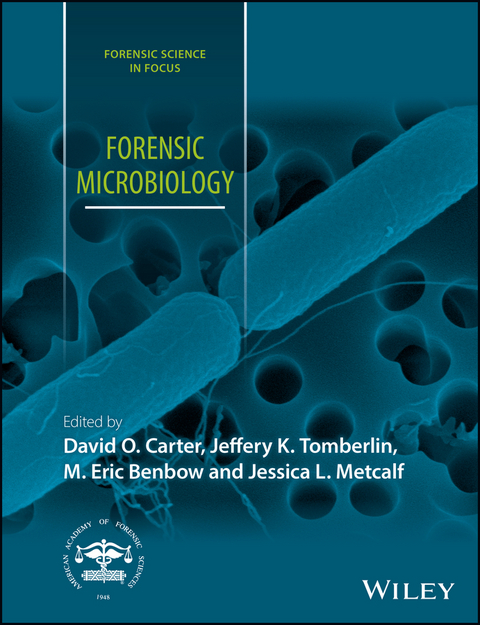
Forensic Microbiology (eBook)
John Wiley & Sons (Verlag)
978-1-119-06257-8 (ISBN)
Forensic Microbiology focuses on newly emerging areas of microbiology relevant to medicolegal and criminal investigations: postmortem changes, establishing cause of death, estimating postmortem interval, and trace evidence analysis. Recent developments in sequencing technology allow researchers, and potentially practitioners, to examine microbial communities at unprecedented resolution and in multidisciplinary contexts. This detailed study of microbes facilitates the development of new forensic tools that use the structure and function of microbial communities as physical evidence.
Chapters cover:
- Experiment design
- Data analysis
- Sample preservation
- The influence of microbes on results from autopsy, toxicology, and histology
- Decomposition ecology
- Trace evidence
This diverse, rapidly evolving field of study has the potential to provide high quality microbial evidence which can be replicated across laboratories, providing spatial and temporal evidence which could be crucial in a broad range of investigative contexts. This book is intended as a resource for students, microbiologists, investigators, pathologists, and other forensic science professionals.
Edited by
David O. Carter
Forensic Sciences Unit, Chaminade University of Honolulu, USA
Jeffery K. Tomberlin
Department of Entomology, Texas A&M University, USA
M. Eric Benbow
Department of Entomology, Michigan State University, USA
Jessica L. Metcalf
Department of Animal Sciences, Colorado State University, USA
Forensic Microbiology focuses on newly emerging areas of microbiology relevant to medicolegal and criminal investigations: postmortem changes, establishing cause of death, estimating postmortem interval, and trace evidence analysis. Recent developments in sequencing technology allow researchers, and potentially practitioners, to examine microbial communities at unprecedented resolution and in multidisciplinary contexts. This detailed study of microbes facilitates the development of new forensic tools that use the structure and function of microbial communities as physical evidence. Chapters cover: Experiment design Data analysis Sample preservation The influence of microbes on results from autopsy, toxicology, and histology Decomposition ecology Trace evidence This diverse, rapidly evolving field of study has the potential to provide high quality microbial evidence which can be replicated across laboratories, providing spatial and temporal evidence which could be crucial in a broad range of investigative contexts. This book is intended as a resource for students, microbiologists, investigators, pathologists, and other forensic science professionals.
Edited by David O. Carter Forensic Sciences Unit, Chaminade University of Honolulu, USA Jeffery K. Tomberlin Department of Entomology, Texas A&M University, USA M. Eric Benbow Department of Entomology, Michigan State University, USA Jessica L. Metcalf Department of Animal Sciences, Colorado State University, USA
CHAPTER 1
A primer on microbiology
David O. Carter1, Emily N. Junkins1,2 and Whitney A. Kodama1
1 Laboratory of Forensic Taphonomy, Forensic Sciences Unit, Division of Natural Sciences and Mathematics, Chaminade University of Honolulu, Honolulu, HI, USA
2 Department of Microbiology and Plant Biology, University of Oklahoma, Norman, OK, USA
1.1 Introduction
In many ways microorganisms are an ideal form of physical evidence. They can be found virtually everywhere and are certainly present in every habitat occupied by humans. Thus, microbes could be collected from every scene under a forensic investigation, yet not all microorganisms are everywhere; like many forms of trace evidence, some microbes are found only in certain locations due to having a preferred habitat, much like how insects, birds, and reptiles have a preferred habitat range. Another valuable characteristic of microorganisms is that many of them can transform themselves into a highly durable structure that is designed to survive harsh conditions, which increases the likelihood of their survival and discovery. Considering all of these attributes, it is probably not surprising that microorganisms have been used as physical evidence since the early days of forensic science, particularly to establish the cause of death (e.g., MacCallum and Hastings, 1899). Forensic microbiology has since grown into an exciting discipline relevant to several areas of forensic science including medicolegal death investigation (Caplan and Koontz, 2001; Forbes et al., 2016), bioterrorism (Budowle et al., 2011), and product authenticity (Brzezinski and Craft, 2012). It will be absolutely fascinating to learn of the new discoveries in forensic microbiology over the next few decades.
Historically microbes have been used almost exclusively as spatial evidence—physical evidence that is used to associate people with diseases, objects, and/or locations (Locard, 1930a, b, c; Caplan and Koontz, 2001; Tridico et al., 2014; Wiltshire et al., 2014; Young et al., 2015). This application is similar to the use of any other form of trace evidence, such as soil (Bisbing, 2016), paint (Kirkbride, 2016), glass (Almirall and Trejos, 2016), and fibers (Houck, 2016). However, recent research has shown that microorganisms represent a relatively unique form of physical evidence that can also serve as temporal evidence, evidence that is used to establish a timeline. This application uses the ability of microorganisms to respond rapidly to changes in their environment (e.g., Carter and Tibbett, 2006), and these changes are temporally predictable (Metcalf et al., 2013; Pechal et al., 2014; Guo et al., 2016; Metcalf et al., 2016), with an apparent ability to serve as an estimate of the postmortem interval (Chapter 2) and human habitation (Chapter 13) interval.
We are currently in an exciting time when multiple research groups around the world are leading advances in postmortem microbiology and trace microbiology (Fierer et al., 2010; Benbow et al., 2015; Lax et al., 2015; Metcalf et al., 2016). These advances are occurring rapidly and have great potential to significantly change how microorganisms are used as physical evidence. Microorganisms will likely play a greater role as physical evidence in the future, so the purpose of the current chapter is to provide an introduction to some fundamental aspects of microbiology and microbial ecology to help the reader develop an appreciation for the vast diversity of microorganisms and how they can be used to identify a location or time period of investigative interest. It is not possible for this chapter to review all known microorganisms, so the contents hereinafter will place an emphasis on bacteria that are of interest to the most recent research relevant to the scope of this book, postmortem microbiology and trace microbiology (e.g., Benbow et al., 2015; Iancu et al., 2015; Finley et al., 2016; Metcalf et al., 2016). However, domains Archaea and Eukarya are also highly relevant, and the current chapter will reference relevant work, when possible, that focuses on these very important taxa within a forensic context.
1.2 Microbial characteristics
Microorganisms can differ in many ways including their morphology, method of movement (motility), metabolic strategy, environmental requirements, and several other characteristics (Brown, 2015). The current chapter will address this issue with relative simplicity by describing how microorganisms survive with a brief description of some relevant taxa.
1.2.1 Microbial taxonomy and function
Classification of life has proven to be a challenge. Presently, there are a number of opinions on how we should organize organisms in terms of their relationship to one another. Although not the focus of this chapter, this topic is of great importance as it impacts our ability to assess microbial communities in general. Thus, we suggest individuals with an interest in forensic microbiology remain cognizant of the ever‐shifting landscape of microbial taxonomy.
For this text, we focus our discussion on three major groups of microorganisms organized as domains: Archaea, Bacteria, and Eukarya (Woese et al., 1990) although a new perspective on this classification was presented recently (Hug et al., 2016). The List of Prokaryotic Names with Standing in Nomenclature (http://www.bacterio.net) currently divides Bacteria into 30 phyla (Table 1.1) and Archaea into five phyla (Crenarchaeota, Euryarchaeota, Korarchaeota, Nanoarchaeota, Thaumarchaeota). These microbes can vary morphologically, with spherical (cocci; Figure 1.1a) and rod‐shaped (historically termed bacilli; Figure 1.1b) being the most common. Variations on these general morphologies exist (Figure 1.1c), as do other morphologies such as club‐shaped cells (coryneform; Figure 1.1d) and curved rods (e.g., vibrio). Thus, referring to a bacterium as a rod or a coccus is a helpful way to begin the identification process.
Table 1.1 Phyla of domain Bacteria included in the list of prokaryotic names with standing in nomenclature, http://www.bacterio.net
| Acidobacteria | Cyanobacteria | Nitrospira |
| Actinobacteria | Deferribacteres | Planctomycetes |
| Aquificae | Deinococcus–Thermus | Proteobacteria |
| Armatimonadetes | Dictyoglomi | Spirochaetes |
| Bacteroidetes | Elusimicrobia | Synergistetes |
| Caldiserica | Fibrobacteres | Tenericutes |
| Chlamydiae | Firmicutes | Thermodesulfobacteria |
| Chlorobi | Fusobacteria | Thermomicrobia |
| Chloroflexi | Gemmatimonadetes | Thermotogae |
| Chrysiogenetes | Lentisphaerae | Verrucomicrobia |
Figure 1.1 Scanning electron micrograph showing some of the contrasting morphologies observed in microbial cells including the widely observed coccus (a: Staphylococcus cohnii) and rod (b: Bacillus subtilis) shapes, which can vary and occur in association with other morphologies (c). Microbial cells can be observed as several other shapes including spiral (spirilla), curved rods (vibrio), and club shaped (coryneform), the latter of which is observed in Sporosarcina contaminans (d)
As the term microbiology indicates, microbes are small. A bacterial cell will likely have a diameter of 1–5 µm (see Figure 1.1), which means that microscopy is necessary to view individual microbial cells. Thus, the shape and size of microbial cells can be used for a general identification, usually to exclude possible identities. Other commonly used characteristics to identify microbes include the reaction to the Gram stain and the ratio of nucleotides in a cell, which is presented as guanine–cytosine (GC) content.
Stains play a significant role in the identification of microorganisms. For example, the Gram stain was developed in the nineteenth century to help visualize microbial cells. Without staining, many microbial cells are transparent and difficult to see. The Gram‐positive and Gram‐negative designation also provides some insight into the structure of the microbial cell wall. The cell wall of a Gram‐positive bacterium is approximately 90% peptidoglycan, whereas the cell wall of a Gram‐negative bacterium is approximately 10% peptidoglycan (Madigan et al., 2012). Interestingly, the Gram designation also provides information about the taxonomy of bacteria. Gram‐positive bacteria are generally found in phyla Actinobacteria and Firmicutes. Some relatively well‐known Gram‐positive bacteria include genera Bacillus (rod), Clostridium (rod), and Streptococcus (coccus), all of which are in phylum Firmicutes. The GC content of a cell can be used to generally distinguish between Actinobacteria and Firmicutes. The GC content represents the proportion of the bacterial genome that comprises GC base pairs, rather than adenine–thymine base pairs, and is presented as high GC (>50% GC content) or low GC (<50% GC content). Phylum Actinobacteria...
| Erscheint lt. Verlag | 27.3.2017 |
|---|---|
| Reihe/Serie | Forensic Science in Focus |
| Forensic Science in Focus | Forensic Science in Focus |
| Sprache | englisch |
| Themenwelt | Medizin / Pharmazie ► Medizinische Fachgebiete |
| Naturwissenschaften ► Biologie | |
| Naturwissenschaften ► Chemie ► Analytische Chemie | |
| Recht / Steuern ► EU / Internationales Recht | |
| Recht / Steuern ► Strafrecht ► Kriminologie | |
| Sozialwissenschaften | |
| Technik | |
| Schlagworte | Analytische Chemie / Forensik • Angewandte Mikrobiologie • applied microbiology • Biowissenschaften • Chemie • Chemistry • clinical microbiology • Decomposition • Epinecrotic • Forensics • Forensic Science • Forensik • Klinische Mikrobiologie • Life Sciences • Medical Science • Medicolegal Death Investigation • Medizin • microbial ecology • microbiome • Mikrobiologie • necrobiome • Postmortem Interval • taphonomy • trace evidence |
| ISBN-10 | 1-119-06257-8 / 1119062578 |
| ISBN-13 | 978-1-119-06257-8 / 9781119062578 |
| Informationen gemäß Produktsicherheitsverordnung (GPSR) | |
| Haben Sie eine Frage zum Produkt? |
 EPUB (Adobe DRM)
Kopierschutz: Adobe-DRM
Adobe-DRM ist ein Kopierschutz, der das eBook vor Mißbrauch schützen soll. Dabei wird das eBook bereits beim Download auf Ihre persönliche Adobe-ID autorisiert. Lesen können Sie das eBook dann nur auf den Geräten, welche ebenfalls auf Ihre Adobe-ID registriert sind.
Details zum Adobe-DRM
Dateiformat: EPUB (Electronic Publication)
EPUB ist ein offener Standard für eBooks und eignet sich besonders zur Darstellung von Belletristik und Sachbüchern. Der Fließtext wird dynamisch an die Display- und Schriftgröße angepasst. Auch für mobile Lesegeräte ist EPUB daher gut geeignet.
Systemvoraussetzungen:
PC/Mac: Mit einem PC oder Mac können Sie dieses eBook lesen. Sie benötigen eine
eReader: Dieses eBook kann mit (fast) allen eBook-Readern gelesen werden. Mit dem amazon-Kindle ist es aber nicht kompatibel.
Smartphone/Tablet: Egal ob Apple oder Android, dieses eBook können Sie lesen. Sie benötigen eine
Geräteliste und zusätzliche Hinweise
Buying eBooks from abroad
For tax law reasons we can sell eBooks just within Germany and Switzerland. Regrettably we cannot fulfill eBook-orders from other countries.
aus dem Bereich