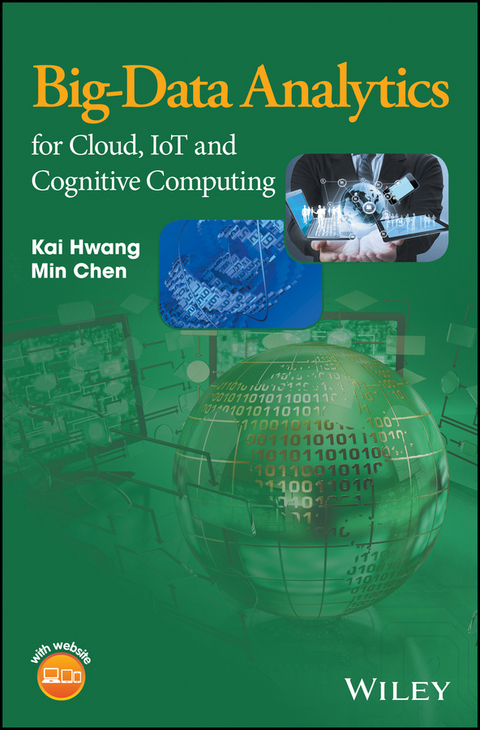
Big-Data Analytics for Cloud, IoT and Cognitive Computing (eBook)
John Wiley & Sons (Verlag)
978-1-119-24729-6 (ISBN)
The definitive guide to successfully integrating social, mobile, Big-Data analytics, cloud and IoT principles and technologies
The main goal of this book is to spur the development of effective big-data computing operations on smart clouds that are fully supported by IoT sensing, machine learning and analytics systems. To that end, the authors draw upon their original research and proven track record in the field to describe a practical approach integrating big-data theories, cloud design principles, Internet of Things (IoT) sensing, machine learning, data analytics and Hadoop and Spark programming.
Part 1 focuses on data science, the roles of clouds and IoT devices and frameworks for big-data computing. Big data analytics and cognitive machine learning, as well as cloud architecture, IoT and cognitive systems are explored, and mobile cloud-IoT-interaction frameworks are illustrated with concrete system design examples. Part 2 is devoted to the principles of and algorithms for machine learning, data analytics and deep learning in big data applications. Part 3 concentrates on cloud programming software libraries from MapReduce to Hadoop, Spark and TensorFlow and describes business, educational, healthcare and social media applications for those tools.
- The first book describing a practical approach to integrating social, mobile, analytics, cloud and IoT (SMACT) principles and technologies
- Covers theory and computing techniques and technologies, making it suitable for use in both computer science and electrical engineering programs
- Offers an extremely well-informed vision of future intelligent and cognitive computing environments integrating SMACT technologies
- Fully illustrated throughout with examples, figures and approximately 150 problems to support and reinforce learning
- Features a companion website with an instructor manual and PowerPoint slides www.wiley.com/go/hwangIOT
Big-Data Analytics for Cloud, IoT and Cognitive Computing satisfies the demand among university faculty and students for cutting-edge information on emerging intelligent and cognitive computing systems and technologies. Professionals working in data science, cloud computing and IoT applications will also find this book to be an extremely useful working resource.
Kai Hwang, PhD is Professor of Electrical Engineering and Computer Science at University of Southern California, USA. He also serves as an EMC-endowed visiting Chair Professor at Tsinghua University, China. He specializes in computer architecture, wireless Internet, cloud computing and network security.
Min Chen, PhD is Professor of Computer Science and Technology, Huazhong University of Science and Technology, China. His work focuses on IoT, mobile cloud, body area networks, healthcare big-data and cyber physical systems.
The definitive guide to successfully integrating social, mobile, Big-Data analytics, cloud and IoT principles and technologies The main goal of this book is to spur the development of effective big-data computing operations on smart clouds that are fully supported by IoT sensing, machine learning and analytics systems. To that end, the authors draw upon their original research and proven track record in the field to describe a practical approach integrating big-data theories, cloud design principles, Internet of Things (IoT) sensing, machine learning, data analytics and Hadoop and Spark programming. Part 1 focuses on data science, the roles of clouds and IoT devices and frameworks for big-data computing. Big data analytics and cognitive machine learning, as well as cloud architecture, IoT and cognitive systems are explored, and mobile cloud-IoT-interaction frameworks are illustrated with concrete system design examples. Part 2 is devoted to the principles of and algorithms for machine learning, data analytics and deep learning in big data applications. Part 3 concentrates on cloud programming software libraries from MapReduce to Hadoop, Spark and TensorFlow and describes business, educational, healthcare and social media applications for those tools. The first book describing a practical approach to integrating social, mobile, analytics, cloud and IoT (SMACT) principles and technologies Covers theory and computing techniques and technologies, making it suitable for use in both computer science and electrical engineering programs Offers an extremely well-informed vision of future intelligent and cognitive computing environments integrating SMACT technologies Fully illustrated throughout with examples, figures and approximately 150 problems to support and reinforce learning Features a companion website with an instructor manual and PowerPoint slides www.wiley.com/go/hwangIOT Big-Data Analytics for Cloud, IoT and Cognitive Computing satisfies the demand among university faculty and students for cutting-edge information on emerging intelligent and cognitive computing systems and technologies. Professionals working in data science, cloud computing and IoT applications will also find this book to be an extremely useful working resource.
Kai Hwang, PhD is Professor of Electrical Engineering and Computer Science at University of Southern California, USA. He also serves as an EMC-endowed visiting Chair Professor at Tsinghua University, China. He specializes in computer architecture, wireless Internet, cloud computing and network security. Min Chen, PhD is Professor of Computer Science and Technology, Huazhong University of Science and Technology, China. His work focuses on IoT, mobile cloud, body area networks, healthcare big-data and cyber physical systems.
About the Authors xi
Preface xiii
About the Companion Website xvii
Part 1 Big Data, Clouds and Internet of Things 1
1. Big Data Science and Machine Intelligence 3
1.1 Enabling Technologies for Big Data Computing 3
1.2 Social-Media, Mobile Networks and Cloud Computing 16
1.3 Big Data Acquisition and Analytics Evolution 24
1.4 Machine Intelligence and Big Data Applications 32
1.5 Conclusions 42
Homework Problems 42
References 43
2. Smart Clouds, Virtualization and Mashup Services 45
2.1 Cloud Computing Models and Services 45
2.2 Creation of Virtual Machines and Docker Containers 57
2.3 Cloud Architectures and Resources Management 65
2.4 Case Studies of IaaS, PaaS and SaaS Clouds 77
2.5 Mobile Clouds and Inter-Cloud Mashup Services 88
2.6 Conclusions 98
Homework Problems 98
References 103
3. IoT Sensing, Mobile and Cognitive Systems 105
3.1 Sensing Technologies for Internet of Things 105
3.2 IoT Interactions with GPS, Clouds and Smart Machines 111
3.3 Radio Frequency Identification (RFID) 119
3.4 Sensors, Wireless Sensor Networks and GPS Systems 124
3.5 Cognitive Computing Technologies and Prototype Systems 139
3.6 Conclusions 149
Homework Problems 150
References 152
Part 2 Machine Learning and Deep Learning Algorithms 155
4. Supervised Machine Learning Algorithms 157
4.1 Taxonomy of Machine Learning Algorithms 157
4.2 Regression Methods for Machine Learning 164
4.3 Supervised Classification Methods 171
4.4 Bayesian Network and Ensemble Methods 187
4.5 Conclusions 200
Homework Problems 200
References 203
5. Unsupervised Machine Learning Algorithms 205
5.1 Introduction and Association Analysis 205
5.2 Clustering Methods without Labels 213
5.3 Dimensionality Reduction and Other Algorithms 225
5.4 How to Choose Machine Learning Algorithms? 233
5.5 Conclusions 243
Homework Problems 243
References 247
6. Deep Learning with Artificial Neural Networks 249
6.1 Introduction 249
6.2 Artificial Neural Networks (ANN) 256
6.3 Stacked Auto Encoder and Deep Belief Network 264
6.4 Convolutional Neural Networks (CNN) and Extensions 277
6.5 Conclusions 287
Homework Problems 288
References 291
Part 3 Big Data Analytics for Health-Care and Cognitive Learning 293
7. Machine Learning for Big Data in Healthcare Applications 295
7.1 Healthcare Problems and Machine Learning Tools 295
7.2 IoT-based Healthcare Systems and Applications 299
7.3 Big Data Analytics for Healthcare Applications 310
7.4 Emotion-Control Healthcare Applications 322
7.5 Conclusions 335
Homework Problems 336
References 339
8. Deep Reinforcement Learning and Social Media Analytics 343
8.1 Deep Learning Systems and Social Media Industry 343
8.2 Text and Image Recognition using ANN and CNN 348
8.3 DeepMind with Deep Reinforcement Learning 362
8.4 Data Analytics for Social-Media Applications 375
8.5 Conclusions 390
Homework Problems 391
References 393
Index 395
Preface
Motivations and Objectives
In the past decade, the computer and information industry has experienced rapid changes in both platform scale and scope of applications. Computers, smart phones, clouds and social networks demand not only high performance but also a high degree of machine intelligence. In fact, we are entering an era of big data analysis and cognitive computing. This trendy movement is observed by the pervasive use of mobile phones, storage and computing clouds, revival of artificial intelligence in practice, extended supercomputer applications, and widespread deployment of Internet of Things (IoT) platforms. To face these new computing and communication paradigm, we must upgrade the cloud and IoT ecosystems with new capabilities such as machine learning, IoT sensing, data analytics, and cognitive power that can mimic or augment human intelligence.
In the big data era, successful cloud systems, web services and data centers must be designed to store, process, learn and analyze big data to discover new knowledge or make critical decisions. The purpose is to build up a big data industry to provide cognitive services to offset human shortcomings in handling labor-intensive tasks with high efficiency. These goals are achieved through hardware virtualization, machine learning, deep learning, IoT sensing, data analytics, and cognitive computing. For example, new cloud services appear as Learning as a Services (LaaS), Analytics as a Service (AaaS), or Security as a Service (SaaS), along with the growing practices of machine learning and data analytics.
Today, IT companies, big enterprises, universities and governments are mostly converting their data centers into cloud facilities to support mobile and networked applications. Supercomputers having a similar cluster architecture as clouds are also under transformation to deal with the large data sets or streams. Smart clouds become greatly on demand to support social, media, mobile, business and government operations. Supercomputers and cloud platforms have different ecosystems and programming environments. The gap between them must close up towards big data computing in the future. This book attempts to achieve this goal.
A Quick Glance of the Book
The book consists of eight Chapters, presented in a logic flow of three technical parts. The three parts should be read or taught in a sequence, entirely or selectively.
- Part I has three chapters on data science, the roles of clouds, and IoT devices or frameworks for big data computing. These chapters cover enabling technologies to explore smart cloud computing with big data analytics and cognitive machine learning capabilities. We cover cloud architecture, IoT and cognitive systems, and software support. Mobile clouds and IoT interaction frameworks are illustrated with concrete system design and application examples.
- Part II has three chapters devoted to the principles and algorithms for machine learning, data analytics, and deep learning in big data applications. We present both supervised and unsupervised machine learning methods and deep learning with artificial neural networks. The brain-inspired computer architectures, such as IBM SyNapse's TrueNorth processors, Google tensor processing unit used in Brain programs, and China's Cambricon chips are also covered here. These chapters lay the necessary foundations for design methodologies and algorithm implementations.
- Part III presents two chapters on big data analytics for machine learning for healthcare and deep learning for cognitive and social-media applications. Readers should master themselves with the systems, algorithms and software tools such as Google's DeepMind projects in promoting big data AI applications on clouds or even on mobile devices or any computer systems. We integrate SMACT technologies (Social, Mobile, Analytics, Clouds and IoT) towards building an intelligent and cognitive computing environments for the future.
- Part I: Big Data, Clouds and Internet of Things
- Chapter 1: Big Data Science and Machine Intelligence
- Chapter 2: Smart Clouds, Virtualization and Mashup Services
- Chapter 3: IoT Sensing, Mobile and Cognitive Systems
- Part II: Machine Learning and Deep Learning Algorithms
- Chapter 4: Supervised Machine Learning Algorithms
- Chapter 5: Unsupervised Machine Learning Algorithms
- Chapter 6: Deep Learning with Artificial Neural Networks
- Part III: Big Data Analytics for Health-Care and Cognitive Learning
- Chapter 7: Machine Learning for Big Data in Healthcare Applications
- Chapter 8: Deep Reinforcement Learning and Social Media Analytics
Our Unique Approach
To promote effective big data computing on smart clouds or supercomputers, we take a technological fusion approach by integrating big data theories with cloud design principles and supercomputing standards. The IoT sensing enables large data collection. Machine learning and data analytics help decision-making. Augmenting clouds and supercomputers with artificial intelligence (AI) features is our fundamental goal. These AI and machine learning tasks are supported by Hadoop, Spark and TensorFlow programming libraries in real-life applications.
The book material is based on the authors' research and teaching experiences over the years. It will benefit those who leverage their computer, analytical and application skills to push for career development, business transformation and scientific discovery in the big data world. This book blends big data theories with emerging technologies on smart clouds and exploring distributed datacenters with new applications. Today, we see cyber physical systems appearing in smart cities, autonomous car driving on the roads, emotion-detection robotics, virtual reality, augmented reality and cognitive services in everyday life.
Building Cloud/IoT Platforms with AI Capabilities
The data analysts, cognitive scientists and computer professionals must work together to solve practical problems. This collaborative learning must involve clouds, mobile devices, datacenters and IoT resources. The ultimate goal is to discover new knowledge, or make important decisions, intelligently. For many years, we have wanted to build brain-like computers that can mimic or augment human functions in sensing, memory, recognition and comprehension. Today, Google, IBM, Microsoft, the Chinese Academy of Science, and Facebook are all exploring AI in cloud and IoT applications.
Some new neuromorphic chips and software platforms are now built by leading research centers to enable cognitive computing. We will examine these advances in hardware, software and ecosystems. The book emphasizes not only machine learning in pattern recognition, speech/image understanding, language translation and comprehension, with low cost and power requirements, but also the emerging new approaches in building future computers.
One example is to build a small rescue robotic system that can automatically distinguish between voices in a meeting and create accurate transcripts for each speaker. Smart computers or cloud systems should be able to recognize faces, detect emotions, and even may be able to issue tsunami alerts or predict earthquakes and severe weather conditions, more accurately and timely. We will cover these and related topics in the three logical parts of the book: systems, algorithms and applications. To close up the application gaps between clouds and big data user groups, over 100 illustrative examples are given to emphasize the strong collaboration among professionals working in different areas.
Intended Audience and Readers Guide
To serve the best interest of our readers, we write this book to meet the growing demand of the updated curriculum in Computer Science and Electrical Engineering education. By teaching various subsets of nine chapters, instructors can use the book at both senior and graduate levels. Four university courses may adopt this book in the subject areas of Big Data Analytics (BD), Cloud Computing (CC), Machine Learning (ML) and Cognitive Systems (CS). Readers could also use the book as a major reference. The suggested course offerings are growing rapidly at major universities throughout the world. Logically, the reading of the book should follow the order of the three parts.
The book will also benefit computer professionals who wish to transform their skills to meet new IT challenges. For examples, interested readers may include Intel engineers working on Cloud of Things. Google brain and DeepMind teams develop machine learning services including autonomic vehicle driving. Facebook explores new AI features, social and entertainment services based on AV/VR (augmented and virtual realities) technology. IBM clients expect to push cognitive computing services in the business and social-media world. Buyers and sellers on Amazon and Alibaba clouds may want to expand their on-line transaction experiences with many other forms of e-commerce and social services.
Instructor Guide
Instructors can teach only selected chapters that match their own expertise and serve the best interest of students at appropriate levels. To teach in each individual subject area (BD, CC, ML and CS), each course covers 6 to 7 chapters as suggested below:
- Big Data...
| Erscheint lt. Verlag | 17.3.2017 |
|---|---|
| Sprache | englisch |
| Themenwelt | Mathematik / Informatik ► Informatik ► Netzwerke |
| Technik ► Elektrotechnik / Energietechnik | |
| Schlagworte | Big Data • Big Data Computing • big data computing on clouds</p> • big data learning algorithms • Cloud Computing • cognitive computing • cognitive computing systems • cognitive computing technologies • Computer Science • Datenanalyse • enabling technologies for big-data computing • Energie • Energy • Grid & Cloud Computing • Grid- u. Cloud-Computing • Informatik • integrated social, mobile, analytics, cloud and IoT systems • integrated social, mobile, analytics, cloud, and IoT technologies • Intelligent Computing Systems • Intelligent computing technologies • internet of things algorithms • Internet of Things Applications • Internet of Things Programming • internet of things protocols • internet of things technologies • IOT • Learning Algorithms • <p>kai hwang • machine learning • machine learning programming with hadoop • matching learning with spark • Networking • Netzwerk • Netzwerke • Parallel Computing • SMACT principles and technologies • Smart Grid • social media, mobile networks, and cloud computing • the internet of things and cloud computing |
| ISBN-10 | 1-119-24729-2 / 1119247292 |
| ISBN-13 | 978-1-119-24729-6 / 9781119247296 |
| Informationen gemäß Produktsicherheitsverordnung (GPSR) | |
| Haben Sie eine Frage zum Produkt? |
 EPUB (Adobe DRM)
Kopierschutz: Adobe-DRM
Adobe-DRM ist ein Kopierschutz, der das eBook vor Mißbrauch schützen soll. Dabei wird das eBook bereits beim Download auf Ihre persönliche Adobe-ID autorisiert. Lesen können Sie das eBook dann nur auf den Geräten, welche ebenfalls auf Ihre Adobe-ID registriert sind.
Details zum Adobe-DRM
Dateiformat: EPUB (Electronic Publication)
EPUB ist ein offener Standard für eBooks und eignet sich besonders zur Darstellung von Belletristik und Sachbüchern. Der Fließtext wird dynamisch an die Display- und Schriftgröße angepasst. Auch für mobile Lesegeräte ist EPUB daher gut geeignet.
Systemvoraussetzungen:
PC/Mac: Mit einem PC oder Mac können Sie dieses eBook lesen. Sie benötigen eine
eReader: Dieses eBook kann mit (fast) allen eBook-Readern gelesen werden. Mit dem amazon-Kindle ist es aber nicht kompatibel.
Smartphone/Tablet: Egal ob Apple oder Android, dieses eBook können Sie lesen. Sie benötigen eine
Geräteliste und zusätzliche Hinweise
Buying eBooks from abroad
For tax law reasons we can sell eBooks just within Germany and Switzerland. Regrettably we cannot fulfill eBook-orders from other countries.
aus dem Bereich