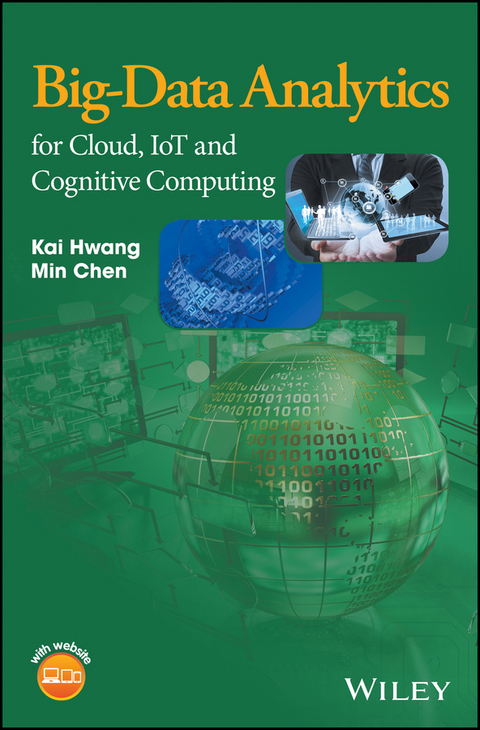
Big-Data Analytics for Cloud, IoT and Cognitive Computing (eBook)
John Wiley & Sons (Verlag)
978-1-119-24704-3 (ISBN)
The definitive guide to successfully integrating social, mobile, Big-Data analytics, cloud and IoT principles and technologies
The main goal of this book is to spur the development of effective big-data computing operations on smart clouds that are fully supported by IoT sensing, machine learning and analytics systems. To that end, the authors draw upon their original research and proven track record in the field to describe a practical approach integrating big-data theories, cloud design principles, Internet of Things (IoT) sensing, machine learning, data analytics and Hadoop and Spark programming.
Part 1 focuses on data science, the roles of clouds and IoT devices and frameworks for big-data computing. Big data analytics and cognitive machine learning, as well as cloud architecture, IoT and cognitive systems are explored, and mobile cloud-IoT-interaction frameworks are illustrated with concrete system design examples. Part 2 is devoted to the principles of and algorithms for machine learning, data analytics and deep learning in big data applications. Part 3 concentrates on cloud programming software libraries from MapReduce to Hadoop, Spark and TensorFlow and describes business, educational, healthcare and social media applications for those tools.
- The first book describing a practical approach to integrating social, mobile, analytics, cloud and IoT (SMACT) principles and technologies
- Covers theory and computing techniques and technologies, making it suitable for use in both computer science and electrical engineering programs
- Offers an extremely well-informed vision of future intelligent and cognitive computing environments integrating SMACT technologies
- Fully illustrated throughout with examples, figures and approximately 150 problems to support and reinforce learning
- Features a companion website with an instructor manual and PowerPoint slides www.wiley.com/go/hwangIOT
Big-Data Analytics for Cloud, IoT and Cognitive Computing satisfies the demand among university faculty and students for cutting-edge information on emerging intelligent and cognitive computing systems and technologies. Professionals working in data science, cloud computing and IoT applications will also find this book to be an extremely useful working resource.
Kai Hwang, PhD is Professor of Electrical Engineering and Computer Science at University of Southern California, USA. He also serves as an EMC-endowed visiting Chair Professor at Tsinghua University, China. He specializes in computer architecture, wireless Internet, cloud computing and network security.
Min Chen, PhD is Professor of Computer Science and Technology, Huazhong University of Science and Technology, China. His work focuses on IoT, mobile cloud, body area networks, healthcare big-data and cyber physical systems.
The definitive guide to successfully integrating social, mobile, Big-Data analytics, cloud and IoT principles and technologies The main goal of this book is to spur the development of effective big-data computing operations on smart clouds that are fully supported by IoT sensing, machine learning and analytics systems. To that end, the authors draw upon their original research and proven track record in the field to describe a practical approach integrating big-data theories, cloud design principles, Internet of Things (IoT) sensing, machine learning, data analytics and Hadoop and Spark programming. Part 1 focuses on data science, the roles of clouds and IoT devices and frameworks for big-data computing. Big data analytics and cognitive machine learning, as well as cloud architecture, IoT and cognitive systems are explored, and mobile cloud-IoT-interaction frameworks are illustrated with concrete system design examples. Part 2 is devoted to the principles of and algorithms for machine learning, data analytics and deep learning in big data applications. Part 3 concentrates on cloud programming software libraries from MapReduce to Hadoop, Spark and TensorFlow and describes business, educational, healthcare and social media applications for those tools. The first book describing a practical approach to integrating social, mobile, analytics, cloud and IoT (SMACT) principles and technologies Covers theory and computing techniques and technologies, making it suitable for use in both computer science and electrical engineering programs Offers an extremely well-informed vision of future intelligent and cognitive computing environments integrating SMACT technologies Fully illustrated throughout with examples, figures and approximately 150 problems to support and reinforce learning Features a companion website with an instructor manual and PowerPoint slides www.wiley.com/go/hwangIOT Big-Data Analytics for Cloud, IoT and Cognitive Computing satisfies the demand among university faculty and students for cutting-edge information on emerging intelligent and cognitive computing systems and technologies. Professionals working in data science, cloud computing and IoT applications will also find this book to be an extremely useful working resource.
Kai Hwang, PhD is Professor of Electrical Engineering and Computer Science at University of Southern California, USA. He also serves as an EMC-endowed visiting Chair Professor at Tsinghua University, China. He specializes in computer architecture, wireless Internet, cloud computing and network security. Min Chen, PhD is Professor of Computer Science and Technology, Huazhong University of Science and Technology, China. His work focuses on IoT, mobile cloud, body area networks, healthcare big-data and cyber physical systems.
Big-Data Analytics for Cloud, IoT and Cognitive Computing 3
Contents 7
About the Authors 13
Preface 15
Motivations and Objectives 15
A Quick Glance of the Book 15
Our Unique Approach 16
Building Cloud/IoT Platforms with AI Capabilities 17
Intended Audience and Readers Guide 17
Instructor Guide 18
About the Companion Website 19
Part 1 Big Data, Clouds and Internet of Things 21
1 Big Data Science and Machine Intelligence 23
1.1 Enabling Technologies for Big Data Computing 23
1.1.1 Data Science and Related Disciplines 24
1.1.2 Emerging Technologies in the Next Decade 27
1.1.3 Interactive SMACT Technologies 33
1.2 Social-Media, Mobile Networks and Cloud Computing 36
1.2.1 Social Networks and Web Service Sites 37
1.2.2 Mobile Cellular Core Networks 39
1.2.3 Mobile Devices and Internet Edge Networks 40
1.2.4 Mobile Cloud Computing Infrastructure 43
1.3 Big Data Acquisition and Analytics Evolution 44
1.3.1 Big Data Value Chain Extracted from Massive Data 44
1.3.2 Data Quality Control, Representation and Database Models 46
1.3.3 Big Data Acquisition and Preprocessing 47
1.3.4 Evolving Data Analytics over the Clouds 50
1.4 Machine Intelligence and Big Data Applications 52
1.4.1 Data Mining and Machine Learning 52
1.4.2 Big Data Applications – An Overview 54
1.4.3 Cognitive Computing – An Introduction 58
1.5 Conclusions 62
Homework Problems 62
References 63
2 Smart Clouds, Virtualization and Mashup Services 65
2.1 Cloud Computing Models and Services 65
2.1.1 Cloud Taxonomy based on Services Provided 66
2.1.2 Layered Development Cloud Service Platforms 70
2.1.3 Cloud Models for Big Data Storage and Processing 72
2.1.4 Cloud Resources for Supporting Big Data Analytics 75
2.2 Creation of Virtual Machines and Docker Containers 77
2.2.1 Virtualization of Machine Resources 78
2.2.2 Hypervisors and Virtual Machines 80
2.2.3 Docker Engine and Application Containers 82
2.2.4 Deployment Opportunity of VMs/Containers 84
2.3 Cloud Architectures and Resources Management 85
2.3.1 Cloud Platform Architectures 85
2.3.2 VM Management and Disaster Recovery 88
2.3.3 OpenStack for Constructing Private Clouds 90
2.3.4 Container Scheduling and Orchestration 94
2.3.5 VMWare Packages for Building Hybrid Clouds 95
2.4 Case Studies of IaaS, PaaS and SaaS Clouds 97
2.4.1 AWS Architecture over Distributed Datacenters 98
2.4.2 AWS Cloud Service Offerings 99
2.4.3 Platform PaaS Clouds – Google AppEngine 103
2.4.4 Application SaaS Clouds – The Salesforce Clouds 106
2.5 Mobile Clouds and Inter-Cloud Mashup Services 108
2.5.1 Mobile Clouds and Cloudlet Gateways 108
2.5.2 Multi-Cloud Mashup Services 111
2.5.3 Skyline Discovery of Mashup Services 115
2.5.4 Dynamic Composition of Mashup Services 116
2.6 Conclusions 118
Homework Problems 118
References 123
3 IoT Sensing, Mobile and Cognitive Systems 125
3.1 Sensing Technologies for Internet of Things 125
3.1.1 Enabling Technologies and Evolution of IoT 126
3.1.2 Introducing RFID and Sensor Technologies 128
3.1.3 IoT Architectural and Wireless Support 130
3.2 IoT Interactions with GPS, Clouds and Smart Machines 131
3.2.1 Local versus Global Positioning Technologies 131
3.2.2 Standalone versus Cloud-Centric IoT Applications 134
3.2.3 IoT Interaction Frameworks with Environments 136
3.3 Radio Frequency Identification (RFID) 139
3.3.1 RFID Technology and Tagging Devices 139
3.3.2 RFID System Architecture 140
3.3.3 IoT Support of Supply Chain Management 142
3.4 Sensors, Wireless Sensor Networks and GPS Systems 144
3.4.1 Sensor Hardware and Operating Systems 144
3.4.2 Sensing through Smart Phones 150
3.4.3 Wireless Sensor Networks and Body Area Networks 151
3.4.4 Global Positioning Systems 154
3.5 Cognitive Computing Technologies and Prototype Systems 159
3.5.1 Cognitive Science and Neuroinformatics 159
3.5.2 Brain-Inspired Computing Chips and Systems 160
3.5.3 Googles Brain Team Projects 162
3.5.4 IoT Contexts for Cognitive Services 165
3.5.5 Augmented and Virtual Reality Applications 166
3.6 Conclusions 169
Homework Problems 170
References 172
Part 2 Machine Learning and Deep Learning Algorithms 175
4 Supervised Machine Learning Algorithms 177
4.1 Taxonomy of Machine Learning Algorithms 177
4.1.1 Machine Learning Based on Learning Styles 178
4.1.2 Machine Learning Based on Similarity Testing 179
4.1.3 Supervised Machine Learning Algorithms 182
4.1.4 Unsupervised Machine Learning Algorithms 183
4.2 Regression Methods for Machine Learning 184
4.2.1 Basic Concepts of Regression Analysis 184
4.2.2 Linear Regression for Prediction and Forecast 186
4.2.3 Logistic Regression for Classification 189
4.3 Supervised Classification Methods 191
4.3.1 Decision Trees for Machine Learning 191
4.3.2 Rule-based Classification 195
4.3.3 The Nearest Neighbor Classifier 201
4.3.4 Support Vector Machines 203
4.4 Bayesian Network and Ensemble Methods 207
4.4.1 Bayesian Classifiers 208
4.4.2 Bayesian Belief Networks 211
4.4.3 Random Forests and Ensemble Methods 215
4.5 Conclusions 220
Homework Problems 220
References 223
5 Unsupervised Machine Learning Algorithms 225
5.1 Introduction and Association Analysis 225
5.1.1 Introduction to Unsupervised Machine Learning 225
5.1.2 Association Analysis and A priori Principle 226
5.1.3 Association Rule Generation 230
5.2 Clustering Methods without Labels 233
5.2.1 Cluster Analysis for Prediction and Forecasting 233
5.2.2 K-means Clustering for Classification 234
5.2.3 Agglomerative Hierarchical Clustering 237
5.2.4 Density-based Clustering 241
5.3 Dimensionality Reduction and Other Algorithms 245
5.3.1 Dimensionality Reduction Methods 245
5.3.2 Principal Component Analysis (PCA) 246
5.3.3 Semi-Supervised Machine Learning Methods 251
5.4 How to Choose Machine Learning Algorithms? 253
5.4.1 Performance Metrics and Model Fitting 253
5.4.2 Methods to Reduce Model Over-Fitting 257
5.4.3 Methods to Avoid Model Under-Fitting 260
5.4.4 Effects of Using Different Loss Functions 262
5.5 Conclusions 263
Homework Problems 263
References 267
6 Deep Learning with Artificial Neural Networks 269
6.1 Introduction 269
6.1.1 Deep Learning Mimics Human Senses 269
6.1.2 Biological Neurons versus Artificial Neurons 271
6.1.3 Deep Learning versus Shallow Learning 274
6.2 Artificial Neural Networks (ANN) 276
6.2.1 Single Layer Artificial Neural Networks 276
6.2.2 Multilayer Artificial Neural Network 277
6.2.3 Forward Propagation and Back Propagation in ANN 278
6.3 Stacked AutoEncoder and Deep Belief Network 284
6.3.1 AutoEncoder 284
6.3.2 Stacked AutoEncoder 287
6.3.3 Restricted Boltzmann Machine 289
6.3.4 Deep Belief Networks 295
6.4 Convolutional Neural Networks (CNN) and Extensions 297
6.4.1 Convolution in CNN 297
6.4.2 Pooling in CNN 300
6.4.3 Deep Convolutional Neural Networks 302
6.4.4 Other Deep Learning Networks 303
6.5 Conclusions 307
Homework Problems 308
References 311
Part 3 Big Data Analytics for Health-Care and Cognitive Learning 313
7 Machine Learning for Big Data in Healthcare Applications 315
7.1 Healthcare Problems and Machine Learning Tools 315
7.1.1 Healthcare and Chronic Disease Detection Problem 315
7.1.2 Software Libraries for Machine Learning Applications 318
7.2 IoT-based Healthcare Systems and Applications 319
7.2.1 IoT Sensing for Body Signals 320
7.2.2 Healthcare Monitoring System 321
7.2.3 Physical Exercise Promotion and Smart Clothing 324
7.2.4 Healthcare Robotics and Mobile Health Cloud 325
7.3 Big Data Analytics for Healthcare Applications 330
7.3.1 Healthcare Big Data Preprocessing 330
7.3.2 Predictive Analytics for Disease Detection 332
7.3.3 Performance Analysis of Five Disease Detection Methods 336
7.3.4 Mobile Big Data for Disease Control 340
7.4 Emotion-Control Healthcare Applications 342
7.4.1 Mental Healthcare System 343
7.4.2 Emotion-Control Computing and Services 343
7.4.3 Emotion Interaction through IoT and Clouds 347
7.4.4 Emotion-Control via Robotics Technologies 349
7.4.5 A 5G Cloud-Centric Healthcare System 352
7.5 Conclusions 355
Homework Problems 356
References 359
8 Deep Reinforcement Learning and Social Media Analytics 363
8.1 Deep Learning Systems and Social Media Industry 363
8.1.1 Deep Learning Systems and Software Support 363
8.1.2 Reinforcement Learning Principles 366
8.1.3 Social-Media Industry and Global Impact 367
8.2 Text and Image Recognition using ANN and CNN 368
8.2.1 Numeral Recognition using TensorFlow for ANN 369
8.2.2 Numeral Recognition using Convolutional Neural Networks 372
8.2.3 Convolutional Neural Networks for Face Recognition 376
8.2.4 Medical Text Analytics by Convolutional Neural Networks 377
8.3 DeepMind with Deep Reinforcement Learning 382
8.3.1 Google DeepMind AI Programs 382
8.3.2 Deep Reinforcement Learning Algorithm 384
8.3.3 Google AlphaGo Game Competition 387
8.3.4 Flappybird Game using Reinforcement Learning 391
8.4 Data Analytics for Social-Media Applications 395
8.4.1 Big Data Requirements in Social-Media Applications 395
8.4.2 Social Networks and Graph Analytics 397
8.4.3 Predictive Analytics Software Tools 403
8.4.4 Community Detection in Social Networks 406
8.5 Conclusions 410
Homework Problems 411
References 413
Index 415
EULA 430
| Erscheint lt. Verlag | 13.3.2017 |
|---|---|
| Sprache | englisch |
| Themenwelt | Mathematik / Informatik ► Informatik ► Netzwerke |
| Technik ► Elektrotechnik / Energietechnik | |
| Schlagworte | Big Data • Big Data Computing • big data computing on clouds</p> • big data learning algorithms • Cloud Computing • cognitive computing • cognitive computing systems • cognitive computing technologies • Computer Science • Datenanalyse • enabling technologies for big-data computing • Energie • Energy • Grid & Cloud Computing • Grid- u. Cloud-Computing • Informatik • integrated social, mobile, analytics, cloud and IoT systems • integrated social, mobile, analytics, cloud, and IoT technologies • Intelligent Computing Systems • Intelligent computing technologies • internet of things algorithms • Internet of Things Applications • Internet of Things Programming • internet of things protocols • internet of things technologies • IOT • Learning Algorithms • <p>kai hwang • machine learning • machine learning programming with hadoop • matching learning with spark • Networking • Netzwerk • Netzwerke • Parallel Computing • SMACT principles and technologies • Smart Grid • social media, mobile networks, and cloud computing • the internet of things and cloud computing |
| ISBN-10 | 1-119-24704-7 / 1119247047 |
| ISBN-13 | 978-1-119-24704-3 / 9781119247043 |
| Informationen gemäß Produktsicherheitsverordnung (GPSR) | |
| Haben Sie eine Frage zum Produkt? |
 PDF (Adobe DRM)
Kopierschutz: Adobe-DRM
Adobe-DRM ist ein Kopierschutz, der das eBook vor Mißbrauch schützen soll. Dabei wird das eBook bereits beim Download auf Ihre persönliche Adobe-ID autorisiert. Lesen können Sie das eBook dann nur auf den Geräten, welche ebenfalls auf Ihre Adobe-ID registriert sind.
Details zum Adobe-DRM
Dateiformat: PDF (Portable Document Format)
Mit einem festen Seitenlayout eignet sich die PDF besonders für Fachbücher mit Spalten, Tabellen und Abbildungen. Eine PDF kann auf fast allen Geräten angezeigt werden, ist aber für kleine Displays (Smartphone, eReader) nur eingeschränkt geeignet.
Systemvoraussetzungen:
PC/Mac: Mit einem PC oder Mac können Sie dieses eBook lesen. Sie benötigen eine
eReader: Dieses eBook kann mit (fast) allen eBook-Readern gelesen werden. Mit dem amazon-Kindle ist es aber nicht kompatibel.
Smartphone/Tablet: Egal ob Apple oder Android, dieses eBook können Sie lesen. Sie benötigen eine
Geräteliste und zusätzliche Hinweise
Buying eBooks from abroad
For tax law reasons we can sell eBooks just within Germany and Switzerland. Regrettably we cannot fulfill eBook-orders from other countries.
aus dem Bereich