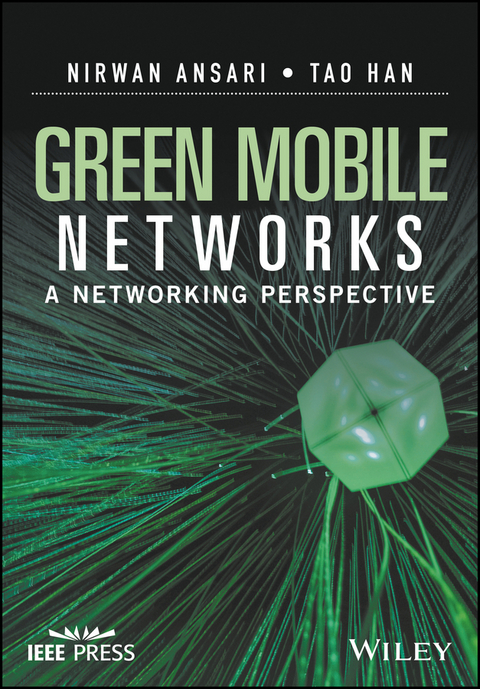
Green Mobile Networks (eBook)
John Wiley & Sons (Verlag)
978-1-119-12511-2 (ISBN)
Green communications is a very hot topic. As mobile networks evolve in terms of higher rates/throughput, a consequent impact on operating costs is due to (aggregate) network energy consumption. As such, design on 4G networks and beyond have increasingly started to focus on `energy efficiency' or so-called 'green' networks. Many techniques and solutions have been proposed to enhance the energy efficiency of mobile networks, yet no book has provided an in-depth analysis of the energy consumption issues in mobile networks nor has detailed theories, tools and solutions for solving the energy efficiency problems.
This book presents the techniques and solutions for enhancing energy efficiency of future mobile networks, and consists of three major parts. The first part presents a general description of mobile network evolution in terms of both capacity and energy efficiency. The second part discusses the advanced techniques to green mobile networks. The third part discusses the solutions that enhance mobile network energy efficiency as well as provides future directions. Whilst the reader is expected to have basic knowledge of wireless communications, the authors present a brief introduction of the evolution of mobile networks, providing the knowledge base for understanding the content of the book. In addition, complicated network problems are illustrated using simple examples. This will help the reader understand the concept and intuition of various techniques and solutions.
- Incorporates the latest research results from both academia and industry, providing an up-to-date overview of existing technologies and solutions on making mobile networks greener
- Consists of three sections with a gradually increasing technical depth on green mobile networks, providing the reader with a systematic view of the research area, and helping those with different technical backgrounds to better understand the content
- Covers existing enabling technologies for green mobile networking, including an innovative discussion of state-of-the-art solutions and algorithms
Nirwan Ansari, New Jersey Institute of Technology, USA
Tao Han, University of North Carolina at Charlotte, USA
Green communications is a very hot topic. As mobile networks evolve in terms of higher rates/throughput, a consequent impact on operating costs is due to (aggregate) network energy consumption. As such, design on 4G networks and beyond have increasingly started to focus on `energy efficiency or so-called green networks. Many techniques and solutions have been proposed to enhance the energy efficiency of mobile networks, yet no book has provided an in-depth analysis of the energy consumption issues in mobile networks nor has detailed theories, tools and solutions for solving the energy efficiency problems. This book presents the techniques and solutions for enhancing energy efficiency of future mobile networks, and consists of three major parts. The first part presents a general description of mobile network evolution in terms of both capacity and energy efficiency. The second part discusses the advanced techniques to green mobile networks. The third part discusses the solutions that enhance mobile network energy efficiency as well as provides future directions. Whilst the reader is expected to have basic knowledge of wireless communications, the authors present a brief introduction of the evolution of mobile networks, providing the knowledge base for understanding the content of the book. In addition, complicated network problems are illustrated using simple examples. This will help the reader understand the concept and intuition of various techniques and solutions. Incorporates the latest research results from both academia and industry, providing an up-to-date overview of existing technologies and solutions on making mobile networks greener Consists of three sections with a gradually increasing technical depth on green mobile networks, providing the reader with a systematic view of the research area, and helping those with different technical backgrounds to better understand the content Covers existing enabling technologies for green mobile networking, including an innovative discussion of state-of-the-art solutions and algorithms
Nirwan Ansari, New Jersey Institute of Technology, USA Tao Han, University of North Carolina at Charlotte, USA
Green Mobile Networks 3
Contents 7
Preface 11
List of Abbreviations 13
Part I Green Mobile Networking Technologies 17
1 Fundamental Green Networking Technologies 19
1.1 Energy Efficient Multi-cell Cooperation 19
1.2 Heterogeneous Networking 20
1.3 Mobile Traffic Offloading 22
1.3.1 Infrastructure Based Mobile Traffic Offloading 23
1.3.2 Ad-hoc Based Mobile Traffic Offloading 23
1.3.3 User–BS Associations in Heterogeneous Mobile Networks 23
1.4 Device-to-Device Communications and Proximity Services 24
1.5 Powering Mobile Networks With Renewable Energy 25
1.6 Green Communications via Cognitive Radio Communications 25
1.7 Green Communications via Optimizing Mobile Content Delivery 27
2 Multi-cell Cooperation Communications 31
2.1 Traffic Intensity Aware Multi-cell Cooperation 31
2.1.1 Cooperation to Estimate Traffic Demands 33
2.1.2 Cooperation to Optimize Switching Off Strategy 34
2.2 Energy Aware Multi-cell Cooperation 35
2.3 Energy Efficient CoMP Transmission 35
2.3.1 Increasing Energy Efficiency for Cell Edge Communications 35
2.3.2 Enabling More BSs Into Sleep Mode 38
2.4 Summary and Future Research 38
2.4.1 Coalition Formation 39
2.4.2 Green Energy Utilization 40
2.4.3 Incentive Mechanism 40
2.5 Questions 40
3 Powering Mobile Networks with Green Energy 41
3.1 Green Energy Models: Generation and Consumption 41
3.1.1 Green Power Generation 41
3.1.2 Mobile Network Energy Consumption 41
3.2 Green Energy Powered Mobile Base Stations 42
3.2.1 Green Energy Provisioning 42
3.2.2 Base Station Resource Management 43
3.3 Green Energy Powered Mobile Networks 44
3.3.1 Off-Grid Green Mobile Networks 45
3.3.2 On-Grid Green Mobile Networks 46
3.3.3 Mixture of Green Base Stations and Grid Powered Base Stations 47
3.4 Summary 48
3.5 Questions 48
4 Spectrum and Energy Harvesting Wireless Networks 49
4.1 Spectrum Harvesting Techniques 49
4.1.1 Energy Efficiency in Spectrum Harvesting Networks 50
4.1.2 Enhancing Energy Efficiency Through Spectrum Harvesting 55
4.2 Energy Harvesting Techniques 60
4.2.1 Green Energy Harvesting Models 60
4.2.2 Green Energy Utilization and Optimization 62
4.2.3 Cognitive Functionalities in Energy Harvesting 63
4.3 FreeNet: Spectrum and Energy Harvesting Wireless Networks 66
4.3.1 FreeNet Application Scenarios 67
4.3.2 Dynamic Network Architecture Optimization 69
4.3.3 Communication Protocol Suite Design 73
4.4 Summary 74
4.5 Questions 74
Part II Green Mobile Networking Solutions 75
5 Energy and Spectrum Efficient Mobile Traffic Offloading 77
5.1 Centralized Energy Spectrum Trading Algorithm 79
5.1.1 System Model and Problem Formulation 80
5.1.2 A Heuristic Power Consumption Minimization Algorithm 83
5.2 Auction-Based Decentralized Algorithm 86
5.2.1 An Auction-Based EST Scheme 88
5.3 Performance Evaluation 97
5.3.1 Centralized Energy Spectrum Trading Algorithm 97
5.3.2 Auction-Based Decentralized Algorithm 103
5.4 Summary 106
5.5 Questions 106
6 Optimizing Green Energy Utilization for Mobile Networks with Hybrid Energy Supplies 107
6.1 Green Energy Optimization Scheme for Mobile Networks With Hybrid Energy Supplies 107
6.1.1 System Model and Problem Formulation 109
6.1.2 Problem Formulation 111
6.1.3 The GEO Algorithm 115
6.1.4 Performance Evaluation 122
6.2 Optimal Renewable Energy Provisioning for BSs 126
6.2.1 Related Work on Provisioning the Green Power System 127
6.2.2 System Model and Problem Formulation 128
6.2.3 The Green Energy Provisioning Solution 132
6.2.4 Performance Evaluation 139
6.3 Summary 144
6.4 Questions 144
7 Energy Aware Traffic Load Balancing in Mobile Networks 145
7.1 Traffic Load Balancing in Mobile Networks 145
7.2 ICE: Intelligent Cell brEathing to Optimize the Utilization of Green Energy 147
7.2.1 Problem Formulation 148
7.2.2 The ICE Algorithm 149
7.2.3 ICE Algorithm Performance 151
7.3 Energy- and QoS-Aware Traffic Load Balancing 154
7.3.1 System Model and Problem Formulation 155
7.3.2 vGALA: A Green Energy and Latency Aware Load Balancing Scheme 160
7.3.3 Properties of vGALA 163
7.3.4 The Practicality of the vGALA Scheme 168
7.3.5 The Admission Control Mechanism 170
7.3.6 Performance Evaluation 171
7.4 Energy Efficient Traffic Load Balancing in Backhaul Constrained Small Cell Networks 181
7.4.1 System Model and Problem Formulation 182
7.4.2 Network Utility Aware Traffic Load Balancing 187
7.4.3 Performance Evaluation 192
7.5 Traffic Load Balancing in Smart Grid Enabled Mobile Networks 201
7.5.1 System Model and Problem Formulation 205
7.5.2 An Approximation Solution 207
7.5.3 Performance Evaluation 213
7.6 Summary 216
7.7 Questions 217
8 Enhancing Energy Efficiency via Device-to-Device Proximity Services 219
8.1 Energy Efficient Cooperative Wireless Multicasting 221
8.1.1 System Model and Problem Formulation 221
8.1.2 Gradient Guided Algorithm 222
8.1.3 Performance Evaluation 223
8.2 Green Relay Assisted D2D Communications 228
8.2.1 System Model and Problem Formulation 228
8.2.2 A Heuristic Green Relay Assignment Algorithm 230
8.3 Green Content Brokerage 237
8.3.1 Problem Formulation and Analysis 240
8.3.2 The Heuristic Traffic Offloading Algorithm 242
8.3.3 Performance Evaluation 248
8.4 Summary 252
8.5 Questions 253
9 Greening Mobile Networks via Optimizing the Efficiency of Content Delivery 255
9.1 Mobile Network Measurements 256
9.1.1 Packet Retransmission 256
9.1.2 Queuing in Mobile Core Networks 256
9.1.3 Network Asymmetry 257
9.1.4 Queue Management 257
9.1.5 First Packet Delay 258
9.1.6 TCP Flaws 258
9.1.7 Application Misbehavior 259
9.1.8 Mobile Devices 259
9.1.9 User Mobility 260
9.2 Mobile System Evolution 260
9.2.1 EUTRAN 261
9.2.2 Integrating Mobile Networks and CDN 263
9.3 Content and Network Optimization 263
9.3.1 Content Domain Techniques 263
9.3.2 Network Domain Techniques 265
9.3.3 Cross Domain Techniques 278
9.4 Mobile Data Offloading 280
9.4.1 Direct Data Offloading 280
9.4.2 Network Aggregation 281
9.5 Web Content Delivery Acceleration System 282
9.5.1 Web Acceleration System 283
9.6 Multimedia Content Delivery Acceleration 288
9.6.1 Adaptive Streaming 289
9.6.2 Other Methods 291
9.7 Summary 293
9.8 Questions 293
References 295
Index 315
| Erscheint lt. Verlag | 16.3.2017 |
|---|---|
| Reihe/Serie | IEEE Press | Wiley - IEEE |
| Sprache | englisch |
| Themenwelt | Naturwissenschaften ► Biologie ► Ökologie / Naturschutz |
| Naturwissenschaften ► Geowissenschaften | |
| Technik ► Elektrotechnik / Energietechnik | |
| Technik ► Nachrichtentechnik | |
| Schlagworte | 5G • Communications technology • Communication technology • Communication Technology - Networks • D2D • Device to Device • Drahtlose Kommunikation • Electrical & Electronics Engineering • Elektrotechnik u. Elektronik • Green communication • Green Networks • Kommunikationsnetze • Kommunikationstechnik • Mobile & Wireless Communications • mobile technology • Networks |
| ISBN-10 | 1-119-12511-1 / 1119125111 |
| ISBN-13 | 978-1-119-12511-2 / 9781119125112 |
| Informationen gemäß Produktsicherheitsverordnung (GPSR) | |
| Haben Sie eine Frage zum Produkt? |
 PDF (Adobe DRM)
Kopierschutz: Adobe-DRM
Adobe-DRM ist ein Kopierschutz, der das eBook vor Mißbrauch schützen soll. Dabei wird das eBook bereits beim Download auf Ihre persönliche Adobe-ID autorisiert. Lesen können Sie das eBook dann nur auf den Geräten, welche ebenfalls auf Ihre Adobe-ID registriert sind.
Details zum Adobe-DRM
Dateiformat: PDF (Portable Document Format)
Mit einem festen Seitenlayout eignet sich die PDF besonders für Fachbücher mit Spalten, Tabellen und Abbildungen. Eine PDF kann auf fast allen Geräten angezeigt werden, ist aber für kleine Displays (Smartphone, eReader) nur eingeschränkt geeignet.
Systemvoraussetzungen:
PC/Mac: Mit einem PC oder Mac können Sie dieses eBook lesen. Sie benötigen eine
eReader: Dieses eBook kann mit (fast) allen eBook-Readern gelesen werden. Mit dem amazon-Kindle ist es aber nicht kompatibel.
Smartphone/Tablet: Egal ob Apple oder Android, dieses eBook können Sie lesen. Sie benötigen eine
Geräteliste und zusätzliche Hinweise
Buying eBooks from abroad
For tax law reasons we can sell eBooks just within Germany and Switzerland. Regrettably we cannot fulfill eBook-orders from other countries.
aus dem Bereich