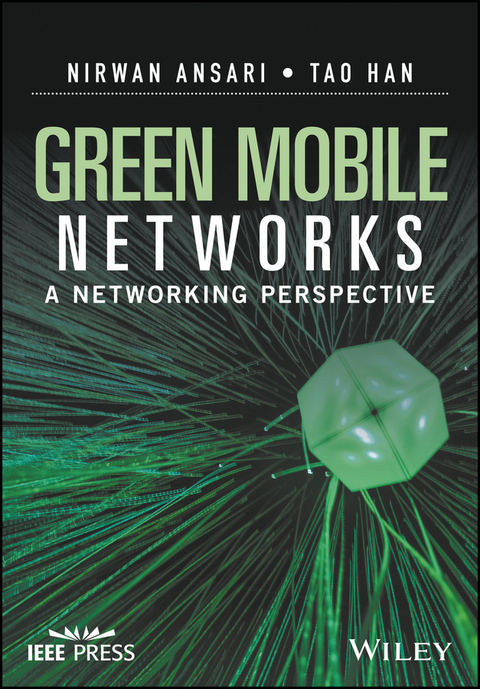
Green Mobile Networks (eBook)
John Wiley & Sons (Verlag)
978-1-119-12512-9 (ISBN)
Green communications is a very hot topic. As mobile networks evolve in terms of higher rates/throughput, a consequent impact on operating costs is due to (aggregate) network energy consumption. As such, design on 4G networks and beyond have increasingly started to focus on `energy efficiency' or so-called 'green' networks. Many techniques and solutions have been proposed to enhance the energy efficiency of mobile networks, yet no book has provided an in-depth analysis of the energy consumption issues in mobile networks nor has detailed theories, tools and solutions for solving the energy efficiency problems.
This book presents the techniques and solutions for enhancing energy efficiency of future mobile networks, and consists of three major parts. The first part presents a general description of mobile network evolution in terms of both capacity and energy efficiency. The second part discusses the advanced techniques to green mobile networks. The third part discusses the solutions that enhance mobile network energy efficiency as well as provides future directions. Whilst the reader is expected to have basic knowledge of wireless communications, the authors present a brief introduction of the evolution of mobile networks, providing the knowledge base for understanding the content of the book. In addition, complicated network problems are illustrated using simple examples. This will help the reader understand the concept and intuition of various techniques and solutions.
- Incorporates the latest research results from both academia and industry, providing an up-to-date overview of existing technologies and solutions on making mobile networks greener
- Consists of three sections with a gradually increasing technical depth on green mobile networks, providing the reader with a systematic view of the research area, and helping those with different technical backgrounds to better understand the content
- Covers existing enabling technologies for green mobile networking, including an innovative discussion of state-of-the-art solutions and algorithms
Nirwan Ansari, New Jersey Institute of Technology, USA
Tao Han, University of North Carolina at Charlotte, USA
Green communications is a very hot topic. As mobile networks evolve in terms of higher rates/throughput, a consequent impact on operating costs is due to (aggregate) network energy consumption. As such, design on 4G networks and beyond have increasingly started to focus on `energy efficiency or so-called green networks. Many techniques and solutions have been proposed to enhance the energy efficiency of mobile networks, yet no book has provided an in-depth analysis of the energy consumption issues in mobile networks nor has detailed theories, tools and solutions for solving the energy efficiency problems. This book presents the techniques and solutions for enhancing energy efficiency of future mobile networks, and consists of three major parts. The first part presents a general description of mobile network evolution in terms of both capacity and energy efficiency. The second part discusses the advanced techniques to green mobile networks. The third part discusses the solutions that enhance mobile network energy efficiency as well as provides future directions. Whilst the reader is expected to have basic knowledge of wireless communications, the authors present a brief introduction of the evolution of mobile networks, providing the knowledge base for understanding the content of the book. In addition, complicated network problems are illustrated using simple examples. This will help the reader understand the concept and intuition of various techniques and solutions. Incorporates the latest research results from both academia and industry, providing an up-to-date overview of existing technologies and solutions on making mobile networks greener Consists of three sections with a gradually increasing technical depth on green mobile networks, providing the reader with a systematic view of the research area, and helping those with different technical backgrounds to better understand the content Covers existing enabling technologies for green mobile networking, including an innovative discussion of state-of-the-art solutions and algorithms
Nirwan Ansari, New Jersey Institute of Technology, USA Tao Han, University of North Carolina at Charlotte, USA
1
Fundamental Green Networking Technologies
As cellular network infrastructures and mobile devices proliferate, an increasing number of users rely on cellular networks for their daily lives. Mobile networks are among the major energy guzzlers of information communications technology (ICT) infrastructure, and their contributions to global energy consumption are accelerating rapidly because of the dramatic surge in mobile data traffic [1, 2, 3, 4]. This growing energy consumption not only escalates the operators’ operational expenditure (OPEX) but also leads to a significant rise of their carbon footprints. Therefore, greening of mobile networks is becoming a necessity to bolster social, environmental, and economic sustainability [5, 6, 7, 8]. In this chapter, we give an overview of the fundamental green networking technologies.
1.1 Energy Efficient Multi-cell Cooperation
The energy consumption of a cellular network is mainly drawn from base stations (BSs), which account for more than 50% of the energy consumption of the network. Thus, improving energy efficiency of BSs is crucial to green cellular networks. Taking advantage of multi-cell cooperation, energy efficiency of cellular networks can be improved from three perspectives. The first is to reduce the number of active BSs required to serve users in an area [9]. The solutions involve adapting the network layout according to traffic demands. The idea is to switch off BSs when their traffic loads are below a certain threshold for a certain period of time. When some BSs are switched off, radio coverage and service provisioning are taken care of by their neighboring cells.
The second aspect is to connect users with green BSs powered by renewable energy. Through multi-cell cooperation, off-grid BSs enlarge their service areas while on-grid BSs shrink their service areas. Zhou et al. [10] proposed a handover parameter tuning algorithm and a power control algorithm to guide mobile users to connect with BSs powered by renewable energy, thus reducing on-grid power expenses. Han and Ansari [11] proposed an energy aware cell size adaptation algorithm named ICE. This algorithm balances the energy consumption among BSs, enables more users to be served with green energy, and therefore reduces on-grid energy consumption. Envisioning future BSs to be powered by multiple types of energy sources, for example, the grid, solar energy, and wind energy, Han and Ansari [12] proposed optimizing the utilization of green energy for cellular networks by cell size optimization. The proposed algorithm achieves significant main grid energy savings by scheduling green energy consumption in the time domain for individual BSs, and balancing green energy consumption among BSs for the cellular network.
The third aspect is to exploit coordinated multi-point (CoMP) transmissions to improve energy efficiency of cellular networks [13]. On the one hand, with the aid of multi-cell cooperation, energy efficiency of BSs on serving cell edge users is increased. On the other hand, the coverage area of BSs can be expanded by adopting multi-cell cooperation, thus further reducing the number of active BSs required to cover a certain area. In addition to discussing multi-cell cooperation solutions, we investigate the challenges for multi-cell cooperation in future cellular networks.
1.2 Heterogeneous Networking
The energy consumption of mobile networks scales with the provisioned traffic capacity. On deploying a mobile network, two types of BSs may be deployed. They are macro BSs (MBSs) and small cell BSs (SCBSs). As compared with SCBSs, MBSs provide a larger convergence area and consume more energy. SCBSs are deployed close to users, and thus consume less energy by leveraging such proximity. Owing to a small coverage area, in order to guarantee traffic capacity in an area, a very large number of SCBSs must be deployed. The total energy consumption of the large number of SCBSs may exceed that of the MBSs. Hence, in order to improve the energy efficiency of the network, a mixed deployment of both MBSs and SCBSs is desirable. In general, there are two SCBS deployment strategies: deployed at cell edges and at traffic hot spots.
- The users located at the edge of a macro cell usually experience bad radio channels due to excessive channel fading. In order to provide service to these users, MBSs could increase their transmit power, but this will result in a low energy efficiency. In a heterogeneous network deployment, SCBSs can be deployed at the edge of macro cells as shown in Figures 1.1–1.4. Depending on the traffic capacity demand, different SCBS deployment strategies can be adopted. For example, when the traffic capacity demand is relatively low, one SCBS may be deployed at the edge of a macro cell to serve the cell edge users as shown in Figure 1.1. As the traffic increases, additional SCBSs can be deployed at the cell edge as shown in Figs. 1.2 and 1.3. When the traffic capacity demand is very high, additional SCBSs should be deployed. For example, five SCBSs are deployed for enhancing the energy efficiency of serving cell edge users in Figure 1.4. The number of SCBSs that are deployed to enhance the energy efficiency of serving users located at the edges of macro cells should be optimized based on traffic capacity demand at the cell edge.
- When the traffic capacity demand in mobile networks is inhomogeneous, deploying SCBSs at the edges of macro cells may not be optimal. Instead, SCBSs can be deployed in areas where there is high traffic capacity demand such as shopping areas, stadiums, and public parks. We define such areas as hotspots. Owing to proximity to the users, SCBSs can provide very high capacity at hotspots and serve the traffic demand with low energy consumption. In order to deploy SCBSs at traffic hotspots to enhance energy efficiency, the distribution of traffic capacity demand should be understood from network measurements. In addition, the traffic capacity demand should be localized so that a large portion of the traffic demand can be offloaded to SCBSs. In the ideal case, MBSs are only serving users with high moving speed while all the other users are served by SCBSs. If the high traffic demand occurs indoors, the indoor deployment of SCBSs can significantly enhance the energy efficiency of mobile networks.
Figure 1.1 Scenario 1: One SCBS per macro site.
Figure 1.2 Scenario 2: Two SCBSs per macro site.
Figure 1.3 Scenario 3: Three SCBSs per macro site.
Figure 1.4 Scenario 4: Five SCBSs per macro site.
1.3 Mobile Traffic Offloading
Mobile traffic offloading, which is referred to as utilizing complementary network communications techniques to deliver mobile traffic, is a promising technique to alleviate congestion and reduce the energy consumption of mobile networks. Based on the network access mode, mobile traffic offloading schemes can be divided into two categories. The first category is infrastructure based mobile traffic offloading, which refers to deploying SCBSs, for example, pico BSs, femto BSs and WiFi hot spots, to offload mobile traffic from MBS [14, 15]. SCBSs usually consume much less power than MBSs. Therefore, offloading mobile traffic to SCBSs can significantly enhance the energy efficiency of mobile networks [6, 16]. However, the lack of cost-effective backhaul connections for SCBSs often impairs their performance in terms of offloading mobile traffic and enhancing the energy efficiency of mobile networks. The second category is ad-hoc based mobile traffic offloading, which refers to applying device-to-device (D2D) communications as an underlay to offload mobile traffic from MBSs. By leveraging Internet of Things (IoT) technologies, smart devices within proximity are able to connect with each other and form a communication network. Data traffic among the devices can be offloaded to the communication networks rather than delivering through MBSs. Moreover, in order to reduce CO2 footprints, mobile traffic can be offloaded to BSs powered by green energy such as sustainable biofuels, solar, and wind energy [17, 12, 10, 18]. In this way, green energy utilization is maximized, and thus the consumption of on-grid energy is minimized. In this section, we briefly overview the related research on mobile traffic offloading and the solutions for user–BS associations in heterogeneous mobile networks.
1.3.1 Infrastructure Based Mobile Traffic Offloading
In infrastructure based mobile traffic offloading, the mobile traffic is offloaded to either pico/femto BSs or WiFi hot spots. Deploying pico/femto BSs improves the spectral and energy efficiency per unit area of cellular networks, and thus reduces the network congestion and energy consumption of cellular networks. Traffic offloading between pico/femto BSs and the MBS is achieved by adapting user–BS associations. Kim et al. [19] proposed a user–BS association to achieve flow level load balancing under spatially heterogeneous traffic distribution. Jo et al. [20] proposed cell biasing algorithms to balance traffic loads among pico/femto BSs and the MBS. The cell biasing algorithms perform user–BS association according to the biased measured pilot signal strength, and enable traffic to be offloaded from the MBS to pico/femto BSs.
WiFi hot spots are also effective in terms of offloading mobile traffic. Lee et al. [21] pointed out that a user is in WiFi coverage for 70% of...
| Erscheint lt. Verlag | 22.3.2017 |
|---|---|
| Reihe/Serie | IEEE Press |
| Wiley - IEEE | Wiley - IEEE |
| Sprache | englisch |
| Themenwelt | Naturwissenschaften ► Biologie ► Ökologie / Naturschutz |
| Naturwissenschaften ► Geowissenschaften | |
| Technik ► Elektrotechnik / Energietechnik | |
| Technik ► Nachrichtentechnik | |
| Schlagworte | 5G • Communications technology • Communication technology • Communication Technology - Networks • D2D • Device to Device • Drahtlose Kommunikation • Electrical & Electronics Engineering • Elektrotechnik u. Elektronik • Green communication • Green Networks • Kommunikationsnetze • Kommunikationstechnik • Mobile & Wireless Communications • mobile technology • Networks |
| ISBN-10 | 1-119-12512-X / 111912512X |
| ISBN-13 | 978-1-119-12512-9 / 9781119125129 |
| Informationen gemäß Produktsicherheitsverordnung (GPSR) | |
| Haben Sie eine Frage zum Produkt? |
 EPUB (Adobe DRM)
Kopierschutz: Adobe-DRM
Adobe-DRM ist ein Kopierschutz, der das eBook vor Mißbrauch schützen soll. Dabei wird das eBook bereits beim Download auf Ihre persönliche Adobe-ID autorisiert. Lesen können Sie das eBook dann nur auf den Geräten, welche ebenfalls auf Ihre Adobe-ID registriert sind.
Details zum Adobe-DRM
Dateiformat: EPUB (Electronic Publication)
EPUB ist ein offener Standard für eBooks und eignet sich besonders zur Darstellung von Belletristik und Sachbüchern. Der Fließtext wird dynamisch an die Display- und Schriftgröße angepasst. Auch für mobile Lesegeräte ist EPUB daher gut geeignet.
Systemvoraussetzungen:
PC/Mac: Mit einem PC oder Mac können Sie dieses eBook lesen. Sie benötigen eine
eReader: Dieses eBook kann mit (fast) allen eBook-Readern gelesen werden. Mit dem amazon-Kindle ist es aber nicht kompatibel.
Smartphone/Tablet: Egal ob Apple oder Android, dieses eBook können Sie lesen. Sie benötigen eine
Geräteliste und zusätzliche Hinweise
Buying eBooks from abroad
For tax law reasons we can sell eBooks just within Germany and Switzerland. Regrettably we cannot fulfill eBook-orders from other countries.
aus dem Bereich