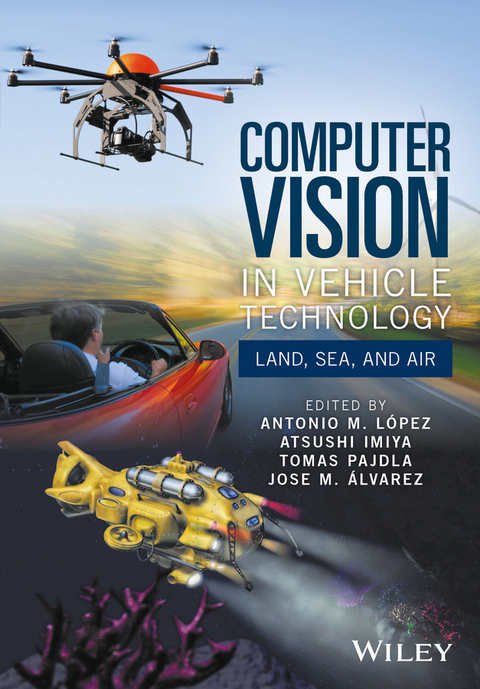
Computer Vision in Vehicle Technology (eBook)
John Wiley & Sons (Verlag)
978-1-118-86804-1 (ISBN)
A unified view of the use of computer vision technology for different types of vehicles
Computer Vision in Vehicle Technology focuses on computer vision as on-board technology, bringing together fields of research where computer vision is progressively penetrating: the automotive sector, unmanned aerial and underwater vehicles. It also serves as a reference for researchers of current developments and challenges in areas of the application of computer vision, involving vehicles such as advanced driver assistance (pedestrian detection, lane departure warning, traffic sign recognition), autonomous driving and robot navigation (with visual simultaneous localization and mapping) or unmanned aerial vehicles (obstacle avoidance, landscape classification and mapping, fire risk assessment).
The overall role of computer vision for the navigation of different vehicles, as well as technology to address on-board applications, is analysed.
Key features:
- Presents the latest advances in the field of computer vision and vehicle technologies in a highly informative and understandable way, including the basic mathematics for each problem.
- Provides a comprehensive summary of the state of the art computer vision techniques in vehicles from the navigation and the addressable applications points of view.
- Offers a detailed description of the open challenges and business opportunities for the immediate future in the field of vision based vehicle technologies.
This is essential reading for computer vision researchers, as well as engineers working in vehicle technologies, and students of computer vision.
Dr. Antonio M. López is the head of the Advanced Driver Assistance Systems (ADAS) Group of the Computer Vision Center (CVC), and Associate Professor of the Computer Science Department, both from the Universitat Autònoma de Barcelona (UAB). Antonio received a BSc degree in Computer Science from the Universitat Politècnica de Catalunya (UPC) and a PhD degree in Computer Vision from the Universitat Autònoma de Barcelona (UAB). In 1996, he participated in the foundation of the CVC at the UAB, where he has held different institutional responsibilities. Antonio is also the responsible of the Software Engineering specialty at the UAB. Moreover, he has been the principal investigator of numerous public and industrial research projects, and is a co-author of more than 100 journal and conference papers, all in the field of computer vision. Antonio's main research interests are vision-based driver assistance and autonomous driving.
Atsushi Imiya is Professor at IMIT, Chiba University. He has served as a PC member of DGCI, IWCIA, and SSVM conferences for many years. He is an editorial member of 'Pattern Recognition (Journal)' and a co-editor of 'Digital and Image Geometry' held at Schloss Dagstuhl in 2000, MLDM2007 (Machine Learning and Data Mining in Pattern Recognition), of which proceedings were published from Springer-Verlag. He is a general co-chair of S+SSPR (Statistical, and Synthetic and Structural Pattern Recognition) 2012. He is participating in a government-funded project titled: 'Computational anatomy for computer-aided diagnosis and therapy: Frontiers of medical image sciences' as an applied mathematician. He also serves as a review committee of the research projects internationally.
Dr. Tomas Pajdla is an Assistant Professor and Distinguished Senior Researcher at the Czech Technical University in Prague. He works in geometry and algebra of computer vision and robotics with the emphasis on geometry a calibration of camera systems, 3D reconstruction and industrial vision. Dr. Pajdla published more than 75 works in journals and proceedings and received awards for his work; OAGM 1998, 2012, BMVC 2002, ICCV 2005 and ACCV 2014. He has served as a program co-chair of ECCV 2004 and ECCV 2014, and regularly as area chair of ICCV, CVPR, ECCV, ACCV, ICRA and BMVC. He is a member of the ECCV Board, and served on the boards of IEEE PAMI, Computer Vision and Image Understanding and IPSJ Transactions on Computer Vision and Applications journals. Dr. Pajdla has connections to the planetary research community through EU projects with NASA, ESA and EADS Astrium and to automotive industry via Daimler AG.
Jose M. Alvarez is currently a researcher at NICTA and a research fellow at the Australian National University, Canberra, Australia. Previously, he was a postdoctoral researcher at the Computational and Biological Learning Group at New York University with Professor Yann LeCun. During his Ph.D. he was a visiting researcher at the University of Amsterdam and Volkswagen AG research. His main research interests include deep learning and data driven methods for dynamic scene understanding.
A unified view of the use of computer vision technology for different types of vehicles Computer Vision in Vehicle Technology focuses on computer vision as on-board technology, bringing together fields of research where computer vision is progressively penetrating: the automotive sector, unmanned aerial and underwater vehicles. It also serves as a reference for researchers of current developments and challenges in areas of the application of computer vision, involving vehicles such as advanced driver assistance (pedestrian detection, lane departure warning, traffic sign recognition), autonomous driving and robot navigation (with visual simultaneous localization and mapping) or unmanned aerial vehicles (obstacle avoidance, landscape classification and mapping, fire risk assessment). The overall role of computer vision for the navigation of different vehicles, as well as technology to address on-board applications, is analysed. Key features: Presents the latest advances in the field of computer vision and vehicle technologies in a highly informative and understandable way, including the basic mathematics for each problem. Provides a comprehensive summary of the state of the art computer vision techniques in vehicles from the navigation and the addressable applications points of view. Offers a detailed description of the open challenges and business opportunities for the immediate future in the field of vision based vehicle technologies. This is essential reading for computer vision researchers, as well as engineers working in vehicle technologies, and students of computer vision.
Dr. Antonio M. López is the head of the Advanced Driver Assistance Systems (ADAS) Group of the Computer Vision Center (CVC), and Associate Professor of the Computer Science Department, both from the Universitat Autònoma de Barcelona (UAB). Antonio received a BSc degree in Computer Science from the Universitat Politècnica de Catalunya (UPC) and a PhD degree in Computer Vision from the Universitat Autònoma de Barcelona (UAB). In 1996, he participated in the foundation of the CVC at the UAB, where he has held different institutional responsibilities. Antonio is also the responsible of the Software Engineering specialty at the UAB. Moreover, he has been the principal investigator of numerous public and industrial research projects, and is a co-author of more than 100 journal and conference papers, all in the field of computer vision. Antonio's main research interests are vision-based driver assistance and autonomous driving. Atsushi Imiya is Professor at IMIT, Chiba University. He has served as a PC member of DGCI, IWCIA, and SSVM conferences for many years. He is an editorial member of "Pattern Recognition (Journal)" and a co-editor of "Digital and Image Geometry" held at Schloss Dagstuhl in 2000, MLDM2007 (Machine Learning and Data Mining in Pattern Recognition), of which proceedings were published from Springer-Verlag. He is a general co-chair of S+SSPR (Statistical, and Synthetic and Structural Pattern Recognition) 2012. He is participating in a government-funded project titled: "Computational anatomy for computer-aided diagnosis and therapy: Frontiers of medical image sciences" as an applied mathematician. He also serves as a review committee of the research projects internationally. Dr. Tomas Pajdla is an Assistant Professor and Distinguished Senior Researcher at the Czech Technical University in Prague. He works in geometry and algebra of computer vision and robotics with the emphasis on geometry a calibration of camera systems, 3D reconstruction and industrial vision. Dr. Pajdla published more than 75 works in journals and proceedings and received awards for his work; OAGM 1998, 2012, BMVC 2002, ICCV 2005 and ACCV 2014. He has served as a program co-chair of ECCV 2004 and ECCV 2014, and regularly as area chair of ICCV, CVPR, ECCV, ACCV, ICRA and BMVC. He is a member of the ECCV Board, and served on the boards of IEEE PAMI, Computer Vision and Image Understanding and IPSJ Transactions on Computer Vision and Applications journals. Dr. Pajdla has connections to the planetary research community through EU projects with NASA, ESA and EADS Astrium and to automotive industry via Daimler AG. Jose M. Alvarez is currently a researcher at NICTA and a research fellow at the Australian National University, Canberra, Australia. Previously, he was a postdoctoral researcher at the Computational and Biological Learning Group at New York University with Professor Yann LeCun. During his Ph.D. he was a visiting researcher at the University of Amsterdam and Volkswagen AG research. His main research interests include deep learning and data driven methods for dynamic scene understanding.
Cover 1
Title Page 5
Copyright 6
Contents 7
List of Contributors 11
Preface 13
Abbreviations and Acronyms 15
Chapter 1 Computer Vision in Vehicles 17
1.1 Adaptive Computer Vision for Vehicles 17
1.1.1 Applications 17
1.1.2 Traffic Safety and Comfort 18
1.1.3 Strengths of (Computer) Vision 18
1.1.4 Generic and Specific Tasks 19
1.1.5 Multi-module Solutions 20
1.1.6 Accuracy, Precision, and Robustness 21
1.1.7 Comparative Performance Evaluation 21
1.1.8 There Are Many Winners 22
1.2 Notation and Basic Definitions 22
1.2.1 Images and Videos 22
1.2.2 Cameras 24
1.2.3 Optimization 26
1.3 Visual Tasks 28
1.3.1 Distance 28
1.3.2 Motion 32
1.3.3 Object Detection and Tracking 34
1.3.4 Semantic Segmentation 37
1.4 Concluding Remarks 39
Acknowledgments 39
Chapter 2 Autonomous Driving 40
2.1 Introduction 40
2.1.1 The Dream 40
2.1.2 Applications 41
2.1.3 Level of Automation 42
2.1.4 Important Research Projects 43
2.1.5 Outdoor Vision Challenges 46
2.2 Autonomous Driving in Cities 47
2.2.1 Localization 49
2.2.2 Stereo Vision-Based Perception in 3D 52
2.2.3 Object Recognition 59
2.3 Challenges 65
2.3.1 Increasing Robustness 65
2.3.2 Scene Labeling 66
2.3.3 Intention Recognition 68
2.4 Summary 68
Acknowledgments 70
Chapter 3 Computer Vision for MAVs 71
3.1 Introduction 71
3.2 System and Sensors 73
3.3 Ego-Motion Estimation 74
3.3.1 State Estimation Using Inertial and Vision Measurements 74
3.3.2 MAV Pose from Monocular Vision 78
3.3.3 MAV Pose from Stereo Vision 79
3.3.4 MAV Pose from Optical Flow Measurements 81
3.4 3D Mapping 83
3.5 Autonomous Navigation 87
3.6 Scene Interpretation 88
3.7 Concluding Remarks 89
Chapter 4 Exploring the Seafloor with Underwater Robots 91
4.1 Introduction 91
4.2 Challenges of Underwater Imaging 93
4.3 Online Computer Vision Techniques 95
4.3.1 Dehazing 95
4.3.2 Visual Odometry 100
4.3.3 SLAM 103
4.3.4 Laser Scanning 107
4.4 Acoustic Imaging Techniques 108
4.4.1 Image Formation 108
4.4.2 Online Techniques for Acoustic Processing 111
4.5 Concluding Remarks 114
Acknowledgments 115
Chapter 5 Vision-Based Advanced Driver Assistance Systems 116
5.1 Introduction 116
5.2 Forward Assistance 117
5.2.1 Adaptive Cruise Control (ACC) and Forward Collision Avoidance (FCA) 117
5.2.2 Traffic Sign Recognition (TSR) 119
5.2.3 Traffic Jam Assist (TJA) 121
5.2.4 Vulnerable Road User Protection 122
5.2.5 Intelligent Headlamp Control 125
5.2.6 Enhanced Night Vision (Dynamic Light Spot) 126
5.2.7 Intelligent Active Suspension 127
5.3 Lateral Assistance 128
5.3.1 Lane Departure Warning (LDW) and Lane Keeping System (LKS) 128
5.3.2 Lane Change Assistance (LCA) 131
5.3.3 Parking Assistance 132
5.4 Inside Assistance 133
5.4.1 Driver Monitoring and Drowsiness Detection 133
5.5 Conclusions and Future Challenges 135
5.5.1 Robustness 135
5.5.2 Cost 137
Acknowledgments 137
Chapter 6 Application Challenges from a Bird's-Eye View 138
6.1 Introduction to Micro Aerial Vehicles (MAVs) 138
6.1.1 Micro Aerial Vehicles (MAVs) 138
6.1.2 Rotorcraft MAVs 139
6.2 GPS-Denied Navigation 140
6.2.1 Autonomous Navigation with Range Sensors 140
6.2.2 Autonomous Navigation with Vision Sensors 141
6.2.3 SFLY: Swarm of Micro Flying Robots 142
6.2.4 SVO, a Visual-Odometry Algorithm for MAVs 142
6.3 Applications and Challenges 143
6.3.1 Applications 143
6.3.2 Safety and Robustness 144
6.4 Conclusions 148
Chapter 7 Application Challenges of Underwater Vision 149
7.1 Introduction 149
7.2 Offline Computer Vision Techniques for Underwater Mapping and Inspection 150
7.2.1 2D Mosaicing 150
7.2.2 2.5D Mapping 160
7.2.3 3D Mapping 162
7.2.4 Machine Learning for Seafloor Classification 170
7.3 Acoustic Mapping Techniques 173
7.4 Concluding Remarks 175
Chapter 8 Closing Notes 177
References 180
Index 211
EULA 218
| Erscheint lt. Verlag | 17.2.2017 |
|---|---|
| Sprache | englisch |
| Themenwelt | Informatik ► Theorie / Studium ► Künstliche Intelligenz / Robotik |
| Technik ► Elektrotechnik / Energietechnik | |
| Technik ► Fahrzeugbau / Schiffbau | |
| Schlagworte | Autonomous Driving • autonomous navigation • Bild- u. Videoverarbeitung • computer vision • Electrical & Electronics Engineering • Elektrotechnik u. Elektronik • Fahrzeugtechnik • Image and Video Processing • Maschinelles Sehen • Micro Aerial Vehicle (MAV) • On-board vision systems • Robotics • Robotik • Rover • Seafloor Rovers • Underwater Imaging • unmanned aerial vehicle • Vision-based Driver Assistance Systems |
| ISBN-10 | 1-118-86804-8 / 1118868048 |
| ISBN-13 | 978-1-118-86804-1 / 9781118868041 |
| Informationen gemäß Produktsicherheitsverordnung (GPSR) | |
| Haben Sie eine Frage zum Produkt? |
 PDF (Adobe DRM)
Kopierschutz: Adobe-DRM
Adobe-DRM ist ein Kopierschutz, der das eBook vor Mißbrauch schützen soll. Dabei wird das eBook bereits beim Download auf Ihre persönliche Adobe-ID autorisiert. Lesen können Sie das eBook dann nur auf den Geräten, welche ebenfalls auf Ihre Adobe-ID registriert sind.
Details zum Adobe-DRM
Dateiformat: PDF (Portable Document Format)
Mit einem festen Seitenlayout eignet sich die PDF besonders für Fachbücher mit Spalten, Tabellen und Abbildungen. Eine PDF kann auf fast allen Geräten angezeigt werden, ist aber für kleine Displays (Smartphone, eReader) nur eingeschränkt geeignet.
Systemvoraussetzungen:
PC/Mac: Mit einem PC oder Mac können Sie dieses eBook lesen. Sie benötigen eine
eReader: Dieses eBook kann mit (fast) allen eBook-Readern gelesen werden. Mit dem amazon-Kindle ist es aber nicht kompatibel.
Smartphone/Tablet: Egal ob Apple oder Android, dieses eBook können Sie lesen. Sie benötigen eine
Geräteliste und zusätzliche Hinweise
Buying eBooks from abroad
For tax law reasons we can sell eBooks just within Germany and Switzerland. Regrettably we cannot fulfill eBook-orders from other countries.
aus dem Bereich