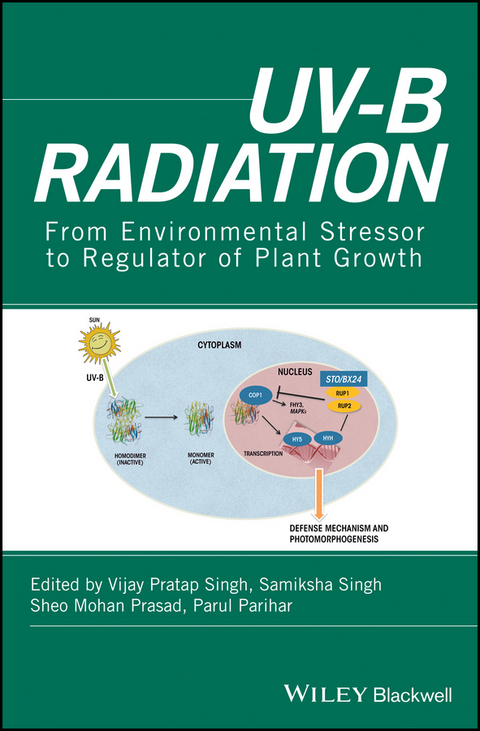
Ultraviolet-B (UV-B) is electromagnetic radiation coming from the sun, with a medium wavelength which is mostly absorbed by the ozone layer. The biological effects of UV-B are greater than simple heating effects, and many practical applications of UV-B radiation derive from its interactions with organic molecules. It is considered particularly harmful to the environment and living things, but what have scientific studies actually shown?
UV-B Radiation: From Environmental Stressor to Regulator of Plant Growth presents a comprehensive overview of the origins, current state, and future horizons of scientific research on ultraviolet-B radiation and its perception in plants. Chapters explore all facets of UV-B research, including the basics of how UV-B's shorter wavelength radiation from the sun reaches the Earth's surface, along with its impact on the environment's biotic components and on human biological systems. Chapters also address the dramatic shift in UV-B research in recent years, reflecting emerging technologies, showing how historic research which focused exclusively on the harmful environmental effects of UV-B radiation has now given way to studies on potential benefits to humans. Topics include:
- UV-B and its climatology
- UV-B and terrestrial ecosystems
- Plant responses to UV-B stress
- UB- B avoidance mechanisms
- UV-B and production of secondary metabolites
- Discovery of UVR8
Timely and important, UV-B Radiation: From Environmental Stressor to Regulator of Plant Growth is an invaluable resource for environmentalists, researchers and students who are into the state-of-the-art research being done on exposure to UV-B radiation.
ABOUT THE EDITORS
VIJAY PRATAP SINGH is Assistant Professor, Govt. Ramanuj Pratap Singhdev Post Graduate College, Chhattisgarh, India.
SAMIKSHA SINGH is Research Scholar, Ranjan Plant Physiology and Biochemistry Laboratory, Department of Botany, University of Allahabad, India.
SHEO MOHAN PRASAD is Professor, Ranjan Plant Physiology and Biochemistry Laboratory, Department of Botany, University of Allahabad, India.
PARUL PARIHAR is Research Scholar, Ranjan Plant Physiology and Biochemistry Laboratory, Department of Botany, University of Allahabad, India.
Ultraviolet-B (UV-B) is electromagnetic radiation coming from the sun, with a medium wavelength which is mostly absorbed by the ozone layer. The biological effects of UV-B are greater than simple heating effects, and many practical applications of UV-B radiation derive from its interactions with organic molecules. It is considered particularly harmful to the environment and living things, but what have scientific studies actually shown? UV-B Radiation: From Environmental Stressor to Regulator of Plant Growth presents a comprehensive overview of the origins, current state, and future horizons of scientific research on ultraviolet-B radiation and its perception in plants. Chapters explore all facets of UV-B research, including the basics of how UV-B's shorter wavelength radiation from the sun reaches the Earth's surface, along with its impact on the environment's biotic components and on human biological systems. Chapters also address the dramatic shift in UV-B research in recent years, reflecting emerging technologies, showing how historic research which focused exclusively on the harmful environmental effects of UV-B radiation has now given way to studies on potential benefits to humans. Topics include: UV-B and its climatology UV-B and terrestrial ecosystems Plant responses to UV-B stress UB- B avoidance mechanisms UV-B and production of secondary metabolites Discovery of UVR8 Timely and important, UV-B Radiation: From Environmental Stressor to Regulator of Plant Growth is an invaluable resource for environmentalists, researchers and students who are into the state-of-the-art research being done on exposure to UV-B radiation.
ABOUT THE EDITORS VIJAY PRATAP SINGH is Assistant Professor, Govt. Ramanuj Pratap Singhdev Post Graduate College, Chhattisgarh, India. SAMIKSHA SINGH is Research Scholar, Ranjan Plant Physiology and Biochemistry Laboratory, Department of Botany, University of Allahabad, India. SHEO MOHAN PRASAD is Professor, Ranjan Plant Physiology and Biochemistry Laboratory, Department of Botany, University of Allahabad, India. PARUL PARIHAR is Research Scholar, Ranjan Plant Physiology and Biochemistry Laboratory, Department of Botany, University of Allahabad, India.
Title Page 5
Copyright Page 6
Contents 9
List of Contributors 17
Preface 21
Chapter 1 An Introduction to UV-B Research in Plant Science 23
1.1 The Historical Background 23
1.2 Biologically Effective Irradiance 24
1.3 UV-B-induced Effects in Plants 25
1.4 Conclusion and Future Perspectives 27
Acknowledgements 28
References 28
Chapter 2 Stimulation of Various Phenolics in Plants Under Ambient UV-B Radiation 31
2.1 Introduction 31
2.2 UV-B Radiation 32
2.3 Phenolics 34
2.3.1 Chemistry of Phenolic Compounds 35
2.3.2 Biosynthesis and Subcellular Localization of Phenolics 35
2.3.3 Functions of Phenolic Compounds Depend on Their Localization 37
2.4 UV-B Radiation Stimulates Phenolic Induction 40
2.4.1 Mechanisms of UV-B Perception 40
2.4.2 UV-B-Induced Accumulation of Phenolic Compounds 42
2.4.3 Interactive Effects of UV-B with UV-A Radiation and PAR on Phenolics Accumulation 51
2.4.4 Interactive Effects of UV-B Radiation with other Environmental Factors on Phenolics Accumulation 52
2.5 UV-B-Induced Photomorphological Responses 53
2.5.1 Connection Between UV-B-Induced Morphological Responses and Phenolics 54
2.5.2 Effect of UV-B Radiation on Root Morphology in Relation to Phenolics 55
2.6 Photosynthesis Under UV-B Radiation 55
2.6.1 Interplay of Phenolics and Photosynthesis Under UV-B Radiation 56
2.7 UV-B Radiation Induces Phenolics Accumulation in Fruits 59
2.8 Conclusion and Future Perspectives 60
References 61
Chapter 3 UV-B Radiation: A Reassessment of its Impact on Plants and Crops 79
3.1 Introduction 79
3.2 Plant Production 80
3.3 Plant Protection Against UV-B 82
References 82
Chapter 4 Interaction of UV-B with the Terrestrial Ecosystem 87
4.1 Introduction 87
4.2 Growth and Development 88
4.3 Secondary Metabolites 89
4.4 Susceptibility to Herbivorous Insects 89
4.5 Plant Sexual Reproduction 89
4.6 Genomic Level 90
4.7 Conclusion 91
References 92
Chapter 5 A Review on Responses of Plants to UV-B Radiation Related Stress 97
5.1 Introduction 97
5.2 Morphological and Yield Response to UV-B 98
5.3 Targets of UV-B in the Carbon Fixation Cycle 101
5.4 Photoreceptors and Signalling Pathway in Response to UV-B Radiation 102
5.5 Acclimatization and Protection in Response to UV-B 104
5.6 Oxidative Stress and Antioxidant System in Response to UV-B 104
5.7 DNA Damage and Repair Mechanism 105
5.8 Exclusion of UV Components: Experimental Approach to Study the Effect on Plants 107
5.9 Conclusion and Future Perspectives 108
Acknowledgement 109
References 109
Chapter 6 Oxidative Stress and Antioxidative Defence System in Plants in Response to UV-B Stress 121
6.1 Introduction 121
6.2 Plant Protection Against UV Radiation 123
6.3 UV-B and ROS 125
6.4 UV-B and Antioxidant Enzymes 126
6.5 UV-B and Antioxidant 129
6.6 UV-B and Signalling 130
6.7 Conclusion and Future Perspectives 132
References 133
Chapter 7 Major influence on phytochrome and photosynthetic machinery under UV-B exposure 145
7.1 Introduction 145
7.2 Photomorphogenesis in Higher Plants 146
7.2.1 Phytochrome system and its interaction with UV-B 146
7.2.2 Photomorphogenic responses of UV-B 147
7.2.3 UV-B signal transduction (UVR8) 149
7.3 Effect of UV-B Exposure on Photosynthetic Machinery 150
7.3.1 Direct effects of UV- B on photosynthetic machinery 150
7.3.1.1 Effects of UV-B stress on components involved in light reaction 150
7.3.1.2 Effect of UV-B stress on photosystems and cytochrome b6/f complex 151
7.3.2 Indirect effect of UV-B stress on components involved in dark reaction 154
7.3.2.1 Impact on regulation of stomata and Rubisco enzyme 154
7.3.3 UV-B induced ROS production in plants 155
7.3.4 Protective adaptation 155
7.4 Conclusion and Future Perspectives 157
References 158
Chapter 8 UV-B Radiation-Induced Damage of Photosynthetic Apparatus of Green Leaves: Protective Strategies vis-a-vis Visible and/or UV-A Light 165
8.1 Introduction 165
8.2 UV-B Effects on the Photosynthetic Apparatus of Leaves 165
8.3 UV-A Effects on Photosynthetic Apparatus of Leaves (Damage and Promotion) 167
8.4 UV-A-Mediated Modulation of UV-B-Induced Damage 167
8.5 PAR-Mediated Balancing of UV-B-Induced Damage 168
8.6 Photosynthetic Adaptation and Acclimation to UV-B Radiation 168
8.7 Corroboration with Sensible Approach 169
8.8 Conclusion 171
Acknowledgements 171
References 171
Chapter 9 Ultraviolet Radiation Targets in the Cellular System:: Current Status and Future Directions 177
9.1 Introduction 177
9.2 Absorption Characteristics of Biomolecules 178
9.3 Action Spectrum 178
9.4 Targets of UV-B 179
9.4.1 Interaction with Nucleic acids 179
9.4.1.1 Deoxyribonucleic Acids 180
9.4.1.2 Ribonucleic Acids 181
9.4.2 Proteins 181
9.4.2.1 Tryptophan (Trp) 182
9.4.2.2 Tyrosine (Tyr) 182
9.4.2.3 Phenylalanine (Phe) 184
9.4.2.4 Histidine (His) 184
9.5 The Photosynthetic Machinery 185
9.5.1 Photosystem I and II 186
9.5.2 The Light-Harvesting Complexes 187
9.6 Cell Division and Expansion 189
9.7 Conclusion and Future Perspectives 190
Acknowledgements 191
References 191
Chapter 10 Silicon: A Potential Element to Combat Adverse Impact of UV-B in plants 197
10.1 Introduction 197
10.2 The role of Silicon Against UV-B Exposure on Morphology of Plants 200
10.3 The defensive role of silicon against UV-B exposure on physiological and biochemical traits of plants 201
10.4 Silicon repairs anatomical structures of plants damaged by UV-B exposures 202
10.5 UV-B-induced oxidative stress and silicon supplementation in plants 203
10.6 Silicon supplementation and the status of antioxidant enzymes in plants exposed to UV-B 205
10.7 Silicon and level of phenolic compounds under UV-B stress 206
10.8 Conclusion and future Perspectives 208
References 209
Chapter 11 Sun-Screening Biomolecules in Microalgae: Role in UV-Photoprotection 219
11.1 Introduction 219
11.2 Global Climate Change and UV Radiation 220
11.3 Effects of UV Radiation on Microalgae 221
11.4 UV-induced Defence Mechanisms 223
11.5 Sun-Screening Biomolecules as Key UV Photoprotectants 223
11.5.1 Mycosporine-Like Amino Acids (MAAs) 224
11.5.2 Scytonemin 226
11.6 UV-Induced Biosynthesis 228
11.7 Photoprotective Function 229
11.8 Conclusion 230
Acknowledgements 230
References 230
Chapter 12 Plant Response: UV-B Avoidance Mechanisms 239
12.1 Introduction 239
12.2 Ultraviolet Radiation: Common Source, Classification and Factors 241
12.2.1 Common Sources of UVR 241
12.2.2 Classification 241
12.2.3 Environmental Factors Affecting UV Level 242
12.3 UV-B and Human Health 242
12.3.1 Effects on the Skin 242
12.3.2 Effects on the Eyes 242
12.4 UV-B and Plant Responses 242
12.4.1 Morphological Responses 242
12.4.1.1 Visible Symptoms 242
12.4.1.2 Plant Growth and Leaf Phenology 243
12.4.1.3 Reproductive Morphology 244
12.4.1.4 UV-B-induced photomorphogenesis 244
12.4.2 Leaf Ultrastructure and Anatomy 244
12.4.3 Crop Yield 245
12.4.4 Photosynthesis 247
12.4.4.1 Pigments 247
12.4.4.2 Photosynthetic Machinery 247
12.4.5 Biochemical Responses 248
12.4.5.1 ROS Production in Plants 248
12.4.5.2 Free Radical Scavenging Mechanism 249
12.4.6 Molecular Responses 249
12.4.6.1 UV-B and Genes 249
12.4.6.1.1 Genes Damaged by UV Radiation 250
12.4.6.1.2 DNA Damage 250
12.4.6.2 UV and Proteins 252
12.4.6.2.1 Amino acids 253
12.5 UV-B Avoidance and Defence Mechanism 256
12.5.1 Avoidance at Morphological Level 256
12.5.1.1 Epicuticular Waxes 256
12.5.2 Avoidance at Biochemical Level 257
12.5.2.1 Possible Role of Pectin Endocytosis in UV-B Avoidance 257
12.5.3 Avoidance at the Molecular Level 258
12.5.3.1 DNA Repair 258
12.5.3.2 Genes and Avoidance 259
12.5.3.3 UV-B Perceived by UVR8 Strongly Inhibits Shade Avoidance 259
12.5.4 UV-B and Secondary Metabolites 260
12.5.4.1 Plant Phenolics 260
12.5.4.2 Anthocyanin 261
12.5.4.3 Alkaloids 262
12.5.4.4 Isoprenoids 262
12.5.4.5 Glucosinolates 262
12.6 UV-B and its Significance 262
12.6.1 Ecological Significance 262
12.6.2 UV-B and Plant Competition 263
12.7 Conclusion and Future Perspectives 264
Acknowledgments 265
References 266
Chapter 13 Impact of UV-B Exposure on Phytochrome and Photosynthetic Machinery: From Cyanobacteria to Plants 281
13.1 Introduction 281
13.2 Effect of UV-B Irradiation on Photosynthetic Machinery of Cyanobacteria 282
13.2.1 Pigments 282
13.2.2 Photosynthetic Electron Transport System 283
13.2.3 Photophosphorylation and CO2 fixation 284
13.3 Effect of UV-B Irradiation on Photosynthetic Machinery of Algae 284
13.4 Effect of UV-B Irradiation on Photosynthetic Machinery of Higher Plants 286
13.4.1 Pigments 286
13.4.1.1 Phytochrome 286
13.4.1.2 Chlorophylls, carotenoids and other pigments 287
13.4.2 Photosystem II 287
13.4.2.1 Oxygen-evolving complex 288
13.4.2.2 Plastoquinones and redox-active tyrosines 288
13.4.2.3 D1 and D2 proteins 289
13.4.3 Photosystem I 289
13.4.4 Cytochrome b6/f complex, ATP synthase and Rubisco 289
13.4.5 Net photosynthesis 290
13.5 Conclusion and future perspectives 290
Acknowledgements 290
References 291
Chapter 14 Discovery of UVR8: New Insight in UV-B Research 301
14.1 Introduction 301
14.2 Photoperception in Plants 302
14.3 Discovery of UVR8: UV-B Photoreceptor 302
14.4 UVR8 Structure 303
14.4.1 Salt Bridge Interactions Mediate UVR8 Dimerization 303
14.4.2 Chromophore and Key Tryptophan Residues 303
14.5 Physiological Roles of UVR8 305
14.5.1 Photomorphogenic Response Regulation by UVR8 305
14.5.2 Regulation of Flavonoid Biosynthesis 306
14.5.3 Plant-Pathogen and Plant-Herbivore Interactions 306
14.6 Conclusion and Future Perspectives 306
References 307
Chapter 15 UVR8 Signalling, Mechanism and Integration with other Pathways 311
15.1 Introduction 311
15.2 UVR8-Arbitrated Signalling 312
15.2.1 Constitutively Photomorphogenic 1 (COP1) 312
15.2.2 Elongated Hypocotyl 5 (HY5) and HYH 313
15.2.3 Repressor of UV-B Photomorphogenesis 1 (RUP1) 314
15.3 Molecular Mechanism of Photoreceptor?Mediated Signalling 315
15.4 UVR8 Involvements in Different Pathways 318
15.4.1 Protection from Photo?Inhibition and Photo Oxidative Stress 319
15.4.2 Flavonoid and Alkaloid Pathways 320
15.4.3 DNA Damage Repair 321
15.4.4 Defence Against Pathogens 321
15.4.5 Inhibition of Plant Shade Avoidance 322
15.4.6 Regulation of Leaf Morphogenesis 322
15.4.7 Regulation of Root Growth and Development 322
15.4.8 Circadian Clock 323
15.5 Conclusion and Future Perspectives 323
Acknowledgements 324
References 324
Index 331
EULA 342
| Erscheint lt. Verlag | 2.2.2017 |
|---|---|
| Sprache | englisch |
| Themenwelt | Naturwissenschaften ► Biologie ► Botanik |
| Naturwissenschaften ► Biologie ► Ökologie / Naturschutz | |
| Technik ► Umwelttechnik / Biotechnologie | |
| Schlagworte | Applications • Biochemie • biochemistry • Biological effects • Biowissenschaften • Botanik • considered • Electromagnetic • Environment • Environmental Science • Environmental Studies • greater • Interactions • Layer • Life Sciences • many • medium wavelength • Molecules • Mostly • organic • Ozone • plant science • Practical • Radiation • radiation derive • Simple • Sun • ultravioletb • Umweltforschung • Umweltwissenschaften • UVB |
| ISBN-13 | 9781119143635 / 9781119143635 |
| Informationen gemäß Produktsicherheitsverordnung (GPSR) | |
| Haben Sie eine Frage zum Produkt? |
 PDF (Adobe DRM)
Kopierschutz: Adobe-DRM
Adobe-DRM ist ein Kopierschutz, der das eBook vor Mißbrauch schützen soll. Dabei wird das eBook bereits beim Download auf Ihre persönliche Adobe-ID autorisiert. Lesen können Sie das eBook dann nur auf den Geräten, welche ebenfalls auf Ihre Adobe-ID registriert sind.
Details zum Adobe-DRM
Dateiformat: PDF (Portable Document Format)
Mit einem festen Seitenlayout eignet sich die PDF besonders für Fachbücher mit Spalten, Tabellen und Abbildungen. Eine PDF kann auf fast allen Geräten angezeigt werden, ist aber für kleine Displays (Smartphone, eReader) nur eingeschränkt geeignet.
Systemvoraussetzungen:
PC/Mac: Mit einem PC oder Mac können Sie dieses eBook lesen. Sie benötigen eine
eReader: Dieses eBook kann mit (fast) allen eBook-Readern gelesen werden. Mit dem amazon-Kindle ist es aber nicht kompatibel.
Smartphone/Tablet: Egal ob Apple oder Android, dieses eBook können Sie lesen. Sie benötigen eine
Geräteliste und zusätzliche Hinweise
Buying eBooks from abroad
For tax law reasons we can sell eBooks just within Germany and Switzerland. Regrettably we cannot fulfill eBook-orders from other countries.
aus dem Bereich