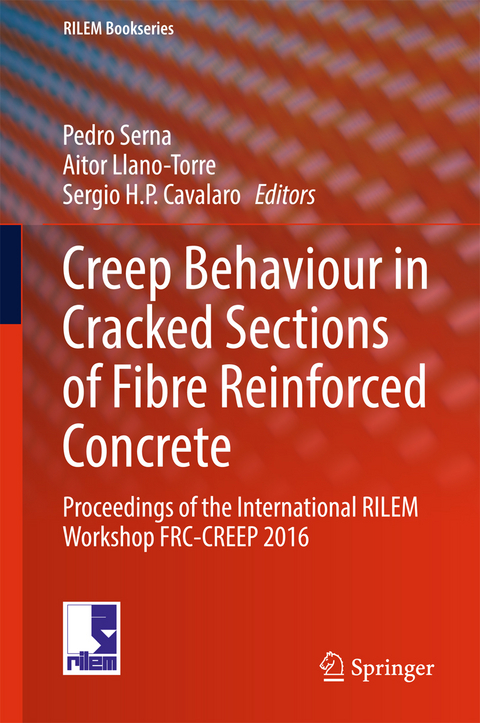
Creep Behaviour in Cracked Sections of Fibre Reinforced Concrete (eBook)
XIII, 249 Seiten
Springer Netherlands (Verlag)
978-94-024-1001-3 (ISBN)
This is the first publication ever focusing strictly on the creep behaviour in cracked sections of Fibre Reinforced Concrete (FRC). These proceedings contain the latest scientific papers about new testing methodologies, results and conclusions of multiple experimental campaigns and recommendations about significant factors of long-term behaviour, experiences from more than ten years of creep testing and some reflections about future perspectives on this topic. This book is an essential reference for all researchers of creep behaviour on FRC.
This volume is the result of the efforts of the RILEM TC 261-CCF, that has been working since 2014 to develop standardized methodologies and guidelines to compare results from different laboratories and get a better understanding of the significant parameters related to creep of FRC.
This is the first publication ever focusing strictly on the creep behaviour in cracked sections of Fibre Reinforced Concrete (FRC). These proceedings contain the latest scientific papers about new testing methodologies, results and conclusions of multiple experimental campaigns and recommendations about significant factors of long-term behaviour, experiences from more than ten years of creep testing and some reflections about future perspectives on this topic. This book is an essential reference for all researchers of creep behaviour on FRC.This volume is the result of the efforts of the RILEM TC 261-CCF, that has been working since 2014 to develop standardized methodologies and guidelines to compare results from different laboratories and get a better understanding of the significant parameters related to creep of FRC.
Preface 6
Committees 8
Organizing Committee 8
Honorary Chairman 8
Scientific Committee 8
Institutions and Sponsors 10
Contents 11
Keynote Lectures 14
1 Factors Influencing Creep of Cracked Fibre Reinforced Concrete: What We Think We Know & What We Do Not Know
Abstract 15
1 Introduction 15
2 Effect of Load, Temperature and Humidity 16
3 Progressive Pull-Out Mechanisms 17
3.1 Damage Due to Anchorage Failure in Deformed Fibres 18
3.2 Filament or Individual Fibre Creep or Relaxation 19
4 Crack Propagation Due to Relaxation of Cohesive Stresses 20
5 Relevance of Wide Cracks 22
6 Conclusions 23
Acknowledgments 23
References 23
2 Creep Testing Methodologies and Results Interpretation 25
Abstract 25
1 Introduction 25
2 Pull-Out Tests 27
3 Uniaxial Tension Tests 27
4 Bending Tests 30
4.1 Test Setup 30
4.2 Interpretation of Results 32
5 Plate Tests 33
6 Conclusions 33
Acknowledgments 34
References 34
Influence of Fibre Type on Creep 37
3 Flexural Creep Tests on Beams—8 Years of Experience with Steel and Synthetic Fibres 38
Abstract 38
1 Introduction 38
2 Literature Review on Flexural Creep Testing on Beams 39
2.1 Discussion of Test Procedure 42
3 Investigations at the OTH 43
3.1 Testing Post Crack Behaviour 44
3.2 Flexural Creep Test 44
3.3 Discussion and Possible Improvements 46
3.4 Concrete Mix Design 46
4 Results of Creep Tests 46
4.1 Failure Mode 49
5 Conclusions 50
Acknowledgments 50
References 50
4 Experiences from 14 Years of Creep Testing of Steel and Polymer Fiber Reinforced Concrete 51
Abstract 51
1 Introduction 51
2 Materials 52
3 Test Programs 53
3.1 Statically Determinate Beam Test 53
3.2 Statically Indeterminate Plate Test 55
4 Program Results and Discussion 58
4.1 Statically Determinate Beam Test 58
4.2 Statically Indeterminate Plate Test 59
5 Conclusions 61
References 62
5 Creep Deformations of Structural Polymeric Macrofibers 63
Abstract 63
1 Introduction 63
2 Experimental Setup 64
2.1 Material Characterization 64
2.2 Creep Frame 65
2.3 Creep Specimens 66
3 Results 66
3.1 Material Characterization 66
3.2 Creep Deformations 67
4 Discussion 68
5 Conclusions 70
Acknowledgments 70
References 70
6 Tensile Creep of Cracked Steel Fibre Reinforced Concrete: Mechanisms on the Single Fibre and at the Macro Level 72
Abstract 72
1 Introduction 72
2 Test Setup 73
2.1 Single Fibre Pull-Out Tests 73
2.2 Single Fibre Pull-Out Creep Test Setup 74
2.3 Uni-Axial Tensile Test Setup 75
2.4 Uni-Axial Tensile Creep Test Setup 75
2.5 Drying Shrinkage Test Setup 76
3 Materials and Test Programme 77
3.1 Materials and Mix Design 77
3.2 Single Fibre Tests 78
3.3 Uni-Axial Tensile Creep Tests 78
4 Test Results 78
4.1 Single Fibre Pull-Out Rate Tests 78
4.2 Single Fibre Pull-Out Creep Tests 79
4.3 Uni-Axial Tensile Creep Tests 81
4.4 Pre-Damaged Single Fibre Pull-Out Creep Tests 82
5 Conclusions 83
References 83
7 Flexural Post-cracking Creep Behaviour of Macro-synthetic and Steel Fiber Reinforced Concrete 85
Abstract 85
1 Introduction 85
2 Experimental Method 86
2.1 Materials and Mix Design 86
2.2 Test Procedure 87
3 Experimental Results and Discussion 91
3.1 Creep Crack Width Results 91
3.2 Creep Coefficient Results 93
4 Conclusions 94
References 95
Creep on Special Materials 96
8 Behavior of Cracked Cross-Section of Fibre Reinforced UHPFRC Under Sustained Load 97
Abstract 97
1 Introduction 97
2 Experimental Program 99
3 UHPFRC Material Behaviour 101
3.1 Preliminary Sustained Load Tests 103
4 Fibre Orientation and Computed Tomography 103
5 Conclusions 104
Acknowledgments 105
References 105
9 Experimental Study on Time-Dependent Behavior of Cracked UHP-FRCC Under Sustained Loads 106
Abstract 106
1 Introduction 107
2 Employed UHP-FRCC in This Study 107
3 Experimental Program 108
4 Results and Discussion 110
5 Conclusions 113
Acknowledgments 114
References 114
10 Creep Behaviour of Cracked High Performance Fibre Reinforced Concrete Beams Under Flexural Load 115
Abstract 115
1 Introduction 115
2 Design of the Frame 116
3 Experimental Program 118
3.1 Materials and Concrete Mix 118
3.2 Pre-cracking and Loading Sequence 119
4 Results 122
4.1 Evolution of the Deflection 122
4.2 Evolution of the Creep Coefficient 123
5 Conclusions 126
Acknowledgments 127
References 127
11 Time-Dependent Flexural Behaviour of SFRSCC Elements 128
Abstract 128
1 Introduction 128
2 Experimental Programme 129
2.1 Concrete Composition 129
2.2 Specimens 130
2.3 Test Setup 130
2.4 Assessment of the Fibre Orientation and Distribution 132
3 Results and Discussion 133
3.1 Fibre Orientation and Distribution 133
3.2 Long-Term Four-Point Bending Test 133
3.3 Influence of the Loading Ratio on the Creep Behaviour 134
3.4 Influence of Notch Plane Orientation on the Creep Behaviour 135
3.5 Influence of Distance from the Casting Point on the Creep Behaviour 136
3.6 Comparison Between Monotonic and Long-Term Behaviour 137
4 Analytical Equation to Predict the SFRSCC Creep Behaviour 138
5 Conclusions 139
Acknowledgments 139
References 139
Creep Testing Methods 141
12 Effect of Residual Strength Parameters on FRC Flexural Creep: Multivariate Analysis 142
Abstract 142
1 Introduction 142
2 Overview of Data and Methodology 143
2.1 Summary of the Information Collected 143
2.2 Treatment of Missing Values 144
3 Multivariate Description of FRC Mechanical Performance 144
3.1 Bivariate Correlations 145
3.2 Principal Component Analysis (PCA) 145
3.3 Redefinition of the Variables Characterising FRC Mixes 146
4 Multiple Regression Analysis 146
4.1 Definition of Regressors 146
4.2 Summary of the MLR Models Obtained 147
5 Discussion of the Models for Creep Coefficients 148
5.1 Effect of Concrete Compressive Strength 148
5.2 Effect of Loading Ratio and Fibre Material 149
5.3 Effect of the Flexural Toughness 150
6 Discussion of the Models for the Crack Opening Rates 151
6.1 Effect of Load Ratio and Fibre Material 151
6.2 Effect of Flexural Toughness 152
7 Conclusions 153
References 153
13 Mid-term Behaviour of Fibre Reinforced Sprayed Concrete Submitted To Flexural Loading 155
Abstract 155
1 Introduction 155
2 Test Method to Evaluate the Mid-term Behaviour of Frsc Submitted to Flexural Loading 156
3 Experimental Programme 158
3.1 Testing Programme 158
3.2 Concrete Mix Design 158
3.3 Concrete Reinforcements 159
3.4 Application 159
3.5 Basic Characteristics 160
4 Main Results 160
4.1 Consistency of the Experimental Loads 160
4.2 Pre-cracking Phase 161
4.3 Mid-term Deflections Under Constant Load 161
4.4 Energy Absorption Capacity Before and After Creep Test 163
4.5 Contribution of Reinforcements Prior to the Softening Phase 165
5 Conclusion, Perspectives 166
Acknowledgments 167
References 167
14 Effect of Beam Width on the Creep Behaviour of Cracked Fibre Reinforced Concrete 168
Abstract 168
1 Introduction 168
2 Experimental Program 169
3 Test Results and Analysis 171
3.1 Characterization Tests and Pre-cracking Process 171
3.2 Creep Tests 171
4 Effect of Long Term Loads on FRC Residual Strength Properties 174
5 Effect of the Content of Fibres in the Cracked Section 175
6 Conclusions 176
Acknowledgments 177
References 177
15 Macro-Synthetic Fibre Reinforced Concrete: Creep and Creep Mechanisms 178
Abstract 178
1 Introduction 178
2 Materials and Methods 180
2.1 Fibre and Concrete 180
2.2 Mould and Specimen Preparation 181
2.3 Uniaxial Tensile Strength Test 182
2.4 Uniaxial Tensile Creep Test 183
2.5 Drying Shrinkage Test 184
2.6 Single Fibre Tests 185
3 Experimental Results and Discussion 186
3.1 Uniaxial Tensile Strength Result 186
3.2 Uniaxial Tensile Creep Result 187
3.3 Single Fibre Tests 188
4 Conclusions 189
References 189
Influence of Applied Load on Creep Tests 191
16 Influence of Fibre Reinforcement on the Long-Term Behaviour of Cracked Concrete 192
Abstract 192
1 Introduction 193
2 Experimental Program 194
2.1 Materials and Mix Design 194
2.2 Reinforcements 194
2.3 Test Specimens 196
2.4 Creep Test Variables 196
3 Flexural Creep Test Methodology 197
3.1 Test Specimen Pre-cracking 198
3.2 Creep Test 198
3.3 Post-creep Flexural Bending Test to Failure 199
4 Test Results and Analysis 200
4.1 Characterization Tests 200
4.2 Creep Tests 200
4.3 Results Analysis 202
4.3.1 Creep Coefficients 202
4.3.2 Crack Opening Rate (COR) 203
5 Conclusions 204
Acknowledgments 205
References 205
17 Creeping Effect of SFRC Elements Under Specific Type of Long Term Loading 207
Abstract 207
1 Introduction 207
2 Experimental Program 208
3 Selected Experimental Results 213
3.1 Time-Dependent Deflections 213
3.2 Time-Dependent Cracks Width 215
4 Conclusions 217
Acknowledgments 218
References 218
18 Creep Behavior of a SFRC Under Service and Ultimate Bending Loads 219
Abstract 219
1 Introduction 219
2 Experimental Program 220
2.1 Materials and Characterization 220
2.2 Flexural Creep Test Procedure 221
3 Results and Discussion 223
3.1 Services Conditions 223
3.1.1 Load-Deflection Responses 223
3.1.2 Deflection-Time and CMOD-Time Responses 224
3.1.3 Compliance Response 225
3.1.4 Significance 225
3.2 Ultimate Conditions 225
3.2.1 Load-Deflection Responses 225
3.2.2 Deflection-Time and CMOD-Time Responses 226
3.2.3 Significance 228
4 Conclusions 229
Acknowledgments 230
References 230
19 Durability of FRC Beams Exposed for Long-Term Under Sustained Service Loading 232
Abstract 232
1 Introduction 233
2 Experimental Campaign 233
3 Results and Discussion 237
4 Conclusions 242
Acknowledgments 243
References 243
| Erscheint lt. Verlag | 23.12.2016 |
|---|---|
| Reihe/Serie | RILEM Bookseries | RILEM Bookseries |
| Zusatzinfo | XIII, 249 p. 143 illus., 97 illus. in color. |
| Verlagsort | Dordrecht |
| Sprache | englisch |
| Themenwelt | Technik ► Bauwesen |
| Technik ► Maschinenbau | |
| Schlagworte | Cracked state • Creep behaviour • fiber reinforced concrete • Long-term behaviour • test method |
| ISBN-10 | 94-024-1001-5 / 9402410015 |
| ISBN-13 | 978-94-024-1001-3 / 9789402410013 |
| Informationen gemäß Produktsicherheitsverordnung (GPSR) | |
| Haben Sie eine Frage zum Produkt? |
 PDF (Wasserzeichen)
DRM: Digitales Wasserzeichen
Dieses eBook enthält ein digitales Wasserzeichen und ist damit für Sie personalisiert. Bei einer missbräuchlichen Weitergabe des eBooks an Dritte ist eine Rückverfolgung an die Quelle möglich.
Dateiformat: PDF (Portable Document Format)
Mit einem festen Seitenlayout eignet sich die PDF besonders für Fachbücher mit Spalten, Tabellen und Abbildungen. Eine PDF kann auf fast allen Geräten angezeigt werden, ist aber für kleine Displays (Smartphone, eReader) nur eingeschränkt geeignet.
Systemvoraussetzungen:
PC/Mac: Mit einem PC oder Mac können Sie dieses eBook lesen. Sie benötigen dafür einen PDF-Viewer - z.B. den Adobe Reader oder Adobe Digital Editions.
eReader: Dieses eBook kann mit (fast) allen eBook-Readern gelesen werden. Mit dem amazon-Kindle ist es aber nicht kompatibel.
Smartphone/Tablet: Egal ob Apple oder Android, dieses eBook können Sie lesen. Sie benötigen dafür einen PDF-Viewer - z.B. die kostenlose Adobe Digital Editions-App.
Buying eBooks from abroad
For tax law reasons we can sell eBooks just within Germany and Switzerland. Regrettably we cannot fulfill eBook-orders from other countries.
aus dem Bereich