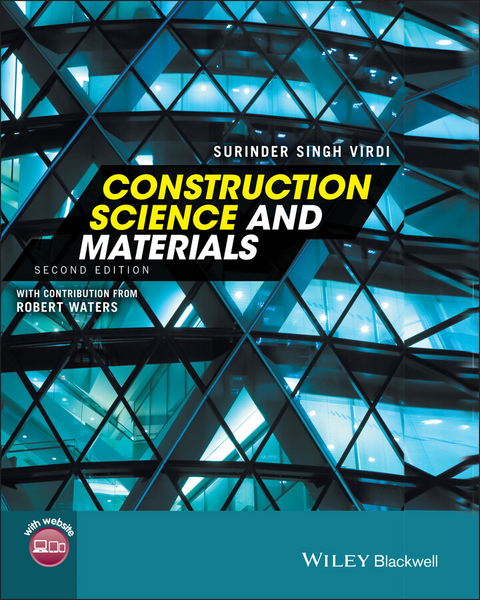
Construction Science and Materials (eBook)
John Wiley & Sons (Verlag)
978-1-119-24510-0 (ISBN)
Construction Science & Materials is designed to cover topics studied at levels 2 - 5 on Construction HND courses and is also suitable for first year undergraduates on construction courses as well as Building surveying, Architectural Technology and Quantity Surveying. It is an essential text for those who have done no science since their GCSEs.
Divided into 17 chapters, each with written explanations supplemented by solved examples and relevant diagrams to substantiate the text. Chapters end with numerical questions covering a range of problems and their answers are given at the end of the book and on the book's website.
About the Author
SURINDER SINGH VIRDI is a lecturer in construction at South and City College Birmingham and visiting lecturer at City of Wolverhampton College. He worked as a civil and structural engineer for a number of years before starting his career in further and higher education. He has been teaching construction science, environmental science, mathematics, ICT and CAD on BTEC National and Higher National courses for over 25 years.
Construction Science & Materials is designed to cover topics studied at levels 2 5 on Construction HND courses and is also suitable for first year undergraduates on construction courses as well as Building surveying, Architectural Technology and Quantity Surveying. It is an essential text for those who have done no science since their GCSEs.Divided into 17 chapters, each with written explanations supplemented by solved examples and relevant diagrams to substantiate the text. Chapters end with numerical questions covering a range of problems and their answers are given at the end of the book and on the book s website.
About the Author SURINDER SINGH VIRDI is a lecturer in construction at South and City College Birmingham and visiting lecturer at City of Wolverhampton College. He worked as a civil and structural engineer for a number of years before starting his career in further and higher education. He has been teaching construction science, environmental science, mathematics, ICT and CAD on BTEC National and Higher National courses for over 25 years.
About the companion Website
1 Introduction to physics
2 Introduction to chemistry
3 Effects of chemicals and atmosphere on materials
4 Electricity
5 Introduction to construction technology
6 Introduction to building services
7 Thermal energy 1
8 Thermal energy 2
9 Forces and structures 1
10 Forces and structures 2
11 Forces and structures 3
12 Fluid mechanics
13 Sound
14 Light
15 Human comfort
16 Construction materials
17 Assignments
Index
1
Introduction to Physics
LEARNING OUTCOMES
- Define speed, velocity and acceleration.
- Explain mass, gravitation and weight.
- Explain Newton’s laws of motion and solve numerical problems based on these laws.
- Explain work, energy and power, and solve numerical problems.
1.1 Speed and Velocity
In the study of moving objects, one of the important things to know is the rate of motion. The rate of motion of a moving object is what we call speed. It may be defined as the distance covered in a given time:
If the distance covered is in metres (m) and the time taken in seconds (s), then speed is measured in metres per second (m/s). If the distance is in kilometres (km) and the time in hours (h), the unit of speed is kilometres per hour (km/h).
When the direction of movement is combined with the speed, we have the velocity of motion. Quantities that have both magnitude and direction are known as vector quantities. Velocity is a vector quantity; its magnitude and direction can be represented by an arrow. Speed, on the other hand, has magnitude but no direction; therefore it is called a scalar quantity.
1.2 Acceleration
An object is said to accelerate if its velocity increases. The rate of increase of velocity is called the acceleration.
If velocity is measured in metres and time in seconds, then acceleration is measured in metres per second per second (m/s/s) or metres per second squared (m/s2). If the velocity of a moving object decreases, it is said to decelerate, i.e. the acceleration is negative. The following relationships may be used to solve problems involving velocity and acceleration:
where, u = initial velocity
- v = final velocity
- a = acceleration
- t = time
- s = distance
1.3 Mass
The amount of matter contained in an object is known as its mass. The basic SI unit of mass is the kilogram (kg).
The mass of an object remains constant irrespective of wherever it is.
1.4 Gravitation
Gravitation can be defined as the force of attraction that exists between all objects in the universe. According to Isaac Newton, every object in the universe attracts every other object with a force directed along the line of centres for the two objects that is proportional to the product of their masses and inversely proportional to the square of the distance between their centres.
where Fg = gravitational force between two objects
- m1 = mass of first object
- m2 = mass of second object
- r = distance between the centres of the two objects
- G = universal constant of gravitation
The value of constant G is so small that the force of attraction between any two objects is negligible. In 1798, Henry Cavendish performed experiments to determine the value of G and found it to be 6.67 × 10⁻¹¹ Nm2/kg2.
If we consider an object and the Earth, the mass of Earth is so large (5.98 × 1024 kg) that, depending on the mass of the object, there could be a considerable force of attraction between the two. That is why when an object is dropped from a height, it falls towards the Earth, not away from it. The initial velocity of the object is zero m/s, but as the distance increases, the velocity of the falling object also increases. The rate of increase in velocity is called acceleration and, in the case of a free‐falling object, it is known as the acceleration due to gravity (symbol: g).
The value of g is 9.807 m/s2, but for all calculations in this book it will be approximated to 9.81 m/s2 (m/s2 can also be written as ms−2).
Example 1.1
Find the gravitational force between the Earth and:
- An object with a mass of 1 kg.
- A person with a mass of 80 kg.
Given: mass of the Earth = 6.0 × 1024 kg; radius of the Earth = 6.4 × 10⁶ m; G = 6.7 × 10⁻¹¹ Nm2/kg2
Solution:
1.5 Weight
The weight of an object is the force with which it is attracted towards Earth. When an object falls freely towards Earth, the average value of the acceleration produced (g) is 9.81 m/s2. The force (F) acting on the object due to Earth’s gravitational pull (or the weight of the object) can be calculated as:
where m is the mass of the object in kg.
The units of weight are the same as the units of force. If the mass is in kilograms, the unit of weight will be newtons (N).
The weight of a 1 kg mass will be:
Similarly, the weight of a 5 kg mass is:
For larger forces, kilonewtons or meganewtons may be used.
The weight of a body is not constant but changes slightly when we move from the Equator to the North Pole. The Earth is not a perfect sphere: it bulges at the Equator. This affects the gravitational force, which varies from 9.78 m/s2 at the Equator to 9.83 m/s2 at the North Pole.
1.6 Volume
All substances, whether they are solid, liquid or gas, occupy space. The amount of space occupied by an object is called its volume.
1.7 Density
If equal volumes of bricks, concrete, timber and other materials are compared, the values of their mass will be different. This is because different materials do not have the same density.
The density of a material is defined as its mass per unit volume.
If the units of mass and volume are kg and m3 respectively, then the unit of density will be kilograms per metre cubed (kg/m3). The density of pure water is 1000 kg/m3. The density of a material is an important property and is used in several areas of building technology, for example:
- To find the self‐weight (dead load) of a component like a beam, column etc., its density must be known.
- The strength of a material, generally, depends on its density.
- The thermal insulation of a material is inversely proportional to its density.
Table 1.1 shows the densities of a selection of materials.
| Material | Density (kg/m3) |
| Concrete blocks (lightweight) | 450–675 |
| Aluminium | 2720 |
| Brick (common) | 2000 |
| Brick (engineering) | 2200 |
| Cement | 1500 |
| Concrete | 2400 |
| Copper | 8800 |
| Cork | 200 |
| Glass | 2500 |
| Granite | 2720 |
| Gravel (coarse) | 1450 |
| Gravel (all‐in) | 1750 |
| Lead | 11300 |
| Limestone | 2250 |
| Marble | 2720 |
| Mercury | 13500 |
| Mild steel | 7820 |
| Sand (dry) | 1600 |
| Sandstone | 2250 |
| Slate | 2800 |
| Timber (Oak) | 600–900 |
| Timber (Beech) | 700–900 |
Example 1.2
The mass of a concrete block measuring 250 mm × 200 mm × 200 mm is 24.0 kg. Find the density of concrete.
Solution:
The dimensions of the concrete block are converted into metres to obtain the density in kg/m3.
Similarly, 200 mm = 0.200 m
Example 1.3
The cross‐sectional measurements of a 7.0 m long concrete beam are 0.3 m × 0.75 m. Find the mass and the weight of the beam. Density of concrete = 2400 kg/m3.
Solution:
1.8 Specific Gravity
The specific gravity of a substance is defined as the ratio of the density of the material to the density of water.
The specific gravity of a material remains the same, irrespective of the units of density.
1.9 Newton’s First Law of Motion
In the seventeenth century, Isaac Newton formulated three laws, which are known as Newton’s laws of motion. The first law states that an object will remain in a state of rest or uniform motion in a...
| Erscheint lt. Verlag | 9.1.2017 |
|---|---|
| Co-Autor | Robert Waters |
| Sprache | englisch |
| Themenwelt | Technik ► Bauwesen |
| Schlagworte | basic construction textbook • Bauingenieur- u. Bauwesen • Bauphysik • Baustoffe • Civil Engineering & Construction • Civil Engineering textbook • Constructional Physics • Construction HND courses • construction materials • Surveying • teaching construction |
| ISBN-10 | 1-119-24510-9 / 1119245109 |
| ISBN-13 | 978-1-119-24510-0 / 9781119245100 |
| Informationen gemäß Produktsicherheitsverordnung (GPSR) | |
| Haben Sie eine Frage zum Produkt? |
 EPUB (Adobe DRM)
Kopierschutz: Adobe-DRM
Adobe-DRM ist ein Kopierschutz, der das eBook vor Mißbrauch schützen soll. Dabei wird das eBook bereits beim Download auf Ihre persönliche Adobe-ID autorisiert. Lesen können Sie das eBook dann nur auf den Geräten, welche ebenfalls auf Ihre Adobe-ID registriert sind.
Details zum Adobe-DRM
Dateiformat: EPUB (Electronic Publication)
EPUB ist ein offener Standard für eBooks und eignet sich besonders zur Darstellung von Belletristik und Sachbüchern. Der Fließtext wird dynamisch an die Display- und Schriftgröße angepasst. Auch für mobile Lesegeräte ist EPUB daher gut geeignet.
Systemvoraussetzungen:
PC/Mac: Mit einem PC oder Mac können Sie dieses eBook lesen. Sie benötigen eine
eReader: Dieses eBook kann mit (fast) allen eBook-Readern gelesen werden. Mit dem amazon-Kindle ist es aber nicht kompatibel.
Smartphone/Tablet: Egal ob Apple oder Android, dieses eBook können Sie lesen. Sie benötigen eine
Geräteliste und zusätzliche Hinweise
Buying eBooks from abroad
For tax law reasons we can sell eBooks just within Germany and Switzerland. Regrettably we cannot fulfill eBook-orders from other countries.
aus dem Bereich