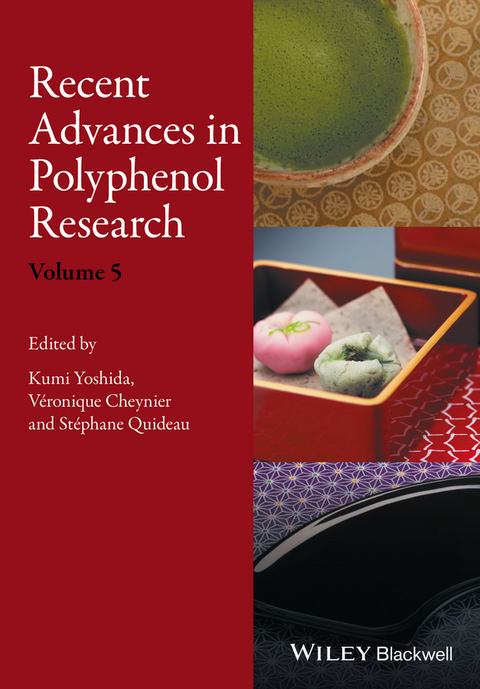
Recent Advances in Polyphenol Research, Volume 5 (eBook)
John Wiley & Sons (Verlag)
978-1-118-88327-3 (ISBN)
Sponsored by the scholarly society Groupe Polyphénols, this publication, which is the fifth volume in this highly regarded Recent Advances in Polyphenol Research series, is edited by Kumi Yoshida, Véronique Cheynier and Stéphane Quideau. They have once again, like their predecessors, put together an impressive collection of cutting-edge chapters written by expert scientists, internationally respected in their respective field of polyphenol sciences. This Volume 5 highlights some of the latest information and opinion on the following major research topics about polyphenols:
• Chemistry, physicochemistry & materials science
• Biosynthesis, genetic & metabolic engineering
• Plant & ecosystem, lignocellulosic biomass
• Food, nutrition & health
• Natural medicine & Kampo
• Tannins & their functions
Chemists, biochemists, plant scientists, pharmacognosists and pharmacologists, biologists, ecologists, food scientists and nutritionists will all find this book an invaluable resource. Libraries in all universities and research institutions where these disciplines are studied and taught should have copies on their bookshelves.
Plant polyphenols are secondary metabolites that constitute one of the most common and widespread groups of natural products. They express a large and diverse panel of biological activities including beneficial effects on both plants and humans. Many polyphenols, from their structurally simplest representatives to their oligo/polymeric versions (also referred to as vegetable tannins), are notably known as phytoestrogens, plant pigments, potent antioxidants, and protein interacting agents.Sponsored by the scholarly society Groupe Polyph nols, this publication, which is the fifth volume in this highly regarded Recent Advances in Polyphenol Research series, is edited by Kumi Yoshida, V ronique Cheynier and St phane Quideau. They have once again, like their predecessors, put together an impressive collection of cutting-edge chapters written by expert scientists, internationally respected in their respective field of polyphenol sciences. This Volume 5 highlights some of the latest information and opinion on the following major research topics about polyphenols: Chemistry, physicochemistry & materials science Biosynthesis, genetic & metabolic engineering Plant & ecosystem, lignocellulosic biomass Food, nutrition & health Natural medicine & Kampo Tannins & their functionsChemists, biochemists, plant scientists, pharmacognosists and pharmacologists, biologists, ecologists, food scientists and nutritionists will all find this book an invaluable resource. Libraries in all universities and research institutions where these disciplines are studied and taught should have copies on their bookshelves.
Kumi Yoshida and Veronique Cheynier are the authors of Recent Advances in Polyphenol Research, Volume 5, published by Wiley.
Chapter 1
The Physical Chemistry of Polyphenols: Insights into the Activity of Polyphenols in Humans at the Molecular Level
Olivier Dangles, Claire Dufour, Claire Tonnelé and Patrick Trouillas
Abstract: This chapter reviews the following versatile physicochemical properties of polyphenols in relation with their potential activity in humans:
- Interactions with proteins and lipid–water interfaces. These interactions must be qualified with respect to the current knowledge on polyphenol bioavailability and metabolism. They are expected to mediate most of the cell signaling activity of polyphenols.
- A general reducing capacity that may be expressed in the gastrointestinal tract submitted to postprandial oxidative stress and also in cells, for example, by direct scavenging of reactive oxygen species, especially if preliminary deconjugation of metabolites takes place
- The complex relationships with transition metal ions involving binding and/or electron transfer in close connection with the antioxidant versus pro‐oxidant activity of polyphenols
Keywords: polyphenol, flavonoid, Health effectsbiological activity, mechanism, antioxidant, protein, membrane, metal ion, gastrointestinal tract, DFT methods.
1.1 Introduction
The activity, functions, and structural diversity of polyphenols in plants, food, and humans reflect the remarkable diversity of their physicochemical properties: UV–visible absorption, electron donation, affinity for metal ions, propensity to develop molecular interactions (van der Waals, hydrogen bonding) with proteins and lipid–water interfaces, and nucleophilicity. This chapter aims to exemplify how polyphenols act to promote health in humans at the molecular level. It rests on two common assumptions based on epidemiological evidence and food analysis (Manach et al., 2005; Crozier et al., 2010; Del Rio et al., 2013):
- The consumption of fruit and vegetables helps prevent chronic diseases and, in particular, favors cardiovascular health.
- Phenolic compounds, from the simple hydroxybenzoic and hydroxycinnamic acids to the complex condensed and hydrolyzable tannins, constitute the most abundant class of plant secondary metabolites in our diet and take part in this protection.
By contributing to the sensorial properties of food, for example, color and astringency, native polyphenols and their derivatives obtained after technological and domestic processing can directly influence the consumer’s choice. Moreover, polyphenols undergo only minimal enzymatic conversion in the oral cavity and in the gastric compartment although their release from the food matrix (bioaccessibility) is an important issue. Thus, intact food polyphenols may directly promote health benefits in the upper digestive tract, in particular by fighting postprandial oxidative stress resulting from an unbalanced diet (Sies et al., 2005; Kanner et al., 2012). Beyond the gastric compartment, polyphenol bioavailability1 (Fig. 1.1) must be considered as a priority to tackle any biological effects (Manach et al., 2005; Crozier et al., 2010; Del Rio et al., 2013). Indeed, even for polyphenols that can be partially absorbed in the upper intestinal tract (aglycones, glucosides), most of the dietary intake reaches the colon where extensive catabolism by the microbiota takes place: hydrolysis of glycosidic and ester bonds, release of flavanol monomers from proanthocyanidins, hydrogenation of the C═C double bond of hydroxycinnamic acids, deoxygenation of aromatic rings, cleavage of the central heterocycle of flavonoids, and so on. Conjugation of polyphenols and their bacterial metabolites in intestinal and liver cells eventually results in a complex mixture of circulating polyphenol O‐β‐D‐glucuronides and O‐sulfo forms (less rigorously called sulfates). When present, catechol groups are also partially methylated.
Fig. 1.1 A simplified view of polyphenol bioavailability.
The concentration of circulating polyphenols is usually evaluated after treatment by a mixture of glucuronidases and sulfatases that release the aglycones and their O‐methyl ethers. This concentration is usually quite low (barely higher than 0.1 μM) and much lower than that of typical plasma antioxidants such as ascorbate (> 30 μM). At first sight, this does not argue in favor of nonspecific biological effects, such as the antioxidant activity by radical scavenging or chelation of transition metal ions to form inert complexes. This seems all the more true that the catechol group, displayed by many common dietary polyphenols and which is a critical determinant of the electron‐donating and metal‐binding capacities, is generally either absent in the circulating metabolites (bacterial deoxygenation) or at least partially conjugated. However, the claim that in vivo polyphenol concentrations are low should be nuanced for the following reasons:
- The complete assessment of polyphenol bioavailability must include the bacterial catabolites and their conjugates, some being much more abundant in the circulation than the parent phenol. A spectacular example can be found in the case of anthocyanins. Indeed, after consumption of blood orange juice, the total amount of native cyanidin 3‐O‐β‐D‐glucoside (C3G) in plasma is 0.02% of the ingested dose versus 44% for (unconjugated) protocatechuic acid (PCA), its main catabolite (Vitaglione et al., 2007). When the fecal content is also taken into account, PCA eventually represents ca. 73% of the metabolic fate of ingested C3G. Its absence in urine (unlike C3G) also suggests that it takes part in the antioxidant protection and is thus oxidized in tissues.
- The circulating concentration and its time dependence say nothing concerning either the possibility of polyphenol metabolites accumulation at a much higher local concentration at specific sites of inflammation and oxidative stress or their deconjugation into more active forms.
For instance, when quercetin is continuously perfused through the vascular wall of arteries, it rapidly undergoes oxidative degradation into PCA, whereas the fraction retained in the wall is much more stable and partially methylated (Menendez et al., 2011). By contrast, quercetin 3‐O‐β‐D‐glucuronide (Q3G), the main circulating metabolite, is not oxidized upon perfusion but slowly converted into quercetin. The kinetics of quercetin release parallels the inhibition in the contractile response of the artery. Thus, the biological effect can be ascribed to quercetin released from its glucuronide, which basically appears as a stable storage form. A schematic view for the bioactivity of polyphenols is summed up in Fig. 1.2.
Fig. 1.2 Health effects expressed by polyphenols.
1.2 Molecular complexation of polyphenols
The phenolic nucleus can be regarded as a benchmark chemical group for molecular interactions as it combines an acidic OH group liable to develop hydrogen bonds (both as a donor and as an acceptor) and an aromatic nucleus for dispersion interactions (the stabilizing component of van der Waals interactions).
1.2.1 Polyphenol–protein binding
Polyphenol–protein binding of nutritional relevance can be classified as follows:
- Binding processes within the gastrointestinal (GI) tract, that is, with food proteins, mucins, and the digestive enzymes, with an impact on the bioaccessibility of polyphenols and the digestibility of macronutrients
- Interactions with plasma proteins, with an impact on transport and the rate of clearance from the general circulation
- Interactions with specific cell proteins (enzymes, receptors, transcription factors, etc.) that would mediate the nonredox health effects of polyphenols
As the last two situations lie downstream the intestinal absorption and passage through the liver, they concern the circulating polyphenol metabolites. However, some exceptions may be found. For instance, epigallocatechin 3‐O‐gallate (EGCG), the major green tea flavanol, is a rare example of a polyphenol entering the blood circulation mostly in its initial (nonconjugated) form (Manach et al., 2005). No less remarkable, EGCG is also one of the rare polyphenols for which a specific receptor has been identified, namely the 67‐kDa laminin receptor (67LR) that is expressed on the surface of various tumor cells (Umeda et al., 2008). EGCG‐67LR binding leads to myosin phosphatase activation and actin cytoskeleton rearrangement, thus inhibiting cell growth. It provides a strong basis for interpreting the in vivo anticancer activity of EGCG and its anti‐inflammatory activity in endothelial cells (Byun et al., 2014).
It is not the authors’ purpose to provide the reader with an exhaustive updated report on polyphenol–protein binding processes (see Dangles and Dufour (2008) for a specific review on this topic). Only a few recent important examples will be discussed with an emphasis on works dealing with polyphenol metabolites.
1.2.1.1 Interactions in the digestive tract
In the postprandial phase, black tea drinking leads to vasorelaxation as evidenced by...
| Erscheint lt. Verlag | 30.11.2016 |
|---|---|
| Reihe/Serie | Recent Advances in Polyphenol Research |
| Recent Advances in Polyphenol Research | Recent Advances in Polyphenol Research |
| Sprache | englisch |
| Themenwelt | Naturwissenschaften ► Biologie ► Biochemie |
| Naturwissenschaften ► Biologie ► Botanik | |
| Technik ► Umwelttechnik / Biotechnologie | |
| Schlagworte | Activities • Biochemie • biochemistry • biological • Biowissenschaften • Botanik / Biochemie • Common • Condensed tannins • Constitute • Effects • Food Science & Technology • Functional Food, Nutraceuticals • Functional Foods & Nutraceuticals • groups • humans • including beneficial • Large • Lebensmittelforschung u. -technologie • Life Sciences • Metabolites • NATURAL • Oligo • Panel • plant biochemistry • plant polyphenols • plants • polymeric • Products • Representatives • Secondary • structurally |
| ISBN-10 | 1-118-88327-6 / 1118883276 |
| ISBN-13 | 978-1-118-88327-3 / 9781118883273 |
| Informationen gemäß Produktsicherheitsverordnung (GPSR) | |
| Haben Sie eine Frage zum Produkt? |
 EPUB (Adobe DRM)
Kopierschutz: Adobe-DRM
Adobe-DRM ist ein Kopierschutz, der das eBook vor Mißbrauch schützen soll. Dabei wird das eBook bereits beim Download auf Ihre persönliche Adobe-ID autorisiert. Lesen können Sie das eBook dann nur auf den Geräten, welche ebenfalls auf Ihre Adobe-ID registriert sind.
Details zum Adobe-DRM
Dateiformat: EPUB (Electronic Publication)
EPUB ist ein offener Standard für eBooks und eignet sich besonders zur Darstellung von Belletristik und Sachbüchern. Der Fließtext wird dynamisch an die Display- und Schriftgröße angepasst. Auch für mobile Lesegeräte ist EPUB daher gut geeignet.
Systemvoraussetzungen:
PC/Mac: Mit einem PC oder Mac können Sie dieses eBook lesen. Sie benötigen eine
eReader: Dieses eBook kann mit (fast) allen eBook-Readern gelesen werden. Mit dem amazon-Kindle ist es aber nicht kompatibel.
Smartphone/Tablet: Egal ob Apple oder Android, dieses eBook können Sie lesen. Sie benötigen eine
Geräteliste und zusätzliche Hinweise
Buying eBooks from abroad
For tax law reasons we can sell eBooks just within Germany and Switzerland. Regrettably we cannot fulfill eBook-orders from other countries.
aus dem Bereich