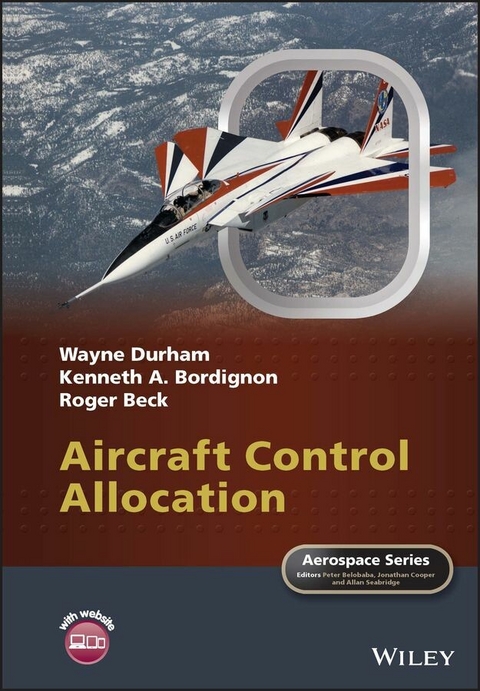
Aircraft Control Allocation (eBook)
John Wiley & Sons (Verlag)
978-1-118-82776-5 (ISBN)
Aircraft Control Allocation
Wayne Durham, Virginia Polytechnic Institute and State University, USA
Kenneth A. Bordignon, Embry-Riddle Aeronautical University, USA
Roger Beck, Dynamic Concepts, Inc., USA
An authoritative work on aircraft control allocation by its pioneers
Aircraft Control Allocation addresses the problem of allocating supposed redundant flight controls. It provides introductory material on flight dynamics and control to provide the context, and then describes in detail the geometry of the problem. The book includes a large section on solution methods, including 'Banks' method', a previously unpublished procedure. Generalized inverses are also discussed at length. There is an introductory section on linear programming solutions, as well as an extensive and comprehensive appendix dedicated to linear programming formulations and solutions. Discrete-time, or frame-wise allocation, is presented, including rate-limiting, nonlinear data, and preferred solutions.
Key features:
- Written by pioneers in the field of control allocation.
- Comprehensive explanation and discussion of the major control allocation solution methods.
- Extensive treatment of linear programming solutions to control allocation.
- A companion web site contains the code of a MATLAB/Simulink flight simulation with modules that incorporate all of the major solution methods.
- Includes examples based on actual aircraft.
The book is a vital reference for researchers and practitioners working in aircraft control, as well as graduate students in aerospace engineering.
Wayne Durham had a full career as a U.S. Navy fighter pilot and test pilot. He is a member of the Society of Experimental Test Pilots. After retiring from the Navy he earned a Ph.D. in Aerospace Engineering at Virginia Tech, researching model-following control under the guidance of the late Fred Lutze. He remained at Virginia Tech teaching aerospace engineering and researching aircraft control, including seminal studies of control allocation.
After earning his Ph.D. from Virginia Tech, Ken Bordignon spent eight years at for Lockheed Martin working on various Advanced Development Projects, including the Joint Strike Fighter Concept Demonstration Aircraft, the X-35. Since 2008 he has taught at Embry-Riddle Aeronautical University in Prescott, Arizona.
Roger Beck has worked as a support contractor providing flight mechanics, simulation, guidance, navigation, and control support to NASA for a variety of aerospace projects. As part of his graduate work at Virginia Tech, Dr. Beck studied the extension of control allocation techniques to systems with more than three objectives. Working with NASA, he has supported flight tests of a variety of different vehicles including UAV flight systems, atmospheric tests of launch vehicles, hypersonic vehicles, even earth and planetary re-entry systems. In addition to flight projects, Dr. Beck provides analytical support to a variety of conceptual studies ranging ground test infrastructure to space technology demonstration missions. Currently, Dr. Beck is employed by Dynamic Concepts, Incorporated of Huntsville, Alabama, working as part of the Flight Mechanics team for the SLS launch vehicle at NASA's Marshall Space Flight Center.
Aircraft Control Allocation An authoritative work on aircraft control allocation by its pioneers Aircraft Control Allocation addresses the problem of allocating redundant flight controls. It provides introductory material on flight dynamics and control to provide the context, and then describes in detail the geometry of the problem. The book includes a large section on solution methods, including Banks method , a previously unpublished procedure. Generalized inverses are also discussed at length. There is an introductory section on linear programming solutions, as well as an extensive and comprehensive appendix on linear programming formulations and solutions. Discrete-time or frame-wise allocation is described, including rate-limiting, nonlinear data, and preferred solutions. Key features: Written by pioneers in the field of control allocation Comprehensive explanation and discussion of the major control-allocation solution methods Extensive treatment of linear programming solutions to control allocation A companion web site contains the code of a MATLAB/Simulink light simulation with modules that incorporate all of the major solution methods Includes examples based on actual aircraft The book is a vital reference for researchers and practitioners working in aircraft control, as well as graduate students in aerospace engineering.
Wayne Durham, Virginia Polytechnic Institute and State University, USA. Kenneth A. Bordignon, Embry-Riddle Aeronautical University, USA. Roger Beck, Dynamic Concepts, Inc., USA.
Cover 1
Title Page 7
Copyright 8
Contents 9
Dedication 15
Series Preface 17
Glossary 19
About the Companion Website 25
Chapter 1 Introduction 27
1.1 Redundant Control Effectors 27
1.2 Overview 29
References 31
Chapter 2 Aircraft Control 32
2.1 Flight Dynamics 32
2.1.1 Equations of Motion 32
2.1.2 Linearized Equations of Motion 36
2.2 Control 38
2.2.1 General 38
2.2.2 Aircraft Control Effectors 39
2.2.3 Aircraft Control Inceptors 43
2.3 Afterword 44
References 45
Chapter 3 Control Laws 46
3.1 Flying Qualities 46
3.1.1 Requirements 47
3.1.2 Control Law Design to Satisfy Flying Qualities Requirements 47
3.2 Dynamic-inversion Control Laws 47
3.2.1 Basics 47
3.2.2 Types of Equations 48
3.2.3 The Controlled Equations 49
3.2.4 The Kinematic and Complementary Equations 51
3.3 Model-following Control Laws 53
3.4 'Conventional' Control Laws 53
3.5 Afterword 54
References 55
Chapter 4 The Problem 56
4.1 Control Effectiveness 56
4.2 Constraints 57
4.3 Control Allocation 57
4.3.1 The Control Allocation Problem 58
4.4 Afterword 58
References 59
Chapter 5 The Geometry of Control Allocation 60
5.1 Admissible Controls 60
5.1.1 General 60
5.1.2 Objects 60
5.1.3 Intersection and Union 63
5.1.4 Convex Hull 65
5.2 Attainable Moments 65
5.3 The Two-moment Problem 69
5.3.1 Area Calculations 74
5.4 The Three-moment Problem 75
5.4.1 Determination of ?3 75
5.4.2 Volume Calculations 82
5.5 Significance of the Maximum Set 84
5.5.1 As a Standard of Comparison of Different Methods 85
5.5.2 Maneuver Requirements 86
5.5.3 Control Failure Reconfiguration 88
5.6 Afterword 88
References 90
Chapter 6 Solutions 91
6.1 On-line vs. Off-line Solutions 91
6.1.1 On-line Solutions 91
6.1.2 Off-line Solutions 91
6.2 Optimal vs. Non-optimal Solutions 92
6.2.1 Maximum Capabilities 92
6.2.2 Maximum Volume 92
6.2.3 Nearest to Preferred 92
6.2.4 Unattainable Moments 93
6.3 Preferred Solutions 94
6.4 Ganging 94
6.5 Generalized Inverses 96
6.5.1 The General Case, and the Significance of P2 96
6.5.2 Tailored Generalized Inverses 99
6.5.3 'Best' Generalized Inverse 100
6.5.4 Pseudo-inverses 101
6.5.5 Methods that Incorporate Generalized Inverses 103
6.6 Direct Allocation 106
6.6.1 The Direct Method for the Two-moment Problem 107
6.6.2 The Direct Method for the Three-moment Problem 108
6.7 Edge and Facet Searching 110
6.7.1 Two-dimensional Edge Searching 111
6.7.2 Three-dimensional Facet Searching 114
6.8 Banks' Method 116
6.8.1 Finding the Original Three Vertices 118
6.8.2 Determining a New Vertex 119
6.8.3 Replacing an Old Vertex 119
6.8.4 Terminating the Algorithm 121
6.9 Linear Programming 121
6.9.1 Casting Control Allocation as a Linear Program 122
6.9.2 Simplex 125
6.10 Moments Attainable by Various Solution Methods 126
6.10.1 General Case (Three-moment Problem) 127
6.10.2 Generalized Inverses (Two- and Three-moment Problems) 128
6.11 Examples 137
6.11.1 Generalized Inverses 137
6.11.2 Direct Allocation 145
6.11.3 Edge and Facet Searching 148
6.11.4 Banks' Method 154
6.11.5 Linear Programming 158
6.11.6 Convex-hull Volume Calculations 160
6.12 Afterword 163
References 163
Chapter 7 Frame-wise Control Allocation 165
7.1 General 165
7.2 Path Dependency 167
7.2.1 Examples of Path Dependency 168
7.3 Global vs. Local Control Effectiveness 173
7.4 Restoring 175
7.4.1 The Augmented B matrix 176
7.4.2 Implementation 178
7.4.3 Chattering 179
7.4.4 Minimum-norm Restoring 180
Chapter 8 Control Allocation and Flight Control System Design 187
8.1 Dynamic-inversion Desired Accelerations 187
8.1.1 The Desired Acceleration: x? des 187
8.1.2 Command and Regulator Examples 189
8.2 The Maximum Set and Control Law Design 194
8.2.1 In the Design Process 194
8.2.2 In a Mature Design 198
8.2.3 Non-optimal Example 200
References 203
Chapter 9 Applications 204
9.1 Lessons Learned from the Design of the X-35 Flight Control System 204
9.1.1 Theory vs. Practice 204
9.2 Uses of Redundancy 205
9.2.1 Preferred Solutions 205
9.2.2 Resolving Path-dependency Issues 206
9.3 Design Constraints 206
9.3.1 Axis Prioritization 206
9.3.2 Structural Loads 208
9.3.3 Effector Bandwidth 209
9.3.4 Gain Limiting and Stability Margins 210
9.4 Failure Accommodation 210
References 211
Appendix A Linear Programming 212
A.1 Control Allocation as a Linear Program 213
A.1.1 Optimality for Attainable Commands 214
A.1.2 Optimality for Unattainable Commands 214
A.2 Standard Forms for Linear Programming Problems 219
A.2.1 Dealing with Negative Unknowns 220
A.2.2 Dealing with Inequality Constraints 221
A.2.3 Writing a Program for Control Allocation in Standard Form 223
A.2.4 Revised Standard Form with Upper Bound 225
A.3 Properties of Linear Program Solutions 227
A.3.1 Basic Solutions 228
A.3.2 Degenerate Basic Solutions 229
A.3.3 Basic Feasible Solutions 230
A.4 Allocating Feasible Commands 230
A.4.1 Minimizing Error to a Preferred Solution 231
A.4.2 Minimizing Maximum Errors 235
A.4.3 Optimizing Linear Secondary Objectives 238
A.5 Building a Control Allocator for Feasible and Infeasible Solutions 239
A.5.1 Dual Branch 240
A.5.2 Single-branch or Mixed Optimization 241
A.5.3 Reduced Program Size without Secondary Optimization 244
A.6 Solvers 245
A.6.1 Preprocessing 246
A.6.2 Solution Algorithms 247
A.6.3 Simplex Method 248
A.6.4 Initialization of the Simplex Algorithm 258
A.7 Afterword 260
References 261
Appendix B Flight Simulation 263
B.1 Introduction 263
B.2 Modifications 263
B.2.1 Three of the top-level blocks have been left almost completely unaltered 263
B.2.2 Minor modifications consist of the new Pilot and Sensors blocks 264
B.3 NDI_CLAW 264
B.3.1 NDI_CLAW/Rate Transition 264
B.3.2 NDI_CLAW/PILOT_Mod 264
B.3.3 NDI_CLAW/INPUT 265
B.3.4 NDI_CLAW/MissionManager 265
B.3.5 NDI_CLAW/DynamicInversionControl 266
References 272
Appendix C Annotated Bibliography 273
References 273
Index 303
EULA 308
"The book is a vital reference for researchers and practitioners working in aircraft control, as well as graduate students in aerospace engineering" Expofairs, Sept 2017
| Erscheint lt. Verlag | 15.11.2016 |
|---|---|
| Reihe/Serie | Aerospace Series | Aerospace Series (PEP) |
| Mitarbeit |
Herausgeber (Serie): Peter Belobaba, Jonathan Cooper, Allan Seabridge |
| Sprache | englisch |
| Themenwelt | Technik ► Fahrzeugbau / Schiffbau |
| Technik ► Luft- / Raumfahrttechnik | |
| Technik ► Maschinenbau | |
| Schlagworte | Aeronautic & Aerospace Engineering • Control Process & Measurements • Control Systems Technology • Electrical & Electronics Engineering • Elektrotechnik u. Elektronik • Flight control<br />Control allocation<br />Redundant controls<br />Limited control movement<br />Control rate limiting<br />Linear programming<br />Flight simulation<br />Flight dynamics • Luftfahrttechnik • Luft- u. Raumfahrttechnik • Maschinenbau • mechanical engineering • Mess- u. Regeltechnik • Regelungstechnik |
| ISBN-10 | 1-118-82776-7 / 1118827767 |
| ISBN-13 | 978-1-118-82776-5 / 9781118827765 |
| Informationen gemäß Produktsicherheitsverordnung (GPSR) | |
| Haben Sie eine Frage zum Produkt? |
 PDF (Adobe DRM)
Kopierschutz: Adobe-DRM
Adobe-DRM ist ein Kopierschutz, der das eBook vor Mißbrauch schützen soll. Dabei wird das eBook bereits beim Download auf Ihre persönliche Adobe-ID autorisiert. Lesen können Sie das eBook dann nur auf den Geräten, welche ebenfalls auf Ihre Adobe-ID registriert sind.
Details zum Adobe-DRM
Dateiformat: PDF (Portable Document Format)
Mit einem festen Seitenlayout eignet sich die PDF besonders für Fachbücher mit Spalten, Tabellen und Abbildungen. Eine PDF kann auf fast allen Geräten angezeigt werden, ist aber für kleine Displays (Smartphone, eReader) nur eingeschränkt geeignet.
Systemvoraussetzungen:
PC/Mac: Mit einem PC oder Mac können Sie dieses eBook lesen. Sie benötigen eine
eReader: Dieses eBook kann mit (fast) allen eBook-Readern gelesen werden. Mit dem amazon-Kindle ist es aber nicht kompatibel.
Smartphone/Tablet: Egal ob Apple oder Android, dieses eBook können Sie lesen. Sie benötigen eine
Geräteliste und zusätzliche Hinweise
Buying eBooks from abroad
For tax law reasons we can sell eBooks just within Germany and Switzerland. Regrettably we cannot fulfill eBook-orders from other countries.
aus dem Bereich