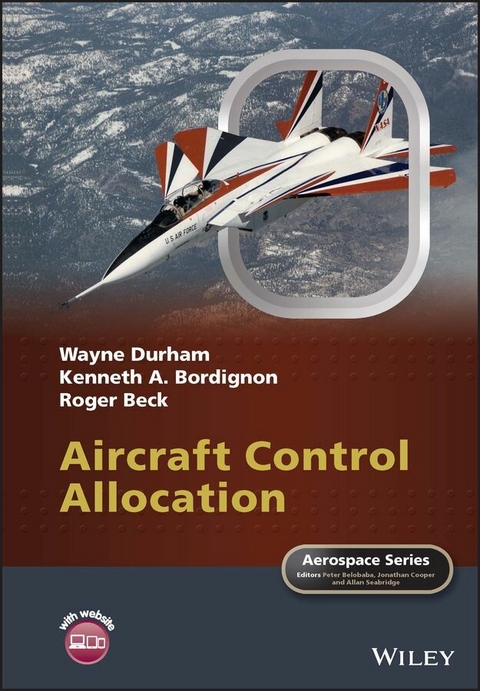
Aircraft Control Allocation (eBook)
John Wiley & Sons (Verlag)
978-1-118-82777-2 (ISBN)
Aircraft Control Allocation
Wayne Durham, Virginia Polytechnic Institute and State University, USA
Kenneth A. Bordignon, Embry-Riddle Aeronautical University, USA
Roger Beck, Dynamic Concepts, Inc., USA
An authoritative work on aircraft control allocation by its pioneers
Aircraft Control Allocation addresses the problem of allocating supposed redundant flight controls. It provides introductory material on flight dynamics and control to provide the context, and then describes in detail the geometry of the problem. The book includes a large section on solution methods, including 'Banks' method', a previously unpublished procedure. Generalized inverses are also discussed at length. There is an introductory section on linear programming solutions, as well as an extensive and comprehensive appendix dedicated to linear programming formulations and solutions. Discrete-time, or frame-wise allocation, is presented, including rate-limiting, nonlinear data, and preferred solutions.
Key features:
- Written by pioneers in the field of control allocation.
- Comprehensive explanation and discussion of the major control allocation solution methods.
- Extensive treatment of linear programming solutions to control allocation.
- A companion web site contains the code of a MATLAB/Simulink flight simulation with modules that incorporate all of the major solution methods.
- Includes examples based on actual aircraft.
The book is a vital reference for researchers and practitioners working in aircraft control, as well as graduate students in aerospace engineering.
Wayne Durham had a full career as a U.S. Navy fighter pilot and test pilot. He is a member of the Society of Experimental Test Pilots. After retiring from the Navy he earned a Ph.D. in Aerospace Engineering at Virginia Tech, researching model-following control under the guidance of the late Fred Lutze. He remained at Virginia Tech teaching aerospace engineering and researching aircraft control, including seminal studies of control allocation.
After earning his Ph.D. from Virginia Tech, Ken Bordignon spent eight years at for Lockheed Martin working on various Advanced Development Projects, including the Joint Strike Fighter Concept Demonstration Aircraft, the X-35. Since 2008 he has taught at Embry-Riddle Aeronautical University in Prescott, Arizona.
Roger Beck has worked as a support contractor providing flight mechanics, simulation, guidance, navigation, and control support to NASA for a variety of aerospace projects. As part of his graduate work at Virginia Tech, Dr. Beck studied the extension of control allocation techniques to systems with more than three objectives. Working with NASA, he has supported flight tests of a variety of different vehicles including UAV flight systems, atmospheric tests of launch vehicles, hypersonic vehicles, even earth and planetary re-entry systems. In addition to flight projects, Dr. Beck provides analytical support to a variety of conceptual studies ranging ground test infrastructure to space technology demonstration missions. Currently, Dr. Beck is employed by Dynamic Concepts, Incorporated of Huntsville, Alabama, working as part of the Flight Mechanics team for the SLS launch vehicle at NASA's Marshall Space Flight Center.
Aircraft Control Allocation An authoritative work on aircraft control allocation by its pioneers Aircraft Control Allocation addresses the problem of allocating redundant flight controls. It provides introductory material on flight dynamics and control to provide the context, and then describes in detail the geometry of the problem. The book includes a large section on solution methods, including Banks method , a previously unpublished procedure. Generalized inverses are also discussed at length. There is an introductory section on linear programming solutions, as well as an extensive and comprehensive appendix on linear programming formulations and solutions. Discrete-time or frame-wise allocation is described, including rate-limiting, nonlinear data, and preferred solutions. Key features: Written by pioneers in the field of control allocation Comprehensive explanation and discussion of the major control-allocation solution methods Extensive treatment of linear programming solutions to control allocation A companion web site contains the code of a MATLAB/Simulink light simulation with modules that incorporate all of the major solution methods Includes examples based on actual aircraft The book is a vital reference for researchers and practitioners working in aircraft control, as well as graduate students in aerospace engineering.
Wayne Durham, Virginia Polytechnic Institute and State University, USA. Kenneth A. Bordignon, Embry-Riddle Aeronautical University, USA. Roger Beck, Dynamic Concepts, Inc., USA.
Dedication
Glossary
1 Introduction
2 Aircraft contro
3 Control laws
4 The problem
5 The geometry of control allocation
6 Solutions
7 Frame-wise control allocation
8 Control allocation and flight control system design
9 Applications
Index
"The book is a vital reference for researchers and practitioners working in aircraft control, as well as graduate students in aerospace engineering" Expofairs, Sept 2017
Glossary
- Dot over quantity: the derivative with respect to time of the contents of the parentheses .
- Hat over quantity: the contents of the parentheses are approximate.
- Angle-of-attack: the aerodynamic angle between the projection of the relative wind onto the airplane's plane of symmetry and a suitably defined body fixed -axis.
- Sideslip angle: The aerodynamic angle between the velocity vector and the airplane's plane of symmetry.
- , ,
- Vector norms: is the square root of the sum of the squares of the entries in the vector. It appears everywhere. is the sum of the absolute values of the entries and is the greatest absolute value. and frequently appear in linear programming problems.
- Either:
- Every combination of control effector deflections that are admissible; in other words, that are within the limits of travel or deflection.
- A normally diagonal matrix used to specify the dynamics in a dynamic-inversion control law.
- The effects, usually body-axis moments, moment coefficients, or angular accelerations, of every combination of control effector deflections in , q.v. (sense 1). Sometimes called the AMS, for ‘attainable moment set’ or subset.
- Bank angle: one of three angles that define a 3-2-1 (--) rotation from inertial to body-fixed reference frames.
- Either:
- (Primarily) A subset of the attainable moments () consisting of all the moments that are generated by a particular control allocation method.
- A plane surface that arises in Banks' method of allocation for the three-moment problem.
- Heading angle: one of three angles that define a 3-2-1 (--) rotation from inertial to body-fixed reference frames.
- A subset of : all admissible controls that a particular control-allocation method can return as solutions to a control-allocation problem.
- Pitch attitude: one of three angles that define a 3-2-1 (--) rotation from inertial to body-fixed reference frames.
- One of the matrices of the linearized equations of motion: is the system matrix, is control effectiveness matrix, and is the output matrix.
- The non-dimensional stability or control derivative of with respect to : it is the non-dimensional form of .
- Complementary: a superscript to certain dynamic responses.
- Controllable: a superscript to certain dynamic responses.
- ,
- Desired: a subscript to a dynamic response, or any other quantity.
- Body-fixed reference frames. The origin is at the airplane's center of mass. The axes and lie in the airplane's plane of symmetry. completes the right-hand system. Once defined, a body-fixed reference system's orientation with respect to the body does not change. Two frequently used body-fixed reference frames are the principal axes and the stability-axis system.
- Local-horizontal reference frame. The axes , , and are oriented north, east, and down, respectively. The earth is flat.
- Wind-axis system. The axis lies in the direction of flight, opposite the relative wind. is in the plane of symmetry, oriented downward.
- Either:
- Acceleration of gravity, or
- The non-dimensional units of load factor , q.v.
- With subscripts; moment of inertia.
- Kinematic: a superscript to certain dynamic responses.
- Lift, side force, and drag: wind-axis forces in the −, − and −directions, respectively.
- Body-axis moments about the axis (rolling), axis (pitching), and axis (yawing), respectively.
- Either:
- Lift, or
- Rolling moment, depending on context.
- Lateral-directional, meaning all motions, accelerations, forces, and so on, that are not longitudinal, q.v. Sometimes lat-dir.
- Longitudinal, meaning all motions, accelerations, forces, and so on, that take place in the airplane's plane of symmetry. Pitching moments, velocities, and accelerations are about the airplane's -axis but the motion is in the – plane.
- The mass of the airplane.
- Load factor, the ratio of lift to weight, . Measured in s.
- Body-axis roll rate, pitch rate, and yaw rate, respectively.
- A generalized inverse of a matrix : and , with appropriate dimensions.
- Subscript, ‘evaluated in reference conditions’.
- Vector of control effector variables.
- ,
- Vector of control effector limits, minimum or maximum.
- ,
- Vector of control effector limits, lower or upper. This notation seems preferred by linear programmers over , , q.v.
- Names of body-axes.
- A weighting matrix, generally diagonal and positive.
- Names of wind axes.
- Where is a force or moment and is a state or control, a dimensional derivative, . It is the dimensional form of , q.v. The definition does not include division by mass or moment of inertia. If is a control effector the result is called a control derivative, otherwise it is called a stability derivative.
- Body-axis forces in the -, - and -directions, respectively.
- Names of axes. With no subscripts usually taken to be body-axes.
- ACTIVE
- Advanced Control Technology for Integrated Vehicles. A research F-15 with differential canards, axisymmetric thrust vectoring, and other novel features.
- ADMIRE
- Aero-Data Model In a Research Environment, simulation code. See Appendix B.
- Admissible
- Of a control effector or suite of control effectors, those deflections that are within the physical limits of employment.
- AMS
- Attainable moment subset or set, .
- Angular accelerations
- See Objectives.
- ARI
- Aileron-rudder interconnect. Normally used to reduce adverse yaw due to aileron deflection.
- Attainable
- Of moments or accelerations; that which can be generated by some admissible combination of control effectors. The term may be applied globally, meaning there is some theoretical combination, or locally, to a particular control allocation method, meaning those combinations of control effectors that the method will generate using its rules.
- Basic feasible solution
- Of linear programs, a basic solution to the equality constraints in a linear program that also solves the inequality constraints.
- Basic solution
- Of linear programs, a solution to the linear equality constraints of a linear program in ‘standard form’ with of the decision variables at their bound.
- CAS
- Control augmentation system.
- Control effectiveness
- A measure of the effect of utilizing a control effector, either moment, moment coefficient, or angular acceleration.
- Control authority
- The aggregate effect of the effectiveness of all the control effectors in whatever combination.
- Control power
- Angular acceleration per unit of control deflection.
- CHR
- Cooper–Harper rating; sometimes HQR.
- Constraint
- Of a control effector, a limiting position, usually imposed by the hardware. It may also refer to a limit on the rate of travel. In linear programming, a constraint may refer to the position limits, but also of an equality that must be satisfied. Thus is an inequality constraint, and is an equality constraint.
- Control effector
- The devices that directly effect control by changing forces or moments, such as ailerons or rudders. When we say ‘the controls’ with no qualification, we usually mean the control effectors. The sign convention for conventional flapping control effectors follows a right-hand rule, with the thumb along the axis about which the effector is designed to generate moments, and the curled fingers denoting the positive deflection of the trailing edge.
- Control inceptor
- Cockpit devices that control, through direct linkage or a flight-control system or computer, the control effectors. Positive control inceptor deflections correspond to positive deflections of the effectors they are connected to, barring such things as aileron–rudder interconnects (ARI, q.v.).
- Cycling
- Of a linear program, a condition in which a sequence of vertices is visited by a solver for which the objective function does not decrease, eventually returning to the starting point in the cycle. Cycling represents a failure to converge and must be addressed by choosing an exchange rule designed to prevent it.
- Degenerate basic solution
- Of linear programs, a basic solution to a linear program in which one of the decision variables in the basis is at its bound in addition to the non-basic variables.
- Decision variables
- The set of unknown parameters being optimized in a linear program.
- FBW
- Fly by wire. The pilot flies the computer, the computer flies the airplane.
- FQ
- Flying qualities.
- Ganged
- Said of mechanical devices that are linked so that they move in fixed relation to each other, such as ailerons.
- HARV
- High angle-of-attack research vehicle.
- HQ
- Handling qualities.
- HQR
- Handling qualities rating.
- Interior point method...
| Erscheint lt. Verlag | 16.11.2016 |
|---|---|
| Reihe/Serie | Aerospace Series |
| Aerospace Series (PEP) | Aerospace Series (PEP) |
| Mitarbeit |
Herausgeber (Serie): Peter Belobaba, Jonathan Cooper, Allan Seabridge |
| Sprache | englisch |
| Themenwelt | Technik ► Fahrzeugbau / Schiffbau |
| Technik ► Luft- / Raumfahrttechnik | |
| Technik ► Maschinenbau | |
| Schlagworte | Aeronautic & Aerospace Engineering • Control Process & Measurements • Control Systems Technology • Electrical & Electronics Engineering • Elektrotechnik u. Elektronik • Flight control<br />Control allocation<br />Redundant controls<br />Limited control movement<br />Control rate limiting<br />Linear programming<br />Flight simulation<br />Flight dynamics • Luftfahrttechnik • Luft- u. Raumfahrttechnik • Maschinenbau • mechanical engineering • Mess- u. Regeltechnik • Regelungstechnik |
| ISBN-10 | 1-118-82777-5 / 1118827775 |
| ISBN-13 | 978-1-118-82777-2 / 9781118827772 |
| Informationen gemäß Produktsicherheitsverordnung (GPSR) | |
| Haben Sie eine Frage zum Produkt? |
 EPUB (Adobe DRM)
Kopierschutz: Adobe-DRM
Adobe-DRM ist ein Kopierschutz, der das eBook vor Mißbrauch schützen soll. Dabei wird das eBook bereits beim Download auf Ihre persönliche Adobe-ID autorisiert. Lesen können Sie das eBook dann nur auf den Geräten, welche ebenfalls auf Ihre Adobe-ID registriert sind.
Details zum Adobe-DRM
Dateiformat: EPUB (Electronic Publication)
EPUB ist ein offener Standard für eBooks und eignet sich besonders zur Darstellung von Belletristik und Sachbüchern. Der Fließtext wird dynamisch an die Display- und Schriftgröße angepasst. Auch für mobile Lesegeräte ist EPUB daher gut geeignet.
Systemvoraussetzungen:
PC/Mac: Mit einem PC oder Mac können Sie dieses eBook lesen. Sie benötigen eine
eReader: Dieses eBook kann mit (fast) allen eBook-Readern gelesen werden. Mit dem amazon-Kindle ist es aber nicht kompatibel.
Smartphone/Tablet: Egal ob Apple oder Android, dieses eBook können Sie lesen. Sie benötigen eine
Geräteliste und zusätzliche Hinweise
Buying eBooks from abroad
For tax law reasons we can sell eBooks just within Germany and Switzerland. Regrettably we cannot fulfill eBook-orders from other countries.
aus dem Bereich