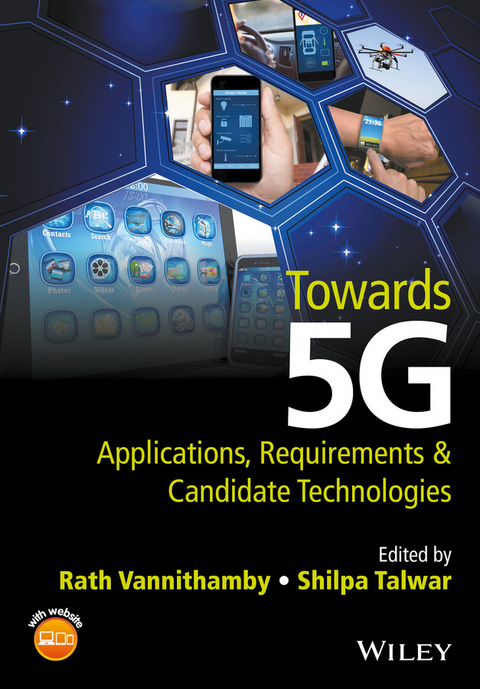
Towards 5G (eBook)
John Wiley & Sons (Verlag)
978-1-118-97989-1 (ISBN)
This book brings together a group of visionaries and technical experts from academia to industry to discuss the applications and technologies that will comprise the next set of cellular advancements (5G). In particular, the authors explore usages for future 5G communications, key metrics for these usages with their target requirements, and network architectures and enabling technologies to meet 5G requirements. The objective is to provide a comprehensive guide on the emerging trends in mobile applications, and the challenges of supporting such applications with 4G technologies.
Rath Vannithamby, Senior Research Scientist at Intel Corporation, Oregon, USA
Rath Vannithamby received his PhD degree in EE from the University of Toronto. He leads and manages a team responsible for 4G/5G cellular research in Intel Labs. Prior to joining Intel, he was a researcher at Ericsson responsible for 3G research. Dr. Vannithamby is a Senior Member of IEEE. He has published over 50 scientific articles and has over 120 patents granted/pending. His research interests are in the area of 4G/5G broadband mobile networks, energy efficiency, QoS for mobile internet applications, cross-layer techniques, cognitive radio, and machine-to-machine communications.
Shilpa Talwar, Principal Engineer at Intel Corporation, California, USA
Shilpa Talwar leads a small research team focused on advanced network topologies for improving the capacity and service quality of cellular networks. Her research interests include heterogeneous networks, multi-radio interworking, device to device communications, and advanced MIMO and interference mitigation techniques. While at Intel, she has contributed to IEEE and 3GPP standard bodies, including an IEEE wide tutorial on Future Wireless Networks with support of many industry partners, which led to formation of multiple study groups in IEEE 802.16, and the 802.16p standard. She is currently coordinating an effort on 5G technologies with several leading universities and industry partners. Shilpa graduated from Stanford University in 1996 with a Ph.D. in Applied mathematics and an M.S. in electrical engineering. She is the author of 60+ technical publications and patents.
This book brings together a group of visionaries and technical experts from academia to industry to discuss the applications and technologies that will comprise the next set of cellular advancements (5G). In particular, the authors explore usages for future 5G communications, key metrics for these usages with their target requirements, and network architectures and enabling technologies to meet 5G requirements. The objective is to provide a comprehensive guide on the emerging trends in mobile applications, and the challenges of supporting such applications with 4G technologies.
Rath Vannithamby, Senior Research Scientist at Intel Corporation, Oregon, USA Rath Vannithamby received his PhD degree in EE from the University of Toronto. He leads and manages a team responsible for 4G/5G cellular research in Intel Labs. Prior to joining Intel, he was a researcher at Ericsson responsible for 3G research. Dr. Vannithamby is a Senior Member of IEEE. He has published over 50 scientific articles and has over 120 patents granted/pending. His research interests are in the area of 4G/5G broadband mobile networks, energy efficiency, QoS for mobile internet applications, cross-layer techniques, cognitive radio, and machine-to-machine communications. Shilpa Talwar, Principal Engineer at Intel Corporation, California, USA Shilpa Talwar leads a small research team focused on advanced network topologies for improving the capacity and service quality of cellular networks. Her research interests include heterogeneous networks, multi-radio interworking, device to device communications, and advanced MIMO and interference mitigation techniques. While at Intel, she has contributed to IEEE and 3GPP standard bodies, including an IEEE wide tutorial on Future Wireless Networks with support of many industry partners, which led to formation of multiple study groups in IEEE 802.16, and the 802.16p standard. She is currently coordinating an effort on 5G technologies with several leading universities and industry partners. Shilpa graduated from Stanford University in 1996 with a Ph.D. in Applied mathematics and an M.S. in electrical engineering. She is the author of 60+ technical publications and patents.
Title Page 5
Copyright Page 6
Contents 7
List of Contributors 17
List of Acronyms 21
About the Companion Website 33
Part I Overview of 5G 35
Chapter 1 Introduction 37
1.1 Evolution of Cellular Systems through the Generations 37
1.2 Moving Towards 5G 38
1.3 5G Networks and Devices 39
1.4 Outline of the Book 41
References 42
Chapter 2 5G Requirements 43
2.1 Introduction 43
2.2 Emerging Trends in Mobile Applications and Services 44
2.2.1 New Types of Mobile Device 44
2.2.2 Video Streaming and Download Services 45
2.2.3 Machine-to-machine Services 45
2.2.4 Cloud Services 46
2.2.5 Context-based and Location-based Services 47
2.2.6 Broadcast Services 48
2.2.7 Summary 48
2.3 General Requirements 49
2.3.1 Capacity Requirements 49
2.3.2 User Data-rate Requirements 51
2.3.3 Latency Requirements 51
2.3.3.1 User-plane Latency 52
2.3.3.2 Control-plane Latency 52
2.3.4 Massive Device Connectivity 53
2.3.5 Energy Saving and Robustness against Emergencies 54
2.3.6 Summary 55
References 55
Chapter 3 Collaborative 5G Research within the EU Framework of funded research 57
3.1 Rationale for 5G Research and the EU’s Motivation 57
3.2 EU Research 59
3.2.1 History 59
3.2.2 EU Bodies, Structure, Roles, and Project Creation 61
3.2.3 Project Creation and Operation 62
3.2.3.1 Project Creation 63
3.2.3.2 Project Operation 64
3.2.4 Details of the FP8 Program 64
3.2.5 European Technology Platforms and Public–Private Partnerships 65
3.2.6 Other Funded Research 66
References 67
Chapter 4 5G: Transforming the User Wireless Experience 68
4.1 Introduction 68
4.2 Intel’s Vision of 5G Technologies 68
4.2.1 Enabling New Spectrum 69
4.2.2 Increasing Spectrum Efficiency 70
4.2.3 Exploiting Multiple Radio Access Technologies 71
4.2.4 Awareness of Application-specific Service Quality 72
4.2.5 Exploiting Context Awareness 72
4.2.6 Improving Device Power Efficiency 73
4.3 Intel Strategic Research Alliance on 5G 74
4.4 ISRA 5G Technical Objectives and Goals 74
4.4.1 Goal 1: Network Capacity 75
4.4.2 Goal 2: Uniform Connectivity Experience 75
4.4.3 Goal 3: Service Quality and User Experience 76
4.5 ISRA 5G Project Summaries 76
4.5.1 Higher, Denser, Wilder: Massively Broadband and Adaptive Wireless for 5th Generation Wireless Communications 76
4.5.2 Fundamental Limits, Self-organization, and Context Awareness for Integrated Cellular and D2D Architectures 78
4.5.3 LAWS: Large Arrays and Wide Spectrum 79
4.5.4 A System View of Interference Management: Radio Circuits, PHY Mechanisms, and Protocol Designs 80
4.5.5 Dynamic Cloud Services Spectrum Sharing Algorithms and Mechanisms for B4G Networks 81
4.5.6 Fundamentals of Spectrum Sharing in Device-to-Device and Heterogeneous Communication Networks 82
4.5.7 Structured Sharing of Network and Compute Resources in a Community of Devices 82
4.5.8 A Unified Framework for Enabling Energy-efficient Mobile Internet Apps and Energy-efficient Cloud Offloading 83
References 84
Part II Candidate Technologies – Evolutionary 87
Chapter 5 Towards Green and Soft 89
5.1 Chapter Overview 89
5.2 Efforts on Green and Soft 5G Networks 90
5.3 Rethink Shannon: EE and SE Co-design for a Green Network 91
5.3.1 EE and SE Co-design Fundamentals 91
5.3.2 5G Candidate Technologies with EE–SE Co-design 95
5.3.2.1 Hybrid BF for LSAS 95
5.3.2.2 NOMA with EE–SE Co-design 99
5.4 “No More Cell” for a Green and Soft Network 101
5.4.1 C-RAN: An Enabling Element for 5G 101
5.4.2 Rethink Signaling and Control for “No More Cell” 104
5.4.3 Service Aggregator: to Accommodate Trillions of Nodes in 5G 107
5.4.3.1 Aggregation of Packet Data from Multiple MTC Devices 108
5.4.3.2 Two Relay Modes of the Aggregators 109
5.5 Summary 109
Acknowledgments 110
References 110
Chapter 6 Proactive Caching in 5G Small Cell Networks 112
6.1 Small Cell Networks: Past, Present, and Future Trends 112
6.2 Cache-enabled Proactive Small Cell Networks 114
6.3 System Model 115
6.4 Proactive Caching at Base Stations 116
6.4.1 Numerical Results and Discussions 117
6.5 Proactive Caching at User Terminals 119
6.5.1 Numerical Results and Discussions 122
6.6 Related Work and Research Directions 124
6.6.1 Proactive Caching and Content Popularity Estimation 126
6.6.2 Approximation Algorithms 126
6.6.3 Coded Caching Gains 127
6.6.4 Joint Designs 128
6.6.5 Mobility 128
6.6.6 Energy Consumption 128
6.6.7 Deployment Aspects 128
6.7 Conclusions 129
Acknowledgments 129
References 129
Chapter 7 Modeling Multi-Radio Coordination and Integration in Converged Heterogeneous Networks 133
7.1 Enabling Technologies for Multi-Radio Heterogeneous Networks 133
7.1.1 Understanding Challenges in Mobile Wireless Networking 133
7.1.2 5G Technology Trends: Heterogeneous Networks 135
7.1.3 5G Technology Trends: Direct Communications 137
7.1.4 Focus and Contributions of our 5G Research 138
7.2 Comprehensive Methodology for Space-Time Network Analysis 139
7.2.1 Capabilities of the Proposed Mathematical Approach 139
7.2.2 Proposed Taxonomy for HetNets 140
7.2.3 General Assumptions of the Model 142
7.2.4 The HetNet Operation Considered 146
7.3 Analysis of Random Dynamic HetNets 148
7.3.1 Core Stochastic Model 148
7.3.1.1 Tier Types I and II Analysis 149
7.3.1.2 Tier Type III Analysis 149
7.3.2 Calculating the Steady-State Distribution 150
7.3.3 Characterizing Transitions for Important HetNet Examples 152
7.3.3.1 Tier Type I Transitions 152
7.3.3.2 Tier Type II Transitions 153
7.3.3.3 Tier Type III Transitions 154
7.4 Quantifying Performance with System-level Evaluations 155
7.4.1 Features of our 5G System-level Simulator 155
7.4.2 Discussing Representative Numerical Results 157
7.5 Summary and Conclusions 160
Acknowledgments 160
References 160
Chapter 8 Distributed Resource Allocation in 5G Cellular Networks 163
8.1 Introduction 163
8.2 Multi-tier 5G Cellular: Overview and Challenges 166
8.2.1 Overview 166
8.2.2 Challenges in Radio Resource Management for Multi-tier Cellular Systems 166
8.3 System Model 169
8.3.1 Network Model and Assumptions 169
8.3.2 Achievable Data Rate 170
8.3.3 Formulation of the Resource Allocation Problem 171
8.4 Resource Allocation using Stable Matching 173
8.4.1 Concept of Matching 173
8.4.2 Utility Function and Preference Profile 174
8.4.3 Algorithm Development 174
8.4.4 Stability, Optimality, and Complexity of the Solution 176
8.4.4.1 Stability 176
8.4.4.2 Optimality 176
8.4.4.3 Complexity 177
8.5 Message-passing Approach for Resource Allocation 177
8.5.1 Overview of the MP Scheme 178
8.5.2 Reformulation of the Resource Allocation Problem Utilizing the MP Approach 178
8.5.3 Effective Implementation of MP Scheme in a Practical Heterogeneous Network 180
8.5.4 Algorithm Development 182
8.5.5 Convergence, Optimality, and Complexity of the Solution 183
8.5.5.1 Convergence and Optimality 183
8.5.5.2 Complexity 185
8.6 Auction-based Resource Allocation 185
8.6.1 Overview of the Auction Approach 185
8.6.2 Auction for Radio Resource Allocation 186
8.6.2.1 Cost Function 187
8.6.2.2 Update of Cost and Bidder Information 187
8.6.3 Algorithm Development 188
8.6.4 Convergence, Complexity, and Optimality of the Auction Approach 189
8.6.4.1 Convergence and Complexity 189
8.6.4.2 Optimality 190
8.7 Qualitative Comparison of the Resource Allocation Schemes 191
8.8 Summary and Conclusion 191
References 193
Additional Reading 194
Chapter 9 Device-to-Device Communications 196
9.1 Introduction and Motivation 196
9.2 Propagation Channels 197
9.2.1 Pathloss 198
9.2.2 Delay Dispersion 199
9.2.3 Temporal Variations 199
9.3 Neighbor Discovery and Channel Estimation 200
9.3.1 Neighbor Discovery 200
9.3.2 Channel Estimation 202
9.4 Mode Selection and Resource Allocation 204
9.4.1 Mode Selection 204
9.4.2 Resource Allocation 206
9.5 Scheduling 209
9.5.1 In-band D2D 209
9.5.2 Out-of-band D2D 210
9.5.3 FlashLinQ and ITLinQ 211
9.6 Multi-hop D2D 214
9.7 Standardization 217
9.8 Applications 218
9.8.1 Content Distribution in Social Networks 218
9.8.2 Video Distribution 218
9.8.3 Roadside Infostations 219
9.8.4 Emergency Communications 219
9.8.5 Distributed Storage Systems 220
9.8.6 Smart Grids 220
9.9 D2D for Video 220
9.9.1 Random Caching and Unicasting 221
9.9.2 Coded Caching and Multicasting 222
9.9.3 Simulation Results 223
9.10 Conclusions 225
Acknowledgments 225
References 225
Chapter 10 Energy-efficient Wireless OFDMA Networks 233
10.1 Overview 233
10.2 Energy Efficiency and Energy-efficient Wireless Networks 234
10.3 Energy Efficiency and Spectral Efficiency Tradeoff in OFDMA 235
10.3.1 Fundamentals of the EE–SE Relationship 237
10.3.2 Impacts of System Parameters on the EE–SE Tradeoff 239
10.4 Energy Efficiency, Power, and Delay Tradeoff in OFDMA 242
10.4.1 Relationship between EE and Transmit Power 245
10.4.2 EE and Delay Tradeoff 246
10.5 Energy-efficient Resource Allocation for Downlink OFDMA 246
10.5.1 Optimal Energy-efficient Resource Allocation 248
10.5.2 Low-complexity Suboptimal Energy-efficient Resource Allocation 248
10.6 Energy-efficient Resource Allocation for Uplink OFDMA 251
10.6.1 Optimal Energy-efficient Resource Allocation 252
10.6.2 Low-complexity Suboptimal Energy-efficient Resource Allocation 252
10.7 Concluding Remarks 253
References 254
Chapter 11 Advanced Multiple-access and MIMO Techniques 256
11.1 Introduction 256
11.2 Non-orthogonal Multiple Access 259
11.2.1 Concept 259
11.2.1.1 Comparison with Orthogonal User Multiplexing 260
11.2.1.2 Motivations and Benefits of NOMA 261
11.2.2 Link-level Considerations 262
11.2.3.1 NOMA Signaling Overhead 267
11.2.3.2 Performance in Low- and High-Mobility Scenarios 269
11.2.3.3 Combination of NOMA and MIMO 269
11.2.3 System-level Considerations 265
11.3 Smart Vertical MIMO 272
11.3.1 Grouping of Antenna Elements for 3D MIMO 272
11.3.2 Adaptive Grouping of Antenna Elements using SV-MIMO 274
11.3.3 Performance Evaluation and Field Experiments 276
11.4 Conclusion 281
References 282
Chapter 12 M2M Communications 284
12.1 Chapter Overview 284
12.2 M2M Communications 284
12.3 LTE Evolution for M2M 287
12.3.1 LTE Features for M2M 288
12.3.1.1 eMTC 292
12.3.1.2 Narrowband Internet of Things 301
12.3.2 Further Enhancements 302
12.4 5G for M2M Communications 304
12.4.1 Coverage 306
12.4.2 Latency 307
12.4.3 Capacity 307
12.5 Conclusion 307
References 308
Chapter 13 Low-latency Radio-interface Perspectives for Small-cell 5G Networks 309
13.1 Introduction to Low-latency Radio-interface Design 309
13.2 Small-cell Channel Environment Considerations and Expected Traffic 311
13.2.1 Centimeter-wave Channel Models 312
13.2.2 Millimeter-wave Channel Models 314
13.2.3 Comments on Expected Traffic and Traffic Modeling 316
13.3 New Radio-interface Design for Low-latency 5G Wireless Access 317
13.3.1 Achieving Ultra-low Latency with Strict Timing Requirements 324
13.3.2 Reference-symbol Layout Design for Spectrally Efficient MIMO Communications in 5GETLA 326
13.4 Extending the 5GETLA Reference Design to Millimeter-Wave Communications 330
13.4.1 High Mobility Support in mm-Wave Communications 332
13.5 Conclusions and Open Research Topics 333
References 334
Part III Candidate Technologies – Revolutionary 337
Chapter 14 New Physical-layer Waveforms for 5G 339
14.1 Why OFDM Fails 339
14.1.1 Sporadic Traffic 340
14.1.2 Spectral and Temporal Fragmentation 340
14.1.3 Real-time Constraints 341
14.2 Unified Frame Structure 342
14.3 Waveform Candidates and Multiple-access Approaches 344
14.3.1 Universal Filtered Multicarrier 344
14.3.1.1 Frequency- and Time-domain Properties 345
14.3.1.2 Relaxed Synchronization Support and Autonomous Timing Advance 347
14.3.1.3 Supporting Multiple Signal Layers with Interleave Division Multiple Access 348
14.3.2 Generalized Frequency Division Multiplexing 350
14.3.2.1 Principles 350
14.3.2.2 GFDM in a Gabor Transform Setting 352
14.3.2.3 Time-reversal Space–Time Coding for GFDM Access 353
14.3.2.4 Reducing Latency in LTE Time–Frequency Grid 354
14.3.3 Filter Bank Multicarrier 355
14.3.3.1 Principles 355
14.3.3.2 Multi-user Receiver Architecture 356
14.3.3.3 Robustness of the Receiver to Channel Delay Spread 358
14.3.3.4 Capacity Results and Analysis 359
14.4 One-shot Random Access 362
14.4.1 Bi-orthogonal Frequency Division Multiplexing 363
14.4.1.1 Transmitter 364
14.4.1.2 Receiver 365
14.4.1.3 Pulse Design 365
14.4.1.4 Numerical Results 367
14.4.2 System-level Performance 368
14.5 Conclusions 373
References 373
Chapter 15 Massive MIMO Communications 376
15.1 Introduction 376
15.2 Overview of Multi-Antenna Techniques in LTE 377
15.3 Moving to 5G Cellular with Large-scale Antenna Arrays 379
15.4 Antenna-array Architectures for 5G Cellular 382
15.5 Massive MIMO for Evolved LTE Systems (Below 6 GHz) 383
15.5.1 3D Channel Models 384
15.5.2 Antenna-array Configurations 385
15.5.3 Uplink Transmission Techniques 385
15.5.4 Downlink Transmission Techniques 386
15.5.4.1 Reciprocity-based Transmission Methods 387
15.5.4.2 Codebook Feedback-based Methods 387
15.5.4.3 Product Codebook Feedback-based Methods 388
15.5.4.4 Direct Feedback Methods 389
15.5.5 Massive Subsectoring with Large-scale Arrays 389
15.6 Massive MIMO for cmWave and mmWave Systems (Above 6 GHz) 392
15.6.1 Channel Modeling Above 6 GHz 392
15.6.2 Hardware Implementation Issues Above 6 GHz 393
15.6.3 Acquiring Channel State Information 394
15.6.4 Transmission Strategies Above 6 GHz 395
15.6.5 SU-MIMO Transmission 395
15.6.6 MU-MIMO Transmission 396
15.7 Conclusion 396
References 397
Chapter 16 Full-duplex Radios 399
16.1 The Problem 401
16.1.1 Requirements for Full Duplex Designs 403
16.1.2 Do Prior Full-duplex Techniques Satisfy these Requirements? 405
16.2 Our Design 406
16.2.1 Analog Cancelation 406
16.2.2 Digital Cancelation 409
16.2.2.1 Canceling Linear Components 409
16.2.2.2 Canceling Non-linear Components 410
16.2.2.3 Complexity 412
16.2.3 Dynamic Adaptation of Analog Cancelation 412
16.2.3.1 Modeling the Frequency Response of Delay Lines ? 414
16.2.3.2 Optimization Algorithm 414
16.3 Implementation 415
16.4 Evaluation 417
16.4.1 Can We Cancel all of the Self-interference? 418
16.4.1.1 Does Our Design Work with Commodity Radios? 419
16.4.1.2 SNR Loss of the Received Signal in Full-duplex Mode 419
16.4.2 Digging Deeper 421
16.4.2.1 Impact of Constellation and Bandwidth 421
16.4.2.2 Deconstructing Analog Cancelation 422
16.4.2.3 Deconstructing Digital Cancelation 423
16.4.2.4 Dynamic Adaptation 424
16.4.3 Does Full Duplex Double Throughput? 426
16.5 Discussion and Conclusion 427
Chapter 17 Point to Multi-point, In-band mmWave Backhaul for 5G Networks 429
17.1 Introduction 429
17.2 Feasibility of In-band Backhaul 431
17.3 Deployment Assumptions 434
17.4 In-band Backhaul Design Considerations 436
17.5 TDM-based Scheduling Scheme for In-band Backhauling 437
17.6 Concluding Remarks 441
Acknowledgments 441
References 441
Chapter 18 Application of NFV and SDN to 5G Infrastructure 442
18.1 Chapter Overview 442
18.2 Background 442
18.3 NFV and SDN 443
18.4 Network Planning and Engineering 444
18.4.1 Cellular Network Design and Traffic Engineering 446
18.4.1.1 Market Design 446
18.4.1.2 Call Model 446
18.4.1.3 Traffic Model 447
18.5 Cellular Wireless Network Infrastructure 448
18.5.1 Reference Points, Interfaces, and Protocol Stacks 448
18.5.2 Description of the EPC Main Element Interactions 448
18.6 Network Workloads and Capacity Factors 451
18.6.1 EPC Workload Stress Vectors 452
18.7 Conclusion 453
Index 455
EULA 469
| Erscheint lt. Verlag | 4.11.2016 |
|---|---|
| Sprache | englisch |
| Themenwelt | Technik ► Elektrotechnik / Energietechnik |
| Technik ► Nachrichtentechnik | |
| Schlagworte | 5G<br />5th generation<br />mobile networks<br />next generation networks<br />wireless technologies • Communication technology • Communication Technology - Networks • Drahtlose Kommunikation • Electrical & Electronics Engineering • Elektrotechnik u. Elektronik • Kommunikationsnetz • Kommunikationsnetze • Kommunikationstechnik • Mobile & Wireless Communications |
| ISBN-10 | 1-118-97989-3 / 1118979893 |
| ISBN-13 | 978-1-118-97989-1 / 9781118979891 |
| Informationen gemäß Produktsicherheitsverordnung (GPSR) | |
| Haben Sie eine Frage zum Produkt? |
 PDF (Adobe DRM)
Kopierschutz: Adobe-DRM
Adobe-DRM ist ein Kopierschutz, der das eBook vor Mißbrauch schützen soll. Dabei wird das eBook bereits beim Download auf Ihre persönliche Adobe-ID autorisiert. Lesen können Sie das eBook dann nur auf den Geräten, welche ebenfalls auf Ihre Adobe-ID registriert sind.
Details zum Adobe-DRM
Dateiformat: PDF (Portable Document Format)
Mit einem festen Seitenlayout eignet sich die PDF besonders für Fachbücher mit Spalten, Tabellen und Abbildungen. Eine PDF kann auf fast allen Geräten angezeigt werden, ist aber für kleine Displays (Smartphone, eReader) nur eingeschränkt geeignet.
Systemvoraussetzungen:
PC/Mac: Mit einem PC oder Mac können Sie dieses eBook lesen. Sie benötigen eine
eReader: Dieses eBook kann mit (fast) allen eBook-Readern gelesen werden. Mit dem amazon-Kindle ist es aber nicht kompatibel.
Smartphone/Tablet: Egal ob Apple oder Android, dieses eBook können Sie lesen. Sie benötigen eine
Geräteliste und zusätzliche Hinweise
Buying eBooks from abroad
For tax law reasons we can sell eBooks just within Germany and Switzerland. Regrettably we cannot fulfill eBook-orders from other countries.
aus dem Bereich