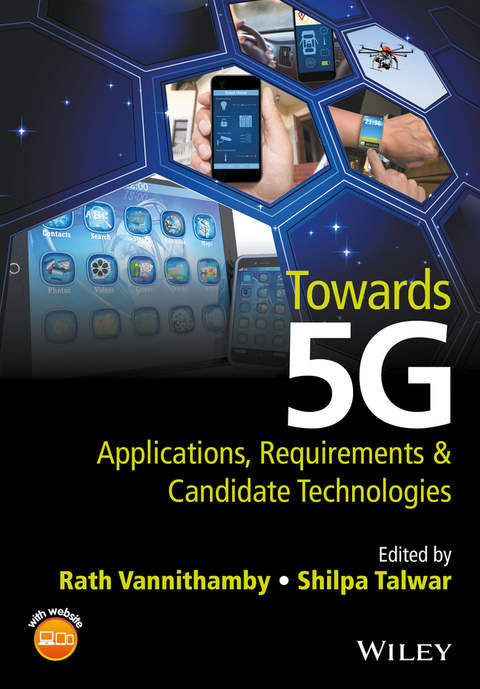
Towards 5G (eBook)
John Wiley & Sons (Verlag)
978-1-118-97991-4 (ISBN)
This book brings together a group of visionaries and technical experts from academia to industry to discuss the applications and technologies that will comprise the next set of cellular advancements (5G). In particular, the authors explore usages for future 5G communications, key metrics for these usages with their target requirements, and network architectures and enabling technologies to meet 5G requirements. The objective is to provide a comprehensive guide on the emerging trends in mobile applications, and the challenges of supporting such applications with 4G technologies.
Rath Vannithamby, Senior Research Scientist at Intel Corporation, Oregon, USA
Rath Vannithamby received his PhD degree in EE from the University of Toronto. He leads and manages a team responsible for 4G/5G cellular research in Intel Labs. Prior to joining Intel, he was a researcher at Ericsson responsible for 3G research. Dr. Vannithamby is a Senior Member of IEEE. He has published over 50 scientific articles and has over 120 patents granted/pending. His research interests are in the area of 4G/5G broadband mobile networks, energy efficiency, QoS for mobile internet applications, cross-layer techniques, cognitive radio, and machine-to-machine communications.
Shilpa Talwar, Principal Engineer at Intel Corporation, California, USA
Shilpa Talwar leads a small research team focused on advanced network topologies for improving the capacity and service quality of cellular networks. Her research interests include heterogeneous networks, multi-radio interworking, device to device communications, and advanced MIMO and interference mitigation techniques. While at Intel, she has contributed to IEEE and 3GPP standard bodies, including an IEEE wide tutorial on Future Wireless Networks with support of many industry partners, which led to formation of multiple study groups in IEEE 802.16, and the 802.16p standard. She is currently coordinating an effort on 5G technologies with several leading universities and industry partners. Shilpa graduated from Stanford University in 1996 with a Ph.D. in Applied mathematics and an M.S. in electrical engineering. She is the author of 60+ technical publications and patents.
This book brings together a group of visionaries and technical experts from academia to industry to discuss the applications and technologies that will comprise the next set of cellular advancements (5G). In particular, the authors explore usages for future 5G communications, key metrics for these usages with their target requirements, and network architectures and enabling technologies to meet 5G requirements. The objective is to provide a comprehensive guide on the emerging trends in mobile applications, and the challenges of supporting such applications with 4G technologies.
Rath Vannithamby, Senior Research Scientist at Intel Corporation, Oregon, USA Rath Vannithamby received his PhD degree in EE from the University of Toronto. He leads and manages a team responsible for 4G/5G cellular research in Intel Labs. Prior to joining Intel, he was a researcher at Ericsson responsible for 3G research. Dr. Vannithamby is a Senior Member of IEEE. He has published over 50 scientific articles and has over 120 patents granted/pending. His research interests are in the area of 4G/5G broadband mobile networks, energy efficiency, QoS for mobile internet applications, cross-layer techniques, cognitive radio, and machine-to-machine communications. Shilpa Talwar, Principal Engineer at Intel Corporation, California, USA Shilpa Talwar leads a small research team focused on advanced network topologies for improving the capacity and service quality of cellular networks. Her research interests include heterogeneous networks, multi-radio interworking, device to device communications, and advanced MIMO and interference mitigation techniques. While at Intel, she has contributed to IEEE and 3GPP standard bodies, including an IEEE wide tutorial on Future Wireless Networks with support of many industry partners, which led to formation of multiple study groups in IEEE 802.16, and the 802.16p standard. She is currently coordinating an effort on 5G technologies with several leading universities and industry partners. Shilpa graduated from Stanford University in 1996 with a Ph.D. in Applied mathematics and an M.S. in electrical engineering. She is the author of 60+ technical publications and patents.
List of Acronyms
Chapter 1
- 1G
- First Generation
- 2G
- Second Generation
- 3G
- Third Generation
- 4G
- Fourth Generation
- 5G
- Fifth Generation
- CDMA
- Code Division Multiple Access
- TDMA
- Time Division Multiple Access
- OFDMA
- Orthogonal Frequency Division Multiple Access
- GSM
- Global System for Mobile communications
- IMT
- International Mobile Telecommunications
- ITU-R
- International Telecommunication Union-Radio
- WCDMA
- Wideband CDMA
- 3GPP
- Third Generation Partnership Project
- HSPA
- High Speed Packet Access
- LTE
- Long-Term Evolution
- FDMA
- Frequency Division Multiple Access
- SC-FDMA
- Single Career Frequency Division Multiple Access
- M2M
- Machine to Machine communications
- IoT
- Internet of Things
- QoE
- Quality of Experience
- RAT
- Radio Access Technology
- MIMO
- Multiple Input Multiple Output
- SDN
- Software Defined Network
- NFV
- Network Function Virtualization
Chapter 2
- 5GMF
- 5G Mobile Communications Promotion Forum
- NGMN
- Next Generation Mobile Networks
- D2D
- Device to Device
- FHD
- Full High Definition
- UHD
- Ultra High Definition
- V2V
- Vehicle-to-Vehicle
- C2C
- Car-to-Car
- V2I
- Vehicle-to-Road Infrastructure
- C2P
- Car-to-Pedestrian
- V2D
- Vehicle-to-Device
- BYOD
- Bring Your Own Device
- SoLoMo
- Social Local Mobile
- HMI
- Human-Machine Interface
- CAGR
- Compound Annual Growth Rate
- WRC
- World Radio Conference
- AR
- Augmented Reality
- RTT
- Round Trip Time
- TTI
- Transmission Time Interval
- HARQ
- Hybrid Automatic Repeat reQuest
Chapter 3
- 3GPP
- 3rd Generation Partnership Project
- BS
- Base Station
- D2D
- Device to Device
- DL
- Downlink
- EE
- Energy Efficiency
- EEC
- European Economic Union
- EFTA
- European Free Trade Association
- EP
- European Parliament
- ETP
- European Technology Platform
- ETSI
- European Telecommunications Standards Institute
- EU
- European Union
- HetNet
- Heterogeneous network
- ICT
- Information and Communication Technology
- IST
- Information Society Technology
- LTE
- Long-Term Evolution
- LTE-A
- Long-Term Evolution-Advanced
- LSA
- Licensed Shared Access
- MIMO
- Multiple Input Multiple Output
- MTC
- Machine Type Communication
- PPP
- Public Private Partnership
- QoS
- Quality of Service
- RAT
- Radio Access Technology
- TDMA
- Time-Division Multiple Access
- UE
- User Equipment
- UL
- Uplink
- UMTS
- Universal Mobile Telecommunications System
Chapter 4
- ISRA
- Intel Strategic Research Alliance
- NTIA
- National Telecommunications and Information Association
- GHz
- Gigahertz
- THz
- Terahertz
- Gbps
- Gigabits per second
- MIMO
- Multi Input Multi Output
- MU-MIMO
- Multi-User MIMO
- VLM
- Very Large MIMO
- CP
- Cyclic Prefix
- OFDM
- Orthogonal Frequency Division Multiplexing
- RAN
- Radio Access Network
- RAT
- Radio Access Technology
- WAN
- Wide Area Network
- LAN
- Local Area Network
- PAN
- Personal Area Network
- IoT
- Internet of Things
- QoE
- Quality of Experience
- QoS
- Quality of Service
- RFP
- Request For Proposals
- OTT
- Over-The-Top
- ARQ
- Automatic Repeat reQuest
- PHY
- Physical Layer
- FFR
- Fractional Frequency Reuse
- LSA
- Licensed Shared Access
- REM
- Radio Environment Map
- PC
- Personal Computer
- GNU
- GNUs Not Unix
Chapter 5
- SE
- Spectral Efficiency
- EE
- Energy Efficiency
- LSAS
- Large Scale Antenna System
- NOMA
- Non Orthogonal Multiple Access
- C-RAN
- Cloud Radio Access Network
- ICT
- Information and Communications Technologies
- MTC
- Machine Type Communications
- QoS
- Quality of Service
- MAC
- Medium Access Control
- PA
- Power Amplifier
- CSI
- Channel State Information
- TDD
- Time Division Duplex
- FDD
- Frequency Division Duplex
- UDN
- Ultra Dense Network
- DAS
- Distributed Antenna System
- CoMP
- Coordinated Multi-Point
- IM
- Instant Messaging
- LAPI
- Low Access Priority Indication
- RRC
- Radio Resource Control
Chapter 6
- SCN
- Small Cell Network
- UT
- User Terminal
- ICIC
- Inter-Cell Interference Coordination
- TTT
- Time to Trigger
- SINR
- Signal-to-Interference-plus-Noise Ratio
- OPEX
- Operational Expenditures
- CF
- Collaborative Filtering
- SVD
- Singular Value Decomposition
- CDN
- Content Delivery Network
- ICN
- Information Centric Networks
- MAB
- Multi-Armed Bandit
- ADMM
- Alternating Direction Method of Multipliers
- DMT
- Diversity-Multiplexing Tradeoff
- SNR
- Signal-to-Noise Ratio
- PPP
- Poisson Point Process
Chapter 7
- D2D
- Device-to-Device
- QoS
- Quality of Service
- RAT
- Radio Access Technology
- UE
- User Equipment
- HetNets
- Heterogeneous Networks
- WLAN
- Wireless Local Area Network
- 3GPP
- Third Generation Partnership Project
- UMTS
- Universal Mobile Telecommunications System
- LTE
- Long-Term Evolution
- RAN
- Radio Access Network
- ANDSF
- Access Network Discovery and Selection Function
- SINR
- Signal-to-Interference-plus-Noise Ratio
- DL
- Downlink
- UL
- Uplink
- MIMO
- Multiple Input Multiple Output
- PPP
- Poisson Point Process
- AP
- Access Point
- BS
- Base Station
- MP
- Maximum Power
- FU
- Full Utilization
- SNR
- Signal-to-Noise Ratio
- SLS
- System Level Simulator
Chapter 8
- LTE-A
- Long-Term Evolution-Advanced
- ABS
- Almost Blank Subframe
- RB
- Resource Block
- CSI
- Channel State Information
Chapter 9
- D2D
- Device-Device
- FCC
- Federal Communications Commission
- V2V
- Vehicle to Vehicle
- D2I
- Device-to-Infrastructure
- RMS
- Root Mean Square
- GSCM
- Geometry-based Stochastic Channel Model
- BS
- Base Station
- MAC
- Medium Access Control
- DVCS
- Directional Virtual Carrier Sensing
- DCF
- Distributed Coordinated Function
- CS
- Compressed Sensing
- ZC
- Zhadoff–Chu
- CSI
- Channel State Information
- TDMA
- Time Division Multiple Access
- CSMA/CS
- Carrier Sense Multiple Access with Collision Sensing
- LATS
- Location Aware Training Scheme
- NMSE
- Normalized Mean Square Error
- QoS
- Quality of Service
- SINR
- Signal-to-Interference-plus-Noise Ratio
- SNR
- Signal-to-Noise Ratio
- SIR
- Signal-to-Interference ratio
- INR
- Interference-to-Noise Ratio
- PPP
- Poisson Point Processes
- MINLP
- Mixed-Integer Nonlinear Programming
- NE
- Nash Equilibrium
- PSO
- Particle Swarm Optimization
- OFDMA
- Orthogonal Frequency Division Multiple Access
- FDMA
- Frequency Division Multiple Access
- ITIS
- Information-Theoretic Independent Sets
- CU
- Cellular User
- ZF
- Zero-Forcing
- MC
- Mobile Cloud
- PCH
- Primary Cluster Head
- SCH
- Secondary Cluster...
| Erscheint lt. Verlag | 4.11.2016 |
|---|---|
| Sprache | englisch |
| Themenwelt | Technik ► Elektrotechnik / Energietechnik |
| Technik ► Nachrichtentechnik | |
| Schlagworte | 5G<br />5th generation<br />mobile networks<br />next generation networks<br />wireless technologies • Communication technology • Communication Technology - Networks • Drahtlose Kommunikation • Electrical & Electronics Engineering • Elektrotechnik u. Elektronik • Kommunikationsnetz • Kommunikationsnetze • Kommunikationstechnik • Mobile & Wireless Communications |
| ISBN-10 | 1-118-97991-5 / 1118979915 |
| ISBN-13 | 978-1-118-97991-4 / 9781118979914 |
| Informationen gemäß Produktsicherheitsverordnung (GPSR) | |
| Haben Sie eine Frage zum Produkt? |
 EPUB (Adobe DRM)
Kopierschutz: Adobe-DRM
Adobe-DRM ist ein Kopierschutz, der das eBook vor Mißbrauch schützen soll. Dabei wird das eBook bereits beim Download auf Ihre persönliche Adobe-ID autorisiert. Lesen können Sie das eBook dann nur auf den Geräten, welche ebenfalls auf Ihre Adobe-ID registriert sind.
Details zum Adobe-DRM
Dateiformat: EPUB (Electronic Publication)
EPUB ist ein offener Standard für eBooks und eignet sich besonders zur Darstellung von Belletristik und Sachbüchern. Der Fließtext wird dynamisch an die Display- und Schriftgröße angepasst. Auch für mobile Lesegeräte ist EPUB daher gut geeignet.
Systemvoraussetzungen:
PC/Mac: Mit einem PC oder Mac können Sie dieses eBook lesen. Sie benötigen eine
eReader: Dieses eBook kann mit (fast) allen eBook-Readern gelesen werden. Mit dem amazon-Kindle ist es aber nicht kompatibel.
Smartphone/Tablet: Egal ob Apple oder Android, dieses eBook können Sie lesen. Sie benötigen eine
Geräteliste und zusätzliche Hinweise
Buying eBooks from abroad
For tax law reasons we can sell eBooks just within Germany and Switzerland. Regrettably we cannot fulfill eBook-orders from other countries.
aus dem Bereich