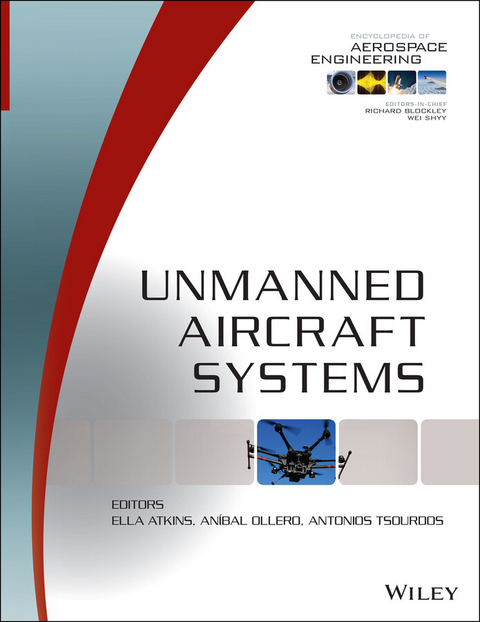
Unmanned Aircraft Systems (eBook)
John Wiley & Sons (Verlag)
978-1-118-86646-7 (ISBN)
Covering the design, development, operation and mission profiles of unmanned aircraft systems, this single, comprehensive volume forms a complete, stand-alone reference on the topic. The volume integrates with the online Wiley Encyclopedia of Aerospace Engineering, providing many new and updated articles for existing subscribers to that work.
UNMANNED AIRCRAF T SYSTEMS UNMANNED AIRCRAF T SYSTEMS An unmanned aircraft system (UAS), sometimes called a drone, is an aircraft without a human pilot on board ??? instead, the UAS can be controlled by an operator station on the ground or may be autonomous in operation. UAS are capable of addressing a broad range of applications in diverse, complex environments. Traditionally employed in mainly military applications, recent regulatory changes around the world are leading to an explosion of interest and wide-ranging new applications for UAS in civil airspace. Covering the design, development, operation, and mission profiles of unmanned aircraft systems, this single, comprehensive volume forms a complete, stand-alone reference on the topic. The volume integrates with the online Wiley Encyclopedia of Aerospace Engineering, providing many new and updated articles for existing subscribers to that work. The chapters cover the following items: Airframe configurations and design (launch systems, power generation, propulsion) Operations (missions, integration issues, and airspace access) Coordination (multivehicle cooperation and human oversight) With contributions from leading experts, this volume is intended to be a valuable addition, and a useful resource, for aerospace manufacturers and suppliers, governmental and industrial aerospace research establishments, airline and aviation industries, university engineering and science departments, and industry analysts, consultants, and researchers.
EDITORS ELLA ATKINS ANÍBAL OLLERO ANTONIOS TSOURDOS
Contributors vii
Foreword xiii
Preface xv
Part 1 Introductory 1
1 UAS Uses, Capabilities, Grand Challenges 3
Part 2 Missions 15
2 Remote Sensing Methodology for Unmanned Aerial Systems 17
3 Autonomous Parachute-Based Precision Delivery Systems 29
4 Networked Multiple UAS 53
5 Weapons Integration 63
Part 3 Airframe Configurations 73
6 Classes and Missions of UAVs 75
7 Launch of UAVs 85
8 Recovery of UAVs 93
9 Development of Centimeter-Sized Aerial Vehicles 101
Part 4 UAS Design and Subsystems 111
10 Overview of UAS Control Stations 113
11 Propulsion Systems 125
12 Power Generation and Energy Management 133
13 Control System Mechanization 153
Part 5 Autonomy 165
14 Relative Navigation in GPS-Degraded Environments 167
15 Target Detection and Mission Planning Based on Pigeon-Inspired Optimization 177
16 Autonomy Architectures 197
17 Obstacle Avoidance: Static Obstacles 211
18 Guided Weapon and UAV Navigation and Path-Planning 217
19 Embedded UAS Autopilot and Sensor Systems 231
Part 6 Control 249
20 Modeling and Frequency-Domain Parameter Identification of a Small-Scale Flybarless Unmanned Helicopter 251
21 Trajectory Planning and Guidance 279
22 Sensor Fusion 295
Part 7 Human Oversight 317
23 Function Allocation between Human and Automation and between Air and Ground 319
24 Coordination with Manned Aircraft and Air Traffic Control 327
25 Aircraft Pilot and Operator Interfaces 335
Part 8 Multi-Vehicle Cooperation and Coordination 345
26 Multi-UAV Cooperation 347
27 Coordinated Standoff Tracking of Moving Ground Targets Using Multiple UAVs 357
28 Distributed Situational Awareness and Control 371
29 Cooperative Search, Reconnaissance, Surveillance 383
30 UAV Swarms: Decision-Making Paradigms 397
31 Integrated Health Monitoring for Multiple Air Vehicles 411
32 Cooperative Control for Multiple Air Vehicles 425
33 Flight Formation Control 435
Part 9 Airspace Access 447
34 Operational Profiles of Unmanned Aircraft Systems in the Context of the US Regulatory Regime 449
35 High Altitude: Among and Above Commercial Transport 465
36 Low-Altitude Rural to Urban Unmanned Aircraft System Operations 475
37 UAS in the Terminal Area: Challenges and Opportunities 489
38 Unmanned Aircraft Systems Operations in US Airspace 507
39 Aircraft Communications and Networking 523
40 Sense-and-Avoid System Based on Radar and Cooperative Sensors 533
41 Standards and Interoperability: A Systems Engineering Perspective 547
Part 10 Integration Issues: Safety, Security, Privacy 559
42 Unmanned Aircraft Systems (UAS) - Regulatory Policy and Processes: A Moving Landscape - A US Perspective 561
43 Requirements: Levels of Safety 579
44 Insurance as a Mission Enabler 589
45 Fail-Safe Systems from a UAS Guidance Perspective 599
46 UAS Reliability and Risk Analysis 615
47 Sense and Avoid: Systems and Methods 627
48 System and Cyber Security: Requirements, Modeling, and Management 637
49 Social and Legal Issues 651
Subject Index 661
Contributors
Brandon R. Abel
International Center for Air Transportation, Massachusetts Institute of Technology, Cambridge, MA, USA
Domenico Accardo
University of Naples “Federico II”, Napoli, Italy
José Joaquin Acevedo
Grupo de Robótica, Visión y Control, Universidad de Sevilla, Seville, Spain
Florian-Michael Adolf
German Aerospace Center (DLR), Department of Unmanned Aircraft, Institute of Flight Systems, Braunschweig, Germany
Jessica Alvarenga
Ritchie School of Engineering and Computer Science, DU Unmanned Research Institute, University of Denver, Denver, CO, USA
Brian M. Argrow
Department of Aerospace Engineering Sciences, Research and Engineering Center for Unmanned Vehicles, University of Colorado Boulder, Boulder, CO, USA
Begoña C. Arrue
Grupo de Robótica, Visión y Control, Universidad de Sevilla, Seville, Spain
Ella M. Atkins
Department of Aerospace Engineering, University of Michigan, Ann Arbor, MI, USA
Randal W. Beard
Department of Electrical and Computer Engineering, Brigham Young University, Provo, UT, USA
Yunfeng Cao
College of Astronautics, Nanjing University of Aeronautics and Astronautics, Nanjing, China
Jesús Capitán
Grupo de Robótica, Visión y Control, Universidad de Sevilla, Seville, Spain
Philip B. Charlesworth
Airbus Group Innovations, Newport, UK
Wen-Hua Chen
Department of Aeronautical and Automotive Engineering, Loughborough University, Loughborough, UK
Yang Quan Chen
School of Engineering, University of California, Merced, CA, USA
Matthew Coombes
Department of Aeronautical and Automotive Engineering, Loughborough University, Loughborough, UK
Mary L. Cummings
Humans and Autonomy Laboratory, Duke University, Durham, NC, USA
Dan DeLaurentis
School of Aeronautics and Astronautics, Purdue University, West Lafayette, IN, USA
Pedro F.A. Di Donato
Department of Aerospace Engineering, University of Michigan, Ann Arbor, MI, USA and National Civil Aviation Agency–Brazil (ANAC), São, José dos Campos, Brazil
Haibin Duan
School of Automation Science and Electrical Engineering, Beihang University, Beijing, P.R. China
John T. Economou
Centre for Defence Engineering, Defence Academy of the United Kingdom, Cranfield University, Swindon, UK
Gary J. Ellingson
Mechanical Engineering Department, Brigham Young University, Provo, UT, USA
Paul G. Fahlstrom
United States Army Materiel Command, Huntsville, AL, USA
Farhan A. Faruqi
Information Processing and Human Sciences Group, Combat and Mission Systems, WCSD, Defence Science and Technology Organisation, Edinburgh, South Australia
Giancarmine Fasano
University of Naples “Federico II”, Napoli, Italy
Karen Feigh
Cognitive Engineering Center, Georgia Tech, Atlanta, GA, USA
C.E. “Noah” Flood
CAVU Global LLC, Purcellville, VA, USA
Michael S. Francis
United Technologies Research Center, East Hartford, CT, USA
Seng Keat Gan
Australian Centre for Field Robotics, The University of Sydney, Sydney, Australia
Alessandro Gardi
RMIT University, Melbourne, Australia
Thomas J. Gleason
Gleason Research Associates, Inc., Columbia, MD, USA
R. John Hansman
International Center for Air Transportation, Massachusetts Institute of Technology, Cambridge, MA, USA
Inseok Hwang
School of Aeronautics and Astronautics, Purdue University, West Lafayette, IN, USA
Mario Innocenti
Munitions Directorate, Eglin Air Force Base, Air Force Research Laboratory, FL, USA
Pantelis Isaiah
Faculty of Aerospace Engineering, The Technion—Israel Institute of Technology, Haifa, Israel
Stéphane Kemkemian
Thales Airborne Systems, Elancourt, France
Seungkeun Kim
Department of Aerospace Engineering, Chungnam National University, Daejeon, Republic of Korea
Trevor Kistan
RMIT University, Melbourne, Australia and THALES Australia, Melbourne, Australia
Daniel P. Koch
Mechanical Engineering Department, Brigham Young University, Provo, UT, USA
Cheolhyeon Kwon
School of Aeronautics and Astronautics, Purdue University, West Lafayette, IN, USA
Jack W. Langelaan
Department of Aerospace Engineering, The Pennsylvania State University, University Park, PA, USA
Nicolas Léchevin
Department of Mechanical and Industrial Engineering, Concordia University, Montreal, Quéebec, Canada
Christopher W. Lum
William E. Boeing Department of Aeronautics & Astronautics, University of Washington, Seattle, WA, USA
Douglas M. Marshall
TrueNorth Consulting LLC, Grand Forks, ND, USAand De Paul University College of Law, Chicago, IL, USA
David W. Matolak
Department of Electrical Engineering, University of South Carolina, Columbia, SC, USA
Iván Maza
Grupo de Robótica, Visión y Control, Universidad de Sevilla, Seville, Spain
Timothy W. McLain
Mechanical Engineering Department, Brigham Young University, Provo, UT, USA
Luis Merino
Grupo de Robótica, Visión y Control, Universidad Pablo de Olavide, Seville, Spain
Antonio Moccia
University of Naples “Federico II”, Napoli, Italy
Linas Mockus
School of Aeronautics and Astronautics, Purdue University, West Lafayette, IN, USA
Eric Mueller
NASA, Moffett Field, CA, USA
Myriam Nouvel
Thales Airborne Systems, Elancourt, France
Paul W. Nyholm
Mechanical Engineering Department, Brigham Young University, Provo, UT, USA
Hyondong Oh
Department of Aeronautical and Automotive Engineering, Loughborough University, Loughborough, UK
Aníbal Ollero
Universidad de Sevilla and Scientific Advisory Department of the Center for Advanced Aerospace Technologies, Seville, Spain
Martina Orefice
Air Transport Sustainability Department, CIRA Italian Aerospace Research Center, Capua, Italy
Charles H. Patchett
School of Engineering, University of Liverpool, Liverpool, UK
Lorenzo Pollini
Department of Information Engineering, University of Pisa, Pisa, Italy
Amy Pritchett
Cognitive Engineering Center, Georgia Tech, Atlanta, GA, USA
Camille A. Rabbath
Department of Mechanical and Industrial Engineering, Concordia University, Montreal, Quéebec, Canada
Matthew R. Rabe
International Center for Air Transportation, Massachusetts Institute of Technology, Cambridge, MA, USA
Subramanian Ramasamy
RMIT University, Melbourne, Australia
Francisco J. Ramos
UAS Ground Segment Department, Airbus Defence & Space, Getafe, Spain
James M. Rankin
Avionics Engineering Center, School of Electrical Engineering and Computer Science, Russ College of Engineering and Technology, Ohio University, Athens, OH, USA
Keith A. Rigby
BAE Systems, Warton Aerodrome, Preston, UK
Matthew J. Rutherford
Ritchie School of Engineering and Computer Science, DU Unmanned Research Institute, University of Denver, Denver, CO, USA
Roberto Sabatini
RMIT University, Melbourne, Australia
Daniel P. Salvano
Aviation Consultant, Safety, Certification and CNS Systems, Haymarket, VA, USA
A. Savvaris
Centre for Cyberphysical Systems, Institute for Aerospace Sciences, Cranfield University, Cranfield, UK
Corey J. Schumacher
711 HPW/RH, Wright-Patterson AFB, Ohio, OH, USA
Pau Segui-Gasco
Centre for Autonomous and Cyber-Physical Systems, SATM, Cranfield University, Cranfield, UK
Madhavan Shanmugavel
School of Engineering, Monash University Malaysia, Selangor, Malaysia
Tal Shima
Faculty of Aerospace Engineering, The Technion—Israel Institute of Technology, Haifa, Israel
Hyo-Sang Shin
Centre for Autonomous and Cyber-Physical Systems, SATM, Cranfield University, Cranfield, UK
Brandon J. Stark
School of Engineering, University of California, Merced, CA, USA
Chun-Yi Su
Department of Mechanical and Industrial Engineering, Concordia University, Montreal, Quéebec, Canada
Salah Sukkarieh
Australian Centre for Field Robotics, The University of Sydney, Sydney, Australia
Shigeru Sunada
Department of Aerospace Engineering, Osaka Prefecture University, Osaka, Japan
Hiroshi Tokutake
Department of Aerospace Engineering, Osaka Prefecture University, Osaka,...
| Erscheint lt. Verlag | 4.11.2016 |
|---|---|
| Mitarbeit |
Chef-Herausgeber: Richard Blockley, Wei Shyy |
| Sprache | englisch |
| Themenwelt | Technik ► Fahrzeugbau / Schiffbau |
| Technik ► Luft- / Raumfahrttechnik | |
| Technik ► Maschinenbau | |
| Schlagworte | Aeronautic & Aerospace Engineering • Bauingenieur- u. Bauwesen • Civil Engineering & Construction • Electrical & Electronics Engineering • Elektrotechnik u. Elektronik • Luftfahrt • Luft- u. Raumfahrttechnik • Maschinenbau • mechanical engineering • Robotics • Robotik • Transportation Engineering • Unbemanntes Luftfahrzeug • Verkehrsbau |
| ISBN-10 | 1-118-86646-0 / 1118866460 |
| ISBN-13 | 978-1-118-86646-7 / 9781118866467 |
| Informationen gemäß Produktsicherheitsverordnung (GPSR) | |
| Haben Sie eine Frage zum Produkt? |
 EPUB (Adobe DRM)
Kopierschutz: Adobe-DRM
Adobe-DRM ist ein Kopierschutz, der das eBook vor Mißbrauch schützen soll. Dabei wird das eBook bereits beim Download auf Ihre persönliche Adobe-ID autorisiert. Lesen können Sie das eBook dann nur auf den Geräten, welche ebenfalls auf Ihre Adobe-ID registriert sind.
Details zum Adobe-DRM
Dateiformat: EPUB (Electronic Publication)
EPUB ist ein offener Standard für eBooks und eignet sich besonders zur Darstellung von Belletristik und Sachbüchern. Der Fließtext wird dynamisch an die Display- und Schriftgröße angepasst. Auch für mobile Lesegeräte ist EPUB daher gut geeignet.
Systemvoraussetzungen:
PC/Mac: Mit einem PC oder Mac können Sie dieses eBook lesen. Sie benötigen eine
eReader: Dieses eBook kann mit (fast) allen eBook-Readern gelesen werden. Mit dem amazon-Kindle ist es aber nicht kompatibel.
Smartphone/Tablet: Egal ob Apple oder Android, dieses eBook können Sie lesen. Sie benötigen eine
Geräteliste und zusätzliche Hinweise
Buying eBooks from abroad
For tax law reasons we can sell eBooks just within Germany and Switzerland. Regrettably we cannot fulfill eBook-orders from other countries.
aus dem Bereich