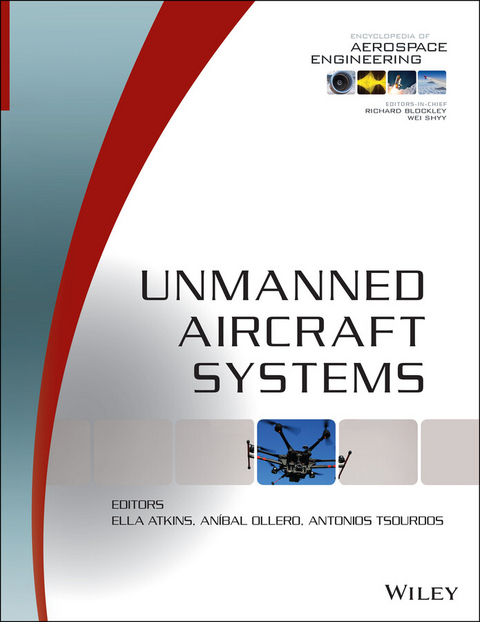
Unmanned Aircraft Systems (eBook)
John Wiley & Sons (Verlag)
978-1-118-86653-5 (ISBN)
Richard H. Blockley, Aerospace Consultant, Cranfield University, UK andformerly Head of Technical Programmes, BAE Systems, Farnborough, UK.
Wei Shyy, Provost and Chair Professor of Mechanical Engineering, Hong Kong University of Science & Technology, China.
Ella Atkins, Associate Professor, Department of Aerospace Engineering at the University of Michigan. Former chair of the AIAA Intelligent Systems Technical Committee, AIAA Associate Fellow, served on the National Academy's Aeronautics and Space Engineering Board (ASEB) 2011-2015.
Anibal Ollero, Center for Advanced Aerospace Technologies, University of Seville, Spain. Co-chair of the IEEE Technical Committee on Aerial Robotics and Unmanned Aerial Vehicles, member of the Board of Directors and coordinator of the Aerial Robotics Topic Group of euRobotics and president of the Spanish Society for Research and Development in Robotics.
Antonios Tsourdos, Professor and Head of the Centre for Autonomous and Cyberphysical System, Cranfield University, UK. Vice-Chair of the IFAC Technical Committees on Aerospace Control, member of the IFAC Technical Committee on Intelligent Autonomous Vehicles and the AIAA Unmanned Systems Program Committee.
UNMANNED AIRCRAF T SYSTEMS UNMANNED AIRCRAF T SYSTEMS An unmanned aircraft system (UAS), sometimes called a drone, is an aircraft without a human pilot on board ??? instead, the UAS can be controlled by an operator station on the ground or may be autonomous in operation. UAS are capable of addressing a broad range of applications in diverse, complex environments. Traditionally employed in mainly military applications, recent regulatory changes around the world are leading to an explosion of interest and wide-ranging new applications for UAS in civil airspace. Covering the design, development, operation, and mission profiles of unmanned aircraft systems, this single, comprehensive volume forms a complete, stand-alone reference on the topic. The volume integrates with the online Wiley Encyclopedia of Aerospace Engineering, providing many new and updated articles for existing subscribers to that work. The chapters cover the following items: Airframe configurations and design (launch systems, power generation, propulsion) Operations (missions, integration issues, and airspace access) Coordination (multivehicle cooperation and human oversight) With contributions from leading experts, this volume is intended to be a valuable addition, and a useful resource, for aerospace manufacturers and suppliers, governmental and industrial aerospace research establishments, airline and aviation industries, university engineering and science departments, and industry analysts, consultants, and researchers.
EDITORS ELLA ATKINS ANÍBAL OLLERO ANTONIOS TSOURDOS
Unmanned Aircraft Systems 1
Contents 7
Contributors 9
Foreword 15
Preface 17
Part 1: Introductory 19
Chapter 1: UAS Uses, Capabilities, Grand Challenges 21
1 Introduction 21
2 Uses - Missions and Applications 22
2.1 Early evolution 22
2.2 Dull, dirty, and dangerous 22
2.3 Emergence of civil and commercial applications 23
3 Emerging Capabilities And A Look Ahead 24
3.1 Expanding the design space and operational envelope 24
3.2 Autonomy 28
4 Grand Challenges Ahead 29
4.1 Access to the airspace 29
4.2 The quest for trust 30
4.3 Integration 31
5 Summary 31
References 31
Part 2: Missions 33
Chapter 2: Remote Sensing Methodology for Unmanned Aerial Systems 35
1 Introduction 35
2 UAS Remote Sensing Methodology 35
3 Core Concepts in UAS Remote Sensing Applications 37
3.1 Detection/Counting Applications 37
3.2 Identification/Localization Applications 38
3.3 Analysis Applications 38
4 UAS Imaging Equipment 39
4.1 Video Systems 40
4.2 Digital Cameras 40
4.3 Calibrated Digital Imagers 41
4.3.1 Digital Cameras as Calibrated Imagers 41
4.3.2 Multispectral and Hyperspectral Imagers 41
4.3.3 Spectral Sensitivity 42
5 Conclusion 44
References 44
Chapter 3: Autonomous Parachute-Based Precision Delivery Systems 47
1 Introduction 47
2 Concept of Operations and Key Requirements 47
3 Pads Family and Steady-State Performance 50
4 Modeling 54
4.1 Governing equations 54
4.2 Apparent mass and inertia 55
4.3 PADS aerodynamics 56
4.4 Effect of the control inputs 58
4.5 Linearized models and stability 59
5 Pads Gnc 60
5.1 Maneuver-based guidance 61
5.2 Accounting for the variable winds 62
5.3 Optimal precision placement guidance 64
6 Other Developments 65
6.1 Glide slope angle control 65
6.2 Reduced cost PADS 66
7 Conclusion 68
References 69
Chapter 4: Networked Multiple UAS 71
1 Introduction 71
2 Principles of Radio Links 72
3 Air-to-Ground Communications 73
4 Air-to-Air Communications 74
5 Antenna Types and Locations 74
5.1 Omnidirectional Antennae 74
5.2 Directional Antennae 75
5.3 Phased Arrays 76
5.4 Antenna Locations 76
6 UAS Networks 76
7 Conclusions 78
Notation 78
Abbreviations 78
References 79
Chapter 5: Weapons Integration 81
1 Introduction 81
2 Issues for System Design and Integration 81
3 Types of Weapon 82
4 Ballistic Bombs 82
4.1 Physical Preparation 82
4.2 Aircraft Attachment 82
4.3 Targeting 83
4.4 Release 83
5 Smart Bombs 84
5.1 Physical Preparation 84
5.2 Aircraft Attachment 84
5.3 Targeting 84
5.4 Release and Guidance 86
6 Complex Air-To-Ground Weapons 86
7 Air-To-Air Missiles 86
7.1 Aircraft Attachment 86
7.2 Targeting 86
7.3 Release and Guidance 87
7.4 End-Game 88
8 Releasing Weapons from Weapon Bays 88
9 Stores Management Systems 88
10 Weapon Interface Standards 89
11 Future Systems 90
Acknowledgments 90
Related Article 90
Further Reading 90
Part 3: Airframe Configurations 91
Chapter 6: Classes and Missions of UAVs 93
Acronyms 93
1 Overview 93
2 Examples of UAVs 93
2.1 Very Small UAVs 94
2.2 Small UAVs 95
2.3 Medium UAVs 95
2.4 Large UAVs 98
3 Expendable UAVs 99
4 Classes of UAV Systems 99
4.1 Classification by Range and Endurance 99
4.2 The Tier System 100
4.3 Commercial and Consumer UAVs 100
5 Missions 100
5.1 Military versus Civilian Missions 101
6 Conclusion 102
Related Article 102
References 102
Chapter 7: Launch of UAVs 103
Acronyms 103
1 Overview 103
2 Basic Considerations 103
3 UAV Launch Methods for Fixed-Wing Vehicles 105
3.1 Rail launchers 106
3.2 Pneumatic launchers 106
3.3 Hydraulic/pneumatic launchers 107
3.4 Zero-length RATO launch of UAVs 108
4 Vertical Takeoff and Landing UAV Launch 110
5 Air Launch of UAVs 110
6 Conclusions 110
Related Article 110
Acknowledgment 110
Reference 110
Chapter 8: Recovery of UAVs 111
Acronyms 111
1 Overview 111
2 Conventional Landings 111
3 Vertical Net Systems 112
4 Parachute Recovery 113
5 VTOL UAVs 114
6 Mid-air Retrieval 115
7 Shipboard Recovery 116
8 Conclusions 117
Related Article 117
Acknowledgment 117
Reference 117
Chapter 9: Development of Centimeter-Sized Aerial Vehicles 119
1 Introduction 119
2 Development of a Fixed-Wing UAV 119
2.1 Overview of Fixed-Wing UAVs’ Configuration 119
2.2 Fixed-Wing UAV Developed in Japan 120
3 Development of a Rotary-Wing UAV 122
3.1 Centimeter-Sized Rotary-wing UAVs Developed All Over The World 122
4 Controller Design of Centimeter-Sized UAV 124
4.1 Control Theory 124
4.2 Equipment 125
4.3 Flight Control Boards MAVCs 1 and 2 126
5 Wing Characteristics at a Low Reynolds Number and Flight Stability of a Fixed-Wing MAV 126
Acknowledgments 127
References 127
Part 4: UAS Design and Subsystems 129
10: Overview of UAS Control Stations 131
1 Introduction 131
2 Terminology and Definition 131
3 Classification 131
4 Main Design Characteristics 132
4.1 Architecture 132
4.2 Main Functions 136
4.3 Human Factors 137
4.4 Environmental Conditions 138
4.5 Certification and Safety 138
4.6 Interoperability 139
4.7 Security 139
5 Future Trends 140
6 Conclusions 140
Acknowledgments 140
References 140
11: Propulsion Systems 143
1 Introduction 143
1.1 Propulsion Variants 144
1.2 Electrification Propulsion Variants 146
1.3 Soft Methods - Intelligent Power Management and Energy Conservation 148
2 Conclusions 150
Notation and Nomenclature 150
References 150
Chapter 12: Power Generation and Energy Management 151
1 Introduction 151
2 Onboard Energy Sources and Design Implications 152
2.1 Combustion Engines 153
2.2 Battery Electric Power 154
2.3 Solar Power 155
2.4 Fuel Cells 156
3 Flight Planning for Energy Management 157
3.1 Energy-Optimal Flight Speed 157
3.2 Energy-Optimal Flight Versus Nominal Cruise Speed Flight 161
3.3 Routing 161
4 Harvesting Atmospheric Energy 161
4.1 Autonomous Static Soaring 165
4.2 Dynamic Soaring 166
5 Conclusion 167
References 168
Chapter 13: Control System Mechanization 171
1 Control Fundamentals of UAS 171
1.1 UAS and Control Systems 171
1.2 Types of FCS 171
1.3 UAS Control Architecture 172
1.4 UAS Control System Design Consideration 172
2 UAS Control System Elements 173
2.1 Sensors and Its Integration 173
2.2 Actuators 175
2.3 Flight Control Computer 176
3 FCS Development Process 176
3.1 Control System Design 176
3.2 Software-in-the-Loop Simulation 177
3.3 Hardware-in-the-Loop Tests 177
4 Some Practical Issues 179
4.1 Fail-Safe Procedures for FCS 179
4.2 Flight Tests and Communication with Control Station 179
5 Summary 180
References 181
Part 5: Autonomy 183
Chapter 14: Relative Navigation in GPS-Degraded Environments 185
1 Introduction 185
2 Relative Navigation Framework 186
2.1 Relative Front-End Overview 186
2.2 Global Back-End Overview 186
2.3 Motivating Scenarios 187
3 Relative Front End 188
3.1 Visual Odometry 188
3.2 Estimation 188
3.3 Low-level Path Generation and Following 189
3.4 Control 190
4 Global Back End 190
4.1 Pose Graph 190
4.2 Place Recognition 191
4.3 Intermittent GPS Integration 191
4.4 Map Optimization 192
4.5 High-Level Path Planning 193
5 Conclusion 193
References 193
Chapter 15: Target Detection and Mission Planning Based on Pigeon-Inspired Optimization 195
1 Introdution 195
2 Pigeon-Inspired Optimization 196
2.1 Natural Behavior of Pigeons 196
2.2 Mathematical Model 196
2.3 The Procedure of Basic PIO 197
3 PIO for Target Detection 198
3.1 Problem Formulation 198
3.2 The Implementation Procedure of SAPIO-Optimized EPF 200
3.3 Experimental Results 201
4 PIO for UAV Path Planning 201
4.1 Path Planning Using PIO 201
4.2 PP-PIO-Based Three-Dimensional Path Planning 205
5 Mission Assignment Based on PIO 209
5.1 Mission Assignment Problem Formulation 209
5.2 Experimental Results 210
6 Summary 212
References 213
Chapter 16: Autonomy Architectures 215
1 Introduction to Autonomy Architectures for UAS 215
1.1 Autonomy Levels for UAS 215
1.2 Overview of Architectures for Autonomous Systems 216
2 Autonomy Architecture for UAS 217
2.1 Low-Level Architecture 218
2.2 High-Level Architecture 219
3 Example of Autonomy Architecture: The ARCAS Project 221
3.1 Low-Level ARCAS Architecture 222
3.2 High-Level ARCAS Architecture 222
3.3 Example of ARCAS Complex Mission: Assembly Operations 224
4 Conclusions 226
References 226
Chapter 17: Obstacle Avoidance: Static Obstacles 229
1 Introduction 229
2 Avoiding Static Obstacles 230
2.1 Voronoi Diagram 230
2.2 Cell Decomposition 230
2.3 Visibility Graph 230
2.4 Potential Field and Sampling-Based Methods 230
3 Research on Obstacle Avoidance 231
4 Avoidance of Static Obstacles 232
5 Reactive Planning 232
6 Summary 233
References 233
Chapter 18: Guided Weapon and UAV Navigation and Path-Planning 235
1 Problems of GPS and INS for Missiles and UAVs 235
1.1 Global Positioning System (GPS) Navigation 235
1.2 Inertial Navigation System (INS) 236
1.3 Inertial Navigation Algorithm 238
1.4 GPS/INS Integration 239
2 Principles and Practice of TERPROM and TERCOM 240
2.1 Aircraft and UAV Path Planning 241
3 Tactical Missile Guidance Strategies 242
3.1 CLOS Guidance and Variations 242
3.2 Proportional Navigation (PN) Guidance 244
3.3 Miss Distance (MD) 245
4 Conclusions 246
Notation 246
Nomenclature 247
References 248
Chapter 19: Embedded UAS Autopilot and Sensor Systems 249
1 Introduction 249
2 Autopilot Architecture 250
3 Inner-Loop Control Structure 251
3.1 Lateral Autopilot 251
3.2 Longitudinal Autopilot 254
4 On-Board Sensors and Sensor Processing 257
4.1 Angular Rates, Airspeed, and Altitude 257
4.2 Roll and Pitch Angles 258
4.3 Inertial Position and Heading 260
5 GPS Navigation 261
5.1 Straight-Line Path Following 262
5.2 Orbit Following 263
6 Summary 264
Acknowledgments 264
End Notes 264
References 264
Part 6: Control 267
Chapter 20: Modeling and Frequency-Domain Parameter Identification of a Small-Scale Flybarless Unmanned Helicopter 269
1 Introduction 269
1.1 Testbed 270
2 System Identification Overview 271
3 Collection of Time History Data 272
3.1 Criteria and Guidelines 272
3.2 Computer-Generated Sweeps 274
3.3 Data Collection 276
4 Frequency-Response Analysis 276
4.1 Frequency-Response Selection 277
5 Model Linearization 277
5.1 Trim 285
5.2 Comprehensive Linear State-Space Model 286
6 Stability and Control Derivatives 287
7 Frequency Response 287
8 Three-Dimensional Rate Gyro 288
9 State-Space Model Identification 290
10 Frequency Response of the Identified Model 290
11 Time-Domain Validation 291
12 Conclusion 294
References 294
Chapter 21: Trajectory Planning and Guidance 297
1 Introduction 297
2 Trajectory Planning 298
2.1 A Basic Kinematic Model for Planar Motion Under Curvature Constraints 298
2.2 Variations on the Basic Model 299
2.3 An Incrementally More Complicated Model 301
2.4 Further Model Variations 302
2.5 Extensions to Three Dimensions 303
2.6 Trajectory Planning with Interior Point Constraints 304
3 Guidance for Path Following 304
3.1 Introduction 304
3.2 Waypoint Guidance 307
3.3 Virtual Target Guidance 309
3.4 Cross-Track Guidance 309
4 Conclusions 311
References 311
Chapter 22: Sensor Fusion 313
1 Introduction 313
2 Sensor Fusion in UAS 313
3 Architectures 315
4 Algorithms 317
4.1 Linear Kalman Filters 319
4.2 Extended Kalman Filters 320
4.3 Unscented Kalman Filters 320
4.4 Particle Filters 320
4.5 Summary of Sensor Fusion Algorithms 321
5 Implementation Issues 322
6 Sensor Fusion Examples 323
6.1 Multisensor-Based Sense and Avoid 323
6.2 Multisensor Integrated Navigation 325
7 Future Developments 331
Acknowledgments 332
References 332
Part 7: Human Oversight 335
Chapter 23: Function Allocation between Human and Automation and between Air and Ground 337
1 Introduction 337
1.1 Requirement 1: Each agent must be allocated functions that it is capable of performing 338
1.2 Requirement 2: Each agent must be capable of performing its collective set of functions 339
1.3 Requirement 3: The function allocation must be realizable with reasonable teamwork 340
1.4 Requirement 4: The function allocation must support the dynamics of the work 341
1.5 Requirement 5: The function allocation should be the result of deliberate design decisions 341
2 Conclusions 342
References 343
Chapter 24: Coordination with Manned Aircraft and Air Traffic Control 345
1 Introduction 345
1.1 The Airspace System 345
1.2 Unmanned Aircraft Systems 346
1.3 Safety Management 346
1.4 Role of Controllers in Air Traffic Management 347
1.5 Communication Between ATC and Unmanned Aircraft 347
2 Evolving UAS Technology and Capability 348
2.1 Fixed Wing Versus Multirotor 348
2.2 Commercial Applications 348
2.3 Communications Architecture 349
3 System Requirements for UAS Airspace Integration and Coordination 349
3.1 Sense and Avoid 349
3.2 Ground-Based Sense and Avoid 349
3.3 Airborne Sense and Avoid 350
4 Command and Control Integration 350
4.1 New ATM Procedures 351
5 Conclusions 351
References 352
Chapter 25: Aircraft Pilot and Operator Interfaces 353
1 Introduction 353
2 Basic Cockpit Design 355
3 The Impact of Increasing Automation in the Cockpit 357
4 Unmanned Aerial Vehicle Ground Control Interfaces 358
5 Conclusion 361
Acknowledgments 361
References 361
Part 8: Multi-Vehicle Cooperation and Coordination 363
Chapter 26: Multi-UAV Cooperation 365
1 Introduction 365
2 Multi-UAV Architectures for Cooperation 365
2.1 Coordination and Cooperation 365
2.2 Classification of Multi-UAV Architectures 366
2.3 Intentional Cooperation Multi-UAV Architectures 367
3 Cooperative Perception 368
4 Decision Making in a Multi-UAV Context 368
4.1 Different Formulations 369
4.2 Centralized versus Decentralized 369
4.3 Abstraction Level 369
4.4 Time Horizon 370
4.5 Classification 370
5 Application: People Tracking with Multiple UAVs 370
6 Conclusions 372
Acknowledgments 373
References 373
Chapter 27: Coordinated Standoff Tracking of Moving Ground Targets Using Multiple UAVs 375
1 Introduction 375
2 Problem Formulation 376
2.1 UAV Dynamic Model 376
2.2 Ground Target and Sensor Model 376
2.3 Ground Target Tracking Filter 377
2.4 Review on Vector Field Guidance 377
3 Recent Techniques on Coordinated Standoff Tracking 378
3.1 Decentralized Adaptive Sliding mode Control Approach 378
3.2 Nonlinear Model Predictive Control Approach 381
3.3 Other Approaches 383
3.4 Discussion 384
4 Coordinated Target Group Tracking Using Multiple UAVs 385
4.1 LVFG with Variable Standoff Distance 385
4.2 Multiple Target Group Tracking by Multiple UAVs 386
4.3 Numerical Simulations 386
5 Conclusions 386
References 387
Chapter 28: Distributed Situational Awareness and Control 389
1 Introduction 389
2 Distributed Situational Awareness 389
2.1 Kalman and Information Filters 390
2.2 Certainty Grid 391
2.3 Particle Filters 393
3 Distributed Control 393
3.1 Coordination and Cooperation 393
3.2 Problem Definition 393
3.3 Problem Simplifications 394
3.4 Solution Approaches 395
4 Simulation Example 398
5 Conclusion 398
References 398
Chapter 29: Cooperative Search, Reconnaissance, Surveillance 401
1 Introduction 401
1.1 Cooperative Surveillance with Multiple Aerial Robots 401
2 A Path Planning Problem 402
2.1 View Point Based Search 402
2.2 Grid-Map Based Search 402
2.3 Coverage Path-Planning Algorithms 402
3 Criteria for Monitoring Missions 403
3.1 Frequency-Based Approach 403
3.2 Urgency Criterion 404
4 Cooperative Patrolling 404
4.1 Formation Strategy 404
4.2 Cyclic Strategies 405
4.3 Path Partitioning Strategies 406
4.4 Area Division Strategies 407
5 Coordination of Multiple Aerial Robots 409
5.1 Distributed Coordination 409
6 Relevant Results 410
6.1 Comparison Among Patrolling Strategies 410
6.2 Convergence Analysis 410
6.3 Experimental Results 411
7 Summary 412
References 413
Chapter 30: UAV Swarms: Decision-Making Paradigms 415
1 Introduction 415
2 Task Allocation in UAV Swarms 416
2.1 Decentralized Task Allocation Approaches 417
3 Communication Network Connectivity 419
3.1 Communication Models 420
3.2 Communications-Aware Task Allocation 421
4 Distributed Guidance and Control 422
4.1 Pure Behavioral Approach 422
4.2 Other Behavioral Approaches 423
5 Summary 426
References 426
Chapter 31: Integrated Health Monitoring for Multiple Air Vehicles 429
1 Introduction 429
2 Integrated Control and Fault Detection 430
3 Decentralized Fault Detection 431
3.1 Abrupt Fault Detector 431
3.2 Nonabrupt Fault Detector 434
4 Automated Threshold Selection for NAFD 436
5 Simulations and Discussions 439
Acknowledgments 440
References 440
Chapter 32: Cooperative Control for Multiple Air Vehicles 443
1 Introduction 443
1.1 Motivation 443
1.2 Cooperative Control Structure 443
1.3 Attributes 444
2 Complexity in Cooperative Teams 444
2.1 Task coupling 445
2.2 Uncertainty 445
2.3 Communication 446
2.4 Partial Information 446
3 Task Assignment Example 446
3.1 Wide Area Search Munition Scenario 447
3.2 Required Tasks 447
3.3 Task Definitions 447
3.4 Capacitated Transshipment Assignment Problem Formulation 448
3.5 Weight Calculations 449
3.6 Simulation Results 450
3.7 Capabilities and Limitations of Capacitated Transshipment Assignment Problem Formulation 451
4 Conclusions 452
References 452
Chapter 33: Flight Formation Control 453
1 Introduction 453
2 Modeling 454
3 Control Strategies 455
4 Reconfiguration 461
5 Sensors 462
6 Examples 463
7 Summary 463
References 464
Part 9: Airspace Access 465
Chapter 34: Operational Profiles of Unmanned Aircraft Systems in the Context of the US Regulatory Regime 467
Acronyms 467
1 Introduction 467
2 Operations under Existing Regulatory Framework 468
2.1 Regulatory Approval Framework 468
2.2 Current UAS Operations 470
3 Operations under Future Regulatory Frameworks 474
3.1 Future Regulatory Frameworks 474
3.2 Future UAS Operations 477
4 Conclusions 480
References 481
Chapter 35: High Altitude: Among and Above Commercial Transport 483
1 Introduction 483
2 High-Altitude UAS Mission Requirements Overview 483
2.1 Mission Overview 485
3 Lost-Link Operations 486
4 Divert/Contingency and Flight Termination Points 487
5 Integrating UAS Mission Differences into the NAS 488
6 UAS Weather Limitations 490
7 Conclusion 491
References 491
Chapter 36: Low-Altitude Rural to Urban Unmanned Aircraft System Operations 493
1 Introduction 493
2 sUAS Technologies: Capabilities and Classifications 494
3 Urban (U) Zone Operations 496
4 Suburban (S) Zone Operations 497
5 Private Rural (R) Zone Operations 499
6 Unpopulated Commercial (UC) Zone Operations 500
7 Unpopulated Public (UP) Zone Operations 501
8 Airport Area Operations 502
9 Airspace Zone Transit: Crossing Boundaries 502
9.1 Transit Between Low-Altitude Zones 502
9.2 Transit Between Low-Altitude Zones and Higher layers 502
10 Conclusions 503
Nomenclature 504
Acknowledgment 504
References 504
Chapter 37: UAS in the Terminal Area: Challenges and Opportunities 507
1 Introduction 507
2 Terminal-Area Operations 508
3 Key Challenges and Opportunities 508
4 CNS+A Concept of Operations 510
5 CNS+A Technologies for UAS 511
6 UAS Flight Management Systems 512
7 Conclusions 521
References 521
Chapter 38: Unmanned Aircraft Systems Operations in US Airspace 525
1 Introduction 525
2 UAS Classification 525
2.1 Levels of Autonomy 526
2.2 Airframe Size and Performance 526
3 Regulatory Compliance 528
3.1 UAS Certification 528
3.2 The COA Application Process 529
4 UAS Platform Designs 529
5 Military Applications 531
6 Civilian Applications 532
7 UAS Flight Test Procedures 536
8 Public Perception of UAS 537
9 Conclusion 537
Acknowledgments 538
Notes 538
References 538
Chapter 39: Aircraft Communications and Networking 541
1 Introduction 541
1.1 Background and Scope 541
1.2 Aircraft Communication Systems 542
1.3 Propagation Basics for Aircraft Communications 542
1.4 Chapter Contents 543
2 Fundamentals of Aircraft Communications 543
2.1 Analog Voice Communications 543
2.2 A “Taxonomy” of Aeronautical Communication Types 543
2.3 Aeronautical Spectrum Allocations 543
3 Current Communication Systems 544
3.1 Voice Communications 544
3.2 Digital Datalink Communications 544
4 Future Aeronautical Communication Systems 546
4.1 NextGen Communications 546
4.2 NextGen Navigation 547
4.3 NextGen Surveillance 547
4.4 NextGen Airport Surface Operations 547
5 Technology and Policy Issues 548
5.1 Bandwidth Limitations 548
5.2 Encryption and Security 548
5.3 Required Communications Performance 548
5.4 Unmanned Aircraft Systems (UAS) 549
6 Summary 549
Nomenclature 549
References 550
Chapter 40: Sense-and-Avoid System Based on Radar and Cooperative Sensors 551
1 Introduction 551
2 Sense-and-Avoid System Requirements 551
2.1 Sense Function 552
2.2 Avoid Function 553
3 Sensor Requirements 553
4 Radar Trade-Offs 554
4.1 Angle Accuracy 554
4.2 Scanning Technologies 554
4.3 Power Budget 556
4.4 What is the Best Operating Frequency? 556
5 Example of Radar System 556
5.1 Architecture 556
5.2 Example Embodiment 558
6 Cooperative Sensors 559
7 Data Fusion and Intruder Trajectory Estimation 560
7.1 Principles of Data Fusion 560
7.2 Multiple-Sensor Tracking Algorithm 561
7.3 Simulations of Data Fusion 562
8 Conclusion 563
References 563
Chapter 41: Standards and Interoperability: A Systems Engineering Perspective 565
1 Introduction 565
2 Standardization 565
3 Interoperability 566
4 Importance of Interoperability and Standardization 568
5 Systems Engineering, Enabled by Modeling andSimulation, for UAS Interoperability and Standardization 570
5.1 Modeling and Simulation 570
6 Key Modular Design Trade Areas 572
7 Mechanical and Electrical Exchanges 574
8 Challenges in UAS Interoperability and Standardization 574
References 575
Part 10: Integration Issues: Safety, Security, Privacy 577
Chapter 42: Unmanned Aircraft Systems (UAS) - Regulatory Policy and Processes: A Moving Landscape - A US Perspective 579
1 Introduction 579
2 UAS Legal, Regulatory, and Policy Documents and the Cause for Confusion 580
2.1 Facts Versus Myth 580
3 UAS Regulations and Policy Today 582
4 Type Certification (TC) and Airworthiness Approvals 584
5 Development of Technical Standards 585
6 European Regulations and Policy 585
7 Summary 585
Appendix A – Definitions 586
Appendix B – Type Certificate Data Sheet (TCDS) 589
References 594
Chapter 43: Requirements: Levels of Safety 597
1 Introduction 597
2 Definitions and Assumptions 597
3 The Context for Unmanned Systems 598
3.1 The Meaning of Safety 598
3.2 UAS Modes of Control 598
3.3 Equivalence and Transparency 598
4 Certification – Aerospace Standards for Softwareand Hardware 599
4.1 CS 1301 and 1309 599
4.2 Systems Development and Design 599
4.3 ARP 4761 Guidelines and Methods for Conducting the Safety Assessment Process on Civil Airborne Systems and Equipment 601
4.4 ARP 4754A Guidelines for Development of Civil Aircraft and Systems 601
4.5 RTCADO-178B/C Software Considerations in Airborne Systems and Equipment Certification 601
4.6 RTCADO-254 Design Assurance Guidance for Airborne Electronic Hardware 601
4.7 CAP-722 Unmanned Aircraft System Operations in UK Airspace-Guidance 602
5 System Design Considerations 602
5.1 Safety Assessment 602
5.2 Development/Design Assurance Levels 602
5.3 Validation and Verification 603
6 Operational Issues 603
6.1 Rules of the Air 603
6.2 Airspace Considerations 603
6.3 Autonomy and Automation 604
6.4 Health Management and Emergency Handling 604
6.5 Communications 605
6.6 Ground Control Station 605
7 Accident Analysis 605
8 Concluding Remarks 606
Acknowledgments 606
References 606
Chapter 44: Insurance as a Mission Enabler 607
1 Introduction 607
2 How Does Insurance Work? 608
2.1 Risk 608
2.2 Indemnity 608
2.3 The Principle of Subrogation 609
3 Managing Risk in UAS 610
3.1 Overview of Risk Management in Aviation 610
3.2 How to Reduce Risk 611
4 Special Considerations in UAS 612
4.1 Statutory and Regulatory Requirements 613
4.2 State Laws May Impose Additional Requirements 613
4.3 Strict Liability 613
4.4 Ultrahazardous Activities 614
4.5 Uninsurable Activities 614
4.6 Business Insurance 614
5 Conclusion 614
References 615
Chapter 45: Fail-Safe Systems from a UAS Guidance Perspective 617
1 Introduction 617
2 ARTIS System Description 618
3 Related Work 619
4 Fail-Safe Systems 620
4.1 Fail-Safe UAS 621
4.2 Fail-Safe Software 622
5 Fail-Safe UAS Requirements 622
5.1 Requirements Formalization 623
5.2 Safety, Liveness, and Fairness 624
6 Fail-Safe Systems Design 624
6.1 Design Verification 624
6.2 Model-Checking Results 626
7 Fail-Safe Systems Verification 626
7.1 Test Methodologies 626
7.2 Test Dimensions 627
8 Fail-Safe Systems Runtime Management 628
9 Conclusion and Outlook 629
References 630
Chapter 46: UAS Reliability and Risk Analysis 633
1 Introduction 633
2 Motivation for Risk Analysis 633
3 Risk Factors 634
3.1 System Failure 634
3.2 Human error 634
3.3 Bird strikes 634
4 Risk Model 635
4.1 Midair Collisions 635
4.2 Ground Collisions 636
5 Example Calculations 637
5.1 Scenario 1: Environmental Monitoring 637
5.2 Scenario 2: Urban Patrol 640
6 Conclusion 641
Notation and Nomenclature 642
References 642
Chapter 47: Sense and Avoid: Systems and Methods 645
1 Introduction 645
2 SAA Systems Regulatory Aspects 645
2.1 Regulatory State of The Art 645
2.2 Certification Challenges of SAA Systems 646
3 SAA Available Technologies 647
3.1 Cooperative Technologies 647
3.2 Noncooperative Technologies 648
3.3 Cooperative and Noncooperative Technologies Summary 649
4 SAA Architectures and Methods 650
5 Conclusions 652
References 652
Chapter 48: System and Cyber Security: Requirements, Modeling, and Management 655
1 Introduction 655
1.1 Recent Cyber Attack Incidents on UAS 655
1.2 Research Challenges to UAS Security 656
2 UAS Cyber Threat Model 657
2.1 UAS Architecture 657
2.2 UAS Communication Network 658
2.3 UAS Computer Security Cyber Threats 658
2.4 Specific Attack Scenarios from the Systems Perspective 661
3 UAS Vulnerability Analysis and Risk Assessment/Mitigation 661
3.1 Proactive Risk Assessment 661
3.2 Post-Attack Behavior Analysis 664
3.3 UAS Cyber Threat Mitigation 667
4 Conclusion 667
References 667
Chapter 49: Social and Legal Issues 669
1 Introduction 669
2 Unmanned Aircraft 669
3 Constitutional Issues 671
4 Additional Issues 675
5 Conclusion 677
References 677
Subject Index 679
| Erscheint lt. Verlag | 4.11.2016 |
|---|---|
| Mitarbeit |
Chef-Herausgeber: Richard Blockley, Wei Shyy |
| Sprache | englisch |
| Themenwelt | Technik ► Fahrzeugbau / Schiffbau |
| Technik ► Luft- / Raumfahrttechnik | |
| Technik ► Maschinenbau | |
| Schlagworte | Aeronautic & Aerospace Engineering • Bauingenieur- u. Bauwesen • Civil Engineering & Construction • Electrical & Electronics Engineering • Elektrotechnik u. Elektronik • Luftfahrt • Luft- u. Raumfahrttechnik • Maschinenbau • mechanical engineering • Robotics • Robotik • Transportation Engineering • Unbemanntes Luftfahrzeug • Verkehrsbau |
| ISBN-10 | 1-118-86653-3 / 1118866533 |
| ISBN-13 | 978-1-118-86653-5 / 9781118866535 |
| Informationen gemäß Produktsicherheitsverordnung (GPSR) | |
| Haben Sie eine Frage zum Produkt? |
 PDF (Adobe DRM)
Kopierschutz: Adobe-DRM
Adobe-DRM ist ein Kopierschutz, der das eBook vor Mißbrauch schützen soll. Dabei wird das eBook bereits beim Download auf Ihre persönliche Adobe-ID autorisiert. Lesen können Sie das eBook dann nur auf den Geräten, welche ebenfalls auf Ihre Adobe-ID registriert sind.
Details zum Adobe-DRM
Dateiformat: PDF (Portable Document Format)
Mit einem festen Seitenlayout eignet sich die PDF besonders für Fachbücher mit Spalten, Tabellen und Abbildungen. Eine PDF kann auf fast allen Geräten angezeigt werden, ist aber für kleine Displays (Smartphone, eReader) nur eingeschränkt geeignet.
Systemvoraussetzungen:
PC/Mac: Mit einem PC oder Mac können Sie dieses eBook lesen. Sie benötigen eine
eReader: Dieses eBook kann mit (fast) allen eBook-Readern gelesen werden. Mit dem amazon-Kindle ist es aber nicht kompatibel.
Smartphone/Tablet: Egal ob Apple oder Android, dieses eBook können Sie lesen. Sie benötigen eine
Geräteliste und zusätzliche Hinweise
Buying eBooks from abroad
For tax law reasons we can sell eBooks just within Germany and Switzerland. Regrettably we cannot fulfill eBook-orders from other countries.
aus dem Bereich