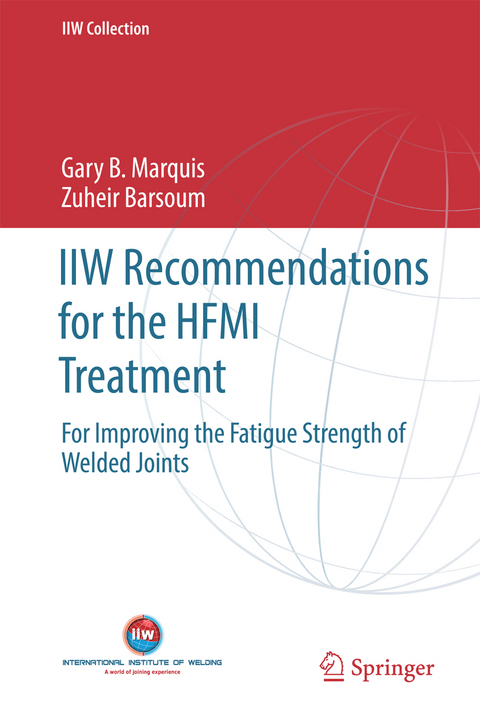
IIW Recommendations for the HFMI Treatment (eBook)
XI, 34 Seiten
Springer Singapore (Verlag)
978-981-10-2504-4 (ISBN)
This book of recommendations presents an overview of High Frequency Mechanical Impact (HFMI) techniques existing today in the market and their proper procedures, quality assurance measures and documentation. Due to differences in HFMI tools and the wide variety of potential applications, certain details of proper treatments and quantitative quality control measures are presented generally. An example of procedure specification as a quality assurance measure is given in the Appendix.
Moreover, the book presents procedures for the fatigue life assessment of HFMI-improved welded joints based on nominal stress, structural hot spot stress and effective notch stress. It also considers the extra benefit that has been experimentally observed for HFMI-treated high-strength steels.
The recommendations offer proposals on the effect of loading conditions like high mean stress fatigue cycles, variable amplitude loading and large amplitude/low cycle fatigue cycles. Special considerations for low stress concentration welded joints are also given. In order to demonstrate the use of the guideline, the book provides several fatigue assessment examples.
Gary Marquis is professor of applied mechanics at Aalto University, Helsinki, Finland where he currently serve as dean for school of engineering. Within IIW, he has served as chairman for Commission XIII (Fatigue of welded components and structures) and is currently the president of IIW.
Zuheir Barsoum is associate professor of lightweight structures at KTH Royal Institute of Technology, Stockholm, Sweden. Within IIW, he is currently leading the XIII-WG2 on Techniques for improving the fatigue strength of welded joints, components and structures and serving as vice-Chair for Commission XIII.
This book of recommendations presents an overview of High Frequency Mechanical Impact (HFMI) techniques existing today in the market and their proper procedures, quality assurance measures and documentation. Due to differences in HFMI tools and the wide variety of potential applications, certain details of proper treatments and quantitative quality control measures are presented generally. An example of procedure specification as a quality assurance measure is given in the Appendix. Moreover, the book presents procedures for the fatigue life assessment of HFMI-improved welded joints based on nominal stress, structural hot spot stress and effective notch stress. It also considers the extra benefit that has been experimentally observed for HFMI-treated high-strength steels.The recommendations offer proposals on the effect of loading conditions like high mean stress fatigue cycles, variable amplitude loading and large amplitude/low cycle fatigue cycles. Special considerations for low stress concentration welded joints are also given. In order to demonstrate the use of the guideline, the book provides several fatigue assessment examples.
Gary Marquis is professor of applied mechanics at Aalto University, Helsinki, Finland where he currently serve as dean for school of engineering. Within IIW, he has served as chairman for Commission XIII (Fatigue of welded components and structures) and is currently the president of IIW.Zuheir Barsoum is associate professor of lightweight structures at KTH Royal Institute of Technology, Stockholm, Sweden. Within IIW, he is currently leading the XIII-WG2 on Techniques for improving the fatigue strength of welded joints, components and structures and serving as vice-Chair for Commission XIII.
Contents 6
About the Authors 7
Nomenclature 8
Abstract 10
1 IIW Recommendations on High Frequency Mechanical Impact (HFMI) Treatment for Improving the Fatigue Strength of Welded Joints 11
Abstract 11
1 Introduction 11
1.1 Background 12
1.2 Purpose 13
1.3 Overview of Post Weld Improvement Techniques 13
2 High Frequency Mechanical Impact (HFMI) 15
2.1 HFMI Equipment 16
3 HFMI Procedures 17
3.1 Operator Training 17
3.2 Weld Preparation 18
3.3 Safety Aspects 19
3.4 Weld Toe Treatment 20
3.5 Other Treatment Conditions 21
4 Quality Control 21
4.1 Qualitative Measures 22
4.2 Quantitative Measures 23
4.3 Documentation 24
4.4 Calibration 25
5 Fatigue Strength Improvement Using HFMI 26
5.1 Fatigue Design Based on Nominal Stress 27
5.1.1 Thickness and Size Effects 28
5.1.2 Influence of Steel Strength 29
5.1.3 Loading Effects 31
5.1.4 Stress Ratio 32
5.1.5 Variable Amplitude Loading 34
5.2 Fatigue Design Based on Structural Hot-Spot Stress 35
5.3 Fatigue Design Based on Effective Notch Stress 36
Appendix 1: HFMI Procedure Specification 37
Appendix 2: Design Examples 39
References 43
| Erscheint lt. Verlag | 29.9.2016 |
|---|---|
| Reihe/Serie | IIW Collection | IIW Collection |
| Zusatzinfo | XI, 34 p. 24 illus., 19 illus. in color. |
| Verlagsort | Singapore |
| Sprache | englisch |
| Themenwelt | Technik ► Bauwesen |
| Technik ► Maschinenbau | |
| Schlagworte | Effective Notch Stress • fatigue life assessment • HFMI-treated high-strength steels • High Frequency Mechanical Impact HFMI • high mean stress fatigue • Low Cycle Fatigue • Nominal Stress • quality assurance measures • structural hot spot stress • Variable amplitude loading • welded structures |
| ISBN-10 | 981-10-2504-5 / 9811025045 |
| ISBN-13 | 978-981-10-2504-4 / 9789811025044 |
| Informationen gemäß Produktsicherheitsverordnung (GPSR) | |
| Haben Sie eine Frage zum Produkt? |
 PDF (Wasserzeichen)
DRM: Digitales Wasserzeichen
Dieses eBook enthält ein digitales Wasserzeichen und ist damit für Sie personalisiert. Bei einer missbräuchlichen Weitergabe des eBooks an Dritte ist eine Rückverfolgung an die Quelle möglich.
Dateiformat: PDF (Portable Document Format)
Mit einem festen Seitenlayout eignet sich die PDF besonders für Fachbücher mit Spalten, Tabellen und Abbildungen. Eine PDF kann auf fast allen Geräten angezeigt werden, ist aber für kleine Displays (Smartphone, eReader) nur eingeschränkt geeignet.
Systemvoraussetzungen:
PC/Mac: Mit einem PC oder Mac können Sie dieses eBook lesen. Sie benötigen dafür einen PDF-Viewer - z.B. den Adobe Reader oder Adobe Digital Editions.
eReader: Dieses eBook kann mit (fast) allen eBook-Readern gelesen werden. Mit dem amazon-Kindle ist es aber nicht kompatibel.
Smartphone/Tablet: Egal ob Apple oder Android, dieses eBook können Sie lesen. Sie benötigen dafür einen PDF-Viewer - z.B. die kostenlose Adobe Digital Editions-App.
Buying eBooks from abroad
For tax law reasons we can sell eBooks just within Germany and Switzerland. Regrettably we cannot fulfill eBook-orders from other countries.
aus dem Bereich