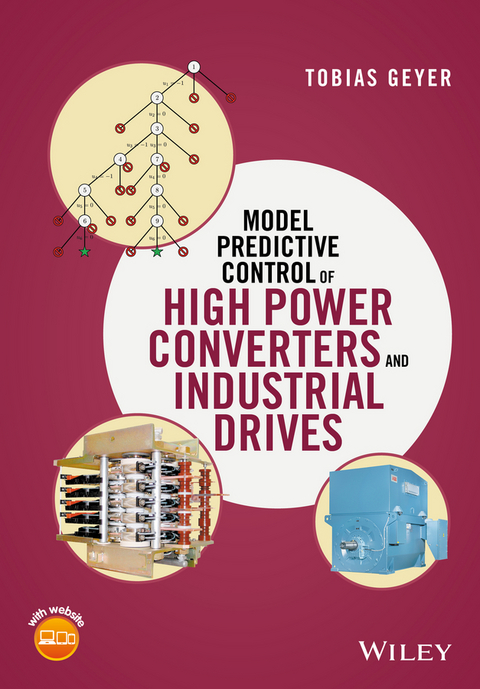
Model Predictive Control of High Power Converters and Industrial Drives (eBook)

In this original book on model predictive control (MPC) for power electronics, the focus is put on high-power applications with multilevel converters operating at switching frequencies well below 1 kHz, such as medium-voltage drives and modular multi-level converters.
Consisting of two main parts, the first offers a detailed review of three-phase power electronics, electrical machines, carrier-based pulse width modulation, optimized pulse patterns, state-of-the art converter control methods and the principle of MPC. The second part is an in-depth treatment of MPC methods that fully exploit the performance potential of high-power converters. These control methods combine the fast control responses of deadbeat control with the optimal steady-state performance of optimized pulse patterns by resolving the antagonism between the two.
MPC is expected to evolve into the control method of choice for power electronic systems operating at low pulse numbers with multiple coupled variables and tight operating constraints it. Model Predictive Control of High Power Converters and Industrial Drives will enable to reader to learn how to increase the power capability of the converter, lower the current distortions, reduce the filter size, achieve very fast transient responses and ensure the reliable operation within safe operating area constraints.
Targeted at power electronic practitioners working on control-related aspects as well as control engineers, the material is intuitively accessible, and the mathematical formulations are augmented by illustrations, simple examples and a book companion website featuring animations. Readers benefit from a concise and comprehensive treatment of MPC for industrial power electronics, enabling them to understand, implement and advance the field of high-performance MPC schemes.
Tobias Geyer, ABB Corporate Research Center, Switzerland
Tobias Geyer joined ABB's Corporate Research Center as a deputy group leader and principal scientist in 2012. In this role, he is building up a dedicated research team focusing on Model predictive control (MPC) for power electronic systems. After obtaining his PhD at ETH Zurich, he spent three years in GE's Corporate Research Center in Munich as a project leader for high-power electronics and drives. He subsequently worked at the intersection of academia and industrial research, fully funded by ABB and part of an ABB research team, whilst being employed by the University of Auckland as a Research Fellow. During this time, his focus was on the development of a new generation of drive control schemes that is intended to replace ABB's currently used schemes in their medium-voltage drive portfolio. Tobias Geyer has been working on MPC for power electronics since 2002, and was one of the first researchers who began working in this field. During the past 12 years he has written approximately 100 peer-reviewed journal and conference publications and patent applications. He is also an Associate Editor of Transactions on Power Electronics and Transactions on Industry Applications.
In this original book on model predictive control (MPC) for power electronics, the focus is put on high-power applications with multilevel converters operating at switching frequencies well below 1 kHz, such as medium-voltage drives and modular multi-level converters. Consisting of two main parts, the first offers a detailed review of three-phase power electronics, electrical machines, carrier-based pulse width modulation, optimized pulse patterns, state-of-the art converter control methods and the principle of MPC. The second part is an in-depth treatment of MPC methods that fully exploit the performance potential of high-power converters. These control methods combine the fast control responses of deadbeat control with the optimal steady-state performance of optimized pulse patterns by resolving the antagonism between the two. MPC is expected to evolve into the control method of choice for power electronic systems operating at low pulse numbers with multiple coupled variables and tight operating constraints it. Model Predictive Control of High Power Converters and Industrial Drives will enable to reader to learn how to increase the power capability of the converter, lower the current distortions, reduce the filter size, achieve very fast transient responses and ensure the reliable operation within safe operating area constraints. Targeted at power electronic practitioners working on control-related aspects as well as control engineers, the material is intuitively accessible, and the mathematical formulations are augmented by illustrations, simple examples and a book companion website featuring animations. Readers benefit from a concise and comprehensive treatment of MPC for industrial power electronics, enabling them to understand, implement and advance the field of high-performance MPC schemes.
Tobias Geyer, ABB Corporate Research Center, Switzerland Tobias Geyer joined ABB's Corporate Research Center as a deputy group leader and principal scientist in 2012. In this role, he is building up a dedicated research team focusing on Model predictive control (MPC) for power electronic systems. After obtaining his PhD at ETH Zurich, he spent three years in GE's Corporate Research Center in Munich as a project leader for high-power electronics and drives. He subsequently worked at the intersection of academia and industrial research, fully funded by ABB and part of an ABB research team, whilst being employed by the University of Auckland as a Research Fellow. During this time, his focus was on the development of a new generation of drive control schemes that is intended to replace ABB's currently used schemes in their medium-voltage drive portfolio. Tobias Geyer has been working on MPC for power electronics since 2002, and was one of the first researchers who began working in this field. During the past 12 years he has written approximately 100 peer-reviewed journal and conference publications and patent applications. He is also an Associate Editor of Transactions on Power Electronics and Transactions on Industry Applications.
List of Abbreviations
Abbreviations
| ac | alternating current |
| A/D | analog-to-digital |
| AFE | active front end |
| ANPC | active neutral-point-clamped |
| CB-PWM | carrier-based pulse width modulation |
| CPU | central processing unit |
| DB | deadbeat |
| dc | direct current |
| DFE | diode front end |
| DFT | discrete Fourier transform |
| DPC | direct power control |
| DSC | direct self-control |
| DSP | digital signal processor |
| DTC | direct torque control |
| EMF | electromotive force |
| FACTS | flexible ac transmission system |
| FC | flying capacitor |
| FCS | finite control set |
| FOC | field-oriented control |
| FPGA | field-programmable gate array |
| GCT | gate-commutated thyristor |
| IGBT | insulated-gate bipolar transistor |
| IGCT | integrated-gate-commutated thyristor |
| IM | induction machine |
| LQR | linear quadratic regulator |
| MIMO | multiple-input multiple-output |
| MLD | mixed logical dynamical |
| MMC | modular multilevel converter |
| MPC | model predictive control |
| MPDBC | model predictive direct balancing control |
| MPDCC | model predictive direct current control |
| MPDPC | model predictive direct power control |
| MPDTC | model predictive direct torque control |
| MPC | model predictive pulse pattern control |
| MV | medium-voltage |
| NPC | neutral-point-clamped |
| OPP | optimized pulse pattern |
| PCC | point of common coupling |
| PI | proportional–integral |
| PMSM | permanent magnet synchronous machine |
| pu | per unit |
| PWM | pulse width modulation |
| QP | quadratic program |
| rms | root-mean-square |
| SHE | selective harmonic elimination |
| SISO | single-input single-output |
| SVM | space vector modulation |
| TDD | total demand distortion |
| THD | total harmonic distortion |
| VC | vector control |
| V/f | volts per frequency |
| VOC | voltage-oriented control |
| VSD | variable-speed drive |
| VSI | voltage source inverter |
Variables
| , | instantaneous value of variables that are functions of time |
| , | space vectors |
| , | rms values |
| column vector |
| row vector |
| matrix |
| set |
Symbols
| zero matrix of dimensions |
| system matrix (discrete time) |
| input matrix (discrete time) |
| coefficient |
| capacitance (F) |
| input matrix (continuous or discrete time) |
| pulse number |
| determinant |
| , | energy (J or pu) |
| frequency (Hz or pu) |
| system matrix (continuous time) |
| input matrix (continuous time) |
| Hessian matrix |
| , , | current (A or pu) |
| identity matrix of dimensions , |
| imaginary unit, |
| cost function |
| discrete time step |
| transformation matrix |
| discrete time step (relative to ) |
| inductance (H) |
| modulation index |
| moment of inertia (kg m or pu) |
| order of harmonic, number of modules |
| length of switching sequence |
| number of pole pairs |
| power factor |
| (instantaneous) real power (W or pu) |
| (instantaneous) reactive power (Var or pu) |
| , | penalty vector or matrix |
| resistance ( or pu) |
| slip |
| apparent power (V A or pu) |
| time (s or pu) |
| torque (N m or pu) |
| , | switch position, input (or manipulated) variable |
| , | change in switch position |
| , | sequence of switch positions (switching sequence) |
| , , | voltage (V or pu) |
| generator matrix |
| , | state variable |
| reactance (pu) |
| , | output variable |
| impedance ( or pu) |
| switching angle in pulse pattern (rad) |
| load angle, that is, angle between the stator and rotor flux vectors (rad) |
| (half of the) bound width |
| , | degree of bound violation (at a time step) |
| , | rms bound violation (over the prediction horizon) |
| scalar penalty weight |
| flux linkage vector (Wb) |
| phase angle (rad) |
| radius of sphere |
| total leakage factor |
| angle (argument) in pulse pattern (rad) |
| insertion index |
| angular position of a reference frame (rad) |
| , | flux (linkage) (pu) |
| flux (linkage) magnitude (pu) |
| time constant (s or pu) |
| rotational speed or angular frequency (rad/s or pu) |
| , , , | slack or auxiliary variable |
Subscripts
| , , | turn–on, turn–off and reverse recovery energy loss coefficients (J/(VA)) |
| module capacitance (F) |
| carrier frequency |
| frequency of deadlocks |
| switching frequency |
| fundamental current |
| , , | phase , , and currents |
| , | real and imaginary parts of the current (in the stationary reference frame) |
| base current |
| converter current vector |
| circulating current vector |
| , | real and imaginary parts of the current (in the rotating reference frame) |
| current error... |
| Erscheint lt. Verlag | 27.9.2016 |
|---|---|
| Sprache | englisch |
| Themenwelt | Technik ► Elektrotechnik / Energietechnik |
| Schlagworte | Control Systems Technology • Electrical & Electronics Engineering • electrical drives • Elektrotechnik u. Elektronik • finite control set model predictive control • Leistungselektronik • Long-horizon model predictive control • Medium voltage drives • Model Predictive Control • Model predictive direct torque control • Model predictive pulse pattern control • Multilevel Converters • Optimized pulse patterns • Power converters • Power Electronics • Regelungstechnik |
| ISBN-13 | 9781119010890 / 9781119010890 |
| Informationen gemäß Produktsicherheitsverordnung (GPSR) | |
| Haben Sie eine Frage zum Produkt? |
 EPUB (Adobe DRM)
Kopierschutz: Adobe-DRM
Adobe-DRM ist ein Kopierschutz, der das eBook vor Mißbrauch schützen soll. Dabei wird das eBook bereits beim Download auf Ihre persönliche Adobe-ID autorisiert. Lesen können Sie das eBook dann nur auf den Geräten, welche ebenfalls auf Ihre Adobe-ID registriert sind.
Details zum Adobe-DRM
Dateiformat: EPUB (Electronic Publication)
EPUB ist ein offener Standard für eBooks und eignet sich besonders zur Darstellung von Belletristik und Sachbüchern. Der Fließtext wird dynamisch an die Display- und Schriftgröße angepasst. Auch für mobile Lesegeräte ist EPUB daher gut geeignet.
Systemvoraussetzungen:
PC/Mac: Mit einem PC oder Mac können Sie dieses eBook lesen. Sie benötigen eine
eReader: Dieses eBook kann mit (fast) allen eBook-Readern gelesen werden. Mit dem amazon-Kindle ist es aber nicht kompatibel.
Smartphone/Tablet: Egal ob Apple oder Android, dieses eBook können Sie lesen. Sie benötigen eine
Geräteliste und zusätzliche Hinweise
Buying eBooks from abroad
For tax law reasons we can sell eBooks just within Germany and Switzerland. Regrettably we cannot fulfill eBook-orders from other countries.
aus dem Bereich