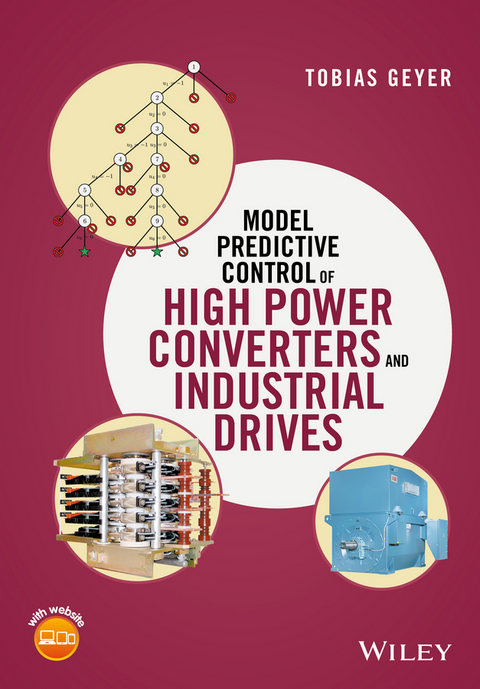
In this original book on model predictive control (MPC) for power electronics, the focus is put on high-power applications with multilevel converters operating at switching frequencies well below 1 kHz, such as medium-voltage drives and modular multi-level converters.
Consisting of two main parts, the first offers a detailed review of three-phase power electronics, electrical machines, carrier-based pulse width modulation, optimized pulse patterns, state-of-the art converter control methods and the principle of MPC. The second part is an in-depth treatment of MPC methods that fully exploit the performance potential of high-power converters. These control methods combine the fast control responses of deadbeat control with the optimal steady-state performance of optimized pulse patterns by resolving the antagonism between the two.
MPC is expected to evolve into the control method of choice for power electronic systems operating at low pulse numbers with multiple coupled variables and tight operating constraints it. Model Predictive Control of High Power Converters and Industrial Drives will enable to reader to learn how to increase the power capability of the converter, lower the current distortions, reduce the filter size, achieve very fast transient responses and ensure the reliable operation within safe operating area constraints.
Targeted at power electronic practitioners working on control-related aspects as well as control engineers, the material is intuitively accessible, and the mathematical formulations are augmented by illustrations, simple examples and a book companion website featuring animations. Readers benefit from a concise and comprehensive treatment of MPC for industrial power electronics, enabling them to understand, implement and advance the field of high-performance MPC schemes.
Tobias Geyer, ABB Corporate Research Center, Switzerland
Tobias Geyer joined ABB's Corporate Research Center as a deputy group leader and principal scientist in 2012. In this role, he is building up a dedicated research team focusing on Model predictive control (MPC) for power electronic systems. After obtaining his PhD at ETH Zurich, he spent three years in GE's Corporate Research Center in Munich as a project leader for high-power electronics and drives. He subsequently worked at the intersection of academia and industrial research, fully funded by ABB and part of an ABB research team, whilst being employed by the University of Auckland as a Research Fellow. During this time, his focus was on the development of a new generation of drive control schemes that is intended to replace ABB's currently used schemes in their medium-voltage drive portfolio. Tobias Geyer has been working on MPC for power electronics since 2002, and was one of the first researchers who began working in this field. During the past 12 years he has written approximately 100 peer-reviewed journal and conference publications and patent applications. He is also an Associate Editor of Transactions on Power Electronics and Transactions on Industry Applications.
In this original book on model predictive control (MPC) for power electronics, the focus is put on high-power applications with multilevel converters operating at switching frequencies well below 1 kHz, such as medium-voltage drives and modular multi-level converters. Consisting of two main parts, the first offers a detailed review of three-phase power electronics, electrical machines, carrier-based pulse width modulation, optimized pulse patterns, state-of-the art converter control methods and the principle of MPC. The second part is an in-depth treatment of MPC methods that fully exploit the performance potential of high-power converters. These control methods combine the fast control responses of deadbeat control with the optimal steady-state performance of optimized pulse patterns by resolving the antagonism between the two. MPC is expected to evolve into the control method of choice for power electronic systems operating at low pulse numbers with multiple coupled variables and tight operating constraints it. Model Predictive Control of High Power Converters and Industrial Drives will enable to reader to learn how to increase the power capability of the converter, lower the current distortions, reduce the filter size, achieve very fast transient responses and ensure the reliable operation within safe operating area constraints. Targeted at power electronic practitioners working on control-related aspects as well as control engineers, the material is intuitively accessible, and the mathematical formulations are augmented by illustrations, simple examples and a book companion website featuring animations. Readers benefit from a concise and comprehensive treatment of MPC for industrial power electronics, enabling them to understand, implement and advance the field of high-performance MPC schemes.
Tobias Geyer, ABB Corporate Research Center, Switzerland Tobias Geyer joined ABB's Corporate Research Center as a deputy group leader and principal scientist in 2012. In this role, he is building up a dedicated research team focusing on Model predictive control (MPC) for power electronic systems. After obtaining his PhD at ETH Zurich, he spent three years in GE's Corporate Research Center in Munich as a project leader for high-power electronics and drives. He subsequently worked at the intersection of academia and industrial research, fully funded by ABB and part of an ABB research team, whilst being employed by the University of Auckland as a Research Fellow. During this time, his focus was on the development of a new generation of drive control schemes that is intended to replace ABB's currently used schemes in their medium-voltage drive portfolio. Tobias Geyer has been working on MPC for power electronics since 2002, and was one of the first researchers who began working in this field. During the past 12 years he has written approximately 100 peer-reviewed journal and conference publications and patent applications. He is also an Associate Editor of Transactions on Power Electronics and Transactions on Industry Applications.
Cover 1
Title Page 5
Copyright 6
Dedication 7
Contents 9
Preface 19
Acknowledgments 21
List of Abbreviations 23
About the Companion Website 29
Part I Introduction 31
Chapter 1 Introduction 33
1.1 Industrial Power Electronics 33
1.2 Control and Modulation Schemes 37
1.3 Model Predictive Control 41
1.4 Research Vision and Motivation 49
1.5 Main Results 49
1.6 Summary of this Book 51
1.7 Prerequisites 55
References 56
Chapter 2 Industrial Power Electronics 59
2.1 Preliminaries 59
2.2 Induction Machines 72
2.3 Power Semiconductor Devices 81
2.4 Multilevel Voltage Source Inverters 84
2.5 Case Studies 98
References 105
Chapter 3 Classic Control and Modulation Schemes 107
3.1 Requirements of Control and Modulation Schemes 107
3.2 Structure of Control and Modulation Schemes 114
3.3 Carrier-Based Pulse Width Modulation 115
3.4 Optimized Pulse Patterns 133
3.5 Performance Trade-Off for Pulse Width Modulation 147
3.6 Control Schemes for Induction Machine Drives 151
Appendix 3.A: Harmonic Analysis of Single-Phase Optimized Pulse Patterns 169
Appendix 3.B: Mathematical Optimization 171
References 175
Part II Direct Model Predictive Control with Reference Tracking 181
Chapter 4 Predictive Control with Short Horizons 183
4.1 Predictive Current Control of a Single-Phase RL Load 183
4.2 Predictive Current Control of a Three-Phase Induction Machine 194
4.3 Predictive Torque Control of a Three-Phase Induction Machine 213
4.4 Summary 223
References 224
Chapter 5 Predictive Control with Long Horizons 225
5.1 Preliminaries 226
5.2 Integer Quadratic Programming Formulation 231
5.3 An Efficient Method for Solving the Optimization Problem 234
5.4 Computational Burden 241
Appendix 5.A: State-Space Model 243
Appendix 5.B: Derivation of the Cost Function in Vector Form 244
References 246
Chapter 6 Performance Evaluation of Predictive Control with Long Horizons 247
6.1 Performance Evaluation for the NPC Inverter Drive System 248
6.2 Suboptimal MPC via Direct Rounding 262
6.3 Performance Evaluation for the NPC Inverter Drive System with an LC Filter 264
6.4 Summary and Discussion 275
Appendix 6.A: State-Space Model 278
Appendix 6.B: Computation of the Output Reference Vector 278
References 281
Part III Direct Model Predictive Control with Bounds 283
Chapter 7 Model Predictive Direct Torque Control 285
7.1 Introduction 285
7.2 Preliminaries 287
7.3 Control Problem Formulation 293
7.4 Model Predictive Direct Torque Control 296
7.5 Extension Methods 307
7.6 Summary and Discussion 314
Appendix 7.A: Controller Model of the NPC Inverter Drive System 316
References 317
Chapter 8 Performance Evaluation of Model Predictive Direct Torque Control 319
8.1 Performance Evaluation for the NPC Inverter Drive System 319
8.2 Performance Evaluation for the ANPC Inverter Drive System 330
8.3 Summary and Discussion 344
Appendix 8.A: Controller Model of the ANPC Inverter Drive System 345
References 346
Chapter 9 Analysis and Feasibility of Model Predictive Direct Torque Control 348
9.1 Target Set 349
9.2 The State-Feedback Control Law 350
9.3 Analysis of the Deadlock Phenomena 361
9.4 Deadlock Resolution 367
9.5 Deadlock Avoidance 370
9.6 Summary and Discussion 377
References 378
Chapter 10 Computationally Efficient Model Predictive Direct Torque Control 380
10.1 Preliminaries 381
10.2 MPDTC with Branch-and-Bound 382
10.3 Performance Evaluation 389
10.4 Summary and Discussion 397
References 398
Chapter 11 Derivatives of Model Predictive Direct Torque Control 399
11.1 Model Predictive Direct Current Control 400
11.2 Model Predictive Direct Power Control 419
11.3 Summary and Discussion 431
Appendix 11.A: Controller Model used in MPDCC 435
Appendix 11.B: Real and Reactive Power 437
Appendix 11.C: Controller Model used in MPDPC 439
References 440
Part IV Model Predictive Control based on Pulse Width Modulation 443
Chapter 12 Model Predictive Pulse Pattern Control 445
12.1 State-of-the-Art Control Methods 445
12.2 Optimized Pulse Patterns 446
12.3 Stator Flux Control 452
12.4 MP3C Algorithm 455
12.5 Computational Variants of MP3C 463
12.6 Pulse Insertion 468
Appendix 12.A: Quadratic Program 473
Appendix 12.B: Unconstrained Solution 474
Appendix 12.C: Transformations for Deadbeat MP3C 475
References 476
Chapter 13 Performance Evaluation of Model Predictive Pulse Pattern Control 477
13.1 Performance Evaluation for the NPC Inverter Drive System 477
13.2 Experimental Results for the ANPC Inverter Drive System 492
13.3 Summary and Discussion 498
References 502
Chapter 14 Model Predictive Control of a Modular Multilevel Converter 504
14.1 Introduction 504
14.2 Preliminaries 505
14.3 Model Predictive Control 509
14.4 Performance Evaluation 516
14.5 Design Parameters 526
14.6 Summary and Discussion 529
Appendix 14.A: Dynamic Current Equations 531
Appendix 14.B: Controller Model of the Converter System 531
References 533
Part V Summary 535
Chapter 15 Summary and Conclusion 537
15.1 Performance Comparison of Direct Model Predictive Control Schemes 537
15.2 Assessment of the Control and Modulation Methods 549
15.3 Conclusion 554
15.4 Outlook 555
References 555
Index 557
EULA 576
| Erscheint lt. Verlag | 12.9.2016 |
|---|---|
| Sprache | englisch |
| Themenwelt | Technik ► Elektrotechnik / Energietechnik |
| Schlagworte | Control Systems Technology • Electrical & Electronics Engineering • electrical drives • Elektrotechnik u. Elektronik • finite control set model predictive control • Leistungselektronik • Long-horizon model predictive control • Medium voltage drives • Model Predictive Control • Model predictive direct torque control • Model predictive pulse pattern control • Multilevel Converters • Optimized pulse patterns • Power converters • Power Electronics • Regelungstechnik |
| ISBN-13 | 9781119010869 / 9781119010869 |
| Informationen gemäß Produktsicherheitsverordnung (GPSR) | |
| Haben Sie eine Frage zum Produkt? |
 PDF (Adobe DRM)
Kopierschutz: Adobe-DRM
Adobe-DRM ist ein Kopierschutz, der das eBook vor Mißbrauch schützen soll. Dabei wird das eBook bereits beim Download auf Ihre persönliche Adobe-ID autorisiert. Lesen können Sie das eBook dann nur auf den Geräten, welche ebenfalls auf Ihre Adobe-ID registriert sind.
Details zum Adobe-DRM
Dateiformat: PDF (Portable Document Format)
Mit einem festen Seitenlayout eignet sich die PDF besonders für Fachbücher mit Spalten, Tabellen und Abbildungen. Eine PDF kann auf fast allen Geräten angezeigt werden, ist aber für kleine Displays (Smartphone, eReader) nur eingeschränkt geeignet.
Systemvoraussetzungen:
PC/Mac: Mit einem PC oder Mac können Sie dieses eBook lesen. Sie benötigen eine
eReader: Dieses eBook kann mit (fast) allen eBook-Readern gelesen werden. Mit dem amazon-Kindle ist es aber nicht kompatibel.
Smartphone/Tablet: Egal ob Apple oder Android, dieses eBook können Sie lesen. Sie benötigen eine
Geräteliste und zusätzliche Hinweise
Buying eBooks from abroad
For tax law reasons we can sell eBooks just within Germany and Switzerland. Regrettably we cannot fulfill eBook-orders from other countries.
aus dem Bereich