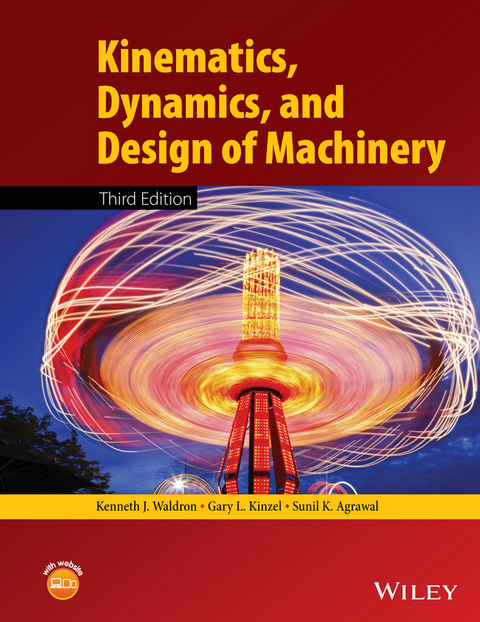
Kinematics, Dynamics, and Design of Machinery (eBook)
John Wiley & Sons (Verlag)
978-1-118-93333-6 (ISBN)
- Presents the traditional approach to the design and analysis of kinematic problems and shows how GCP can be used to solve the same problems more simply
- Provides a new and simpler approach to cam design
- Includes an increased number of exercise problems
- Accompanied by a website hosting a solutions manual, teaching slides and MATLAB® programs
Kenneth Waldron is Professor at the University of Technology, Sydney and Professor Emeritus of Stanford University. He has taught subjects in machine design and engineering mechanics over a career spanning more than forty years. He has also conducted research in kinematics of machinery, robotics, biomechanics and machine dynamics. He has received a number of awards including the American Society of Mechanical Engineers (ASME) Machine Design, Leonardo da Vinci and Ruth and Joel Spira Outstanding Design Educator Awards, and the Robotics Industries Association Joseph Engelberger Award.
Professor Waldron has served as the Technical Editor of the ASME Transactions Journal of Machine Design. He served two terms as President of IFToMM, the International Federation for the Promotion of Machine and Mechanism Science, as well as holding many offices within ASME.
Professor Waldron is excited by the many new developments in the field and the challenge of keeping this book up to date.
Gary Kinzel is an emeritus professor in the Department of Mechanical and Aerospace Engineering at The Ohio State University. He received his PhD from Purdue in 1973. After graduation, he worked for six years at Battelle and was a regular faculty member at Ohio State until he retired in 2011. His research was in design, education, and manufacturing. He has more than 150 research publications, has coauthored two books, has one patent, and has supervised to completion the research of more than one hundred graduate students. He taught courses in machine design, kinematics, stress analysis and form synthesis and received ten research and teaching awards, including the OSU Alumni Teaching Award, the ASME Ruth and Joel Spira Outstanding Design Educator Award, and the ASEE Ralph Coates Roe Award.
Sunil Agrawal has authored more than 175 archival journal papers, 225 refereed conference papers, 2 books, and 13 US patents. His work is well cited by the research community and can be viewed at Google Scholar at (scholar.google.com/citations). He has graduated 20 PhD and 25 MS students. Currently, there are 10 PhD students working under his guidance.
Kinematics, Dynamics, and Design of Machinery, Third Edition, presents a fresh approach to kinematic design and analysis and is an ideal textbook for senior undergraduates and graduates in mechanical, automotive and production engineering Presents the traditional approach to the design and analysis of kinematic problems and shows how GCP can be used to solve the same problems more simply Provides a new and simpler approach to cam design Includes an increased number of exercise problems Accompanied by a website hosting a solutions manual, teaching slides and MATLAB programs
Kenneth Waldron is Professor at the University of Technology, Sydney and Professor Emeritus of Stanford University. He has taught subjects in machine design and engineering mechanics over a career spanning more than forty years. He has also conducted research in kinematics of machinery, robotics, biomechanics and machine dynamics. He has received a number of awards including the American Society of Mechanical Engineers (ASME) Machine Design, Leonardo da Vinci and Ruth and Joel Spira Outstanding Design Educator Awards, and the Robotics Industries Association Joseph Engelberger Award. Professor Waldron has served as the Technical Editor of the ASME Transactions Journal of Machine Design. He served two terms as President of IFToMM, the International Federation for the Promotion of Machine and Mechanism Science, as well as holding many offices within ASME. Professor Waldron is excited by the many new developments in the field and the challenge of keeping this book up to date. Gary Kinzel is an emeritus professor in the Department of Mechanical and Aerospace Engineering at The Ohio State University. He received his PhD from Purdue in 1973. After graduation, he worked for six years at Battelle and was a regular faculty member at Ohio State until he retired in 2011. His research was in design, education, and manufacturing. He has more than 150 research publications, has coauthored two books, has one patent, and has supervised to completion the research of more than one hundred graduate students. He taught courses in machine design, kinematics, stress analysis and form synthesis and received ten research and teaching awards, including the OSU Alumni Teaching Award, the ASME Ruth and Joel Spira Outstanding Design Educator Award, and the ASEE Ralph Coates Roe Award. Sunil Agrawal has authored more than 175 archival journal papers, 225 refereed conference papers, 2 books, and 13 US patents. His work is well cited by the research community and can be viewed at Google Scholar at (scholar.google.com/citations). He has graduated 20 PhD and 25 MS students. Currently, there are 10 PhD students working under his guidance.
Kinematics, Dynamics, and Design of Machinery 1
Contents 7
Preface 15
1: Introduction 17
1.1 Historical Perspective 17
1.2 Kinematics 19
1.3 Design: Analysis and Synthesis 20
1.4 Mechanisms 20
1.5 Planar Linkages 22
1.6 Visualization 25
1.7 Constraint Analysis 28
1.8 Constraint Analysis of Spatial Linkages 34
1.9 Idle Degrees of Freedom 38
1.10 Overconstrained Linkages 40
1.11 Uses of the Mobility Criterion 44
1.12 Inversion 44
1.13 Reference Frames 45
1.14 Motion Limits 46
1.15 Continuously Rotatable Joints 47
1.16 Coupler-Driven Linkages 51
1.17 Motion Limits for Slider-Crank Mechanisms 51
1.18 Interference 54
1.19 Practical Design Considerations 57
1.19.1 Revolute Joints 57
1.19.2 Prismatic Joints 58
1.19.3 Higher Pairs 60
1.19.4 Cams versus Linkages 60
References 60
Problems 61
2: Techniques in Geometric Constraint Programming 75
2.1 Introduction 75
2.2 Geometric Constraint Programming 76
2.3 Constraints and Program Structure 77
2.3.1 Required Constraints 77
2.3.2 Other Constraint Options 78
2.3.3 Annotations 78
2.3.4 Use of Drawing Layers 78
2.3.5 Limitations of GCP 79
2.4 Initial Setup for a GCP Session 80
2.4.1 Effect of Typical Constraints 80
2.4.2 Unintended Constraints 82
2.4.3 Layers, Line Type, and Line Color 82
2.5 Drawing a Basic Linkage Using GCP 82
2.5.1 Drawing a Four-Bar Linkage Using GCP 82
2.5.2 Including Ground Pivots and Bushings 84
2.5.3 Drawing a Slider-Crank Linkage 84
2.6 Troubleshooting Graphical Programs Developed Using GCP 95
References 96
Problems 97
Appendix 2A Drawing Slider Lines, Pin Bushings, and Ground Pivots 101
2A.1 Slider Lines 101
2A.2 Pin Bushings and Ground Pivots 103
Appendix 2B Useful Constructions When Equation Constraints Are Not Available 104
2B.1 Constrain Two Angles to Be Integral Multiples of Another Angle 105
2B.2 Constrain a Line to Be Half the Length of Another Line 105
2B.3 Construction for Scaling 106
2B.4 Construction for Square Ratio v2/r 107
2B.5 Construction for Function x = yz/r 107
3: Planar Linkage Design 109
3.1 Introduction 109
3.2 Two-Position Double-Rocker Design 112
3.2.1 Graphical Solution Procedure 113
3.2.2 Solution Using Geometric Constraint Programming 113
3.2.3 Numerical Solution Procedure 115
3.3 Synthesis of Crank-Rocker Linkages for Specified Rocker Amplitude 116
3.3.1 The Rocker-Amplitude Problem: Graphical Approach 116
3.3.2 Alternative Graphical Design Procedure Based on Specification of A*B* 121
3.3.3 Using GCP to Design Crank-Rocker and Crank-Shaper Mechanisms 123
3.4 Motion Generation 130
3.4.1 Introduction 130
3.4.2 Two Positions 130
3.4.3 Three Positions with Selected Moving Pivots 132
3.4.4 Synthesis of a Crank with Chosen Fixed Pivots 133
3.4.5 Design of Slider-Cranks and Elliptic-Trammels 134
3.4.6 Change of Branch 134
3.4.7 Using GCP for Rigid-Body Guidance 140
3.5 Path Synthesis 149
3.5.1 Design of Six-Bar Linkages Using Coupler Curves 149
3.5.2 Motion Generation for Parallel Motion Using Coupler Curves 154
3.5.3 Cognate Linkages 157
3.5.4 Using GCP for Path Synthesis 160
References 164
Problems 166
4: Graphical Position, Velocity, and Acceleration Analysis for Mechanisms with Revolute Joints or Fixed Slides 185
4.1 Introduction 185
4.2 Graphical Position Analysis 186
4.3 Planar Velocity Polygons 187
4.4 Graphical Acceleration Analysis 189
4.5 Graphical Analysis of a Four-Bar Mechanism 191
4.6 Graphical Analysis of a Slider-Crank Mechanism 199
4.7 Velocity Image Theorem 202
4.8 Acceleration Image Theorem 205
4.9 Solution By Geometric Constraint Programming 210
4.9.1 Introduction 210
4.9.2 Scaling Property of Velocity Polygons 211
4.9.3 Using GCP to Analyze Linkages That Cannot Be Analyzed by Classical Means for Velocities 215
References 221
Problems 221
5: Linkages with Rolling and Sliding Contacts, and Joints on Moving Sliders 237
5.1 Introduction 237
5.2 Reference Frames 238
5.3 General Velocity and Acceleration Equations 239
5.3.1 Velocity Equations 239
5.3.2 Acceleration Equations 241
5.3.3 Chain Rule for Positions, Velocities, and Accelerations 242
5.4 Special Cases for the Velocity and Acceleration Equations 244
5.4.1 Two Points Fixed in a Moving Body 244
5.4.2 Two Points Are Instantaneously Coincident 245
5.4.3 Two Points Are Instantaneously Coincident and in Rolling Contact 246
5.5 Linkages With Rotating Sliding Joints 246
5.6 Rolling Contact 251
5.6.1 Basic Kinematic Relationships for Rolling Contact 251
5.6.2 Modeling Rolling Contact Using a Virtual Linkage 257
5.7 Cam Contact 259
5.7.1 Direct Approach to the Analysis of Cam Contact 259
5.7.2 Analysis of Cam Contact Using Equivalent Linkages 262
5.8 General Coincident Points 266
5.8.1 Velocity Analyses Involving General Coincident Points 266
5.8.2 Acceleration Analyses Involving General Coincident Points 267
5.9 Solution By Geometric Constraint Programming 273
Problems 279
6: Instant Centers of Velocity 295
6.1 Introduction 295
6.2 Definition 296
6.3 Existence Proof 296
6.4 Location of an Instant Center From the Directions of Two Velocities 297
6.5 Instant Center At a Revolute Joint 298
6.6 Instant Center of a Curved Slider 298
6.7 Instant Center of a Prismatic Joint 298
6.8 Instant Center of a Rolling Contact Pair 298
6.9 Instant Center of a General Cam-Pair Contact 298
6.10 Centrodes 299
6.11 The Kennedy-Aronhold Theorem 301
6.12 Circle Diagram As a Strategy for Finding Instant Centers 303
6.13 Using Instant Centers to Find Velocities: the Rotating-Radius Method 303
6.14 Finding Instant Centers Using Geometric Constraint Programming 311
References 316
Problems 316
7: Computational Analysis of Linkages 331
7.1 Introduction 331
7.2 Position, Velocity, and Acceleration Representations 332
7.2.1 Position Representation 332
7.2.2 Velocity Representation 332
7.2.3 Acceleration Representation 333
7.2.4 Special Cases 334
7.2.5 Mechanisms to Be Considered 335
7.3 Analytical Closure Equations for Four-Bar Linkages 335
7.3.1 Solution of Closure Equations for Four-Bar Linkages When Link 2 Is the Driver 335
7.3.2 Analysis When the Coupler (Link 3) Is the Driving Link 338
7.3.3 Velocity Equations for Four-Bar Linkages 338
7.3.4 Acceleration Equations for Four-Bar Linkages 339
7.4 Analytical Equations for a Rigid Body After the Kinematic Properties of Two Points Are Known 342
7.5 Analytical Equations for Slider-Crank Mechanisms 345
7.5.1 Solution to Position Equations When ?2 Is Input 346
7.5.2 Solution to Position Equations When r1 Is Input 348
7.5.3 Solution to Position Equations When ?3 Is Input 349
7.5.4 Velocity Equations for Slider-Crank Mechanism 350
7.5.5 Acceleration Equations for Slider-Crank Mechanism 350
7.6 Other Four-Bar Mechanisms With Revolute and Prismatic Joints 354
7.6.1 Slider-Crank Inversion 355
7.6.2 A RPRP Mechanism 355
7.6.3 A RRPP Mechanism 356
7.6.4 Elliptic-Trammel Mechanism 356
7.6.5 Oldham Mechanism 357
7.7 Closure or Loop Equation Approach for Compound Mechanisms 357
7.7.1 Handling Points Not on the Vector Loops 360
7.7.2 Solving the Position Equations 361
7.8 Closure Equations for Mechanisms With Higher Pairs 363
7.9 Notational Differences: Vectors and Complex Numbers 368
Problems 370
8: Special Mechanisms 377
8.1 Special Planar Mechanisms 377
8.1.1 Introduction 377
8.1.2 Straight-Line and Circle Mechanisms 378
8.1.3 Pantographs 384
8.2 Spherical Mechanisms 390
8.2.1 Introduction 390
8.2.2 Gimbals 392
8.2.3 Universal Joints 393
8.3 Constant-Velocity Couplings 397
8.3.1 Geometric Requirements of Constant-Velocity Couplings 397
8.3.2 Practical Constant-Velocity Couplings 397
8.4 Automotive Steering and Suspension Mechanisms 398
8.4.1 Introduction 398
8.4.2 Steering Mechanisms 398
8.4.3 Suspension Mechanisms 402
8.5 Indexing Mechanisms 403
8.5.1 Geneva Mechanisms 403
References 408
Problems 408
9: Computational Analysis of Spatial Linkages 411
9.1 Spatial Mechanisms 411
9.1.1 Introduction 411
9.1.2 Velocity and Acceleration Relationships 412
9.2 Robotic Mechanisms 417
9.3 Direct Position Kinematics of Serial Chains 419
9.3.1 Introduction 419
9.3.2 Concatenation of Transformations 420
9.3.3 Homogeneous Transformations 423
9.4 Inverse Position Kinematics 426
9.5 Rate Kinematics 426
9.5.1 Introduction 426
9.5.2 Direct Rate Kinematics 426
9.5.3 Inverse Rate Kinematics 430
9.6 Closed-Loop Linkages 432
9.7 Lower-Pair Joints 434
9.8 Motion Platforms 437
9.8.1 Mechanisms Actuated in Parallel 437
9.8.2 The Stewart-Gough Platform 438
9.8.3 The 3-2-1 Platform 439
References 439
Problems 439
10: Profile Cam Design 447
10.1 Introduction 447
10.2 Cam-Follower Systems 448
10.3 Synthesis of Motion Programs 450
10.4 Analysis of Different Types of Follower-Displacement Functions 452
10.4.1 Uniform Motion 453
10.4.2 Parabolic Motion 454
10.4.3 Harmonic Follower-Displacement Programs 459
10.4.4 Cycloidal Follower-Displacement Programs 460
10.4.5 General Polynomial Follower-Displacement Programs 461
10.5 Determining the Cam Profile 464
10.5.1 Graphical Cam Profile Layout 466
10.5.2 Analytical Determination of Cam Profile 476
References 498
Problems 498
11: Spur Gears 505
11.1 Introduction 505
11.2 Spur Gears 506
11.3 Condition for Constant-Velocity Ratio 507
11.4 Involutes 508
11.5 Gear Terminology and Standards 510
11.5.1 Terminology 510
11.5.2 Standards 512
11.6 Contact Ratio 513
11.7 Involutometry 517
11.8 Internal Gears 520
11.9 Gear Manufacturing 521
11.10 Interference and Undercutting 524
11.11 Nonstandard Gearing 526
11.12 Cartesian Coordinates of an Involute Tooth Generated With a Rack 530
11.12.1 Coordinate Systems 530
11.12.2 Gear Equations 532
References 536
Problems 536
12: Helical, Bevel, and Worm Gears 539
12.1 Helical Gears 539
12.1.1 Helical Gear Terminology 539
12.1.2 Helical Gear Manufacturing 542
12.1.3 Minimum Tooth Number to Avoid Undercutting 542
12.1.4 Helical Gears with Parallel Shafts 543
12.1.5 Crossed Helical Gears 549
12.2 Worm Gears 552
12.2.1 Worm Gear Nomenclature 553
12.3 Involute Bevel Gears 556
12.3.1 Tredgold's Approximation for Bevel Gears 557
12.3.2 Additional Nomenclature for Bevel Gears 558
12.3.3 Crown Bevel Gears and Face Gears 559
12.3.4 Miter Gears 560
12.3.5 Angular Bevel Gears 560
12.3.6 Zerol Bevel Gears 560
12.3.7 Spiral Bevel Gears 561
12.3.8 Hypoid Gears 562
References 563
Problems 563
13: Gear Trains 565
13.1 General Gear Trains 565
13.2 Direction of Rotation 565
13.3 Simple Gear Trains 566
13.3.1 Simple Reversing Mechanism 567
13.4 Compound Gear Trains 568
13.4.1 Concentric Gear Trains 571
13.5 Planetary Gear Trains 574
13.5.1 Planetary Gear Nomenclature 574
13.5.2 Analysis of Planetary Gear Trains Using Equations 575
13.5.3 Analysis of Planetary Gear Trains Using Tabular Method 583
13.6 Harmonic Drive Speed Reducers 586
References 588
Problems 588
14: Static Force Analysis of Mechanisms 595
14.1 Introduction 595
14.2 Forces, Moments, and Couples 596
14.3 Static Equilibrium 597
14.4 Free-Body Diagrams 598
14.5 Solution of Static Equilibrium Problems 601
14.6 Transmission Angle in a Four-Bar Linkage 603
14.7 Friction Considerations 606
14.7.1 Friction in Cam Contact 607
14.7.2 Friction in Slider Joints 607
14.7.3 Friction in Revolute Joints 609
14.8 In-Plane and Out-of-Plane Force Systems 613
14.9 Conservation of Energy and Power 617
14.10 Virtual Work 621
14.11 Gear Loads 623
14.11.1 Spur Gears 623
14.11.2 Helical Gears 625
14.11.3 Worm Gears 627
14.11.4 Straight Bevel Gears 628
Problems 629
15: Dynamic Force Analysis of Mechanisms 639
15.1 Introduction 639
15.2 Problems Solvable Using Particle Kinetics 641
15.2.1 Dynamic Equilibrium of Systems of Particles 641
15.2.2 Conservation of Energy 646
15.2.3 Conservation of Momentum 646
15.3 Dynamic Equilibrium of Systems of Rigid Bodies 649
15.4 Flywheels 655
Problems 657
16: Static and Dynamic Balancing 661
16.1 Introduction 661
16.2 Single-Plane (Static) Balancing 662
16.3 Multi-Plane (Dynamic) Balancing 665
16.4 Balancing Reciprocating Masses 670
16.4.1 Lumped Mass Distribution 671
16.4.2 Balancing a Slider-Crank Mechanism 674
16.5 Expressions for Inertial Forces 677
16.6 Balancing Multi-Cylinder Machines 679
16.6.1 Balancing a Three-Cylinder In-Line Engine 683
16.6.2 Balancing an Eight-Cylinder V Engine 685
16.7 Static Balancing of Mechanisms 687
16.7.1 Gravity Balancing of Planar Mechanisms: Examples 688
16.7.2 Gravity-Balancing Orthosis 691
16.8 Reactionless Mechanisms 691
References 692
Problems 692
17: Integration of Computer Controlled Actuators 701
17.1 Introduction 701
17.2 Computer Control of the Linkage Motion 702
17.3 The Basics of Feedback Control 703
17.4 Actuator Selection and Types 704
17.4.1 Electric Actuation 705
17.4.2 Hydraulic Actuation 708
17.4.3 Pneumatic Actuation 709
17.5 Hands-On Machine-Design Laboratory 710
17.5.1 Examples of Class Projects 711
References 712
Problems 712
Index 715
End User License Agreement 721
| Erscheint lt. Verlag | 20.9.2016 |
|---|---|
| Sprache | englisch |
| Themenwelt | Technik ► Elektrotechnik / Energietechnik |
| Technik ► Maschinenbau | |
| Schlagworte | automotive engineering • Electrical & Electronics Engineering • Elektrotechnik u. Elektronik • Fahrzeugtechnik • <p>Graphical Constraint Programming<br />Cam design<br />Linkage analysis equations<br />Linkage synthesis<br />Mechanism force analysis<br />Mechanism balancing<br />Spur and helical gear design<br />Coupler curves<br />Spatial linkage analysis<br />Linkage actuation and controls</p> • Maschinenbau • Maschinenbau - Entwurf • mechanical engineering • Mechanical Engineering - Design • Numerical Methods & Algorithms • Numerische Methoden u. Algorithmen |
| ISBN-10 | 1-118-93333-8 / 1118933338 |
| ISBN-13 | 978-1-118-93333-6 / 9781118933336 |
| Informationen gemäß Produktsicherheitsverordnung (GPSR) | |
| Haben Sie eine Frage zum Produkt? |
 PDF (Adobe DRM)
Kopierschutz: Adobe-DRM
Adobe-DRM ist ein Kopierschutz, der das eBook vor Mißbrauch schützen soll. Dabei wird das eBook bereits beim Download auf Ihre persönliche Adobe-ID autorisiert. Lesen können Sie das eBook dann nur auf den Geräten, welche ebenfalls auf Ihre Adobe-ID registriert sind.
Details zum Adobe-DRM
Dateiformat: PDF (Portable Document Format)
Mit einem festen Seitenlayout eignet sich die PDF besonders für Fachbücher mit Spalten, Tabellen und Abbildungen. Eine PDF kann auf fast allen Geräten angezeigt werden, ist aber für kleine Displays (Smartphone, eReader) nur eingeschränkt geeignet.
Systemvoraussetzungen:
PC/Mac: Mit einem PC oder Mac können Sie dieses eBook lesen. Sie benötigen eine
eReader: Dieses eBook kann mit (fast) allen eBook-Readern gelesen werden. Mit dem amazon-Kindle ist es aber nicht kompatibel.
Smartphone/Tablet: Egal ob Apple oder Android, dieses eBook können Sie lesen. Sie benötigen eine
Geräteliste und zusätzliche Hinweise
Buying eBooks from abroad
For tax law reasons we can sell eBooks just within Germany and Switzerland. Regrettably we cannot fulfill eBook-orders from other countries.
aus dem Bereich