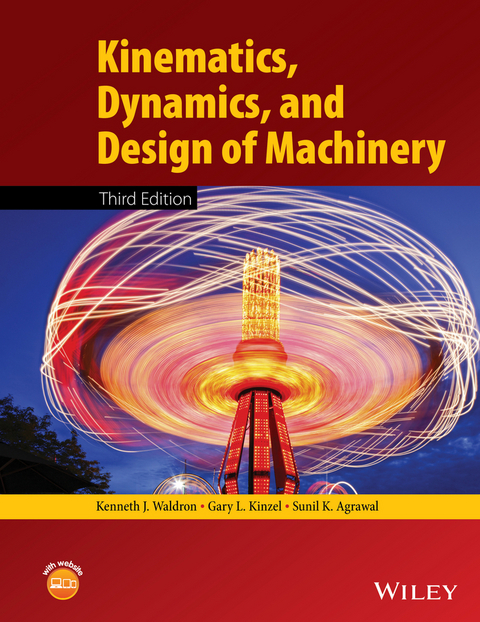
Kinematics, Dynamics, and Design of Machinery (eBook)
John Wiley & Sons (Verlag)
978-1-118-93332-9 (ISBN)
- Presents the traditional approach to the design and analysis of kinematic problems and shows how GCP can be used to solve the same problems more simply
- Provides a new and simpler approach to cam design
- Includes an increased number of exercise problems
- Accompanied by a website hosting a solutions manual, teaching slides and MATLAB® programs
Kenneth Waldron is Professor at the University of Technology, Sydney and Professor Emeritus of Stanford University. He has taught subjects in machine design and engineering mechanics over a career spanning more than forty years. He has also conducted research in kinematics of machinery, robotics, biomechanics and machine dynamics. He has received a number of awards including the American Society of Mechanical Engineers (ASME) Machine Design, Leonardo da Vinci and Ruth and Joel Spira Outstanding Design Educator Awards, and the Robotics Industries Association Joseph Engelberger Award.
Professor Waldron has served as the Technical Editor of the ASME Transactions Journal of Machine Design. He served two terms as President of IFToMM, the International Federation for the Promotion of Machine and Mechanism Science, as well as holding many offices within ASME.
Professor Waldron is excited by the many new developments in the field and the challenge of keeping this book up to date.
Gary Kinzel is an emeritus professor in the Department of Mechanical and Aerospace Engineering at The Ohio State University. He received his PhD from Purdue in 1973. After graduation, he worked for six years at Battelle and was a regular faculty member at Ohio State until he retired in 2011. His research was in design, education, and manufacturing. He has more than 150 research publications, has coauthored two books, has one patent, and has supervised to completion the research of more than one hundred graduate students. He taught courses in machine design, kinematics, stress analysis and form synthesis and received ten research and teaching awards, including the OSU Alumni Teaching Award, the ASME Ruth and Joel Spira Outstanding Design Educator Award, and the ASEE Ralph Coates Roe Award.
Sunil Agrawal has authored more than 175 archival journal papers, 225 refereed conference papers, 2 books, and 13 US patents. His work is well cited by the research community and can be viewed at Google Scholar at (scholar.google.com/citations). He has graduated 20 PhD and 25 MS students. Currently, there are 10 PhD students working under his guidance.
Kenneth Waldron is Professor at the University of Technology, Sydney and Professor Emeritus of Stanford University. He has taught subjects in machine design and engineering mechanics over a career spanning more than forty years. He has also conducted research in kinematics of machinery, robotics, biomechanics and machine dynamics. He has received a number of awards including the American Society of Mechanical Engineers (ASME) Machine Design, Leonardo da Vinci and Ruth and Joel Spira Outstanding Design Educator Awards, and the Robotics Industries Association Joseph Engelberger Award. Professor Waldron has served as the Technical Editor of the ASME Transactions Journal of Machine Design. He served two terms as President of IFToMM, the International Federation for the Promotion of Machine and Mechanism Science, as well as holding many offices within ASME. Professor Waldron is excited by the many new developments in the field and the challenge of keeping this book up to date. Gary Kinzel is an emeritus professor in the Department of Mechanical and Aerospace Engineering at The Ohio State University. He received his PhD from Purdue in 1973. After graduation, he worked for six years at Battelle and was a regular faculty member at Ohio State until he retired in 2011. His research was in design, education, and manufacturing. He has more than 150 research publications, has coauthored two books, has one patent, and has supervised to completion the research of more than one hundred graduate students. He taught courses in machine design, kinematics, stress analysis and form synthesis and received ten research and teaching awards, including the OSU Alumni Teaching Award, the ASME Ruth and Joel Spira Outstanding Design Educator Award, and the ASEE Ralph Coates Roe Award. Sunil Agrawal has authored more than 175 archival journal papers, 225 refereed conference papers, 2 books, and 13 US patents. His work is well cited by the research community and can be viewed at Google Scholar at (scholar.google.com/citations). He has graduated 20 PhD and 25 MS students. Currently, there are 10 PhD students working under his guidance.
1
Introduction
Prerequisite Knowledge Needed for Chapter 1
No prior knowledge is required for this chapter. It is an advantage to have completed undergraduate courses in statics and dynamics, but is certainly not essential.
1.1 Historical Perspective
A mechanism is a machine composed of rigid members that are joined together. Joints permit the members to interact with one another. Portions of the surfaces of the members that contact one another form the joints. The geometries of the contacting surface segments determine the properties of each joint.
Mechanisms are used for diverse purposes. Some are incorporated into items we use every day. Figure 1.1 shows a mechanism whose function is to magnify the force generated by a user squeezing the handles to a very large force exerted by the jaws. It is also designed to lock in place while generating that force, so the handles can be released while the jaws remain clamped on a work piece. This is an example of a planar mechanism because the members of the mechanism all move parallel to a single plane of motion. Many familiar mechanisms have this characteristic. Planar mechanisms are the primary focus of Chapters 3 through 7 of this book. Mechanisms whose primary function is transmitting force, like this one, are discussed in Chapter 14.
Figure 1.1 A pair of vice-grip pliers. A planar mechanism that multiplies the force applied by a user to the handles to apply a much greater force at the jaws. The mechanism is also designed to be locked in the closed position.
Other mechanisms are characterized by points in their members following paths that are curves in space. In Figure 1.2, the leg mechanisms allow the feet to be placed anywhere within a volume of space. Each mechanism is primarily used to generate a straight-line foot trajectory relative to the body, so that the machine can walk at a constant height with uniform speed. Notice that the critical function here is the ability to have a designated point generate a path of specified geometry (a straight line). This is known as a path generation problem. The leg mechanisms used here are called pantographs. A pantograph is a special kind of planar mechanism discussed in Section 8.1.3.
Figure 1.2 The Adaptive Suspension Vehicle [7]. Each leg is a planar pantograph mechanism hinged to the body about an axis parallel to the longitudinal axis of the vehicle. The feet can be placed anywhere within a volume of space, so this is, overall, a spatial mechanism. The pantograph mechanism allows the ankle joint to be moved in a straight line relative to the vehicle body by a single hydraulic cylinder.
Figure 1.3 is the drive mechanism of an ornithopter, a vehicle that flies by flapping its wings like a bird. Here a spatial trajectory of the entire wing must be generated relative to the body, not just the path of a point, as was the case with Figure 1.2. The wings must flap relative to the body, but they must also rotate about the long axis of the wing at the top of the flap to allow the wing to generate lift. The wing must rotate back (feathering) at the bottom of the flap to minimize air resistance to the upstroke. This is an example of using a mechanism to generate a specified path in space of a whole body (the wing). We call this a motion-generation problem. There are many other ways in which mechanisms are used. Here the wings are flapped by two planar four-bar mechanisms that are geared together. The rotation about the wing axis is accomplished by a cam-and-follower mechanism. Cam mechanisms are discussed in Chapter 10.
Figure 1.3 The drive mechanism of an ornithopter [1]. The mechanism must both flap the wings and rotate them about their long axes at the top and bottom of the flapping motion. A pair of four-bar mechanisms that are geared together accomplish the flapping motion. Cam and follower mechanisms are used to accomplish rotation of the wing at the top and bottom of the flapping motion.
Other common examples of ways in which mechanisms are used include the suspension of an automobile. A mechanism is used to maintain the wheels in a proper relationship with the body of the vehicle while allowing them to move to accommodate variations in the profile of the road. The suspension functions as a mechanical filter isolating the body of the vehicle and its occupants from bumps in the road.
Yet another example is the mechanism of an excavator, like the one shown in Figure 1.4, in which multiple hydraulic actuators are used to provide versatile paths of the bucket under direct control of the human operator to accomplish varied digging tasks.
Figure 1.4 Several hydraulic cylinders control a mechanical excavator.
The design of mechanisms is a technical area that is unique to mechanical engineering. Its history stretches back to prehistoric times. Artisans such as blacksmiths and carpenters also functioned as designers of mechanisms. One of the original functions of engineers was the design of mechanisms for both warfare and peaceful uses. During the Renaissance, Leonardo da Vinci [9] depicted a sophisticated variety of mechanisms, mostly for military purposes. Sometime thereafter, civil engineering and military engineering became distinct entities.
The modern era in mechanism design, along with the history of mechanical engineering as a distinct discipline, can be viewed as starting with James Watt [4]. However, the subject has not remained static. In fact, there have been dramatic changes in the practice of mechanism design in recent years.
Traditionally, machines were designed to be powered by a single “prime mover,” with all functions mechanically coordinated—a tradition that predates Watt. Developments in computer technology starting in the early 1970s, coupled with improvements in electric motors and other actuators, have made it possible to use a different approach. In this approach, machines are powered by multiple actuators coordinated electronically. The resulting machines are simpler, less expensive, more easily maintained, and more reliable. Another major change is in the techniques used in mechanism design. The use of interactive computer graphics has had a dramatic impact on design practice. One of our motivations in producing this book is to provide a treatment that reflects these changes in practice.
The functions for which mechanisms are used have changed with time, as have the methods used in designing them. Mechanisms were earlier used to generate irregular motion patterns. The Norden bombsight of World War II was a mechanical analog computer with dozens of mechanisms generating special functions mechanically [10]. Not only can those calculations now be performed more accurately and flexibly by a digital computer, but any desired motion can be generated easily and inexpensively with a computer-controlled electric motor, so there is little interest in using mechanisms in this way anymore.
1.2 Kinematics
Kinematics is the study of position and its time derivatives. Specifically, we are concerned with the positions, velocities, and accelerations of points and with the angular positions, angular velocities, and angular accelerations of solid bodies. The position of a body can be defined by the position of a nominated point of that body combined with the angular position of the body. In some circumstances, we are also interested in the higher time derivatives of position and angular position.
The subject of kinematics is a study of the geometry of motion—geometry with the element of time added. The bulk of the subject matter of this book can be referred to as the kinematics of mechanisms. Kinetics brings in the relationship between force and acceleration embodied in Newton's laws of motion is another important topic. Together, kinematics and kinetics constitute the subject known as dynamics. The subject matter is approached from a mechanical designer's perspective to present techniques that can be used to design mechanisms to meet specific motion requirements.
1.3 Design: Analysis and Synthesis
The material in this book falls into two sections. The first comprises methods for mathematically determining the geometry of a mechanism to produce a desired set of positions and/or velocities or accelerations. These are rational synthesis techniques. The second section discusses techniques to determine the positions, velocities, and accelerations of points in the members of mechanisms and the angular positions, velocities, and accelerations of those members. These are kinematic analysis techniques.
The creative activity that distinguishes engineering from science is design or, more formally, synthesis. Science is the study of what is; engineering is the creation of what is to be. The classical rational synthesis techniques developed by kinematicians offer a rather direct route to mechanism design that lends itself well to automation using computer-graphics workstations. However, these techniques represent only one way to design mechanisms, and they are relatively restrictive. Rational synthesis techniques exist only for specific types of mechanism design problems, and many practical mechanism design problems do not fit within the available class of solutions.
A new set of techniques that depend on the computational capabilities of modern graphical modeling software, in combination with a knowledge of motion...
| Erscheint lt. Verlag | 10.5.2016 |
|---|---|
| Sprache | englisch |
| Themenwelt | Technik ► Elektrotechnik / Energietechnik |
| Technik ► Maschinenbau | |
| Schlagworte | automotive engineering • Electrical & Electronics Engineering • Elektrotechnik u. Elektronik • Fahrzeugtechnik • <p>Graphical Constraint Programming<br />Cam design<br />Linkage analysis equations<br />Linkage synthesis<br />Mechanism force analysis<br />Mechanism balancing<br />Spur and helical gear design<br />Coupler curves<br />Spatial linkage analysis<br />Linkage actuation and controls</p> • Maschinenbau • Maschinenbau - Entwurf • mechanical engineering • Mechanical Engineering - Design • Numerical Methods & Algorithms • Numerische Methoden u. Algorithmen |
| ISBN-10 | 1-118-93332-X / 111893332X |
| ISBN-13 | 978-1-118-93332-9 / 9781118933329 |
| Informationen gemäß Produktsicherheitsverordnung (GPSR) | |
| Haben Sie eine Frage zum Produkt? |
 EPUB (Adobe DRM)
Kopierschutz: Adobe-DRM
Adobe-DRM ist ein Kopierschutz, der das eBook vor Mißbrauch schützen soll. Dabei wird das eBook bereits beim Download auf Ihre persönliche Adobe-ID autorisiert. Lesen können Sie das eBook dann nur auf den Geräten, welche ebenfalls auf Ihre Adobe-ID registriert sind.
Details zum Adobe-DRM
Dateiformat: EPUB (Electronic Publication)
EPUB ist ein offener Standard für eBooks und eignet sich besonders zur Darstellung von Belletristik und Sachbüchern. Der Fließtext wird dynamisch an die Display- und Schriftgröße angepasst. Auch für mobile Lesegeräte ist EPUB daher gut geeignet.
Systemvoraussetzungen:
PC/Mac: Mit einem PC oder Mac können Sie dieses eBook lesen. Sie benötigen eine
eReader: Dieses eBook kann mit (fast) allen eBook-Readern gelesen werden. Mit dem amazon-Kindle ist es aber nicht kompatibel.
Smartphone/Tablet: Egal ob Apple oder Android, dieses eBook können Sie lesen. Sie benötigen eine
Geräteliste und zusätzliche Hinweise
Buying eBooks from abroad
For tax law reasons we can sell eBooks just within Germany and Switzerland. Regrettably we cannot fulfill eBook-orders from other countries.
aus dem Bereich