Thermoelectrics (eBook)
John Wiley & Sons (Verlag)
978-1-118-84893-7 (ISBN)
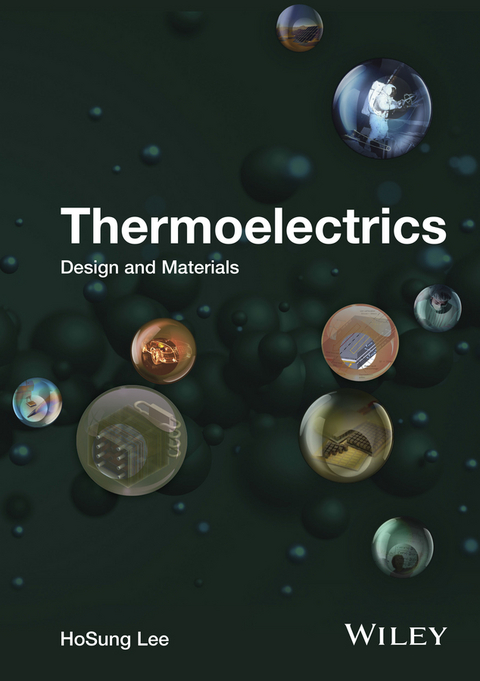
Thermoelectrics: Design and Materials
HoSung Lee, Western Michigan University, USA
A comprehensive guide to the basic principles of thermoelectrics
Thermoelectrics plays an important role in energy conversion and electronic temperature control. The book comprehensively covers the basic physical principles of thermoelectrics as well as recent developments and design strategies of materials and devices.
The book is divided into two sections: the first section is concerned with design and begins with an introduction to the fast developing and multidisciplinary field of thermoelectrics. This section also covers thermoelectric generators and coolers (refrigerators) before examining optimal design with dimensional analysis. A number of applications are considered, including solar thermoelectric generators, thermoelectric air conditioners and refrigerators, thermoelectric coolers for electronic devices, thermoelectric compact heat exchangers, and biomedical thermoelectric energy harvesting systems. The second section focuses on materials, and covers the physics of electrons and phonons, theoretical modeling of thermoelectric transport properties, thermoelectric materials, and nanostructures.
Key features:
- Provides an introduction to a fast developing and interdisciplinary field.
- Includes detailed, fundamental theories.
- Offers a platform for advanced study.
Thermoelectrics: Design and Materials is a comprehensive reference ideal for engineering students, as well as researchers and practitioners working in thermodynamics.
Cover designed by Yujin Lee
HoSung Lee is a Professor in the Department of Mechanical and Aerospace Engineering at Western Michigan University. His main areas of research include energy conversion, and thermoelectrics with particular focus on optimal design and applications, thermal design and automotive engine cooling and fuel efficiency. He also teaches numerous courses in the area of thermodynamics and heat transfer.
Thermoelectrics: Design and Materials HoSung Lee, Western Michigan University, USA A comprehensive guide to the basic principles of thermoelectrics Thermoelectrics plays an important role in energy conversion and electronic temperature control. The book comprehensively covers the basic physical principles of thermoelectrics as well as recent developments and design strategies of materials and devices. The book is divided into two sections: the first section is concerned with design and begins with an introduction to the fast developing and multidisciplinary field of thermoelectrics. This section also covers thermoelectric generators and coolers (refrigerators) before examining optimal design with dimensional analysis. A number of applications are considered, including solar thermoelectric generators, thermoelectric air conditioners and refrigerators, thermoelectric coolers for electronic devices, thermoelectric compact heat exchangers, and biomedical thermoelectric energy harvesting systems. The second section focuses on materials, and covers the physics of electrons and phonons, theoretical modeling of thermoelectric transport properties, thermoelectric materials, and nanostructures. Key features: Provides an introduction to a fast developing and interdisciplinary field. Includes detailed, fundamental theories. Offers a platform for advanced study. Thermoelectrics: Design and Materials is a comprehensive reference ideal for engineering students, as well as researchers and practitioners working in thermodynamics. Cover designed by Yujin Lee
HoSung Lee, PhD at the University of Michigan, Ann Arbor in 1993, is Emeritus Professor in the Department of Mechanical and Aerospace Engineering at Western Michigan University. His main areas of research include energy conversion, and thermoelectrics with particular focus on optimal design and applications, thermal design and automotive engine cooling and fuel efficiency. He also teaches numerous courses in the area of thermodynamics and heat transfer.
1
Introduction
1.1 Introduction
Thermoelectrics is literally associated with thermal and electrical phenomena. Thermoelectric processes can directly convert thermal energy into electrical energy or vice versa. A thermocouple uses the electrical potential (electromotive force) generated between two dissimilar wires to measure temperature. Basically, there are two devices: thermoelectric generators and thermoelectric coolers. These devices have no moving parts and require no maintenance. Thermoelectric generators have great potential for waste heat recovery from power plants and automotive vehicles. Such devices can also provide reliable power in remote areas such as in deep space and mountaintop telecommunication sites. Thermoelectric coolers provide refrigeration and temperature control in electronic packages and medical instruments. The science of thermoelectrics has become increasingly important with numerous applications. Since thermoelectricity was discovered in the early nineteenth century, there has not been much improvement in efficiency or materials until the recent development of nanotechnology, which has led to a remarkable improvement in performance. It is, thus, very important to understand the fundamentals of thermoelectrics for the development and the thermal design. We start with a brief history of thermoelectricity.
In 1821, Thomas J. Seebeck discovered that an electromotive force or a potential difference could be produced by a circuit made from two dissimilar wires when one of the junctions was heated. This is called the Seebeck effect.
Thirteen years later, in 1834, Jean Peltier discovered the reverse process—that the passage of an electric current through a thermocouple produces heating or cooling depending on its direction. This is called the Peltier effect. Although these two effects were demonstrated to exist, it was very difficult to measure each effect as a property of the material because the Seebeck effect is always associated with two dissimilar wires and the Peltier effect is always followed by the additional Joule heating that is heat generation due to the electrical resistance to the passage of a current. Joule heating was discovered in 1841 by James P. Joule.
In 1854, William Thomson (later Lord Kelvin) discovered that if a temperature difference exists between any two points of a current-carrying conductor, heat is either liberated or absorbed depending on the direction of current and material, which is in addition to the Peltier heating. This is called the Thomson effect. He also studied the relationships between these three effects thermodynamically, showing that the electrical Seebeck effect results from a combination of the thermal Peltier and Thomson effects. Although the Thomson effect itself is small compared with the other two, it leads to a very important and useful relationship, which is called the Kelvin relationship.
The mechanisms of thermoelectricity were not understood well until the discovery of electrons at the end of the nineteenth century. Now it is known that solar energy, an electric field, or thermal energy can liberate some electrons from their atomic binding, even at room temperature, moving them (from the valence band to the conduction band of a conductor) where the electrons are free to move. This is the reason why we have electrostatics everywhere. However, when a temperature difference across a conductor is applied as shown in Figure 1.1, the hot region of the conductor produces more free electrons, and diffusion of these electrons (charge carriers including holes) naturally occurs from the hot region to the cold region. On the other hand, the electron distribution provokes an electric field, which also causes the electrons to move from the hot region to the cold region via the Coulomb forces. Hence, an electromotive force (emf) is generated in a way that an electric current flows against the temperature gradient. As mentioned, the reverse is also true. If a current is applied to the conductor, electrons move and interestingly carry thermal energy. Therefore, a heat flow occurs in the opposite direction of the current, which is also shown in Figure 1.1.
Figure 1.1 Electron concentrations in a thermoelectric material
In many applications, a number of thermocouples, each of which consists of p-type and n-type semiconductor elements, are connected electrically in series and thermally in parallel by sandwiching them between two high–thermal conductivity but low–electrical conductivity ceramic plates to form a module, which is shown in Figure 1.2.
Figure 1.2 Cutaway of a typical thermoelectric module
Consider two wires made from different metals joined at both ends, as shown in Figure 1.3, forming a close circuit. Ordinarily, nothing will happen. However, when one of the junctions is heated, something interesting happens. Current flows continuously in the circuit. this is the Seebeck effect. The circuit that incorporates both thermal and electrical effects is called a thermoelectric circuit. A thermocouple uses the Seebeck effect to measure temperature, and the effect forms the basis of a thermoelectric generator.
Figure 1.3 Thermocouple
In 1834, Jean Peltier discovered the reverse of the Seebeck effect by demonstrating that cooling can take place by applying a current across the junction. The heat pumping is possible without a refrigerator or compressor. The thermal energy can convert to electrical energy without turbine or engines.
There are some advantages of thermoelectric devices despite their low thermal efficiency. There are no moving parts in the device; therefore, there is less potential for failure in operation. Controllability of heating and cooling is very attractive in many applications such as lasers, optical detectors, medical instruments, and microelectronics.
1.2 Thermoelectric Effect
The thermoelectric effect consists of three effects: the Seebeck effect, the Peltier effect, and the Thomson effect.
1.2.1 Seebeck Effect
The Seebeck effect is the conversion of a temperature difference into an electric current. As shown in Figure 1.3, wire A is joined at both ends to wire B and a voltmeter is inserted in wire B. Suppose that a temperature difference is imposed between two junctions; then, it will generally be found that a potential difference or voltage V will appear on the voltmeter. The potential difference is proportional to the temperature difference. The potential difference V is
where ΔT = Th − Tc and ; is called the Seebeck coefficient (also called the thermopower), which is usually measured in μV/K. The sign of α is positive if the emf tends to drive an electric current through wire A from the hot junction to the cold junction, as shown in Figure 1.3. In practice, one rarely measures the absolute Seebeck coefficient because the voltage meter always reads the relative Seebeck coefficient between wires A and B. The absolute Seebeck coefficient can be calculated from the Thomson coefficient.
1.2.2 Peltier Effect
When current flows across a junction between two different wires, it is found that heat must be continuously added or subtracted at the junction in order to keep its temperature constant, which is illustrated in Figure 1.4. The heat is proportional to the current flow and changes sign when the current is reversed. Thus, the Peltier heat absorbed or liberated is
where πAB is the Peltier coefficient and the sign of πAB is positive if the junction at which the current enters wire A is heated and the junction at which the current leaves wire A is cooled. The Peltier heating or cooling is reversible between heat and electricity. This means that heating (or cooling) will produce electricity and electricity will produce heating (or cooling) without a loss of energy.
Figure 1.4 Schematic for the Peltier effect and the Thomson effect
1.2.3 Thomson Effect
When current flows as shown in Figure 1.4, heat is absorbed in wire A due to the negative temperature gradient and liberated in wire B due to the positive temperature gradient, which is experimental observation [1], depending on the material. The Thomson heat is proportional to both the electric current and the temperature gradient, which is schematically shown in Figure 1.4. Thus, the Thomson heat absorbed or liberated across a wire is
where τ is the Thomson coefficient. The Thomson coefficient is unique among the three thermoelectric coefficients because it is the only thermoelectric coefficient directly measurable for individual materials. There is other form of heat, called Joule heating (I2R), which is irreversible and is always generated as current flows in a wire. The Thomson heat is reversible between heat and electricity.
1.2.4 Thomson (or Kelvin) Relationships
The interrelationships between the three thermoelectric effects are important in order to understand the basic phenomena. In 1854, Thomson [2] studied the relationships thermodynamically and provided two relationships as shown in Equations (1.4) and (1.5) by applying...
| Erscheint lt. Verlag | 12.9.2016 |
|---|---|
| Sprache | englisch |
| Themenwelt | Technik ► Elektrotechnik / Energietechnik |
| Technik ► Maschinenbau | |
| Schlagworte | Bauingenieur- u. Bauwesen • Baustatik u. Baumechanik • Civil Engineering & Construction • electrical conductivity • Maschinenbau • mechanical engineering • Physics • physics of thermoelectrics • Physik • Seebeck coefficient • Structural Theory & Structural Mechanics • theoretical physics • Theoretische Physik • thermal conductivity • thermodynamics • Thermodynamik • thermoelectric coolers • Thermoelectric design • Thermoelectric Generators • Thermoelectric materials • thermoelectrics • thermoelectric transport properties • Thermoelektrik • Thermoelektrizität • Thermoelektrizität |
| ISBN-10 | 1-118-84893-4 / 1118848934 |
| ISBN-13 | 978-1-118-84893-7 / 9781118848937 |
| Informationen gemäß Produktsicherheitsverordnung (GPSR) | |
| Haben Sie eine Frage zum Produkt? |
 EPUB (Adobe DRM)
Kopierschutz: Adobe-DRM
Adobe-DRM ist ein Kopierschutz, der das eBook vor Mißbrauch schützen soll. Dabei wird das eBook bereits beim Download auf Ihre persönliche Adobe-ID autorisiert. Lesen können Sie das eBook dann nur auf den Geräten, welche ebenfalls auf Ihre Adobe-ID registriert sind.
Details zum Adobe-DRM
Dateiformat: EPUB (Electronic Publication)
EPUB ist ein offener Standard für eBooks und eignet sich besonders zur Darstellung von Belletristik und Sachbüchern. Der Fließtext wird dynamisch an die Display- und Schriftgröße angepasst. Auch für mobile Lesegeräte ist EPUB daher gut geeignet.
Systemvoraussetzungen:
PC/Mac: Mit einem PC oder Mac können Sie dieses eBook lesen. Sie benötigen eine
eReader: Dieses eBook kann mit (fast) allen eBook-Readern gelesen werden. Mit dem amazon-Kindle ist es aber nicht kompatibel.
Smartphone/Tablet: Egal ob Apple oder Android, dieses eBook können Sie lesen. Sie benötigen eine
Geräteliste und zusätzliche Hinweise
Buying eBooks from abroad
For tax law reasons we can sell eBooks just within Germany and Switzerland. Regrettably we cannot fulfill eBook-orders from other countries.
aus dem Bereich