Thermoelectrics (eBook)
John Wiley & Sons (Verlag)
978-1-118-84892-0 (ISBN)
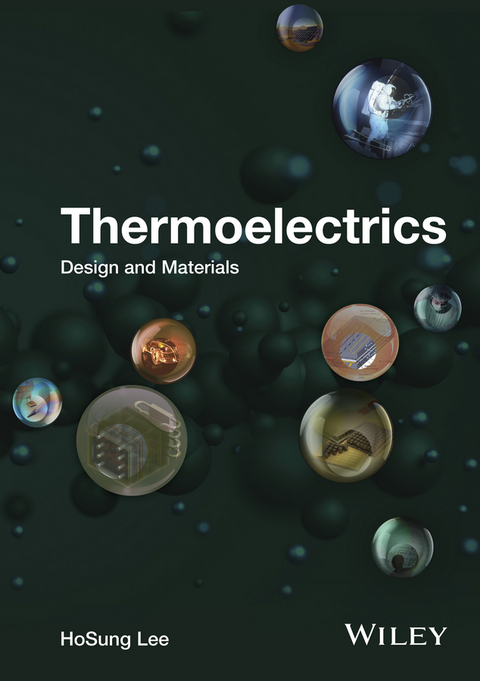
Thermoelectrics: Design and Materials
HoSung Lee, Western Michigan University, USA
A comprehensive guide to the basic principles of thermoelectrics
Thermoelectrics plays an important role in energy conversion and electronic temperature control. The book comprehensively covers the basic physical principles of thermoelectrics as well as recent developments and design strategies of materials and devices.
The book is divided into two sections: the first section is concerned with design and begins with an introduction to the fast developing and multidisciplinary field of thermoelectrics. This section also covers thermoelectric generators and coolers (refrigerators) before examining optimal design with dimensional analysis. A number of applications are considered, including solar thermoelectric generators, thermoelectric air conditioners and refrigerators, thermoelectric coolers for electronic devices, thermoelectric compact heat exchangers, and biomedical thermoelectric energy harvesting systems. The second section focuses on materials, and covers the physics of electrons and phonons, theoretical modeling of thermoelectric transport properties, thermoelectric materials, and nanostructures.
Key features:
- Provides an introduction to a fast developing and interdisciplinary field.
- Includes detailed, fundamental theories.
- Offers a platform for advanced study.
Thermoelectrics: Design and Materials is a comprehensive reference ideal for engineering students, as well as researchers and practitioners working in thermodynamics.
Cover designed by Yujin Lee
HoSung Lee is a Professor in the Department of Mechanical and Aerospace Engineering at Western Michigan University. His main areas of research include energy conversion, and thermoelectrics with particular focus on optimal design and applications, thermal design and automotive engine cooling and fuel efficiency. He also teaches numerous courses in the area of thermodynamics and heat transfer.
Thermoelectrics: Design and Materials HoSung Lee, Western Michigan University, USA A comprehensive guide to the basic principles of thermoelectrics Thermoelectrics plays an important role in energy conversion and electronic temperature control. The book comprehensively covers the basic physical principles of thermoelectrics as well as recent developments and design strategies of materials and devices. The book is divided into two sections: the first section is concerned with design and begins with an introduction to the fast developing and multidisciplinary field of thermoelectrics. This section also covers thermoelectric generators and coolers (refrigerators) before examining optimal design with dimensional analysis. A number of applications are considered, including solar thermoelectric generators, thermoelectric air conditioners and refrigerators, thermoelectric coolers for electronic devices, thermoelectric compact heat exchangers, and biomedical thermoelectric energy harvesting systems. The second section focuses on materials, and covers the physics of electrons and phonons, theoretical modeling of thermoelectric transport properties, thermoelectric materials, and nanostructures. Key features: Provides an introduction to a fast developing and interdisciplinary field. Includes detailed, fundamental theories. Offers a platform for advanced study. Thermoelectrics: Design and Materials is a comprehensive reference ideal for engineering students, as well as researchers and practitioners working in thermodynamics. Cover designed by Yujin Lee
HoSung Lee, PhD at the University of Michigan, Ann Arbor in 1993, is Emeritus Professor in the Department of Mechanical and Aerospace Engineering at Western Michigan University. His main areas of research include energy conversion, and thermoelectrics with particular focus on optimal design and applications, thermal design and automotive engine cooling and fuel efficiency. He also teaches numerous courses in the area of thermodynamics and heat transfer.
Thermoelectrics: Design and Materials 1
Contents 9
Preface 15
1: Introduction 17
1.1 Introduction 17
1.2 Thermoelectric Effect 19
1.2.1 Seebeck Effect 19
1.2.2 Peltier Effect 19
1.2.3 Thomson Effect 20
1.2.4 Thomson (or Kelvin) Relationships 20
1.3 The Figure of Merit 20
1.3.1 New-Generation Thermoelectrics 21
Problems 23
References 23
2: Thermoelectric Generators 24
2.1 Ideal Equations 24
2.2 Performance Parameters of a Thermoelectric Module 27
2.3 Maximum Parameters for a Thermoelectric Module 28
2.4 Normalized Parameters 29
Example 2.1 Exhaust Waste Heat Recovery 31
2.5 Effective Material Properties 33
2.6 Comparison of Calculations with a Commercial Product 34
Problems 35
Computer Assignment 37
References 38
3: Thermoelectric Coolers 39
3.1 Ideal Equations 39
3.2 Maximum Parameters 42
3.3 Normalized Parameters 43
Example 3.1 Thermoelectric Air Conditioner 45
3.4 Effective Material Properties 49
3.4.1 Comparison of Calculations with a Commercial Product 50
Problems 52
Reference 53
4: Optimal Design 54
4.1 Introduction 54
4.2 Optimal Design for Thermoelectric Generators 54
Example 4.1 Exhaust Thermoelectric Generators 62
4.3 Optimal Design of Thermoelectric Coolers 65
Example 4.2 Automotive Thermoelectric Air Conditioner 73
Problems 77
References 79
5: Thomson Effect, Exact Solution, and Compatibility Factor 80
5.1 Thermodynamics of Thomson Effect 80
5.2 Exact Solutions 84
5.2.1 Equations for the Exact Solutions and the Ideal Equation 84
5.2.2 Thermoelectric Generator 86
5.2.3 Thermoelectric Coolers 87
5.3 Compatibility Factor 87
5.4 Thomson Effects 95
5.4.1 Formulation of Basic Equations 95
5.4.2 Numeric Solutions of Thomson Effect 99
5.4.3 Comparison between Thomson Effect and Ideal Equation 101
Problems 103
Projects 104
References 104
6: Thermal and Electrical Contact Resistances for Micro and Macro Devices 105
6.1 Modeling and Validation 105
6.2 Micro and Macro Thermoelectric Coolers 108
6.3 Micro and Macro Thermoelectric Generators 110
Problems 113
Computer Assignment 113
References 114
7: Modeling of Thermoelectric Generators and Coolers With Heat Sinks 115
7.1 Modeling of Thermoelectric Generators With Heat Sinks 115
7.2 Plate Fin Heat Sinks 124
7.3 Modeling of Thermoelectric Coolers With Heat Sinks 127
Problems 135
References 135
8: Applications 136
8.1 Exhaust Waste Heat Recovery 136
8.1.1 Recent Studies 136
8.1.2 Modeling of Module Tests 138
8.1.3 Modeling of a TEG 142
8.1.4 New Design of a TEG 149
8.2 Solar Thermoelectric Generators 154
8.2.1 Recent Studies 154
8.2.2 Modeling of a STEG 154
8.2.3 Optimal Design of a STEG (Dimensional Analysis) 160
8.2.4 New Design of a STEG 162
8.3 Automotive Thermoelectric Air Conditioner 165
8.3.1 Recent Studies 165
8.3.2 Modeling of an Air-to-Air TEAC 166
8.3.3 Optimal Design of a TEAC 173
8.3.4 New Design of a TEAC 176
Problems 178
References 179
9: Crystal Structure 180
9.1 Atomic Mass 180
9.1.1 Avogadro's Number 180
Example 9.1 Mass of One Atom 180
9.2 Unit Cells of a Crystal 181
9.2.1 Bravais Lattices 182
Example 9.2 Lattice Constant of Gold 185
9.3 Crystal Planes 186
Example 9.3 Indices of a Plane 187
Problems 187
10: Physics of Electrons 188
10.1 Quantum Mechanics 188
10.1.1 Electromagnetic Wave 188
10.1.2 Atomic Structure 190
10.1.3 Bohr's Model 190
10.1.4 Line Spectra 192
10.1.5 De Broglie Wave 193
10.1.6 Heisenberg Uncertainty Principle 194
10.1.7 Schrödinger Equation 194
10.1.8 A Particle in a One-Dimensional Box 195
10.1.9 Quantum Numbers 197
10.1.10 Electron Configurations 199
Example 10.1 Electronic Configuration of a Silicon Atom 200
10.2 Band Theory and Doping 201
10.2.1 Covalent Bonding 201
10.2.2 Energy Band 202
10.2.3 Pseudo-Potential Well 202
10.2.4 Doping, Donors, and Acceptors 203
Problems 204
References 204
11: Density of States, Fermi Energy, and Energy Bands 205
11.1 Current and Energy Transport 205
11.2 Electron Density of States 206
11.2.1 Dispersion Relation 206
11.2.2 Effective Mass 206
11.2.3 Density of States 207
11.3 Fermi-Dirac Distribution 209
11.4 Electron Concentration 210
11.5 Fermi Energy in Metals 211
Example 11.1 Fermi Energy in Gold 212
11.6 Fermi Energy in Semiconductors 213
Example 11.2 Fermi Energy in Doped Semiconductors 214
11.7 Energy Bands 215
11.7.1 Multiple Bands 216
11.7.2 Direct and Indirect Semiconductors 216
11.7.3 Periodic Potential (Kronig-Penney Model) 217
Problems 221
References 221
12: Thermoelectric Transport Properties for Electrons 222
12.1 Boltzmann Transport Equation 222
12.2 Simple Model of Metals 224
12.2.1 Electric Current Density 224
12.2.2 Electrical Conductivity 224
Example 12.1 Electron Relaxation Time of Gold 226
12.2.3 Seebeck Coefficient 226
Example 12.2 Seebeck Coefficient of Gold 228
12.2.4 Electronic Thermal Conductivity 228
Example 12.3 Electronic Thermal Conductivity of Gold 229
12.3 Power-Law Model for Semiconductors 229
12.3.1 Equipartition Principle 230
12.3.2 Parabolic Single-Band Model 231
Example 12.4 Seebeck Coefficient of PbTe 233
Example 12.5 Material Parameter 237
12.4 Electron Relaxation Time 238
12.4.1 Acoustic Phonon Scattering 238
12.4.2 Polar Optical Phonon Scattering 238
12.4.3 Ionized Impurity Scattering 239
Example 12.6 Electron Mobility 239
12.5 Multiband Effects 240
12.6 Nonparabolicity 241
Problems 244
References 245
13: Phonons 246
13.1 Crystal Vibration 246
13.1.1 One Atom in a Primitive Cell 246
13.1.2 Two Atoms in a Unit Cell 248
13.2 Specific Heat 250
13.2.1 Internal Energy 250
13.2.2 Debye Model 251
Example 13.1 Atomic Size and Specific Heat 255
13.3 Lattice Thermal Conductivity 257
13.3.1 Klemens-Callaway Model 257
13.3.2 Umklapp Processes 260
13.3.3 Callaway Model 260
13.3.4 Phonon Relaxation Times 261
Example 13.2 Lattice Thermal Conductivity 263
Problems 265
References 266
14: Low-Dimensional Nanostructures 267
14.1 Low-Dimensional Systems 267
14.1.1 Quantum Well (2D) 267
Example 14.1 Energy Levels of a Quantum Well 271
14.1.2 Quantum Wires (1D) 272
14.1.3 Quantum Dots (0D) 274
14.1.4 Thermoelectric Transport Properties of Quantum Wells 276
14.1.5 Thermoelectric Transport Properties of Quantum Wires 277
14.1.6 Proof-of-Principle Studies 279
14.1.7 Size Effects of Quantum Well on Lattice Thermal Conductivity 280
Problems 283
References 283
15: Generic Model of Bulk Silicon and Nanowires 284
15.1 Electron Density of States for Bulk and Nanowires 284
15.1.1 Density of States 284
15.2 Carrier Concentrations for Two-band Model 285
15.2.1 Bulk 285
15.2.2 Nanowires 285
15.2.3 Bipolar Effect and Fermi Energy 285
15.3 Electron Transport Properties for Bulk and Nanowires 286
15.3.1 Electrical Conductivity 286
15.3.2 Seebeck Coefficient 286
15.3.3 Electronic Thermal Conductivity 286
15.4 Electron Scattering Mechanisms 287
15.4.1 Acoustic-Phonon Scattering 287
15.4.2 Ionized Impurity Scattering 288
15.4.3 Polar Optical Phonon Scattering 288
15.5 Lattice Thermal Conductivity 289
15.6 Phonon Relaxation Time 289
15.7 Input Data for Bulk Si and Nanowires 291
15.8 Bulk Si 291
15.8.1 Fermi Energy 291
15.8.2 Electron Mobility 291
15.8.3 Thermoelectric Transport Properties 291
15.8.4 Dimensionless Figure of Merit 292
15.9 Si Nanowires 292
15.9.1 Electron Properties 292
15.9.2 Phonon Properties for Si Nanowires 296
Problems 298
References 300
16: Theoretical Model of Thermoelectric Transport Properties 302
16.1 Introduction 302
16.2 Theoretical Equatons 303
16.2.1 Carrier Transport Properties 303
16.2.2 Scattering Mechanisms for Electron Relaxation Times 306
16.2.3 Lattice Thermal Conductivity 309
16.2.4 Phonon Relaxation Times 309
16.2.5 Phonon Density of States and Specific Heat 311
16.2.6 Dimensionless Figure of Merit 311
16.3 Results and Discussion 311
16.3.1 Electron or Hole Scattering Mechanisms 311
16.3.2 Transport Properties 315
16.4 Summary 331
Problems 332
References 332
Appendix A: Physical Properties 339
Appendix B: Optimal Dimensionless Parameters for TEGs with ZT?2 = 1 369
Appendix C: ANSYS TEG Tutorial 381
Appendix D: Periodic Table 392
Appendix E: Thermoelectric Properties 407
Appendix F: Fermi Integral 415
Appendix G: Hall Factor 418
Appendix H: Conversion Factors 421
Index 425
End User License Agreement 437
| Erscheint lt. Verlag | 7.9.2016 |
|---|---|
| Sprache | englisch |
| Themenwelt | Technik ► Elektrotechnik / Energietechnik |
| Technik ► Maschinenbau | |
| Schlagworte | Bauingenieur- u. Bauwesen • Baustatik u. Baumechanik • Civil Engineering & Construction • electrical conductivity • Maschinenbau • mechanical engineering • Physics • physics of thermoelectrics • Physik • Seebeck coefficient • Structural Theory & Structural Mechanics • theoretical physics • Theoretische Physik • thermal conductivity • thermodynamics • Thermodynamik • thermoelectric coolers • Thermoelectric design • Thermoelectric Generators • Thermoelectric materials • thermoelectrics • thermoelectric transport properties • Thermoelektrik • Thermoelektrizität • Thermoelektrizität |
| ISBN-10 | 1-118-84892-6 / 1118848926 |
| ISBN-13 | 978-1-118-84892-0 / 9781118848920 |
| Informationen gemäß Produktsicherheitsverordnung (GPSR) | |
| Haben Sie eine Frage zum Produkt? |
 PDF (Adobe DRM)
Kopierschutz: Adobe-DRM
Adobe-DRM ist ein Kopierschutz, der das eBook vor Mißbrauch schützen soll. Dabei wird das eBook bereits beim Download auf Ihre persönliche Adobe-ID autorisiert. Lesen können Sie das eBook dann nur auf den Geräten, welche ebenfalls auf Ihre Adobe-ID registriert sind.
Details zum Adobe-DRM
Dateiformat: PDF (Portable Document Format)
Mit einem festen Seitenlayout eignet sich die PDF besonders für Fachbücher mit Spalten, Tabellen und Abbildungen. Eine PDF kann auf fast allen Geräten angezeigt werden, ist aber für kleine Displays (Smartphone, eReader) nur eingeschränkt geeignet.
Systemvoraussetzungen:
PC/Mac: Mit einem PC oder Mac können Sie dieses eBook lesen. Sie benötigen eine
eReader: Dieses eBook kann mit (fast) allen eBook-Readern gelesen werden. Mit dem amazon-Kindle ist es aber nicht kompatibel.
Smartphone/Tablet: Egal ob Apple oder Android, dieses eBook können Sie lesen. Sie benötigen eine
Geräteliste und zusätzliche Hinweise
Buying eBooks from abroad
For tax law reasons we can sell eBooks just within Germany and Switzerland. Regrettably we cannot fulfill eBook-orders from other countries.
aus dem Bereich