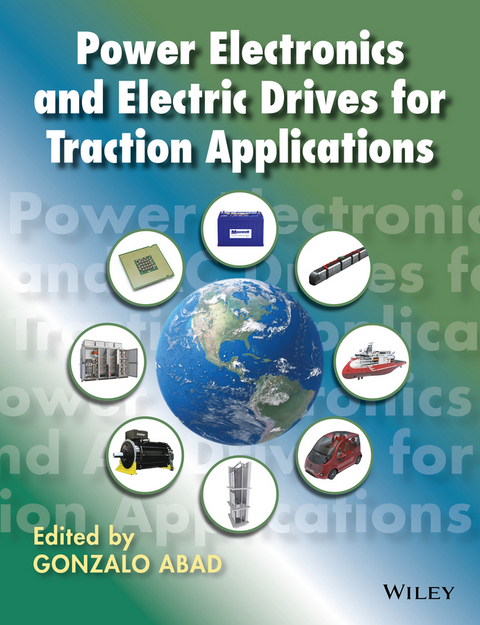
Power Electronics and Electric Drives for Traction Applications offers a practical approach to understanding power electronics applications in transportation systems ranging from railways to electric vehicles and ships. It is an application-oriented book for the design and development of traction systems accompanied by a description of the core technology.
The first four introductory chapters describe the common knowledge and background required to understand the preceding chapters. After that, each application-specific chapter: highlights the significant manufacturers involved; provides a historical account of the technological evolution experienced; distinguishes the physics and mechanics; and where possible, analyses a real life example and provides the necessary models and simulation
tools, block diagrams and simulation based validations.
Key features:
Surveys power electronics state-of-the-art in all aspects of traction applications.
Presents vital design and development knowledge that is extremely important for the professional community in an original, simple, clear and complete manner.Offers design guidelines for power electronics traction systems in high-speed rail, ships, electric/hybrid vehicles, elevators and more applications.
Application-specific chapters co-authored by traction industry expert.
Learning supplemented by tutorial sections, case studies and MATLAB/Simulink-based simulations with data from practical systems.
A valuable reference for application engineers in traction industry responsible for design and development of products as well as traction industry researchers, developers and graduate students on power electronics and motor drives needing a reference to the application examples.
Gonzalo Abad, Computing and Electronics Department, University of Mondragon, Spain
Gonzalo Abad received his degree in Electrical Engineering from the University of Mondragon in 2000, his M.Sc. degree in Advanced Control from the University of Manchester (UK) in 2001 and his Ph.D. degree in Electrical Engineering from the University of Mondragon in 2008. He joined the Electronics and Computing Department of the University of Mondragon in 2001. His main research interests include renewable energies, power conversion and motor drives. He has co-authored several papers, patents and books in the areas of wind power generation, multilevel power converters and control of AC drives.
Power Electronics and Electric Drives for Traction Applications offers a practical approach to understanding power electronics applications in transportation systems ranging from railways to electric vehicles and ships. It is an application-oriented book for the design and development of traction systems accompanied by a description of the core technology. The first four introductory chapters describe the common knowledge and background required to understand the preceding chapters. After that, each application-specific chapter: highlights the significant manufacturers involved; provides a historical account of the technological evolution experienced; distinguishes the physics and mechanics; and where possible, analyses a real life example and provides the necessary models and simulationtools, block diagrams and simulation based validations. Key features: Surveys power electronics state-of-the-art in all aspects of traction applications. Presents vital design and development knowledge that is extremely important for the professional community in an original, simple, clear and complete manner. Offers design guidelines for power electronics traction systems in high-speed rail, ships, electric/hybrid vehicles, elevators and more applications. Application-specific chapters co-authored by traction industry expert. Learning supplemented by tutorial sections, case studies and MATLAB/Simulink-based simulations with data from practical systems. A valuable reference for application engineers in traction industry responsible for design and development of products as well as traction industry researchers, developers and graduate students on power electronics and motor drives needing a reference to the application examples.
Gonzalo Abad, Computing and Electronics Department, University of Mondragon, Spain Gonzalo Abad received his degree in Electrical Engineering from the University of Mondragon in 2000, his M.Sc. degree in Advanced Control from the University of Manchester (UK) in 2001 and his Ph.D. degree in Electrical Engineering from the University of Mondragon in 2008. He joined the Electronics and Computing Department of the University of Mondragon in 2001. His main research interests include renewable energies, power conversion and motor drives. He has co-authored several papers, patents and books in the areas of wind power generation, multilevel power converters and control of AC drives.
Title Page 5
Copyright 6
Contents 7
List of contributors 10
Preface 12
Chapter 1 Introduction 17
1.1 Introduction to the book 17
1.2 Traction applications 19
1.3 Electric drives for traction applications 25
1.3.1 General description 25
1.3.2 Different electric drive configurations 29
1.4 Classification of different parts of electric drives: converter, machines, control strategies, and energy sources 42
1.4.1 Converters 42
1.4.2 Machines 44
1.4.3 Control strategies 46
1.4.4 AC and DC voltage sources 48
1.5 Future challenges for electric drives 49
1.6 Historical evolution 50
References 52
Chapter 2 Control of induction machines 53
2.1 Introduction 53
2.2 Modeling of induction motors 53
2.2.1 Dynamic model of the induction motor using three-phase variables 54
2.2.2 Basics of space vector theory 56
2.2.3 Dynamic model of the induction machine using complex space vectors 59
2.2.4 Dynamic model in the stationary reference frame 62
2.2.5 Dynamic models in a synchronous reference frame 64
2.2.6 Torque and power equations 65
2.3 Rotor flux oriented vector control 68
2.3.1 Fundamentals of rotor flux oriented control 69
2.3.2 The stator voltage equation 72
2.3.3 Synchronous current regulators 74
2.3.4 Rotor flux estimation 80
2.4 Torque capability of the induction machine 85
2.4.1 Constant torque region 86
2.4.2 Flux-weakening region I (constant power region) 86
2.4.3 Flux-weakening region II (constant Tem?m2) 87
2.5 Rotor flux selection 87
2.5.1 Rotor flux reference selection below rated speed 87
2.5.2 Accurate criteria for flux reference generation 89
2.5.3 Feedback based field weakening 94
2.6 Outer control loops 94
2.6.1 Speed control 95
2.6.2 Rotor flux control loop 98
2.7 Sensorless control 100
2.7.1 Sensorless control of induction machines using model-based methods 100
2.7.2 Sensorless control using saliency-tracking-based methods 104
2.8 Steady-state equations and limits of operation of the induction machine 104
2.8.1 Calculation of the maximum capability curves 104
2.8.2 Calculation of the steady-state operation 107
References 114
Chapter 3 Control of synchronous machines 116
3.1 Introduction 116
3.2 Types of synchronous machines 116
3.3 Modeling of synchronous machines 119
3.3.1 Dynamic models of synchronous machines using three-phase variables 119
3.3.2 Dynamic model of synchronous machines in the stationary reference frame using complex space vectors 120
3.3.3 Dynamic model of synchronous machines in the synchronous reference frame 121
3.4 Torque equation for synchronous machines 122
3.4.1 Surface permanent magnet synchronous machine (non-salient machines) 123
3.4.2 Interior permanent magnet synchronous machine (salient machines with magnets) 124
3.4.3 Synchronous reluctance machines (salient machines without magnets) 125
3.4.4 Maximum torque per ampere (MTPA) in interior permanent magnet machines 125
3.5 Vector control of permanent magnet synchronous machines 127
3.5.1 Vector control of non-salient synchronous machines 128
3.5.2 Vector control of salient synchronous machines 129
3.5.3 Synchronous current regulators 129
3.6 Operation under voltage and current constraints 131
3.6.1 Current and voltage limits 131
3.6.2 Stator voltage equation at high speeds: Field weakening 131
3.6.3 Control of non-salient machines under voltage constraints 133
3.6.4 Control of salient machines under voltage constraints 135
3.6.5 Synchronous reluctance machines 138
3.6.6 Feedback-based flux weakening of vector controlled synchronous machines 139
3.7 Speed control 140
3.8 Sensorless control 141
3.8.1 Permanent magnet synchronous machine model 141
3.8.2 Model-based sensorless control of PMSM 143
3.8.3 Sensorless control using saliency-tracking-based methods 146
3.8.4 Position estimation using rotating high-frequency voltage injection and the negative sequence current 149
3.8.5 Magnet polarity detection 154
3.8.6 Use of saliency-tracking methods with induction machines 155
3.9 Numerical calculation of the steady-state of synchronous machines 156
3.9.1 Calculation of the maximum capability curves 156
3.9.2 Calculation of the steady-state operation 160
References 162
Chapter 4 Control of grid-connected converters 164
4.1 Introduction 164
4.2 Three-phase grid-connected converter model 165
4.2.1 Converter model 167
4.2.2 Filter model 168
4.2.3 DC-link model 173
4.2.4 Sinusoidal PWM with third harmonic injection 175
4.2.5 Steady-state model equations 178
4.2.6 Dynamic model equations 180
4.2.7 LCL filter analysis and design 185
4.3 Three-phase grid-connected converter control 191
4.3.1 Alignment with the grid voltage space vector 191
4.3.2 Vector control strategy 192
4.3.3 Synchronization method 195
4.3.4 Tuning of the current regulators 195
4.3.5 Simulation-based example 199
4.4 Three-phase grid-connected converter control under unbalanced voltage conditions 201
4.4.1 Unbalanced three-phase systems 201
4.4.2 Voltage equations of the grid-connected converter system 208
4.4.3 Power expressions 212
4.4.4 Vector control under unbalanced conditions 215
4.4.5 Synchronization method for unbalanced grid voltages 218
4.4.6 Tuning of the current regulators 221
4.4.7 Simulation-based example 221
4.5 Single-phase grid-connected converter model and modulation 223
4.5.1 Model 223
4.5.2 Sinusoidal PWM 225
4.6 Single-phase grid-connected converter control 228
4.6.1 Synchronization method for single-phase converters 230
4.6.2 Simulation-based examples 231
References 236
Chapter 5 Railway traction 237
5.1 Introduction 237
5.2 General description 237
5.2.1 Railway systems in Europe 237
5.2.2 Railway vehicles classification 240
5.2.3 Railway vehicles power architecture 243
5.2.4 Electric power system components classification 245
5.3 Physical approach 264
5.3.1 Forces 264
5.3.2 Adhesion 267
5.3.3 Model of the train 269
5.4 Electric drive in railway traction 271
5.4.1 Converters and catenaries 271
5.4.2 Electric machines 277
5.4.3 Control strategy 280
5.5 Railway power supply system 292
5.5.1 DC supply system 292
5.5.2 AC 50Hz supply system 292
5.5.3 AC 16.7Hz supply systems 293
5.6 ESSs for railway applications 294
5.6.1 Introduction 294
5.6.2 Energy storage technologies 298
5.6.3 Trackside energy storage applications 311
5.6.4 On-board energy storage applications 318
5.6.5 Power converters for ESSs 338
5.6.6 EN 62864-1 standard for railway applications 348
5.7 Ground level power supply systems 348
5.7.1 Contact type GLPS systems 349
5.7.2 Contact-less type GLPS systems 351
5.7.3 Advantages and disadvantages of GLPS systems 352
5.8 Auxiliary power systems for railway applications 354
5.8.1 Low-frequency auxiliary power converter 354
5.8.2 MF auxiliary power converter 355
5.9 Real examples 356
5.9.1 Tram-train example 356
5.9.2 Recife metro 359
5.9.3 Tram-train Cádiz, Spain 362
5.9.4 Chittaranjan locomotive, India 363
5.10 Historical evolution 367
5.11 New trends and future challenges 367
5.11.1 Converter topologies 367
5.11.2 Power semiconductors 371
5.11.3 ESSs 373
References 373
Chapter 6 Ships 378
6.1 Introduction 378
6.2 General description 378
6.2.1 Definition and basic concepts 378
6.2.2 Types of ships 379
6.2.3 Components of a ship 381
6.2.4 Propulsion system 386
6.3 Physical approach of the ship propulsion system 392
6.3.1 Ship resistance 392
6.3.2 Propeller propulsion 394
6.3.3 Dynamic model for computer-based simulation 401
6.3.4 Brief steady-state analysis 403
6.4 Variable speed drive in electric propulsion 408
6.4.1 General characteristics and general configurations 408
6.4.2 Electric machine 413
6.4.3 Power electronic converter and transformer 416
6.4.4 Control strategy 422
6.5 Power generation and distribution system 425
6.5.1 Power generation and distribution configurations 425
6.5.2 Electric power generation 429
6.5.3 Power cables 439
6.5.4 Fault protection 442
6.5.5 Harmonic distortion and voltage droop analyses 451
6.6 Computer-based simulation example 455
6.6.1 Ship under study 455
6.6.2 Electric propulsion drive 456
6.6.3 Simulation performance 460
6.7 Design and dimensioning of the electric system 464
6.8 Real examples 466
6.8.1 Simon Stevin fall pipe and rock dumping vessel 466
6.8.2 Shuttle tanker 468
6.8.3 Field support vessels 469
6.8.4 Cruise liner 470
6.9 Dynamic positioning (DP) 471
6.10 Historical evolution 474
6.11 New trends and future challenges 479
6.11.1 DC distribution networks 479
6.11.2 Hybrid mechanical-electrical propulsion 480
6.11.3 Hybrid generation 481
References 482
Chapter 7 Electric and hybrid vehicles 484
7.1 Introduction 484
7.2 Physical approach to the electric vehicle: Dynamic model 484
7.2.1 Forces actuating on the vehicle 486
7.2.2 Model block diagram of a four-wheel drive car 491
7.2.3 Model block diagram of a two-wheel drive car 492
7.2.4 Load characteristic of a vehicle 494
7.2.5 Simulation performance 495
7.2.6 Anti-slip control 500
7.3 Electric vehicle configurations 508
7.3.1 Drive train configurations 509
7.4 Hybrid electric vehicle configurations 513
7.4.1 Series hybrid electric vehicle 513
7.4.2 Parallel hybrid electric vehicle 519
7.4.3 Series-parallel hybrid electric vehicle 521
7.5 Variable speed drive of the electric vehicle 522
7.5.1 General view 522
7.5.2 Electric motors in electric vehicles 524
7.5.3 Power electronic converter 527
7.6 Battery chargers in electric vehicles 531
7.6.1 Introduction 531
7.6.2 General structure 534
7.6.3 Power factor corrector 534
7.6.4 DC/DC converters 536
7.6.5 Bi-directional battery charger 537
7.6.6 Example: 2013 Nissan LEAF charger 539
7.6.7 Battery charging strategies 539
7.7 Energy storage systems in electric vehicles 541
7.7.1 Battery cell chemistries for electric vehicles 542
7.7.2 Battery pack 543
7.8 Battery management systems (BMS) 546
7.9 Computer-based simulation example 550
7.9.1 Vehicle study 550
7.9.2 Simulation 551
7.9.3 Quasi-static simulations 554
7.10 Electric vehicle design example: Battery pack design 558
7.11 Real examples 559
7.11.1 Electric vehicle examples 559
7.11.2 Hybrid electric vehicle examples 559
7.12 Historical evolution 562
7.13 New trends and future challenges 562
References 564
Chapter 8 Elevators 566
8.1 Introduction 566
8.2 General description 566
8.2.1 Definition 566
8.2.2 Classification 567
8.2.3 Technical parameters 570
8.2.4 Components of an elevator installation 572
8.2.5 Elevation system 581
8.3 Physical approach 585
8.3.1 Model equations of elevators with a 1:1 roping arrangement 585
8.3.2 Model equations of elevators with a 2:1 roping arrangement 589
8.4 Electric drive 593
8.4.1 General scheme and general specifications 593
8.4.2 Control strategy 598
8.4.3 Electric machine 600
8.4.4 Power electronic converter 604
8.4.5 Electric brake 609
8.4.6 Dimensioning of the electric drive 610
8.5 Computer-based simulation 615
8.6 Elevator manufacturers 618
8.7 Summary of the most interesting standards and norms 625
8.8 Door opening/closing mechanism 626
8.9 Rescue system 627
8.10 Traffic 628
8.11 Historical evolution 628
8.11.1 Geared with one constant speed 630
8.11.2 Geared with two constant speeds 630
8.11.3 Geared with speed control 631
8.11.4 Gearless with speed control 632
8.12 New trends and future challenges 632
8.12.1 Reducing the required space 632
8.12.2 Improving energy efficiency 633
References 634
Index 635
EULA 647
"The book shows how each drive is sized to provide the desired performance, provides real-world examples and illustrates the technology changes experienced by the drive, showing past, present and potential future technology and future trends" IEEE, July 2017
| Erscheint lt. Verlag | 13.9.2016 |
|---|---|
| Sprache | englisch |
| Themenwelt | Technik ► Elektrotechnik / Energietechnik |
| Schlagworte | AC Drives • Control • Electrical & Electronics Engineering • Elektroantrieb • Elektrotechnik u. Elektronik • Grid Connected Converters • Leistungselektronik • MATLAB • Modelling • Multilevel voltage sourse • Power Electronic Converters • Power Electronics • Power System • Traction Systems • Transportation Systems |
| ISBN-13 | 9781118954430 / 9781118954430 |
| Informationen gemäß Produktsicherheitsverordnung (GPSR) | |
| Haben Sie eine Frage zum Produkt? |
 PDF (Adobe DRM)
Kopierschutz: Adobe-DRM
Adobe-DRM ist ein Kopierschutz, der das eBook vor Mißbrauch schützen soll. Dabei wird das eBook bereits beim Download auf Ihre persönliche Adobe-ID autorisiert. Lesen können Sie das eBook dann nur auf den Geräten, welche ebenfalls auf Ihre Adobe-ID registriert sind.
Details zum Adobe-DRM
Dateiformat: PDF (Portable Document Format)
Mit einem festen Seitenlayout eignet sich die PDF besonders für Fachbücher mit Spalten, Tabellen und Abbildungen. Eine PDF kann auf fast allen Geräten angezeigt werden, ist aber für kleine Displays (Smartphone, eReader) nur eingeschränkt geeignet.
Systemvoraussetzungen:
PC/Mac: Mit einem PC oder Mac können Sie dieses eBook lesen. Sie benötigen eine
eReader: Dieses eBook kann mit (fast) allen eBook-Readern gelesen werden. Mit dem amazon-Kindle ist es aber nicht kompatibel.
Smartphone/Tablet: Egal ob Apple oder Android, dieses eBook können Sie lesen. Sie benötigen eine
Geräteliste und zusätzliche Hinweise
Buying eBooks from abroad
For tax law reasons we can sell eBooks just within Germany and Switzerland. Regrettably we cannot fulfill eBook-orders from other countries.
aus dem Bereich