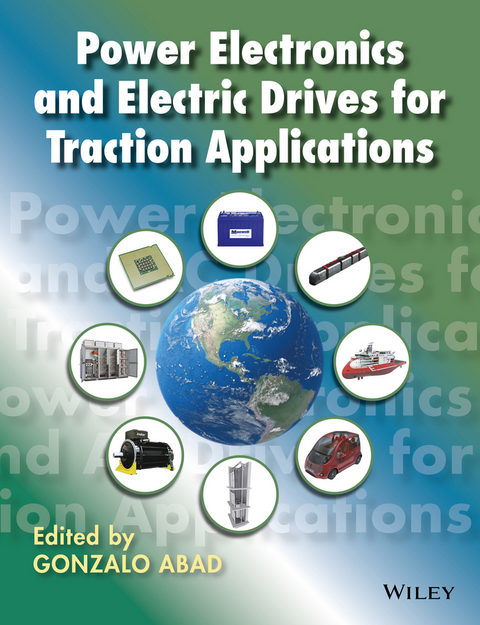
Power Electronics and Electric Drives for Traction Applications offers a practical approach to understanding power electronics applications in transportation systems ranging from railways to electric vehicles and ships. It is an application-oriented book for the design and development of traction systems accompanied by a description of the core technology.
The first four introductory chapters describe the common knowledge and background required to understand the preceding chapters. After that, each application-specific chapter: highlights the significant manufacturers involved; provides a historical account of the technological evolution experienced; distinguishes the physics and mechanics; and where possible, analyses a real life example and provides the necessary models and simulation
tools, block diagrams and simulation based validations.
Key features:
Surveys power electronics state-of-the-art in all aspects of traction applications.
Presents vital design and development knowledge that is extremely important for the professional community in an original, simple, clear and complete manner.Offers design guidelines for power electronics traction systems in high-speed rail, ships, electric/hybrid vehicles, elevators and more applications.
Application-specific chapters co-authored by traction industry expert.
Learning supplemented by tutorial sections, case studies and MATLAB/Simulink-based simulations with data from practical systems.
A valuable reference for application engineers in traction industry responsible for design and development of products as well as traction industry researchers, developers and graduate students on power electronics and motor drives needing a reference to the application examples.
Gonzalo Abad, Computing and Electronics Department, University of Mondragon, Spain
Gonzalo Abad received his degree in Electrical Engineering from the University of Mondragon in 2000, his M.Sc. degree in Advanced Control from the University of Manchester (UK) in 2001 and his Ph.D. degree in Electrical Engineering from the University of Mondragon in 2008. He joined the Electronics and Computing Department of the University of Mondragon in 2001. His main research interests include renewable energies, power conversion and motor drives. He has co-authored several papers, patents and books in the areas of wind power generation, multilevel power converters and control of AC drives.
Power Electronics and Electric Drives for Traction Applications offers a practical approach to understanding power electronics applications in transportation systems ranging from railways to electric vehicles and ships. It is an application-oriented book for the design and development of traction systems accompanied by a description of the core technology. The first four introductory chapters describe the common knowledge and background required to understand the preceding chapters. After that, each application-specific chapter: highlights the significant manufacturers involved; provides a historical account of the technological evolution experienced; distinguishes the physics and mechanics; and where possible, analyses a real life example and provides the necessary models and simulationtools, block diagrams and simulation based validations. Key features: Surveys power electronics state-of-the-art in all aspects of traction applications. Presents vital design and development knowledge that is extremely important for the professional community in an original, simple, clear and complete manner. Offers design guidelines for power electronics traction systems in high-speed rail, ships, electric/hybrid vehicles, elevators and more applications. Application-specific chapters co-authored by traction industry expert. Learning supplemented by tutorial sections, case studies and MATLAB/Simulink-based simulations with data from practical systems. A valuable reference for application engineers in traction industry responsible for design and development of products as well as traction industry researchers, developers and graduate students on power electronics and motor drives needing a reference to the application examples.
Gonzalo Abad, Computing and Electronics Department, University of Mondragon, Spain Gonzalo Abad received his degree in Electrical Engineering from the University of Mondragon in 2000, his M.Sc. degree in Advanced Control from the University of Manchester (UK) in 2001 and his Ph.D. degree in Electrical Engineering from the University of Mondragon in 2008. He joined the Electronics and Computing Department of the University of Mondragon in 2001. His main research interests include renewable energies, power conversion and motor drives. He has co-authored several papers, patents and books in the areas of wind power generation, multilevel power converters and control of AC drives.
List of contributors
Preface
1 Introduction
Gonzalo Abad
2 Control of Induction Machines
Fernando Briz and Gonzalo Abad
3 Control of Synchronous Machines
Fernando Briz and Gonzalo Abad
4 Control of Grid connected converters
Aritz Milicua and Gonzalo Abad
5 Railway traction
Xabier Agirre and Gonzalo Abad
6 Ships
Iñigo Atutxa and Gonzalo Abad
7 Electric and Hybrid vehicles
David Garrido and Gonzalo Abad
8 Elevators
Ana Escalada and Gonzalo Abad
Index
"The book shows how each drive is sized to provide the desired performance, provides real-world examples and illustrates the technology changes experienced by the drive, showing past, present and potential future technology and future trends" IEEE, July 2017
Preface
The work presented in this book offers a practical approach to electric drives. Electric drives are in charge of controlling the movement of devices or appliances that we can find in our daily lives, such as air conditioning systems, washing machines, trains, trams, ships, electric vehicles, hybrid vehicles, elevators, ventilation systems, and wind generators. Thus, the electric drive is part of the electromechanical equipment that enables, for instance, the driver of an electric vehicle to accelerate, decelerate, and maintain a constant speed—ultimately, to drive the car. In a similar way, the electric drive enables an elevator to move from one floor to another as required by its users, while maintaining certain standards of comfort, safety, efficiency, and so on.
This book describes in detail electric drives used in the following extensively used elements and devices: trains, ships, electric and hybrid vehicles, and elevators. In all these elements, and in many others, the electric drive is designed to be able to produce a controlled movement in accordance with the needs and preferences of the user. In essence, the basic electric and electronic working principles and fundamentals of the electric drive for each device are the same. However, for an optimized, safe, efficient, reliable, and comfortable. Performance, the basic fundamental electric drive concept must be adapted to each application or device.
Thus, in this book, the various characteristics of electric drives employed in the above‐mentioned applications are described, providing details of how the device itself, with its needs, defines the characteristics of the electric drive. This means, for instance, that the electric drive of a train must be prepared to receive energy from the catenary, transform this electric energy into a controlled movement of the wheels that move the wagon, being able to travel to the different speeds and accelerations required by the driver, and avoiding undesirable and dangerous slipping of the traction wheels so typical in trains.
Structurally, the electric drive is composed of three basic technologies. First, electric machine technology is an important part of the electric drive. The electric machine converts electrical energy into mechanical energy employed to move something. For instance, in an elevator, the electric motor moves the drive sheave. At the same time, this drive sheave moves ropes attached to the car to ferry passengers from floor to floor. In a similar way, the movement of a ship is carried out by the propeller, and the electric machine is in charge of generating the rotatory movement of the blades of the propeller at different speeds. Equally, in road vehicles and trains, the electric motor is in charge of controlling the rotatory movement of the driving wheels.
The power electronic converter technology is in the electric drive. The power electronic converter supplies the electric machine with the necessary electric energy, taken from the energy source. For instance, in an electric vehicle, a power electronic converter supplies the electric motor with energy, typically in AC form, converted from the batteries (the energy source) in DC form.
Third, a control strategy or control algorithm is also necessary in the electric drive. There exist different control philosophies or technologies in electric drives. The strategy controls the movement of the electric motor by sending the necessary orders to the power electronic converter, responding to the demands of the user. For instance, in a ship, the control algorithm, following a demand from the user to travel at a certain speed, controls the speed of the electric machine at a constant speed, which also moves the blades of the propeller. To this end, it sends the appropriate orders to the power electronic converter to provide the required energy to the electric machine. Note that the control must be able to employ the required energy from the energy source, no matter how much the wind is in opposition to the ship or the load it carries, or how rough or calm the sea is.
There is another element that has already been mentioned, which is the energy source. Sometimes, the electric source can be considered a part of the drive itself. This element obviously influences the design and construction of the electric drive and consequently the performance of the ship, train, elevator, and so on. For instance, in electric vehicles, the most commonly employed energy sources are batteries. Depending on the nature and characteristics of these batteries, the electric drive must be accordingly adapted, which is an important part of the global design of the drive.
To use an analogy, the propeller of a ship is like a person’s legs. The electric machine in charge of rotating the propeller to move the ship could be the heart and the nervous system. These organs provide blood and nervous stimulus to move the muscles of the legs, thus the energy source of the ship, which is often a combination of diesel engines and batteries, in the person would be the food, water, air, and so on. needed to be able to walk. The power electronic converter that converts the energy in a ship from batteries and diesel engines into electric energy for supplying the electric machine in a human could be the digestive and respiratory systems. Finally, the control system in a ship sends orders to the power electronic converter, to produce movement at the machine and therefore at the propeller. In a human the control could be the brain, which is in charge, among other things, of sending orders to the nervous system to move the legs by means of its muscles. Also, of course, there are many other technologies in electric drives which have not been highlighted, for instance, measurers or sensors of speeds, currents, voltages, etc. necessary for control. In humans, we have, for instance, a vision system, auditory system, olfactory system, etc. which are needed to send information from images, sounds, and smells to the brain to be processed.
Obviously, this comparison, like all analogies, is not perfect, but it gives an idea of the romantic parallelism between humans or animals on the one hand and devices such as vehicles, ships, elevators, and so on, which are created by humans, on the other. It is clear that animals are much more complex than the technology created by humans. Animals and humans are the result of many millions of years of evolution. However, humans started creating technology, according to some anthropologists, only around two or three millions years ago, when one of our “grandfathers”, an early hominid, discovered that braking a boulder with another boulder creates broken boulders with an edge, which is a kind of device that allowed early humans to cut meat. From that moment on, technology created by humans has evolved to very sophisticated elements of equipment, such as elevators, vehicles, ships, airplanes, robots, smartphones, rockets; unimaginable to those ancient humans.
Over millions of years, life, whether it be plant or animal, has evolved to adapt to an ever‐changing environment. In parallel, technology created by humans is also evolving, trying to adapt to the ever‐changing needs of humans. For instance, many concepts employed in shipbuilding that once were useful, even innovatory, have passed by the way, to be replaced by the modern, electrically propelled ship. In a very similar way, many species of animals have disappeared or become extinct, but they were the base or root of the species of animals today. In a similar way, in Nature we can find diversification of life, for instance falcons that can fly very fast and have developed incredibly strong eyesight share the skies with ducks that can walk and swim over the water as well as fly. And so, for instance, with trains: there are trains that specialize in travelling at high speed over long distances, others in carrying heavy and bulky loads, and yet others in travelling at low speeds through the cities, in some cases even disconnected from the catenary or energy source and travelling with the help of batteries. Moreover, there exist some types of trains which do not employ catenary or external energy sources but take their required energy from an engine that is located within the train. These types of trains are, essentially, moved by a tractive electric concept that is very similar to those employed in hybrid‐electric vehicles that travel on roads with tires. Thus, this could be understood as an adaptive approach of trains to road vehicles. In Nature, we can also find many equivalent approaches. For example, the dolphin is a mammal with the bones, digestive system, respiratory system, limbic system, social habits, and so on that are very similar to other mammals—such as humans, cows, pigs, and horses—but whose adaptation to its marine environment, and specifically its hydrodynamic requirements, has made it externally in appearance like other fishes, for instance sharks. In a similar way, bats are probably the only mammals that fly, having adapted their forelimbs to wings. Also, having the dense bones of mammals compared to those of birds, they require a huge amount of energy to sustain their flight, and so they need to eat a great many insects in relation to their weight.
In this way, it can be said that human technological developments, which evolve to survive the changing needs of societies, are living entities which adapt to the environment, adopting many different strategies. Just as flowers need to attract bees to aid their pollination and, therefore, their reproduction, elevators created by humans must be attractive to other humans in order to maintain the demand for them so that they will be produced again...
| Erscheint lt. Verlag | 13.9.2016 |
|---|---|
| Sprache | englisch |
| Themenwelt | Technik ► Elektrotechnik / Energietechnik |
| Schlagworte | AC Drives • Control • Electrical & Electronics Engineering • Elektroantrieb • Elektrotechnik u. Elektronik • Grid Connected Converters • Leistungselektronik • MATLAB • Modelling • Multilevel voltage sourse • Power Electronic Converters • Power Electronics • Power System • Traction Systems • Transportation Systems |
| ISBN-13 | 9781118954447 / 9781118954447 |
| Informationen gemäß Produktsicherheitsverordnung (GPSR) | |
| Haben Sie eine Frage zum Produkt? |
 EPUB (Adobe DRM)
Kopierschutz: Adobe-DRM
Adobe-DRM ist ein Kopierschutz, der das eBook vor Mißbrauch schützen soll. Dabei wird das eBook bereits beim Download auf Ihre persönliche Adobe-ID autorisiert. Lesen können Sie das eBook dann nur auf den Geräten, welche ebenfalls auf Ihre Adobe-ID registriert sind.
Details zum Adobe-DRM
Dateiformat: EPUB (Electronic Publication)
EPUB ist ein offener Standard für eBooks und eignet sich besonders zur Darstellung von Belletristik und Sachbüchern. Der Fließtext wird dynamisch an die Display- und Schriftgröße angepasst. Auch für mobile Lesegeräte ist EPUB daher gut geeignet.
Systemvoraussetzungen:
PC/Mac: Mit einem PC oder Mac können Sie dieses eBook lesen. Sie benötigen eine
eReader: Dieses eBook kann mit (fast) allen eBook-Readern gelesen werden. Mit dem amazon-Kindle ist es aber nicht kompatibel.
Smartphone/Tablet: Egal ob Apple oder Android, dieses eBook können Sie lesen. Sie benötigen eine
Geräteliste und zusätzliche Hinweise
Buying eBooks from abroad
For tax law reasons we can sell eBooks just within Germany and Switzerland. Regrettably we cannot fulfill eBook-orders from other countries.
aus dem Bereich