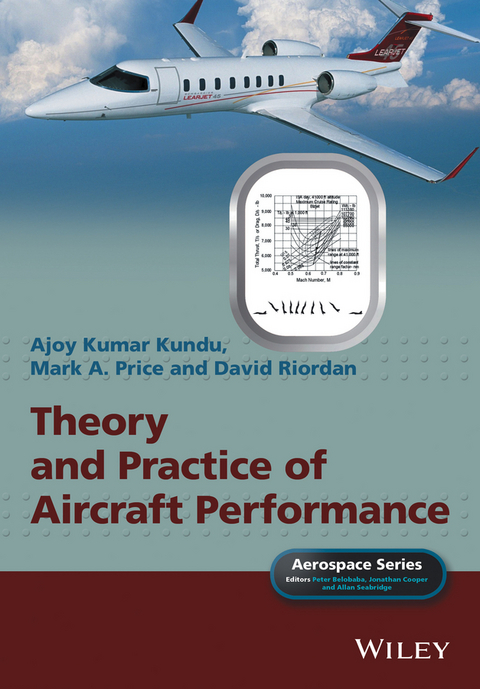
Theory and Practice of Aircraft Performance (eBook)
John Wiley & Sons (Verlag)
978-1-119-07419-9 (ISBN)
Textbook introducing the fundamentals of aircraft performance using industry standards and examples: bridging the gap between academia and industry
- Provides an extensive and detailed treatment of all segments of mission profile and overall aircraft performance
- Considers operating costs, safety, environmental and related systems issues
- Includes worked examples relating to current aircraft (Learjet 45, Tucano Turboprop Trainer, Advanced Jet Trainer and Airbus A320 types of aircraft)
- Suitable as a textbook for aircraft performance courses
Ajoy Kumar Kundu graduated with Mechanical Engineering degree from Jadavpur University, India, followed by studying in the United Kingdom (Cranfield University and Queen's University Belfast) and in the United States of America (University of Michigan and Stanford University). His professional experience spans more than thirty years in the aircraft industries and nearly 20 years in academia. In India, he was Professor at the Indian Institute of Technology, Kharagpur; and the Chief Designer at the Hindustan Aeronautics, Bangalore. In North America, he served as Research Engineer for the Boeing Aircraft Company, Renton and as Intermediate Engineer for Canadair Ltd. His aeronautical engineering career began in the United Kingdom with Short Brothers and Harland Ltd., retiring from Bombardier Aerospace-Belfast, as Assistant Chief Aerodynamicist. He is currently associated with Queen's University Belfast. He has authored the book title Aircraft Design published by Cambridge University Press. He held British, Canadian and Indian Private Pilot's License. He is a Fellow of the Royal Aeronautical Society and the Institute of Mechanical Engineers, UK.
Professor Mark Price is the Pro-Vice-Chancellor for the Faculty of Engineering and Physical Sciences at Queen's University Belfast. Formerly he was the Head of School of Mechanical and Aerospace Engineering having progressed through his academic career as a Professor of Aeronautics teaching aircraft structures and design, and leading a research team in design and manufacturing. He graduated in 1987 with a 1st Class Honours degree in Aeronautical Engineering from Queen's University Belfast before taking up a post as a stress engineer in Bombardier Aerospace. He returned later to QUB to undertake a PhD in Mechanical Engineering after which he joined TranscenData Europe as a software engineer and project manager to implement his research in their product CADFix. In 1998 he returned to QUB lecturing in aircraft structures and design. With a strong focus on design applications and integrated performance and cost models, including manufacturing processing effects in design simulations, he received the 2006 Thomas Hawksley medal from the IMechE. He has published over 200 articles and supervised 20 PhDs to completion. Mark is a Fellow of the Royal Aeronautical Society and the Institute of Mechanical Engineers, UK.
David Riordan commenced employment with Short Brothers PLC in 1978 as an Undergraduate Apprentice. He then graduated in 1982 from Queen's University Belfast, with a 1st Class Honours degree in Mechanical Engineering. In 1986 he attained an MSc in Advanced Manufacturing Technology from the Cranfield Institute of Technology, England.
David was appointed Chief Technical Engineer during 2002; in which position provides leadership at the Bombardier Belfast site for all activities associated with the technical engineering fields of aerodynamics, thermodynamics, fire safety and noise; mechanical systems, electrical systems, reliability & safety. David is also functionally responsible for the department of Airworthiness and Engineering Quality.
Responsibilities cover all products associated with Bombardier at Belfast, including metallic fuselage barrels (business jet and regional aircraft applications); composite aerostructures (including the composite wing for the Bombardier CSeries aircraft) and engine nacelles (including the complete nacelle system for the PW1400G-JM propulsion system powering the IRKUT MC-21 aircraft).
Textbook introducing the fundamentals of aircraft performance using industry standards and examples: bridging the gap between academia and industry Provides an extensive and detailed treatment of all segments of mission profile and overall aircraft performance Considers operating costs, safety, environmental and related systems issues Includes worked examples relating to current aircraft (Learjet 45, Tucano Turboprop Trainer, Advanced Jet Trainer and Airbus A320 types of aircraft) Suitable as a textbook for aircraft performance courses
Ajoy Kumar Kundu graduated with Mechanical Engineering degree from Jadavpur University, India, followed by studying in the United Kingdom (Cranfield University and Queen's University Belfast) and in the United States of America (University of Michigan and Stanford University). His professional experience spans more than thirty years in the aircraft industries and nearly 20 years in academia. In India, he was Professor at the Indian Institute of Technology, Kharagpur; and the Chief Designer at the Hindustan Aeronautics, Bangalore. In North America, he served as Research Engineer for the Boeing Aircraft Company, Renton and as Intermediate Engineer for Canadair Ltd. His aeronautical engineering career began in the United Kingdom with Short Brothers and Harland Ltd., retiring from Bombardier Aerospace-Belfast, as Assistant Chief Aerodynamicist. He is currently associated with Queen's University Belfast. He has authored the book title Aircraft Design published by Cambridge University Press. He held British, Canadian and Indian Private Pilot's License. He is a Fellow of the Royal Aeronautical Society and the Institute of Mechanical Engineers, UK. Professor Mark Price is the Pro-Vice-Chancellor for the Faculty of Engineering and Physical Sciences at Queen's University Belfast. Formerly he was the Head of School of Mechanical and Aerospace Engineering having progressed through his academic career as a Professor of Aeronautics teaching aircraft structures and design, and leading a research team in design and manufacturing. He graduated in 1987 with a 1st Class Honours degree in Aeronautical Engineering from Queen's University Belfast before taking up a post as a stress engineer in Bombardier Aerospace. He returned later to QUB to undertake a PhD in Mechanical Engineering after which he joined TranscenData Europe as a software engineer and project manager to implement his research in their product CADFix. In 1998 he returned to QUB lecturing in aircraft structures and design. With a strong focus on design applications and integrated performance and cost models, including manufacturing processing effects in design simulations, he received the 2006 Thomas Hawksley medal from the IMechE. He has published over 200 articles and supervised 20 PhDs to completion. Mark is a Fellow of the Royal Aeronautical Society and the Institute of Mechanical Engineers, UK. David Riordan commenced employment with Short Brothers PLC in 1978 as an Undergraduate Apprentice. He then graduated in 1982 from Queen's University Belfast, with a 1st Class Honours degree in Mechanical Engineering. In 1986 he attained an MSc in Advanced Manufacturing Technology from the Cranfield Institute of Technology, England. David was appointed Chief Technical Engineer during 2002; in which position provides leadership at the Bombardier Belfast site for all activities associated with the technical engineering fields of aerodynamics, thermodynamics, fire safety and noise; mechanical systems, electrical systems, reliability & safety. David is also functionally responsible for the department of Airworthiness and Engineering Quality. Responsibilities cover all products associated with Bombardier at Belfast, including metallic fuselage barrels (business jet and regional aircraft applications); composite aerostructures (including the composite wing for the Bombardier CSeries aircraft) and engine nacelles (including the complete nacelle system for the PW1400G-JM propulsion system powering the IRKUT MC-21 aircraft).
Title Page 5
Copyright Page 6
Contents 7
Preface 21
Series Preface 23
Road Map of the Book 25
Acknowledgements 29
Nomenclature 33
Chapter 1 Introduction 43
1.1 Overview 43
1.2 Brief Historical Background 43
1.2.1 Flight in Mythology 43
1.2.2 Fifteenth to Nineteenth Centuries 43
1.2.3 From 1900 to World War I (1914) 45
1.2.4 World War I (1914–1918) 46
1.2.5 The Inter-War Period: the Golden Age (1918–1939) 49
1.2.6 World War II (1939–1945) 49
1.2.7 Post World War II 50
1.3 Current Aircraft Design Status 50
1.3.1 Current Civil Aircraft Trends 51
1.3.2 Current Military Aircraft Trends 52
1.4 Future Trends 53
1.4.1 Trends in Civil Aircraft 53
1.4.2 Trends in Military Aircraft 55
1.4.3 Forces and Drivers 56
1.5 Airworthiness Requirements 56
1.6 Current Aircraft Performance Analyses Levels 58
1.7 Market Survey 59
1.8 Typical Design Process 61
1.8.1 Four Phases of Aircraft Design 61
1.9 Classroom Learning Process 65
1.10 Cost Implications 67
1.11 Units and Dimensions 68
1.12 Use of Semi?empirical Relations and Graphs 68
1.13 How Do Aircraft Fly? 68
1.13.1 Classification of Flight Mechanics 69
1.14 Anatomy of Aircraft 69
1.14.1 Comparison between Civil and Military Design Requirements 72
1.15 Aircraft Motion and Forces 72
1.15.1 Motion – Kinematics 73
1.15.2 Forces – Kinetics 75
1.15.3 Aerodynamic Parameters – Lift, Drag and Pitching Moment 76
1.15.4 Basic Controls – Sign Convention 76
References 78
Chapter 2 Aerodynamic and Aircraft Design Considerations 79
2.1 Overview 79
2.2 Introduction 79
2.3 Atmosphere 81
2.3.1 Hydrostatic Equations and Standard Atmosphere 81
2.3.2 Non-standard/Off-standard Atmosphere 89
2.3.3 Altitude Definitions – Density Altitude (Off?standard) 90
2.3.4 Humidity Effects 92
2.3.5 Greenhouse Gases Effect 92
2.4 Airflow Behaviour: Laminar and Turbulent 93
2.4.1 Flow Past an Aerofoil 97
2.5 Aerofoil 98
2.5.1 Subsonic Aerofoil 99
2.5.2 Supersonic Aerofoil 106
2.6 Generation of Lift 106
2.6.1 Centre of Pressure and Aerodynamic Centre 108
2.6.2 Relation between Centre of Pressure and Aerodynamic Centre 110
2.7 Types of Stall 113
2.7.1 Buffet 113
2.8 Comparison of Three NACA Aerofoils 114
2.9 High-Lift Devices 115
2.10 Transonic Effects – Area Rule 116
2.10.1 Compressibility Correction 117
2.11 Wing Aerodynamics 118
2.11.1 Induced Drag and Total Aircraft Drag 121
2.12 Aspect Ratio Correction of 2D-Aerofoil Characteristics for 3D-Finite Wing 121
2.13 Wing Definitions 123
2.13.1 Planform Area, SW 123
2.13.2 Wing Aspect Ratio 124
2.13.3 Wing-Sweep Angle 124
2.13.4 Wing Root (croot) and Tip (ctip) Chords 124
2.13.5 Wing-Taper Ratio, ? 124
2.13.6 Wing Twist 124
2.13.7 High/Low Wing 125
2.13.8 Dihedral/Anhedral Angles 125
2.14 Mean Aerodynamic Chord 126
2.15 Compressibility Effect: Wing Sweep 128
2.16 Wing-Stall Pattern and Wing Twist 129
2.17 Influence of Wing Area and Span on Aerodynamics 130
2.17.1 The Square-Cube Law 130
2.17.2 Aircraft Wetted Area (AW) versus Wing Planform Area (SW) 131
2.17.3 Additional Wing Surface Vortex Lift – Strake/Canard 132
2.17.4 Additional Surfaces on Wing – Flaps/Slats and High?Lift Devices 133
2.17.5 Other Additional Surfaces on Wing 133
2.18 Empennage 134
2.18.1 Tail-arm 137
2.18.2 Horizontal Tail (H-Tail) 137
2.18.3 Vertical Tail (V-Tail) 138
2.18.4 Tail-Volume Coefficients 138
2.19 Fuselage 140
2.19.1 Fuselage Axis/Zero-Reference Plane 140
2.19.2 Fuselage Length, Lfus 140
2.19.3 Fineness Ratio, FR 141
2.19.4 Fuselage Upsweep Angle 141
2.19.5 Fuselage Closure Angle 141
2.19.6 Front Fuselage Closure Length, Lf 141
2.19.7 Aft Fuselage Closure Length, La 141
2.19.8 Mid-Fuselage Constant Cross-Section Length, Lm 141
2.19.9 Fuselage Height, H 141
2.19.10 Fuselage Width, W 142
2.19.11 Average Diameter, Dave 142
2.20 Nacelle and Intake 142
2.20.1 Large Commercial/Military Logistic and Old Bombers Nacelle Group 143
2.20.2 Small Civil Aircraft Nacelle Position 145
2.20.3 Intake/Nacelle Group (Military Aircraft) 146
2.20.4 Futuristic Aircraft Nacelle Positions 148
2.21 Speed Brakes and Dive Brakes 148
References 148
Chapter 3 Air Data Measuring Instruments, Systems and Parameters 151
3.1 Overview 151
3.2 Introduction 151
3.3 Aircraft Speed 152
3.3.1 Definitions Related to Aircraft Velocity 153
3.3.2 Theory Related to Computing Aircraft Velocity 154
3.3.3 Aircraft Speed in Flight Deck Instruments 158
3.3.4 Atmosphere with Wind Speed (Non-zero Wind) 159
3.3.5 Calibrated Airspeed 160
3.3.6 Compressibility Correction (?Vc ) 162
3.3.7 Other Position Error Corrections 164
3.4 Air Data Instruments 164
3.4.1 Altitude Measurement – Altimeter 165
3.4.2 Airspeed Measuring Instrument – Pitot-Static Tube 167
3.4.3 Angle-of-Attack Probe 168
3.4.4 Vertical Speed Indicator 168
3.4.5 Temperature Measurement 169
3.4.6 Turn-Slip Indicator 169
3.5 Aircraft Flight-Deck (Cockpit) Layout 170
3.5.1 Multifunctional Displays and Electronic Flight Information Systems 171
3.5.2 Combat Aircraft Flight Deck 173
3.5.3 Head-Up Display (HUD) 174
3.6 Aircraft Mass (Weights) and Centre of Gravity 175
3.6.1 Aircraft Mass (Weights) Breakdown 175
3.6.2 Desirable CG Position 176
3.6.3 Weights Summary – Civil Aircraft 178
3.6.4 CG Determination – Civil Aircraft 179
3.6.5 Bizjet Aircraft CG Location – Classroom Example 180
3.6.6 Weights Summary – Military Aircraft 180
3.6.7 CG Determination – Military Aircraft 180
3.6.8 Classroom Worked Example – Military AJT CG Location 180
3.7 Noise Emissions 183
3.7.1 Airworthiness Requirements 184
3.7.2 Summary 187
3.8 Engine-Exhaust Emissions 187
3.9 Aircraft Systems 188
3.9.1 Aircraft Control System 188
3.9.2 ECS: Cabin Pressurization and Air?Conditioning 190
3.9.3 Oxygen Supply 191
3.9.4 Anti-icing, De-icing, Defogging and Rain Removal System 191
3.10 Low Observable (LO) Aircraft Configuration 192
3.10.1 Heat Signature 192
3.10.2 Radar Signature 192
References 194
Chapter 4 Equations of Motion for a Flat Stationary Earth 195
4.1 Overview 195
4.2 Introduction 196
4.3 Definitions of Frames of Reference (Flat Stationary?E?arth) and Nomenclature Used 196
4.3.1 Notation and Symbols Used in this Chapter 199
4.4 Eulerian Angles 200
4.4.1 Transformation of?Eulerian Angles 201
4.5 Simplified Equations of Motion for a Flat Stationary Earth 203
4.5.1 Important Aerodynamic Angles 203
4.5.2 In Pitch Plane (Vertical XZ Plane) 204
4.5.3 In Yaw Plane (Horizontal Plane) – Coordinated Turn 206
4.5.4 In Pitch-Yaw Plane – Coordinated Climb-Turn (Helical Trajectory) 207
4.5.5 Discussion on Turn 208
Reference 209
Chapter 5 Aircraft Load 211
5.1 Overview 211
5.2 Introduction 211
5.2.1 Buffet 212
5.2.2 Flutter 212
5.3 Flight Manoeuvres 213
5.3.1 Pitch Plane (X-Z) Manoeuvre 213
5.3.2 Roll Plane (Y-Z) Manoeuvre 213
5.3.3 Yaw Plane (Y-X) Manoeuvre 213
5.4 Aircraft Loads 213
5.5 Theory and Definitions 214
5.5.1 Load Factor, n 214
5.6 Limits – Loads and Speeds 215
5.6.1 Maximum Limit of Load Factor 216
5.7 V-n Diagram 216
5.7.1 Speed Limits 217
5.7.2 Extreme Points of the V-n Diagram 217
5.7.3 Low Speed Limit 219
5.7.4 Manoeuvre Envelope Construction 220
5.7.5 High Speed Limit 221
5.8 Gust Envelope 221
5.8.1 Gust Load Equations 222
5.8.2 Gust Envelope Construction 224
Reference 225
Chapter 6 Stability Considerations Affecting Aircraft Performance 227
6.1 Overview 227
6.2 Introduction 227
6.3 Static and Dynamic Stability 228
6.3.1 Longitudinal Stability – Pitch Plane (Pitch Moment, M?) 230
6.3.2 Directional Stability – Yaw Plane (Yaw Moment, N) 230
6.3.3 Lateral Stability – Roll Plane (Roll Moment, L) 231
6.4 Theory 234
6.4.1 Pitch Plane 234
6.4.2 Yaw Plane 237
6.4.3 Roll Plane 238
6.5 Current Statistical Trends for Horizontal and Vertical Tail Coefficients 239
6.6 Inherent Aircraft Motions as Characteristics of Design 240
6.6.1 Short-Period Oscillation and Phugoid Motion 240
6.6.2 Directional/Lateral Modes of Motion 242
6.7 Spinning 244
6.8 Summary of Design Considerations for Stability 245
6.8.1 Civil Aircraft 245
6.8.2 Military Aircraft – Non-linear Effects 246
6.8.3 Active Control Technology (ACT) – Fly-by-Wire 247
References 249
Chapter 7 Aircraft Power Plant and Integration 251
7.1 Overview 251
7.2 Background 251
7.3 Definitions 256
7.4 Air-Breathing Aircraft Engine Types 257
7.4.1 Simple Straight-through Turbojets 257
7.4.2 Turbofan – Bypass Engine 258
7.4.3 Afterburner Jet Engines 258
7.4.4 Turboprop Engines 260
7.4.5 Piston Engines 260
7.5 Simplified Representation of Gas Turbine (Brayton/Joule) Cycle 261
7.6 Formulation/Theory – Isentropic Case 263
7.6.1 Simple Straight-through Turbojets 263
7.6.2 Bypass Turbofan Engines 264
7.6.3 Afterburner Jet Engines 266
7.6.4 Turboprop Engines 268
7.7 Engine Integration to Aircraft – Installation Effects 268
7.7.1 Subsonic Civil Aircraft Nacelle and Engine Installation 269
7.7.2 Turboprop Integration to Aircraft 271
7.7.3 Combat Aircraft Engine Installation 272
7.8 Intake/Nozzle Design 273
7.8.1 Civil Aircraft Intake Design 273
7.8.2 Military Aircraft Intake Design 274
7.9 Exhaust Nozzle and Thrust Reverser 275
7.9.1 Civil Aircraft Exhaust Nozzles 275
7.9.2 Military Aircraft?TR?Application and Exhaust Nozzles 275
7.10 Propeller 276
7.10.1 Propeller-Related Definitions 278
7.10.2 Propeller Theory 279
7.10.3 Propeller Performance – Practical Engineering Applications 285
7.10.4 Propeller Performance – Three- to Four-Bladed 288
References 288
Chapter 8 Aircraft Power Plant Performance 289
8.1 Overview 289
8.2 Introduction 290
8.2.1 Engine Performance Ratings 290
8.2.2 Turbofan Engine Parameters 291
8.3 Uninstalled Turbofan Engine Performance Data – Civil Aircraft 292
8.3.1 Turbofans with BPR around 4 294
8.3.2 Turbofans with BPR around 5–6 294
8.4 Uninstalled Turbofan Engine Performance Data – Military Aircraft 296
8.5 Uninstalled Turboprop Engine Performance Data 297
8.5.1 Typical Turboprop Performance 299
8.6 Installed Engine Performance Data of Matched Engines to Coursework Aircraft 299
8.6.1 Turbofan Engine (Smaller Engines for Bizjets – BPR ? 4) 299
8.6.2 Turbofans with BPR around 5–6 (Larger Jets) 302
8.6.3 Military Turbofan (Very Low BPR) 302
8.7 Installed Turboprop Performance Data 303
8.7.1 Typical Turboprop Performance 303
8.7.2 Propeller Performance – Worked Example 304
8.8 Piston Engine 306
8.9 Engine Performance Grid 309
8.9.1 Installed Maximum Climb Rating (TFE 731-20 Class Turbofan) 311
8.9.2 Maximum Cruise Rating (TFE731-20 Class Turbofan) 312
8.10 Some Turbofan Data 314
Reference 315
Chapter 9 Aircraft Drag 317
9.1 Overview 317
9.2 Introduction 317
9.3 Parasite Drag Definition 319
9.4 Aircraft Drag Breakdown (Subsonic) 320
9.5 Aircraft Drag Formulation 321
9.6 Aircraft Drag Estimation Methodology 323
9.7 Minimum Parasite Drag Estimation Methodology 323
9.7.1 Geometric Parameters, Reynolds Number and Basic CF Determination 324
9.7.2 Computation of Wetted Area 325
9.7.3 Stepwise Approach to Computing Minimum Parasite Drag 325
9.8 Semi-Empirical Relations to Estimate Aircraft Component Parasite Drag 326
9.8.1 Fuselage 326
9.8.2 Wing, Empennage, Pylons and Winglets 329
9.8.3 Nacelle Drag 331
9.8.4 Excrescence Drag 335
9.8.5 Miscellaneous Parasite Drags 336
9.9 Notes on Excrescence Drag Resulting from Surface Imperfections 337
9.10 Minimum Parasite Drag 338
9.11 ?CDp Estimation 338
9.12 Subsonic Wave Drag 338
9.13 Total Aircraft Drag 340
9.14 Low-Speed Aircraft Drag at Takeoff and Landing 340
9.14.1 High-Lift Device Drag 340
9.14.2 Dive Brakes and Spoilers Drag 344
9.14.3 Undercarriage Drag 344
9.14.4 One-Engine Inoperative Drag 345
9.15 Propeller-Driven Aircraft Drag 346
9.16 Military Aircraft Drag 346
9.17 Supersonic Drag 347
9.18 Coursework Example – Civil Bizjet Aircraft 348
9.18.1 Geometric and Performance Data 348
9.18.2 Computation of Wetted Areas, Re and Basic CF 351
9.18.3 Computation of 3D and Other Effects 352
9.18.4 Summary of Parasite Drag 356
9.18.5 ?CDp Estimation 356
9.18.6 Induced Drag 356
9.18.7 Total Aircraft Drag at LRC 356
9.19 Classroom Example – Subsonic Military Aircraft (Advanced Jet Trainer) 357
9.19.1 AJT Specifications 359
9.19.2 CAS Variant Specifications 360
9.19.3 Weights 361
9.19.4 AJT Details 361
9.20 Classroom Example – Turboprop Trainer 361
9.20.1 TPT Specification 362
9.20.2 TPT Details 363
9.20.3 Component Parasite Drag Estimation 364
9.21 Classroom Example – Supersonic Military Aircraft 367
9.21.1 Geometric and Performance Data for the Vigilante RA-C5 Aircraft 367
9.21.2 Computation of Wetted Areas, Re and Basic CF 368
9.21.3 Computation of 3D and Other Effects to Estimate Component CDpmin 369
9.21.4 Summary of Parasite Drag 371
9.21.5 ?CDp Estimation 371
9.21.6 Induced Drag 372
9.21.7 Supersonic Drag Estimation 372
9.21.8 Total Aircraft Drag 374
9.22 Drag Comparison 374
9.23 Some Concluding Remarks and Reference Figures 376
References 380
Chapter 10 Fundamentals of Mission Profile, Drag Polar and Aeroplane Grid 381
10.1 Overview 381
10.2 Introduction 382
10.2.1 Evolution in Aircraft Performance Capabilities 383
10.2.2 Levels of Aircraft Performance Analyses 384
10.3 Civil Aircraft Mission (Payload–Range) 384
10.3.1 Civil Aircraft Classification and Mission Segments 386
10.4 Military Aircraft Mission 387
10.4.1 Military Aircraft Performance Segments 389
10.5 Aircraft Flight Envelope 391
10.6 Understanding Drag Polar 393
10.6.1 Actual Drag Polar 393
10.6.2 Parabolic Drag Polar 393
10.6.3 Comparison between Actual and Parabolic Drag Polar 394
10.7 Properties of Parabolic Drag Polar 396
10.7.1 The Maximum and Minimum Conditions Applicable to Parabolic Drag Polar 396
10.7.2 Propeller-Driven Aircraft 401
10.8 Classwork Examples of Parabolic Drag Polar 405
10.8.1 Bizjet Market Specifications 405
10.8.2 Turboprop Trainer Specifications 405
10.8.3 Advanced Jet Trainer Specifications 407
10.8.4 Comparison of Drag Polars 408
10.9 Bizjet Actual Drag Polar 408
10.9.1 Comparing Actual with Parabolic Drag Polar 409
10.9.2 (Lift/Drag) and (Mach?×?Lift/Drag) Ratios 410
10.9.3 Velocity at Minimum (D/V) 411
10.9.4 (Lift/Drag)max, CL?@?(L/D)max and VDmin 411
10.9.5 Turboprop Trainer (TPT) Example – Parabolic Drag Polar 412
10.9.6 TPT (Lift/Drag)max, CL@(L/D)max and VDmin 412
10.9.7 TPT (ESHP)min_reqd and VPmin 413
10.9.8 Summary for TPT 414
10.10 Aircraft and Engine Grid 414
10.10.1 Aircraft and Engine Grid (Jet Aircraft) 415
10.10.2 Classwork Example – Bizjet Aircraft and Engine Grid 416
10.10.3 Aircraft and Engine Grid (Turboprop Trainer) 418
References 420
Chapter 11 Takeoff and Landing 421
11.1 Overview 421
11.2 Introduction 422
11.3 Airfield Definitions 422
11.3.1 Stopway (SWY) and Clearway (CWY) 423
11.3.2 Available Airfield Definitions 424
11.3.3 Actual Field Length Definitions 425
11.4 Generalized Takeoff Equations of Motion 426
11.4.1 Ground Run Distance 428
11.4.2 Time Taken for the Ground Run SG 430
11.4.3 Flare Distance and Time Taken from VR?to V2 430
11.4.4 Ground Effect 431
11.5 Friction – Wheel Rolling and Braking Friction Coefficients 431
11.6 Civil Transport Aircraft Takeoff 433
11.6.1 Civil Aircraft Takeoff Segments 433
11.6.2 Balanced Field Length (BFL) – Civil Aircraft 437
11.6.3 Flare to 35 ft?Height (Average Speed Method) 438
11.7 Worked Example – Bizjet 438
11.7.1 All-Engine Takeoff 440
11.7.2 Flare from VR?to V2 440
11.7.3 Balanced Field Takeoff – One Engine Inoperative 441
11.8 Takeoff Presentation 446
11.8.1 Weight, Altitude and Temperature Limits 447
11.9 Military Aircraft Takeoff 447
11.10 Checking Takeoff Field Length (AJT) 448
11.10.1 AJT?Aircraft and Aerodynamic Data 448
11.10.2 Takeoff with 8° Flap 450
11.11 Civil Transport Aircraft Landing 451
11.11.1 Airfield Definitions 451
11.11.2 Landing Performance Equations 454
11.11.3 Landing Field Length for the Bizjet 456
11.11.4 Landing Field Length for the AJT 458
11.12 Landing Presentation 459
11.13 Approach Climb and Landing Climb 460
11.14 Fuel Jettisoning 460
References 460
Chapter 12 Climb and Descent Performance 461
12.1 Overview 461
12.2 Introduction 462
12.2.1 Cabin Pressurization 463
12.2.2 Aircraft Ceiling 463
12.3 Climb Performance 464
12.3.1 Climb Performance Equations of Motion 465
12.3.2 Accelerated Climb 465
12.3.3 Constant EAS?Climb 467
12.3.4 Constant Mach Climb 469
12.3.5 Unaccelerated Climb 470
12.4 Other Ways to Climb (Point Performance) – Civil Aircraft 470
12.4.1 Maximum Rate of Climb and Maximum Climb Gradient 470
12.4.2 Steepest Climb 474
12.4.3 Economic Climb at Constant EAS 475
12.4.4 Discussion on Climb Performance 476
12.5 Classwork Example – Climb Performance (Bizjet) 477
12.5.1 Takeoff Segments Climb Performance (Bizjet) 477
12.5.2 En-Route Climb Performance (Bizjet) 481
12.5.3 Bizjet Climb Schedule 482
12.6 Hodograph Plot 482
12.6.1 Aircraft Ceiling 485
12.7 Worked Example – Bizjet 485
12.7.1 Bizjet Climb Rate at Normal Climb Speed Schedule 485
12.7.2 Rate of Climb Performance versus Altitude 486
12.7.3 Bizjet Ceiling 486
12.8 Integrated Climb Performance – Computational Methodology 486
12.8.1 Worked Example – Initial En-Route Rate of Climb (Bizjet) 488
12.8.2 Integrated Climb Performance (Bizjet) 489
12.8.3 Turboprop Trainer Aircraft (TPT) 489
12.9 Specific Excess Power (SEP) – High-Energy Climb 489
12.9.1 Specific Excess Power Characteristics 492
12.9.2 Worked Example of SEP Characteristics (Bizjet) 492
12.9.3 Example of AJT 495
12.9.4 Supersonic Aircraft 495
12.10 Descent Performance 496
12.10.1 Glide 499
12.10.2 Descent Properties 500
12.10.3 Selection of Descent Speed 500
12.11 Worked Example – Descent Performance (Bizjet) 501
12.11.1 Limitation of Maximum Descent Rate 502
References 504
Chapter 13 Cruise Performance and Endurance 505
13.1 Overview 505
13.2 Introduction 506
13.2.1 Definitions 507
13.3: Equations of Motion for the Cruise Segment 508
13.4 Cruise Equations 508
13.4.1 Propeller-Driven Aircraft Cruise Equations 509
13.4.2 Jet Engine Aircraft Cruise Equations 511
13.5 Specific Range 512
13.6 Worked Example (Bizjet) 513
13.6.1 Aircraft and Engine Grid at Cruise Rating 513
13.6.2 Specific Range Using Actual Drag Polar 513
13.6.3 Specific Range and Range Factor 515
13.7 Endurance Equations 520
13.7.1 Propeller-Driven (Turboprop) Aircraft 521
13.7.2 Turbofan Powered Aircraft 522
13.8 Options for Cruise Segment (Turbofan Only) 523
13.9 Initial Maximum Cruise Speed (Bizjet) 529
13.10 Worked Example of AJT – Military Aircraft 530
13.10.1 To Compute the AJT Fuel Requirement 530
13.10.2 To Check Maximum Speed 530
References 531
Chapter 14 Aircraft Mission Profile 533
14.1 Overview 533
14.2 Introduction 534
14.3 Payload-Range Capability 535
14.3.1 Reserve Fuel 535
14.4 The?Bizjet Payload-Range Capability 537
14.4.1 Long-Range Cruise (LRC) at Constant Altitude 538
14.4.2 High-Speed Cruise (HSC) at Constant Altitude and Speed 542
14.4.3 Discussion on Cruise Segment 543
14.5 Endurance (Bizjet) 544
14.6 Effect of Wind on Aircraft Mission Performance 544
14.7 Engine Inoperative Situation at Climb and Cruise – Drift-Down Procedure 545
14.7.1 Engine Inoperative Situation at Climb 545
14.7.2 Engine Inoperative Situation at Cruise (Figure 14.5) 546
14.7.3 Point of No-Return and Equal Time Point 547
14.7.4 Engine Data 547
14.7.5 Drift-Down in Cruise 547
14.8 Military Missions 548
14.8.1 Military Training Mission Profile – Advanced Jet Trainer (AJT) 548
14.9 Flight Planning by the Operators 549
References 550
Chapter 15 Manoeuvre Performance 551
15.1 Overview 551
15.2 Introduction 551
15.3 Aircraft Turn 552
15.3.1 In Horizontal (Yaw) Plane – Sustained Coordinated Turn 552
15.3.2 Maximum Conditions for Turn in Horizontal Plane 558
15.3.3 Minimum Radius of Turn in Horizontal Plane 559
15.3.4 Turning in Vertical (Pitch) Plane 559
15.3.5 In Pitch-Yaw Plane – Climbing Turn in Helical Path 561
15.4 Classwork Example –?AJT 562
15.5 Aerobatics Manoeuvre 564
15.5.1 Lazy-8 in Horizontal Plane 565
15.5.2 Chandelle 566
15.5.3 Slow Roll 566
15.5.4 Hesitation Roll 566
15.5.5 Barrel Roll 567
15.5.6 Loop in Vertical Plane 567
15.5.7 Immelmann – Roll at the Top in the Vertical Plane 568
15.5.8 Stall Turn in Vertical Plane 569
15.5.9 Cuban-Eight in Vertical Plane 569
15.5.10 Pugachev’s Cobra Movement 570
15.6 Combat Manoeuvre 570
15.6.1 Basic Fighter Manoeuvre 570
15.7 Discussion on Turn 572
References 573
Chapter 16 Aircraft Sizing and Engine Matching 575
16.1 Overview 575
16.2 Introduction 576
16.3 Theory 577
16.3.1 Sizing for Takeoff Field Length – Two Engines 578
16.3.2 Sizing for the Initial Rate of Climb (All Engines Operating) 581
16.3.3 Sizing to Meet Initial Cruise 582
16.3.4 Sizing for Landing Distance 582
16.4 Coursework Exercises: Civil Aircraft Design (Bizjet) 583
16.4.1 Takeoff 583
16.4.2 Initial Climb 584
16.4.3 Cruise 584
16.4.4 Landing 585
16.5 Sizing Analysis: Civil Aircraft (Bizjet) 585
16.5.1 Variants in the Family of Aircraft Design 586
16.5.2 Example: Civil Aircraft 587
16.6 Classroom Exercise – Military Aircraft (AJT) 588
16.6.1 Takeoff 588
16.6.2 Initial Climb 588
16.6.3 Cruise 589
16.6.4 Landing 590
16.6.5 Sizing for Turn Requirement of 4?g at Sea-Level 590
16.7 Sizing Analysis – Military Aircraft 593
16.7.1 Single Seat Variants 594
16.8 Aircraft Sizing Studies and Sensitivity Analyses 595
16.8.1 Civil Aircraft Sizing Studies 595
16.8.2 Military Aircraft Sizing Studies 596
16.9 Discussion 596
16.9.1 The AJT 599
References 600
Chapter 17 Operating Costs 601
17.1 Overview 601
17.2 Introduction 602
17.3 Aircraft Cost and Operational Cost 603
17.3.1 Manufacturing Cost 605
17.3.2 Operating Cost 607
17.4 Aircraft Direct Operating Cost (DOC) 609
17.4.1 Formulation to Estimate DOC 611
17.4.2 Worked Example of DOC?– Bizjet 613
17.5 Aircraft Performance Management (APM) 616
17.5.1 Methodology 618
17.5.2 Discussion – the Broader Issues 619
References 619
Chapter 18 Miscellaneous Considerations 621
18.1 Overview 621
18.2 Introduction 621
18.3 History of the FAA 622
18.3.1 Code of Federal Regulations 624
18.3.2 The Role of Regulation 624
18.4 Flight Test 625
18.5 Contribution of the Ground Effect on Takeoff 627
18.6 Flying in Adverse Environments 628
18.6.1 Adverse Environment as Loss of Visibility 628
18.6.2 Adverse Environment Due to Aerodynamic and Stability/Control Degradation 629
18.7 Bird Strikes 632
18.8 Military Aircraft Flying Hazards and Survivability 633
18.9 Relevant Civil Aircraft Statistics 633
18.9.1 Maximum Takeoff Mass versus Operational Empty Mass 633
18.9.2 MTOM versus Fuel Load, Mf 634
18.9.3 MTOM versus Wing Area, SW 635
18.9.4 MTOM versus Engine Power 636
18.9.5 Empennage Area versus Wing Area 637
18.9.6 Wing Loading versus Aircraft Span 639
18.10 Extended Twin-Engine Operation (ETOP) 639
18.11 Flight and Human Physiology 640
References 641
Appendex A Conversions 643
Appendex B International Standard Atmosphere Table 647
Appendex C Fundamental Equations 651
C.1 Kinetics 651
C.2 Thermodynamics 652
C.3 Aerodynamics 653
C.3.1 Normal Shock 653
C.3.2 Oblique Shock 654
Appendex D Airbus 320 Class Case Study 657
D.1 Dimensions 657
D.2 Drag Computation 658
D.2.1 Fuselage 658
D.2.2 Wing 659
D.2.3 Vertical Tail 659
D.2.4 Horizontal Tail 660
D.2.5 Nacelle, CFn 660
D.2.6 Thrust Reverser Drag 661
D.2.7 Pylon 661
D.2.8 Roughness Effect 661
D.2.9 Trim Drag 661
D.2.10 Aerial and Other Protrusions 662
D.2.11 Air-conditioning 662
D.2.12 Aircraft Parasite Drag Build-Up Summary and CDpmin 662
D.2.13 ?CDp Estimation 662
D.2.14 Induced Drag, CDi 662
D.2.15 Total Aircraft Drag 663
D.2.16 Engine Rating 663
D.2.17 Weights Breakdown 663
D.2.18 Payload-Range 664
D.2.19 Cost Calculations 666
Appendex E Problem Sets 669
E.1 The Belfast (B100) 669
E.1.1 Geometric and Performance Data 669
E.1.2 The B100 Component Weights 670
E.2 The AK4 672
E.2.1 Geometric and Performance Data 672
E.2.2 The AK4 Component Weights 673
E.2.3 Drag Coefficient at 5000 ft Altitude 675
E.3 Problem Assignments 676
E.3.1 Chapter 1 676
E.3.2 Chapter 2 676
E.3.3 Chapter 3 678
E.3.4 Chapters 4 and 5 679
E.3.5 Chapter 6 680
E.3.6 Chapters 7 and 8 680
E.3.7 Chapter 9 681
E.3.8 Chapter 10 682
E.3.9 Chapter 11 682
E.3.10 Chapter 12 684
E.3.11 Chapter 13 684
E.3.12 Chapter 14 685
E.3.13 Chapter 15 686
E.3.14 Chapters 16–17 687
Appendex F Aerofoil Data 689
Index 697
EULA 707
| Erscheint lt. Verlag | 2.9.2016 |
|---|---|
| Reihe/Serie | Aerospace Series |
| Aerospace Series (PEP) | Aerospace Series (PEP) |
| Sprache | englisch |
| Themenwelt | Technik ► Fahrzeugbau / Schiffbau |
| Technik ► Luft- / Raumfahrttechnik | |
| Technik ► Maschinenbau | |
| Schlagworte | aerodynamic • Aeronautic & Aerospace Engineering • aerospace engineering</p> • aerospace industry standards • aerospace textbook • Aircraft • aircraft design • air data • Applied Mathematics in Engineering • Applied Mathmatics in Engineering • Betriebswirtschaft u. Operationsforschung • Business & Management • Equations of motion • flight drag • Flight Performance • flight stability • fundamentals • <p>Aircraft Performance • Luft- u. Raumfahrttechnik • Management Science/Operational Research • Maschinenbau • Mathematics • Mathematik • Mathematik in den Ingenieurwissenschaften • mechanical engineering • systems parameters • Wirtschaft u. Management |
| ISBN-10 | 1-119-07419-3 / 1119074193 |
| ISBN-13 | 978-1-119-07419-9 / 9781119074199 |
| Informationen gemäß Produktsicherheitsverordnung (GPSR) | |
| Haben Sie eine Frage zum Produkt? |
 PDF (Adobe DRM)
Kopierschutz: Adobe-DRM
Adobe-DRM ist ein Kopierschutz, der das eBook vor Mißbrauch schützen soll. Dabei wird das eBook bereits beim Download auf Ihre persönliche Adobe-ID autorisiert. Lesen können Sie das eBook dann nur auf den Geräten, welche ebenfalls auf Ihre Adobe-ID registriert sind.
Details zum Adobe-DRM
Dateiformat: PDF (Portable Document Format)
Mit einem festen Seitenlayout eignet sich die PDF besonders für Fachbücher mit Spalten, Tabellen und Abbildungen. Eine PDF kann auf fast allen Geräten angezeigt werden, ist aber für kleine Displays (Smartphone, eReader) nur eingeschränkt geeignet.
Systemvoraussetzungen:
PC/Mac: Mit einem PC oder Mac können Sie dieses eBook lesen. Sie benötigen eine
eReader: Dieses eBook kann mit (fast) allen eBook-Readern gelesen werden. Mit dem amazon-Kindle ist es aber nicht kompatibel.
Smartphone/Tablet: Egal ob Apple oder Android, dieses eBook können Sie lesen. Sie benötigen eine
Geräteliste und zusätzliche Hinweise
Buying eBooks from abroad
For tax law reasons we can sell eBooks just within Germany and Switzerland. Regrettably we cannot fulfill eBook-orders from other countries.
aus dem Bereich