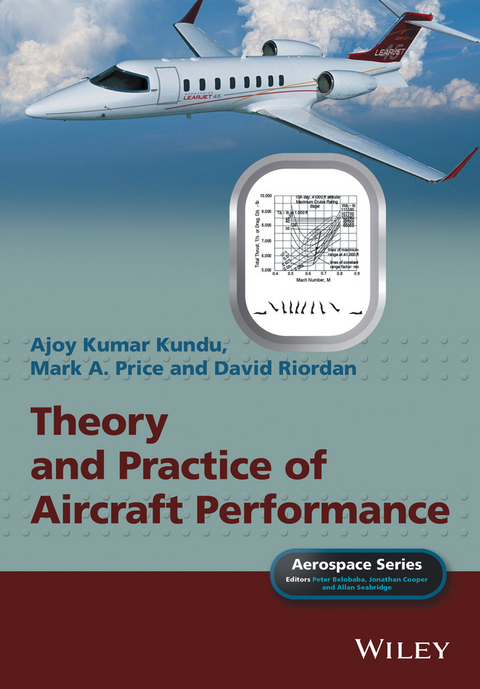
Theory and Practice of Aircraft Performance (eBook)
John Wiley & Sons (Verlag)
978-1-119-07418-2 (ISBN)
Textbook introducing the fundamentals of aircraft performance using industry standards and examples: bridging the gap between academia and industry
- Provides an extensive and detailed treatment of all segments of mission profile and overall aircraft performance
- Considers operating costs, safety, environmental and related systems issues
- Includes worked examples relating to current aircraft (Learjet 45, Tucano Turboprop Trainer, Advanced Jet Trainer and Airbus A320 types of aircraft)
- Suitable as a textbook for aircraft performance courses
Textbook introducing the fundamentals of aircraft performance using industry standards and examples: bridging the gap between academia and industry Provides an extensive and detailed treatment of all segments of mission profile and overall aircraft performance Considers operating costs, safety, environmental and related systems issues Includes worked examples relating to current aircraft (Learjet 45, Tucano Turboprop Trainer, Advanced Jet Trainer and Airbus A320 types of aircraft) Suitable as a textbook for aircraft performance courses
Ajoy Kumar Kundu graduated with Mechanical Engineering degree from Jadavpur University, India, followed by studying in the United Kingdom (Cranfield University and Queen's University Belfast) and in the United States of America (University of Michigan and Stanford University). His professional experience spans more than thirty years in the aircraft industries and nearly 20 years in academia. In India, he was Professor at the Indian Institute of Technology, Kharagpur; and the Chief Designer at the Hindustan Aeronautics, Bangalore. In North America, he served as Research Engineer for the Boeing Aircraft Company, Renton and as Intermediate Engineer for Canadair Ltd. His aeronautical engineering career began in the United Kingdom with Short Brothers and Harland Ltd., retiring from Bombardier Aerospace-Belfast, as Assistant Chief Aerodynamicist. He is currently associated with Queen's University Belfast. He has authored the book title Aircraft Design published by Cambridge University Press. He held British, Canadian and Indian Private Pilot's License. He is a Fellow of the Royal Aeronautical Society and the Institute of Mechanical Engineers, UK. Professor Mark Price is the Pro-Vice-Chancellor for the Faculty of Engineering and Physical Sciences at Queen's University Belfast. Formerly he was the Head of School of Mechanical and Aerospace Engineering having progressed through his academic career as a Professor of Aeronautics teaching aircraft structures and design, and leading a research team in design and manufacturing. He graduated in 1987 with a 1st Class Honours degree in Aeronautical Engineering from Queen's University Belfast before taking up a post as a stress engineer in Bombardier Aerospace. He returned later to QUB to undertake a PhD in Mechanical Engineering after which he joined TranscenData Europe as a software engineer and project manager to implement his research in their product CADFix. In 1998 he returned to QUB lecturing in aircraft structures and design. With a strong focus on design applications and integrated performance and cost models, including manufacturing processing effects in design simulations, he received the 2006 Thomas Hawksley medal from the IMechE. He has published over 200 articles and supervised 20 PhDs to completion. Mark is a Fellow of the Royal Aeronautical Society and the Institute of Mechanical Engineers, UK. David Riordan commenced employment with Short Brothers PLC in 1978 as an Undergraduate Apprentice. He then graduated in 1982 from Queen's University Belfast, with a 1st Class Honours degree in Mechanical Engineering. In 1986 he attained an MSc in Advanced Manufacturing Technology from the Cranfield Institute of Technology, England. David was appointed Chief Technical Engineer during 2002; in which position provides leadership at the Bombardier Belfast site for all activities associated with the technical engineering fields of aerodynamics, thermodynamics, fire safety and noise; mechanical systems, electrical systems, reliability & safety. David is also functionally responsible for the department of Airworthiness and Engineering Quality. Responsibilities cover all products associated with Bombardier at Belfast, including metallic fuselage barrels (business jet and regional aircraft applications); composite aerostructures (including the composite wing for the Bombardier CSeries aircraft) and engine nacelles (including the complete nacelle system for the PW1400G-JM propulsion system powering the IRKUT MC-21 aircraft).
Road Map of the Book
Organization
In a step‐by‐step manner, I have developed a road map to learning industry standard aircraft performance methodology that can be followed in classrooms. Except for Chapter 1, the book is written in formal third‐person grammatical usage. The chapters are arranged quite linearly, and there is not much choice in tailoring a course. While the course material progresses linearly, the following diagram depicts how the topics are interlinked.
Chapter 1 introduces some background material to prepare readers on the scope of aeronautical engineering. It gives broad coverage of some historical perspective, future trends, role of marketing, project phases from conception to completion, role of airworthiness requirements, and some miscellaneous topics. The main purpose of this chapter is to motivate readers to explore and learn about aircraft.
Chapter 2 covers atmosphere, aircraft aerodynamics and design considerations that influence aircraft performance and must be known to the engineers. This is the only chapter that could be browsed, as these topics are normally covered separately in academies. Chapter 3 introduces the definitions of various kinds of aircraft velocities, related topics on static stability, and some related flight deck instruments. The equations of motion for a flat stationary Earth are derived in Chapter 4, and classroom work starts from here. Next, the aircraft load limits are introduced in Chapter 5, as these define the aircraft performance envelope. Stability considerations are dealt with in Chapter 6; understanding aircraft stability is essential to performance analyses. Aircraft performance computations cannot start without engine performance data, and they are dealt with in Chapters 7 and 8. Aircraft drag data is evaluated in Chapter 9.
Chapters 10 to 15 present the core treatment of aircraft performance. Aircraft sizing and engine matching are done by aircraft performance engineers, and dealt with in Chapter 16 in a formal manner after completing studies on performance. The methodology is treated uniquely in close conformation with industry practices, and is an indispensable part of analyses at the conceptual design phase of a project, as it finalizes aircraft configuration and demonstrates compliance with customer specifications. The procedure offers a “satisfying” solution to generating a family of aircraft variants. This approach is widely practised by all major aircraft manufacturing organizations. The chapter also permits parametric sensitivity studies, which will eventually prove the key to success through balancing comfort with cost in a fiercely competitive market. Readers are encouraged to study aircraft design considerations along with performance analyses. It is to be stressed all the time that aircraft safety is never compromised. Each chapter starts with an overview, a summary of what is learnt, and the classroom work content.
Direct operating cost estimates are looked at in Chapter 17. For commercial aircraft the economic factors are the most important considerations, and for military aircraft it is the performance. Safety and reliability is never sacrificed. The importance of developing the configurations in a family concept is emphasized. The variants can emerge at a low cost by retaining component commonality and covering a wider market area: one might say, lightheartedly, “Design one and get the second at half the development cost”. Finally, Chapter 18 concludes by discussing some miscellaneous topics related to aircraft performance.
Appendices A and B give the conversion factors and the ISA day atmospheric tables for both the SI and Imperial systems. Appendix C covers some important formulae. Appendix D gives a basic review on matrices and determinants required to study equations of motion and some important equations. Appendix E gives the problem sets for the pertinent chapters. It is recommended that these should be worked out. Appendix F gives a case study of the class Airbus 320 aircraft. Finally, Appendix G considers some interesting aerofoil in wide usage. This book is meant to reflect what aircraft performance engineers do in industry and airline operation.
Jane’s Aircraft Manual [1] is an indispensable book for the vital statistics of aircraft geometries, design data and relevant performance details. This yearly publication has served many generations of aeronautical engineers around the world for more than half a century. The data from Jane’s Aircraft Manual can be used to compare classroom work on similar types of aircraft. Flightglobal.com is another good source to study cutaway diagrams of aircraft and engines. Products from different origins do show similarities, and this is picked up as a strong statistical pattern, which can help to give an idea of what is to be expected in a new design (Section 18.9). Readers should prepare their own statistics for the type of aircraft under study. Other useful publications are [2] to [5]. I would recommend the readers to look at the Virginia Tech web site on Aircraft Design Bibliographies [6]. Their compilation of aircraft design information sources is comprehensive. Related web sites also give useful data.
Many categories of aircraft have been designed. I have chosen the important ones that will broadly cover a wide range of classroom exercises; these will provide adequate exposure for the students. The associated examples in the book would be those of four cases: (i) a turbofan powered Learjet 45 class business jet (Bizjet); (ii) a turboprop powered propeller‐driven Tucano class military trainer aircraft (TPT); (iii) a military advanced jet trainer (AJT) in the class of BAe Hawk that has a close support role variant; and (iv) performance computation of a high subsonic jet in the class of Boeing 737/Airbus 320 aircraft is given in Appendix E. These are the types recommended as the most suitable for classroom projects. Classroom methodology should be in harmony with industrial practices, otherwise the gap between academy and industry might widen.
Case studies are indispensable in the course of learning in the classroom. Example exercises must bear high fidelity with the real ones – I take some satisfaction in providing real world examples modified to classroom usage to maintain commercial confidence. These are not from any academic projects, but follow the designs of the real ones worked out by myself. At this point, I highlight that the results are not those from the industry, but have been compared with the performance data available. Industry is not liable for what I present here.
The book gives full coverage of worked‐out examples. Instructors have the flexibility to generate problem assignment sets at the level of class requirements. I strongly recommend the adoption of manual computation, leaving the repetitive aspects to spreadsheets to be developed by the students as part of their learning process. This is essential if students are to develop a feel for numbers and to learn the labour content of a design (it is expensive to make mid‐course changes). Also, extensive theoretical treatment is embedded for research workers to extend their analytical work. It is common nowadays to provide CDs as companion software. I have elected not to follow this practice because the supplied software to handle repetitive tasks constrains students to interact more deeply with the governing equations, which is an important part of the learning experience.
If students elect to use off‐the‐shelf software, then let it be the reputable ones. However, these are more meaningful after the subject is well understood, that is, after completing the course with manual computation. This will lead to an appreciation of how realistic the computer output is and how to make changes in input to improve results. It is better to postpone the usage of aircraft performance software until one joins industry. In academia, a student can use computational fluid dynamics (CFD) and finite element method (FEM) analyses as computer‐aided engineering (CAE). Today’s students are proficient with computers and can generate their own programs.
Suggested Structure for the Coursework
The author suggests a typical pathway for one term of 36 hours of classroom contact hours – 24 hours of lectures and 12 hours of tutorials. [A note of caution: what is done in about 36 hours of classroom lectures takes about 36 weeks in industry.]
| Classroom lecture (contact) hours |
| 1. | Coverage of Chapter 1 and some topics from Chapter 2 as selected by the instructor (other topics are to be sandwiched as and when required). | 1 |
| 2. | Chapter 3 – to cover velocities, stability criteria, etc. | 1.5 |
| 3. | Equation of motion – Chapter 4. | 2 |
| 4. | Aircraft load – Chapter 5. | 1 |
| 5. | Air stability, weights and CG – Chapter 9. | 0.5 |
| 6. | Engine performance (establish engine data) – Chapters 7 and 8. | 2.5 |
| 7. | Drag estimation – Chapter 9. | 2 |
| 8. | Fundamentals of aircraft... |
| Erscheint lt. Verlag | 22.8.2016 |
|---|---|
| Reihe/Serie | Aerospace Series |
| Aerospace Series (PEP) | Aerospace Series (PEP) |
| Sprache | englisch |
| Themenwelt | Technik ► Fahrzeugbau / Schiffbau |
| Technik ► Luft- / Raumfahrttechnik | |
| Technik ► Maschinenbau | |
| Schlagworte | aerodynamic • Aeronautic & Aerospace Engineering • aerospace engineering</p> • aerospace industry standards • aerospace textbook • Aircraft • aircraft design • air data • Applied Mathematics in Engineering • Betriebswirtschaft u. Operationsforschung • Business & Management • Equations of motion • flight drag • Flight Performance • flight stability • fundamentals • <p>Aircraft Performance • Luft- u. Raumfahrttechnik • Management Science/Operational Research • Maschinenbau • Mathematics • Mathematik • Mathematik in den Ingenieurwissenschaften • mechanical engineering • systems parameters • Wirtschaft u. Management |
| ISBN-10 | 1-119-07418-5 / 1119074185 |
| ISBN-13 | 978-1-119-07418-2 / 9781119074182 |
| Informationen gemäß Produktsicherheitsverordnung (GPSR) | |
| Haben Sie eine Frage zum Produkt? |
 EPUB (Adobe DRM)
Kopierschutz: Adobe-DRM
Adobe-DRM ist ein Kopierschutz, der das eBook vor Mißbrauch schützen soll. Dabei wird das eBook bereits beim Download auf Ihre persönliche Adobe-ID autorisiert. Lesen können Sie das eBook dann nur auf den Geräten, welche ebenfalls auf Ihre Adobe-ID registriert sind.
Details zum Adobe-DRM
Dateiformat: EPUB (Electronic Publication)
EPUB ist ein offener Standard für eBooks und eignet sich besonders zur Darstellung von Belletristik und Sachbüchern. Der Fließtext wird dynamisch an die Display- und Schriftgröße angepasst. Auch für mobile Lesegeräte ist EPUB daher gut geeignet.
Systemvoraussetzungen:
PC/Mac: Mit einem PC oder Mac können Sie dieses eBook lesen. Sie benötigen eine
eReader: Dieses eBook kann mit (fast) allen eBook-Readern gelesen werden. Mit dem amazon-Kindle ist es aber nicht kompatibel.
Smartphone/Tablet: Egal ob Apple oder Android, dieses eBook können Sie lesen. Sie benötigen eine
Geräteliste und zusätzliche Hinweise
Buying eBooks from abroad
For tax law reasons we can sell eBooks just within Germany and Switzerland. Regrettably we cannot fulfill eBook-orders from other countries.
aus dem Bereich