Signal Processing for 5G (eBook)
John Wiley & Sons (Verlag)
978-1-119-11648-6 (ISBN)
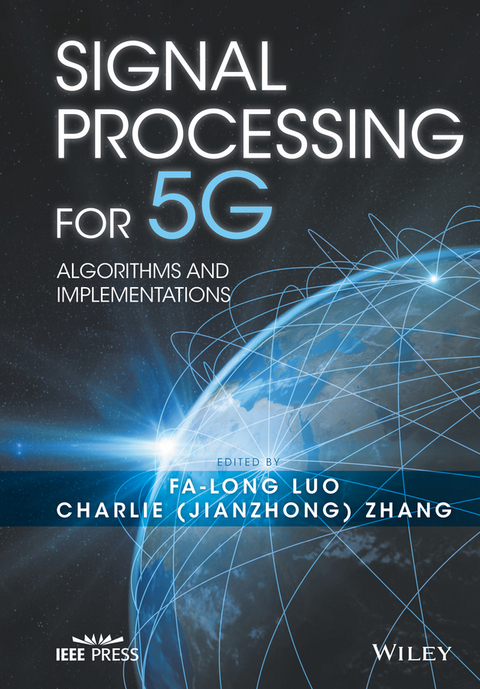
A comprehensive and invaluable guide to 5G technology, implementation and practice in one single volume. For all things 5G, this book is a must-read.
Signal processing techniques have played the most important role in wireless communications since the second generation of cellular systems. It is anticipated that new techniques employed in 5G wireless networks will not only improve peak service rates significantly, but also enhance capacity, coverage, reliability , low-latency, efficiency, flexibility, compatibility and convergence to meet the increasing demands imposed by applications such as big data, cloud service, machine-to-machine (M2M) and mission-critical communications.
This book is a comprehensive and detailed guide to all signal processing techniques employed in 5G wireless networks. Uniquely organized into four categories, New Modulation and Coding, New Spatial Processing, New Spectrum Opportunities and New System-level Enabling Technologies, it covers everything from network architecture, physical-layer (down-link and up-link), protocols and air interface, to cell acquisition, scheduling and rate adaption, access procedures and relaying to spectrum allocations. All technology aspects and major roadmaps of global 5G standard development and deployments are included in the book.
Key Features:
- Offers step-by-step guidance on bringing 5G technology into practice, by applying algorithms and design methodology to real-time circuit implementation, taking into account rapidly growing applications that have multi-standards and multi-systems.
- Addresses spatial signal processing for 5G, in particular massive multiple-input multiple-output (massive-MIMO), FD-MIMO and 3D-MIMO along with orbital angular momentum multiplexing, 3D beamforming and diversity.
- Provides detailed algorithms and implementations, and compares all multicarrier modulation and multiple access schemes that offer superior data transmission performance including FBMC, GFDM, F-OFDM, UFMC, SEFDM, FTN, MUSA, SCMA and NOMA.
- Demonstrates the translation of signal processing theories into practical solutions for new spectrum opportunities in terms of millimeter wave, full-duplex transmission and license assisted access.
- Presents well-designed implementation examples, from individual function block to system level for effective and accurate learning.
- Covers signal processing aspects of emerging system and network architectures, including ultra-dense networks (UDN), software-defined networks (SDN), device-to-device (D2D) communications and cloud radio access network (C-RAN).
Fa-Long Luo, Element CXI, San Jose, California
Dr. Fa-Long Luo is an IEEE Fellow and the Chief Scientist of two leading international companies, headquartered in Silicon Valley, dealing with software-defined radio and wireless multimedia. He is also an Affiliate Full Professor at the University of Washington. From 2007 to 2011, he was the founding editor-in-chief of the International Journal of Digital Multimedia Broadcasting. From 2011 to 2012, he was the chairman of the IEEE Industry DSP Standing Committee and technical board member of the IEEE Signal Processing Society. He is now associate editor of the IEEE Access and IEEE Internet of Things Journal. He has 33 years of research and industry experience in signal processing, multimedia, communication and broadcasting with real-time implementation, applications and standardization and has gained international recognition. He has published 5 books, more than 100 technical papers, and has 18 patents in these fields. He was awarded the Fellowship by the Alexander von Humboldt Foundation of Germany.
Charlie (Jianzhong) Zhang, Samsung Research America, USA
Charlie (Jianzhong) Zhang is Vice President and head of the Standards and Research Lab with Samsung Research America at Dallas, where he leads research and standard efforts for 5G cellular systems and next generation multimedia networks. From Aug 2009 to Aug 2013, he served as the Vice Chairman of 3GPP RAN1 working group and led development of LTE and LTE-Advanced technologies such as 3D channel modeling, UL-MIMO and CoMP, Carrier Aggregation for TD-LTE, etc. Before joining Samsung, he was with Motorola from 2006 to 2007 working on 3GPP HSPA standards, and with Nokia Research Center from 2001 to 2006 working on IEEE 802.16e (WiMAX) standard and EDGE/CDMA algorithms. He received his Ph.D. degree from the University of Wisconsin, Madison. Dr. Zhang is also an IEEE Fellow.
A comprehensive and invaluable guide to 5G technology, implementation and practice in one single volume. For all things 5G, this book is a must-read. Signal processing techniques have played the most important role in wireless communications since the second generation of cellular systems. It is anticipated that new techniques employed in 5G wireless networks will not only improve peak service rates significantly, but also enhance capacity, coverage, reliability , low-latency, efficiency, flexibility, compatibility and convergence to meet the increasing demands imposed by applications such as big data, cloud service, machine-to-machine (M2M) and mission-critical communications. This book is a comprehensive and detailed guide to all signal processing techniques employed in 5G wireless networks. Uniquely organized into four categories, New Modulation and Coding, New Spatial Processing, New Spectrum Opportunities and New System-level Enabling Technologies, it covers everything from network architecture, physical-layer (down-link and up-link), protocols and air interface, to cell acquisition, scheduling and rate adaption, access procedures and relaying to spectrum allocations. All technology aspects and major roadmaps of global 5G standard development and deployments are included in the book. Key Features: Offers step-by-step guidance on bringing 5G technology into practice, by applying algorithms and design methodology to real-time circuit implementation, taking into account rapidly growing applications that have multi-standards and multi-systems. Addresses spatial signal processing for 5G, in particular massive multiple-input multiple-output (massive-MIMO), FD-MIMO and 3D-MIMO along with orbital angular momentum multiplexing, 3D beamforming and diversity. Provides detailed algorithms and implementations, and compares all multicarrier modulation and multiple access schemes that offer superior data transmission performance including FBMC, GFDM, F-OFDM, UFMC, SEFDM, FTN, MUSA, SCMA and NOMA. Demonstrates the translation of signal processing theories into practical solutions for new spectrum opportunities in terms of millimeter wave, full-duplex transmission and license assisted access. Presents well-designed implementation examples, from individual function block to system level for effective and accurate learning. Covers signal processing aspects of emerging system and network architectures, including ultra-dense networks (UDN), software-defined networks (SDN), device-to-device (D2D) communications and cloud radio access network (C-RAN).
Fa-Long Luo, Element CXI, San Jose, California Dr. Fa-Long Luo is an IEEE Fellow and the Chief Scientist of two leading international companies, headquartered in Silicon Valley, dealing with software-defined radio and wireless multimedia. He is also an Affiliate Full Professor at the University of Washington. From 2007 to 2011, he was the founding editor-in-chief of the International Journal of Digital Multimedia Broadcasting. From 2011 to 2012, he was the chairman of the IEEE Industry DSP Standing Committee and technical board member of the IEEE Signal Processing Society. He is now associate editor of the IEEE Access and IEEE Internet of Things Journal. He has 33 years of research and industry experience in signal processing, multimedia, communication and broadcasting with real-time implementation, applications and standardization and has gained international recognition. He has published 5 books, more than 100 technical papers, and has 18 patents in these fields. He was awarded the Fellowship by the Alexander von Humboldt Foundation of Germany. Charlie (Jianzhong) Zhang, Samsung Research America, USA Charlie (Jianzhong) Zhang is Vice President and head of the Standards and Research Lab with Samsung Research America at Dallas, where he leads research and standard efforts for 5G cellular systems and next generation multimedia networks. From Aug 2009 to Aug 2013, he served as the Vice Chairman of 3GPP RAN1 working group and led development of LTE and LTE-Advanced technologies such as 3D channel modeling, UL-MIMO and CoMP, Carrier Aggregation for TD-LTE, etc. Before joining Samsung, he was with Motorola from 2006 to 2007 working on 3GPP HSPA standards, and with Nokia Research Center from 2001 to 2006 working on IEEE 802.16e (WiMAX) standard and EDGE/CDMA algorithms. He received his Ph.D. degree from the University of Wisconsin, Madison. Dr. Zhang is also an IEEE Fellow.
Preface
5G wireless technology is developing at an explosive rate and is one of the biggest areas of research within academia and industry. In this rapid development, signal processing techniques are playing the most important role. In 2G, 3G and 4G, the peak service rate was the dominant metric for performance. Each of these previous generations was defined by a standout signal processing technology that represented the most important advance made. In 2G, this technology was time-division multiple access (TDMA); in 3G, it was code-division multiple access (CDMA); and in 4G, it was orthogonal frequency-division multiple access (OFDMA). However, this will not be the case for 5G systems – there will be no dominant performance metric that defines requirements for 5G technologies. Instead, a number of new signal processing techniques will be used to continuously increase peak service rates, and there will be a new emphasis on greatly increasing capacity, coverage, efficiency (power, spectrum, and other resources), flexibility, compatibility, reliability and convergence. In this way, 5G systems will be able to handle the explosion in demand arising from emerging applications such as big data, cloud services, and machine-to-machine communication.
A number of new signal processing techniques have been proposed for 5G systems and are being considered for international standards development and deployment. These new signal processing techniques for 5G can be categorized into four groups:
- new modulation and coding schemes
- new spatial processing techniques
- new spectrum opportunities
- new system-level enabling techniques.
The successful development and implementation of these technologies for 5G will be challenging and will require huge effort from industry, academia, standardization organizations and regulatory authorities.
From an algorithm and implementation perspective, this book aims to be the first single volume to provide a comprehensive and highly coherent treatment of all the signal processing techniques that enable 5G, covering system architecture, physical (PHY)-layer (down link and up link), protocols, air interface, cell acquisition, scheduling and rate adaption, access procedures, relaying and spectrum allocation. This book is organized into twenty-three chapters in five parts.
Part 1: Modulation, Coding and Waveform for 5G
The first part, consisting of eight chapters, will present and compare the detailed algorithms and implementations of all major candidate modulation and coding schemes for 5G, including generalized frequency division multiplexing (GFDM), filter-bank multi-carrier (FBMC) transmission, universal filtered multi-carrier (UFMC) transmission, bi-orthogonal frequency division multiplexing (BFDM), spectrally efficient frequency division multiplexing (SEFDM), the faster-than-Nyquist signaling (FTN) based time-frequency packing (TFP), sparse code multiple access (SCMA), multi-user shared access (MUSA) and non-orthogonal multiple access (NOMA).
With a focus on FBMC, GFDM, UFMC, BFDM and TFP, Chapter 1 presents a comprehensive introduction to these waveform generation and modulation schemes by covering the basic principles, mathematical models, step-by-step algorithms, implementation complexities, schematic processing flows and the corresponding application scenarios involved.
Chapter 2 is devoted to the FTN data transmission method, with the emphasis on applications that are important for future 5G systems. What is explored in this chapter mainly includes time-FTN methods with non-binary modulation and multi-subcarrier methods that are similar in structure to OFDM. In either, there is an acceleration processing in time or compacting in frequency that makes signal streams no longer orthogonal. FTN can be combined with error-correcting coding structures to form true waveform coding schemes that work at high-bit rates per Hertz and second. As a matter of fact, FTN based systems can potentially double data transmission rates.
The technical evolution from OFDM to FBMC is addressed in Chapter 3, covering the principles, algorithms, designs and implementations of these two schemes. This chapter first presents the details of OFDM-based schemes and the major shortcomings that prevent them from being employed in 5G. Through introduction of synthesis and analysis filter banks, prototype filter design and the corresponding polyphase implementation, Chapter 3 then extensively deals with the working principles of FBMC and compares it with OFDM in terms of performance – power spectral density and out of band power radiation – and complexity – number of fast Fourier transforms and filter banks. One can also see from this chapter that OFDM is a special case of FBMC.
Easy and effective integration with massive multiple-input and multiple-output (MIMO) technology is a key requirement for a modulation and waveform generation scheme in 5G. Chapter 4 demonstrates that FBMC can serve as a viable candidate waveform in the application of massive MIMO. The chapter outlines the system model, algorithm formulation, self-equalization property and pilot contamination of FBMC for massive MIMO channels, and also shows that while FBMC offers the same processing gain as OFDM, it offers the advantages of: more flexible carrier aggregation (CA), higher bandwidth efficiency – because of the absence of cyclic prefix (CP) – blind channel equalization and larger subcarrier spacing, and hence less sensitivity to carrier frequency offset and lower peak-to-average power ratio (PAPR).
Chapter 5 presents a non-orthogonal multicarrier system, namely, spectrally efficient frequency division multiplexing (SEFDM), which packs subcarriers at a frequency separation less than the symbol rate while maintaining the same transmission rate per individual subcarrier. Thus spectral efficiency is improved in comparison with the OFDM system. By transmitting the same amount of data, the SEFDM system can conceptually save up to 45% bandwidth. This chapter also describes a practical experiment in which the SEFDM concept is evaluated in a CA scenario considering a realistic fading channel. On the other hand, SEFDM involves higher computation complexity and longer processing delays, mainly due to the requirement for complex signal detection. This suggests that advanced hardware implementation is still highly desirable, so as to make SEFDM a better fit to 5G.
As pointed out in Chapter 6, non-orthogonal multi-user superposition and shared access is a promising technology that can increase the system throughput and simultaneously serve massive connections. Non-orthogonal access allows multiple users to share time and frequency resources in the same spatial layer via simple linear superposition or code-domain multiplexing. This chapter overviews all major non-orthogonal access schemes, categorizing them into two groups:
- the non-spreading methods, where modulation symbols are one-to-one mapped to the time/frequency resource elements
- the spreading methods, where symbols are first spread and then mapped to time/frequency resources.
Their design principles, key features, advantages and disadvantages are extensively discussed in this chapter.
Chapter 7 is devoted to a new multiple access scheme, termed NOMA, which introduces power-domain user multiplexing and exploits channel differences among users to improve spectrum efficiency. This chapter also explains the interface design aspects of NOMA, for example multi-user scheduling and multi-user power control, and its combination with MIMO. The performance evaluation and ongoing experimental trials of downlink and uplink NOMA are reported. The simulation results and the measurements obtained from the testbed show that under multiple configurations the cell throughput achieved by NOMA is 30% higher than that of OFDMA.
With a tutorial style, Chapter 8 presents an overview of all the major multicarrier modulation (MCM) candidates for 5G, categorizing them into three groups:
- subcarrier filtered MCM using linear convolution
- subcarrier filtered MCM using circular convolution
- subband windowed MCM.
General comparisons of these candidate algorithms are made in this chapter, covering PAPR, OOB emission, processing and implementation complexity, spectrum efficiency, the requirement of CP, intercarrier interference, intersymbol interference, multipath distortion, orthogonality and the related effects of frequency offset and phase noise, synchronization requirements in both the time domain and the frequency domain, latency, mobility, compatibility and integration with other processing such as massive MIMO.
Part 2: New Spatial Signal Processing for 5G
The five chapters in Part 2 focus on new spatial signal processing technologies for 5G, mainly addressing massive MIMO, full-dimensional MIMO (FD-MIMO), three-dimensional MIMO (3D-MIMO), adaptive 3D beamforming and diversity, continuous aperture phased MIMO (CAP-MIMO) and orbital angular momentum (OAM) based multiplexing. Chapter 9 mainly deals with the principle, theory, algorithm, design, testing, implementation and prototyping on advanced computing and processing platforms for the massive MIMO technique, which will certainly be employed in 5G standards. Core processing blocks, such as downlink precoding, uplink detection and channel estimation, are reviewed first, after which the emphasis is put on the various hardware implementation issues of massive MIMO, covering radio frequency (RF) front-end calibration, baseband processing,...
| Erscheint lt. Verlag | 11.8.2016 |
|---|---|
| Reihe/Serie | IEEE Press |
| Wiley - IEEE | Wiley - IEEE |
| Sprache | englisch |
| Themenwelt | Technik ► Elektrotechnik / Energietechnik |
| Technik ► Nachrichtentechnik | |
| Schlagworte | 5G • Cloud-RAN Radio Access Network • D2D Device-to-Device Communication • Drahtlose Kommunikation • Electrical & Electronics Engineering • Elektrotechnik u. Elektronik • FBMC Filter Bank Multi-Carrier • Full-Duplex Transmission • Massive MIMO • mmWave • Mobile & Wireless Communications • Non-orthogonal multiple access • SDN Software Defined Network • Signal Processing • Signalverarbeitung • UDN Ultra Dense Network |
| ISBN-10 | 1-119-11648-1 / 1119116481 |
| ISBN-13 | 978-1-119-11648-6 / 9781119116486 |
| Informationen gemäß Produktsicherheitsverordnung (GPSR) | |
| Haben Sie eine Frage zum Produkt? |
 EPUB (Adobe DRM)
Kopierschutz: Adobe-DRM
Adobe-DRM ist ein Kopierschutz, der das eBook vor Mißbrauch schützen soll. Dabei wird das eBook bereits beim Download auf Ihre persönliche Adobe-ID autorisiert. Lesen können Sie das eBook dann nur auf den Geräten, welche ebenfalls auf Ihre Adobe-ID registriert sind.
Details zum Adobe-DRM
Dateiformat: EPUB (Electronic Publication)
EPUB ist ein offener Standard für eBooks und eignet sich besonders zur Darstellung von Belletristik und Sachbüchern. Der Fließtext wird dynamisch an die Display- und Schriftgröße angepasst. Auch für mobile Lesegeräte ist EPUB daher gut geeignet.
Systemvoraussetzungen:
PC/Mac: Mit einem PC oder Mac können Sie dieses eBook lesen. Sie benötigen eine
eReader: Dieses eBook kann mit (fast) allen eBook-Readern gelesen werden. Mit dem amazon-Kindle ist es aber nicht kompatibel.
Smartphone/Tablet: Egal ob Apple oder Android, dieses eBook können Sie lesen. Sie benötigen eine
Geräteliste und zusätzliche Hinweise
Buying eBooks from abroad
For tax law reasons we can sell eBooks just within Germany and Switzerland. Regrettably we cannot fulfill eBook-orders from other countries.
aus dem Bereich