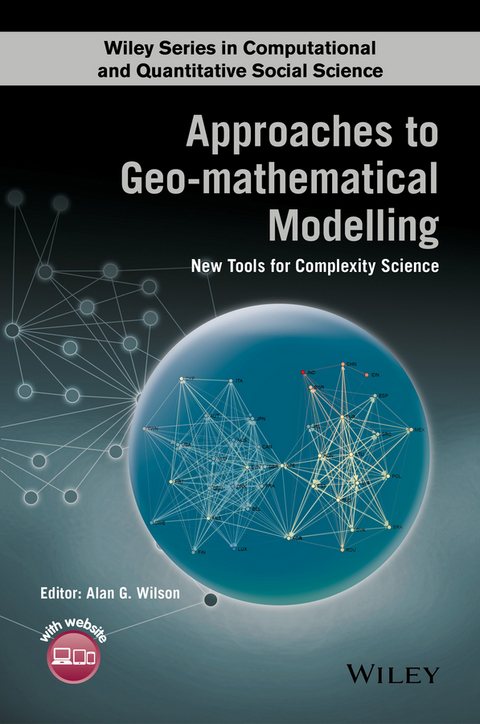
Approaches to Geo-mathematical Modelling (eBook)
John Wiley & Sons (Verlag)
978-1-118-93744-0 (ISBN)
Geo-mathematical modelling: models from complexity science
Sir Alan Wilson, Centre for Advanced Spatial Analysis, University College London
Mathematical and computer models for a complexity science tool kit
Geographical systems are characterised by locations, activities at locations, interactions between them and the infrastructures that carry these activities and flows. They can be described at a great variety of scales, from individuals and organisations to countries. Our understanding, often partial, of these entities, and in many cases this understanding is represented in theories and associated mathematical models.
In this book, the main examples are models that represent elements of the global system covering such topics as trade, migration, security and development aid together with examples at finer scales. This provides an effective toolkit that can not only be applied to global systems, but more widely in the modelling of complex systems. All complex systems involve nonlinearities involving path dependence and the possibility of phase changes and this makes the mathematical aspects particularly interesting. It is through these mechanisms that new structures can be seen to 'emerge', and hence the current notion of 'emergent behaviour'. The range of models demonstrated include account-based models and biproportional fitting, structural dynamics, space-time statistical analysis, real-time response models, Lotka-Volterra models representing 'war', agent-based models, epidemiology and reaction-diffusion approaches, game theory, network models and finally, integrated models.
Geo-mathematical modelling:
- Presents mathematical models with spatial dimensions.
- Provides representations of path dependence and phase changes.
- Illustrates complexity science using models of trade, migration, security and development aid.
- Demonstrates how generic models from the complexity science tool kit can each be applied in a variety of situations
This book is for practitioners and researchers in applied mathematics, geography, economics, and interdisciplinary fields such as regional science and complexity science. It can also be used as the basis of a modelling course for postgraduate students.
Geo-mathematical modelling: models from complexity science Sir Alan Wilson, Centre for Advanced Spatial Analysis, University College London Mathematical and computer models for a complexity science tool kit Geographical systems are characterised by locations, activities at locations, interactions between them and the infrastructures that carry these activities and flows. They can be described at a great variety of scales, from individuals and organisations to countries. Our understanding, often partial, of these entities, and in many cases this understanding is represented in theories and associated mathematical models. In this book, the main examples are models that represent elements of the global system covering such topics as trade, migration, security and development aid together with examples at finer scales. This provides an effective toolkit that can not only be applied to global systems, but more widely in the modelling of complex systems. All complex systems involve nonlinearities involving path dependence and the possibility of phase changes and this makes the mathematical aspects particularly interesting. It is through these mechanisms that new structures can be seen to emerge , and hence the current notion of emergent behaviour . The range of models demonstrated include account-based models and biproportional fitting, structural dynamics, space-time statistical analysis, real-time response models, Lotka-Volterra models representing war , agent-based models, epidemiology and reaction-diffusion approaches, game theory, network models and finally, integrated models. Geo-mathematical modelling: Presents mathematical models with spatial dimensions. Provides representations of path dependence and phase changes. Illustrates complexity science using models of trade, migration, security and development aid. Demonstrates how generic models from the complexity science tool kit can each be applied in a variety of situations This book is for practitioners and researchers in applied mathematics, geography, economics, and interdisciplinary fields such as regional science and complexity science. It can also be used as the basis of a modelling course for postgraduate students.
Alan Geoffrey Wilson, Centre for Advanced Spatial Analysis, University College London, UK. His research interests have been concerned with many aspects of mathematical modelling and the use of models in planning in relation to all aspects of cities and regions - including demography, economic input-output modelling, transport and locational structures. He was responsible for the introduction of a number of model building techniques which are now in common use internationally. These models have been widely used in areas such as transport planning. He made important contributions through the rigorous deployment of accounts' concepts in demography and economic modelling. In recent years he has been particularly concerned with applications of dynamical systems theory in relation to the task of modelling the evolution of urban structure, initially described in Catastrophe theory and bifurcation: applications to urban and regional systems. His current research, supported by ESRC and EPSRC grants of around ?3M, is on the evolution of cities and the dynamics of global trade and migration.
Notes on Contributors
Preface
Acknowledgements
About the companion website
Part 1. Approaches
Chapter 1. The tool kit
Alan Wilson
Part 2. Estimating missing data: biproportional fitting and principal components' analysis
Chapter 2. Inter-regional migration in Europe in relation to economic and labour market inequalities
Adam Dennett
Chapter 3. International trade flows
Simone Caschili and Alan Wilson
Chapter 4. Service flows in inter-regional input-output models
Rob Levy and Alan Wilson
Chapter 5. A method for estimating unknown national input-output tables using limited data
Thomas Oléron Evans and Rob Levy
Part 3. Dynamics in account-based models
Chapter 6. A dynamic global trade model
Hannah M. Fry, Alan Wilson and Frank
Chapter 7. Global dynamical modelling
Anthony Korte and Alan Wilson
Part 4. Space-time statistical analysis
Chapter 8. Space-time analysis of point patterns in Crime and Security events
Toby Davies, Shane Johnson, Alex Braithwaite and Elio Marchione
Part 5. Real time response models
Chapter 9. The London riots-1: epidemiology, spatial interaction and probability of arrest
Toby Davies, Hannah M. Fry, Alan Wilson and Steven Bishop
Chapter 10. The London riots-2: a discrete choice model/ an agent-based model
eter Baudains, Alex Braithwaite and Shane Johnson
Part 6. The mathematics of war
Chapter 11. Richardson models with space
Peter Baudains, Alex Braithwaite, Hannah M. Fry, Toby Davies, Alan Wilson and Steven R. Bishop
Part 7. Agent-based models
Chapter 12. Agent-based models of piracy
Elio Marchione, Shane Johnson and Alan Wilson
Chapter 13. A simple approach for the prediction of extinction events in multi-agent models
Thomas Oléron Evans, Steven R. Bishop and Frank T. Smith
Part 8. Diffusion models
Chapter 14. Urban agglomeration through the diffusion of investment impacts
Minette D'Lima, Francescs R. Medda and Alan Wilson
Part 9. Game theory
Chapter 15. From Colonel Blotto to Field Marshall Blotto
Peter Baudains, Toby Davies, Hannah M. Fry, and Alan Wilson
Chapter 16. Modelling strategic interactions in a global context
Janina Beiser
Chapter 17. A general framework for static, spatially explicit games of search and concealment
Thomas Oléron Evans, Steven R. Bishop and Frank T. Smith
Part 10. Networks
Chapter 18. Network evolution: a transport example
Francesca Pagliara, Alan Wilson and Valerio de Martinis
Chapter 19. The structure of global transportation networks
Sean Hanna, Joan Serras and Tasos Varoudis
Chapter 20. Trade networks and optimal consumption
Rob Downes and Rob Levy
Part 11. Integration
Chapter 21. Research priorities
Alan Wilson
Index
Notes on Contributors
Peter Baudains is a Research Associate at the Department of Security and Crime Science at University College London. He obtained his PhD in Mathematics from UCL in 2015 and worked for five years on the EPSRC-funded ENFOLDing project, contributing to a wide range of research projects. His research interests are in the development and application of novel analytical techniques for studying complex social systems, with a particular attention on crime, rioting and terrorism. He has authored research articles appearing in journals such as Criminology, Applied Geography, Policing and the European Journal of Applied Mathematics.
Janina Beiser obtained her PhD in the Department of Political Science at University College London. During her PhD, she was part of the security workstream of the ENFOLDing project at UCL's Centre for Advanced Spatial Analysis for three years. Her research is concerned with the contagion of armed civil conflict as well as with government repression. She is now a Research Fellow in the Department of Government at the University of Essex.
Steven R. Bishop is a Professor of Mathematics at University College London, where he has been since arriving in 1984 as a postdoctoral researcher. He published over 150 academic papers, edited books and has had appearances on television and radio. Historically, his research investigated topics such as chaos theory, reducing vibrations of engineering structures and how sand dunes are formed, but he has more recently worked on ‘big data’ and the modelling of social systems. Steven held a prestigious ‘Dream’ Fellowship funded by the UK Research Council (EPSRC) until December 2013, allowing him to consider creative ways to arrive at scientific narratives. He was influential in the formation of a European network of physical and social scientists in order to investigate how decision support systems can be developed to assist policy makers and, to drive this, has organised conferences in the UK and European Parliaments. He has been involved in several European Commission–funded projects and has helped to forge a research agenda which looks at the behaviour of systems that cross policy domains and country borders.
Alex Braithwaite is an Associate Professor in the School of Government and Public Policy at the University of Arizona, as well as a Senior Research Associate in the School of Public Policy at University College London. He obtained a PhD in Political Science from the Pennsylvania State University in 2006 and has since held academic positions at Colorado State University, UCL, and the University of Arizona. He was a co-investigator on the EPSRC-funded ENFOLDing project between 2010 and 2013, contributing to a wide range of projects under the “security” umbrella. His research interests lie in the causes and geography of violent and nonviolent forms of political conflict and has been published in journals such as Journal of Politics, International Studies Quarterly, British Journal of Political Science, Journal of Peace Research, Criminology and Journal of Quantitative Criminology.
Simone Caschili has a PhD in Land Engineering and Urban Planning, and after being a Research Associate at the Centre for Advanced Spatial Analysis (at University College London) and Senior Fellow of the UCL QASER Lab, is currently an Associate at LaSalle Investment Management, London. His research interests cover the modelling of urban and regional systems, property markets, spatial-temporal and economic networks and policy evaluation for planning in both transport and environmental governance.
Minette D'Lima is a researcher in the QASER (Quantitative and Applied Spatial Economics Research) Laboratory at University College London. She was trained as a pure mathematician with bachelors' degrees in Mathematics and Computer Technology, followed by a PhD in Algebraic Geometry. She works in a multidisciplinary group of mathematicians, physicists and economists providing innovative solutions to financial and economic problems. Her research covers a broad range of projects from complexity analysis and stochastic modelling to structuring portfolios in urban investments. She has been a researcher on an EPSRC Programme Grant, “SCALE: Small Changes Lead to Large Effects,” and developed a discrete spatial interaction model to study the effect of transport investments on urban space. She has developed a stochastic model for quantifying resilience on a FuturICT-sponsored project, “ANTS: Adaptive Networks for Complex Transport Systems.” She has also worked on developing a mathematical model using portfolio theory and agent-based modelling to simulate the agricultural supply chain in Uganda for a World Bank project, “Rethinking Logistics in Lagging Regions.” She is currently working in the EPSRC Programme Grant “Liveable Cities,” structuring and optimising portfolios for urban investments, and taking into account the socio-environmental impacts of such investments and their interactions.
Toby P. Davies is a Research Associate working on the Crime, Policing and Citizenship project at University College London, having previously been a member of the UCL SECReT Doctoral Training Centre. His background is in mathematics, and his work concerns the application of mathematical techniques in the analysis and modelling of crime and other security issues. His main area of interest is the spatio-temporal distribution of crime, in particular its relationship with urban form and its analysis using network-based methods.
Valerio de Martinis is Scientific Assistant at the Institute of Transport Planning and System (ETH Zurich). He is part of SCCER Mobility (Swiss Competence Center on Energy Research), and his research activities focus on energy efficiency and railway systems. He received his PhD in Transportation Systems in 2008 at the University of Naples Federico II.
Adam Dennett is a Lecturer in Urban Analytics in the Centre for Advanced Spatial Analysis at University College London. He is a geographer and fellow of the Royal Geographical Society and has worked for a number of years in the broad area of population geography, applying quantitative techniques to the understanding of human populations; much of this involves the use of spatial interaction models to understand the migration flows of people around the UK, Europe and the world. A former secondary school teacher, Adam arrived at UCL in 2010 after completing a PhD at the University of Leeds.
Robert J. Downes is a MacArthur Fellow in Nuclear Security working at the Centre for Science and Security Studies at the Department of War Studies, King's College London. Trained as a mathematician, Rob received his PhD in mathematics from University College London in 2014; he studied the interplay between geometry and spectral theory with applications to physical systems and gravitation. He also holds an MSci in Mathematics with Theoretical Physics awarded by UCL. As a Postdoctoral Research Associate on the ENFOLDing project at The Bartlett Centre for Advanced Spatial Analysis, Rob studied the structure and dynamics of global socio-economic systems using ideas from complexity science, with particular emphasis on national economic structure and development aid.
Hannah M. Fry is a Lecturer in the Mathematics of Cities at the Centre for Advanced Spatial Analysis (CASA). She was trained as a mathematician with a first degree in mathematics and theoretical physics, followed by a PhD in fluid dynamics. This technical background is now applied in the mathematical modelling of complex social and economic systems, her main research interest. These systems can take a variety of forms, from retail to riots and terrorism, and exist at various scales, from the individual to the urban, regional and global, but – more generally – they deal with the patterns that emerge in space and time.
Sean Hanna is Reader in Space and Adaptive Architectures at University College London, Director of the Bartlett Faculty of the Built Environment's MSc/MRes programmes in Adaptive Architecture and Computation, and Academic Director of UCL's Doctoral Training Centre in Virtual Environments, Imaging and Visualisation. He is a member of the UCL Space Group. His research is primarily in developing computational methods for dealing with complexity in design and the built environment, including the comparative modelling of space, and the use of machine learning and optimisation techniques for the design and fabrication of structures. He maintains close design industry collaboration with world-leading architects and engineers.
Shane D. Johnson is a Professor in the Department of Security and Crime Science at University College London. He has worked within the fields of criminology and forensic psychology for over 15 years, and has particular interests in complex systems, patterns of crime and insurgent activity, event forecasting and design against crime. He has published over 100 articles and book chapters.
Anthony Korte is a Research Associate in the Centre for Advanced Spatial Analysis at University College London, where he works on spatial interaction and input–output models relevant to the mathematical modelling of global trade dynamics.
Robert G. Levy is a researcher at the Centre for Advanced Spatial Analysis at University College London. He has a background in quantitative economics, database administration, coding and visualisation. His first love was Visual Basic but now writes Python and...
| Erscheint lt. Verlag | 25.7.2016 |
|---|---|
| Reihe/Serie | Wiley Series in Computational and Quantitative Social Science |
| Wiley Series in Computational and Quantitative Social Science | Wiley Series in Computational and Quantitative Social Science |
| Sprache | englisch |
| Themenwelt | Mathematik / Informatik ► Mathematik ► Angewandte Mathematik |
| Mathematik / Informatik ► Mathematik ► Statistik | |
| Mathematik / Informatik ► Mathematik ► Wahrscheinlichkeit / Kombinatorik | |
| Technik | |
| Schlagworte | account-based models and biproportional fitting • agent-based models • Ãkonomie in Städten, ländlichen Räumen u. Regionen • complexity science using models of trade • Economics • epidemiology and reaction-diffusion approaches • Game Theory • Geo-mathematical modelling • Integrated Models • Komplexes System • Mathematical Modeling • mathematical models with spatial dimensions • Mathematics • Mathematik • Mathematische Modellierung • Mathematisches Modell • Migration • Network Models • Ökonomie in Städten, ländlichen Räumen u. Regionen • path dependence and phase changes • real-time response models • security and development aid. • space-time statistical analysis • Statistics • Statistics for Social Sciences • Statistik • Statistik in den Sozialwissenschaften • structural dynamics • Urban, Rural & Regional Economics • Volkswirtschaftslehre |
| ISBN-10 | 1-118-93744-9 / 1118937449 |
| ISBN-13 | 978-1-118-93744-0 / 9781118937440 |
| Informationen gemäß Produktsicherheitsverordnung (GPSR) | |
| Haben Sie eine Frage zum Produkt? |
 EPUB (Adobe DRM)
Kopierschutz: Adobe-DRM
Adobe-DRM ist ein Kopierschutz, der das eBook vor Mißbrauch schützen soll. Dabei wird das eBook bereits beim Download auf Ihre persönliche Adobe-ID autorisiert. Lesen können Sie das eBook dann nur auf den Geräten, welche ebenfalls auf Ihre Adobe-ID registriert sind.
Details zum Adobe-DRM
Dateiformat: EPUB (Electronic Publication)
EPUB ist ein offener Standard für eBooks und eignet sich besonders zur Darstellung von Belletristik und Sachbüchern. Der Fließtext wird dynamisch an die Display- und Schriftgröße angepasst. Auch für mobile Lesegeräte ist EPUB daher gut geeignet.
Systemvoraussetzungen:
PC/Mac: Mit einem PC oder Mac können Sie dieses eBook lesen. Sie benötigen eine
eReader: Dieses eBook kann mit (fast) allen eBook-Readern gelesen werden. Mit dem amazon-Kindle ist es aber nicht kompatibel.
Smartphone/Tablet: Egal ob Apple oder Android, dieses eBook können Sie lesen. Sie benötigen eine
Geräteliste und zusätzliche Hinweise
Buying eBooks from abroad
For tax law reasons we can sell eBooks just within Germany and Switzerland. Regrettably we cannot fulfill eBook-orders from other countries.
aus dem Bereich