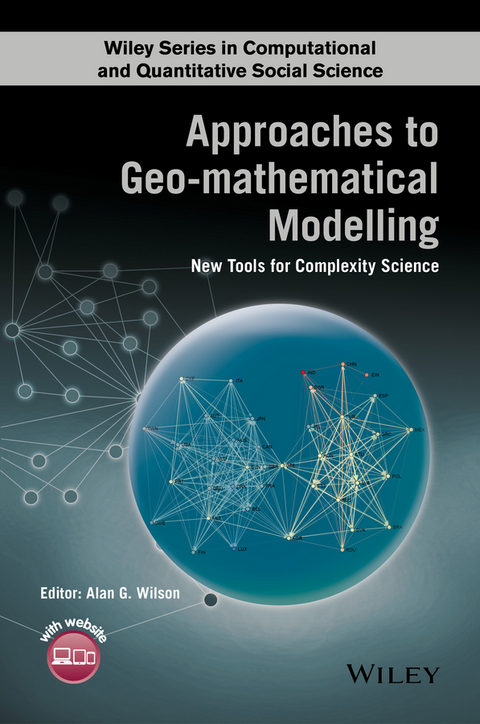
Approaches to Geo-mathematical Modelling (eBook)
John Wiley & Sons (Verlag)
978-1-118-93745-7 (ISBN)

Geo-mathematical modelling: models from complexity science
Sir Alan Wilson, Centre for Advanced Spatial Analysis, University College London
Mathematical and computer models for a complexity science tool kit
Geographical systems are characterised by locations, activities at locations, interactions between them and the infrastructures that carry these activities and flows. They can be described at a great variety of scales, from individuals and organisations to countries. Our understanding, often partial, of these entities, and in many cases this understanding is represented in theories and associated mathematical models.
In this book, the main examples are models that represent elements of the global system covering such topics as trade, migration, security and development aid together with examples at finer scales. This provides an effective toolkit that can not only be applied to global systems, but more widely in the modelling of complex systems. All complex systems involve nonlinearities involving path dependence and the possibility of phase changes and this makes the mathematical aspects particularly interesting. It is through these mechanisms that new structures can be seen to 'emerge', and hence the current notion of 'emergent behaviour'. The range of models demonstrated include account-based models and biproportional fitting, structural dynamics, space-time statistical analysis, real-time response models, Lotka-Volterra models representing 'war', agent-based models, epidemiology and reaction-diffusion approaches, game theory, network models and finally, integrated models.
Geo-mathematical modelling:
- Presents mathematical models with spatial dimensions.
- Provides representations of path dependence and phase changes.
- Illustrates complexity science using models of trade, migration, security and development aid.
- Demonstrates how generic models from the complexity science tool kit can each be applied in a variety of situations
This book is for practitioners and researchers in applied mathematics, geography, economics, and interdisciplinary fields such as regional science and complexity science. It can also be used as the basis of a modelling course for postgraduate students.
Alan Geoffrey Wilson, Centre for Advanced Spatial Analysis, University College London, UK. His research interests have been concerned with many aspects of mathematical modelling and the use of models in planning in relation to all aspects of cities and regions - including demography, economic input-output modelling, transport and locational structures. He was responsible for the introduction of a number of model building techniques which are now in common use internationally. These models have been widely used in areas such as transport planning. He made important contributions through the rigorous deployment of accounts' concepts in demography and economic modelling. In recent years he has been particularly concerned with applications of dynamical systems theory in relation to the task of modelling the evolution of urban structure, initially described in Catastrophe theory and bifurcation: applications to urban and regional systems. His current research, supported by ESRC and EPSRC grants of around ?3M, is on the evolution of cities and the dynamics of global trade and migration.
Geo-mathematical modelling: models from complexity science Sir Alan Wilson, Centre for Advanced Spatial Analysis, University College London Mathematical and computer models for a complexity science tool kit Geographical systems are characterised by locations, activities at locations, interactions between them and the infrastructures that carry these activities and flows. They can be described at a great variety of scales, from individuals and organisations to countries. Our understanding, often partial, of these entities, and in many cases this understanding is represented in theories and associated mathematical models. In this book, the main examples are models that represent elements of the global system covering such topics as trade, migration, security and development aid together with examples at finer scales. This provides an effective toolkit that can not only be applied to global systems, but more widely in the modelling of complex systems. All complex systems involve nonlinearities involving path dependence and the possibility of phase changes and this makes the mathematical aspects particularly interesting. It is through these mechanisms that new structures can be seen to emerge , and hence the current notion of emergent behaviour . The range of models demonstrated include account-based models and biproportional fitting, structural dynamics, space-time statistical analysis, real-time response models, Lotka-Volterra models representing war , agent-based models, epidemiology and reaction-diffusion approaches, game theory, network models and finally, integrated models. Geo-mathematical modelling: Presents mathematical models with spatial dimensions. Provides representations of path dependence and phase changes. Illustrates complexity science using models of trade, migration, security and development aid. Demonstrates how generic models from the complexity science tool kit can each be applied in a variety of situations This book is for practitioners and researchers in applied mathematics, geography, economics, and interdisciplinary fields such as regional science and complexity science. It can also be used as the basis of a modelling course for postgraduate students.
Alan Geoffrey Wilson, Centre for Advanced Spatial Analysis, University College London, UK. His research interests have been concerned with many aspects of mathematical modelling and the use of models in planning in relation to all aspects of cities and regions - including demography, economic input-output modelling, transport and locational structures. He was responsible for the introduction of a number of model building techniques which are now in common use internationally. These models have been widely used in areas such as transport planning. He made important contributions through the rigorous deployment of accounts' concepts in demography and economic modelling. In recent years he has been particularly concerned with applications of dynamical systems theory in relation to the task of modelling the evolution of urban structure, initially described in Catastrophe theory and bifurcation: applications to urban and regional systems. His current research, supported by ESRC and EPSRC grants of around ?3M, is on the evolution of cities and the dynamics of global trade and migration.
Cover 1
Title Page 5
Copyright 6
Contents 7
Notes on Contributors 17
Acknowledgements 23
About the Companion Website 25
Part I Approaches 27
Chapter 1 The Toolkit 29
Part II Estimating Missing Data: Bi-proportional Fitting and Principal Components Analysis 33
Chapter 2 The Effects of Economic and Labour Market Inequalities on Interregional Migration in Europe 35
2.1 Introduction 35
2.2 The Approach 38
2.3 Data 38
2.4 Preliminary Analysis 39
2.5 Multinomial Logit Regression Analysis 41
2.6 Discussion 48
2.7 Conclusions 50
References 51
Chapter 3 Test of Bi-Proportional Fitting Procedure Applied to International Trade 52
3.1 Introduction 52
3.2 Model 53
3.3 Notes of Implementation 54
3.4 Results 56
References 58
Chapter 4 Estimating Services Flows 59
4.1 Introduction 59
4.2 Estimation Via Iterative Proportional Fitting 60
4.2.1 The Method 60
4.2.2 With All Initial Values Equal 61
4.2.3 Equivalence to Entropy Maximisation 62
4.2.4 Estimation with Some Known Flows 63
4.2.5 Drawbacks to Estimating Services Flows with IPF 63
4.3 Estimating Services Flows Using Commodities Flows 63
4.3.1 The Gravity Model 63
4.3.2 Splitting Up Value Added 66
4.4 A Comparison of The Methods 66
4.4.1 Unbalanced Row and Column Margins 68
4.4.2 Iterative Proportional Fitting 68
4.4.3 Gravity Model 68
4.4.4 Gravity Model Followed by IPF 70
4.5 Results 71
4.5.1 Selecting a Representative Sector 71
4.5.2 Estimated in-Sample Flows 72
4.5.3 Estimated Export Totals 73
4.6 Conclusion 75
References 76
Chapter 5 A Method for Estimating Unknown National Input-Output Tables Using Limited Data 77
5.1 Motivation and Aims 77
5.2 Obstacles to The Estimation of National Input-Output Tables 78
5.3 Vector Representation of Input-Output Tables 79
5.4 Method 80
5.4.1 Concept 80
5.4.2 Estimation Procedure 81
5.4.3 Cross-Validation 83
5.5 In-Sample Assessment of The Estimates 84
5.5.1 Summary Statistics 84
5.5.2 Visual Comparison 87
5.6 Out-of-Sample Discussion of The Estimates 89
5.6.1 Final Demand Closeness 89
5.6.2 Technical Coefficient Clustering 91
5.7 Conclusion 93
References 94
Part III Dynamics in Account-based Models 95
Chapter 6 A Dynamic Global Trade Model With Four Sectors: Food, Natural Resources, Manufactured Goods and Labour 97
6.1 Introduction 97
6.2 Definition of Variables for System Description 99
6.3 The Pricing and Trade Flows Algorithm 99
6.4 Initial Setup 101
6.5 The Algorithm to Determine Farming Trade Flows 103
6.5.1 The Accounts for the Farming Industry 105
6.5.2 A Final Point on The Farming Flows 105
6.6 The Algorithm to Determine The Natural Resources Trade Flows 106
6.6.1 The Accounts for The Natural Resources Sector 106
6.7 The Algorithm to Determine Manufacturing Trade Flows 107
6.7.1 The Accounts for The Manufacturing Industry 108
6.8 The Dynamics 109
6.9 Experimental Results 110
6.9.1 Concluding Comments 114
References 116
Chapter 7 Global Dynamical Input-Output Modelling 117
7.1 Towards a Fully Dynamic Inter-country Input-Output Model 117
7.2 National Accounts 118
7.2.1 Definitions 118
7.2.2 The Production Account 120
7.2.3 The Commodity Markets Account 120
7.2.4 The Household Account 120
7.2.5 The Capital Markets Account 120
7.2.6 The Rest of the World (RoW) Account 120
7.2.7 The Government Account 121
7.2.8 The Net Worth of an Economy and Revaluations 121
7.2.9 Overview of the National Accounts 121
7.2.10 Closing the Model: Making Final Demand Endogenous 122
7.3 The Dynamical International Model 123
7.3.1 Supply and Demand 123
7.3.2 The National Accounts Revisited 125
7.4 Investment: Modelling Production Capacity: The Capacity Planning Model 126
7.4.1 The Multi-region, Multi-sector Capacity Planning Model 126
7.5 Modelling Production Capacity: The Investment Growth Approach 129
7.5.1 Multi-region, multi-sector Investment Growth Models with Reversibility 129
7.5.2 One-country, One-sector Investment Growth Model with Reversibility 130
7.5.3 Two-country, Two-sector Investment Growth Model with Reversibility 132
7.5.4 A Multi-region, Multi-sector, Investment Growth Model without Reversibility 134
7.5.5 A Multi-region, Multi-sector, Investment Growth Model without Reversibility, with Variable Trade Coefficients 137
7.5.6 Dynamical Final Demand 140
7.5.7 Labour 141
7.5.8 The Price Model 144
7.6 Conclusions 147
References 148
Appendix 149
A.1 Proof of Linearity of the Static Model and the Equivalence of Two Modelling Approaches 149
Part IV Space-Time Statistical Analysis 151
Chapter 8 Space-Time Analysis of Point Patterns in Crime and Security Events 153
8.1 Introduction 153
8.1.1 Clustering 153
8.1.2 Clustering of Urban Crime 155
8.1.3 The Knox Test 156
8.2 Application in Novel Areas 158
8.2.1 Maritime Piracy 158
8.2.2 Space-Time Clustering of Piracy 160
8.2.3 Insurgency and Counterinsurgency in Iraq 162
8.3 Motif Analysis 164
8.3.1 Introduction 164
8.3.2 Event Networks 166
8.3.3 Network Motifs 166
8.3.4 Statistical Analysis 167
8.3.5 Random Network Generation 168
8.3.6 Results 169
8.4 Discussion 173
References 174
Part V Real-Time Response Models 177
Chapter 9 The London Riots - 1: Epidemiology, Spatial Interaction and Probability of Arrest 179
9.1 Introduction 179
9.2 Characteristics of Disorder 182
9.3 The Model 184
9.3.1 Outline 184
9.3.2 General Concepts 184
9.3.3 Riot Participation 185
9.3.4 Spatial Assignment 186
9.3.5 Interaction between Police and Rioters 188
9.4 Demonstration Case 188
9.5 Concluding Comments 192
References 192
Appendix 194
A.1 Note on Methods: Data 194
A.2 Numerical Simulations 195
Chapter 10 The London Riots - 2: A Discrete Choice Model 196
10.1 Introduction 196
10.2 Model Setup 196
10.3 Modelling the Observed Utility 198
10.4 Results 202
10.5 Simulating the 2011 London Riots: Towards a Policy Tool 207
10.6 Modelling Optimal Police Deployment 213
References 216
Part VI The Mathematics of War 219
Chapter 11 Richardson Models with Space 221
11.1 Introduction 221
11.2 The Richardson Model 222
11.3 Empirical Applications of Richardson's Model 228
11.4 A Global Arms Race Model 230
11.5 Relationship to a Spatial Conflict Model 232
11.6 An Empirical Application 233
11.6.1 Two Models of Global Military Expenditure 233
11.6.2 The Alliance Measure Cij 234
11.6.3 A Spatial Richardson Model of Global Military Expenditure 236
11.6.4 Results 237
11.7 Conclusion 238
References 239
Part VII Agent-Based Models 241
Chapter 12 Agent-based Models of Piracy 243
12.1 Introduction 243
12.2 Data 245
12.3 An Agent-based Model 247
12.3.1 Defining Maritime Piracy Maps 247
12.3.2 Defining Vessel Route Maps 248
12.3.3 Defining Pirates', Naval Units' and Vessels' Behaviours 250
12.3.4 Comparing Risk Maps 253
12.4 Model Calibration 258
12.5 Discussion 258
References 261
Chapter 13 A Simple Approach for the Prediction of Extinction Events in Multi-agent Models 263
13.1 Introduction 263
13.2 Key Concepts 264
13.2.1 Binary Classification 264
13.2.2 Measures of Classifier Performance 264
13.2.3 Stochastic Processes 266
13.3 The NANIA Predator-prey Model 267
13.3.1 Background 267
13.3.2 An ODD Description of the NANIA Model 267
13.3.3 Behaviour of the NANIA Model 271
13.3.4 Extinctions in the NANIA Model 272
13.4 Computer Simulation 273
13.4.1 Data Generation 273
13.4.2 Categorisation of the Data 275
13.5 Period Detection 275
13.6 A Monte Carlo Approach to Prediction 278
13.6.1 Binned Data 278
13.6.2 Confidence Intervals 283
13.6.3 Predicting Extinctions using Binned Population Data 283
13.6.4 ROC and Precision-recall Curves for Monte Carlo Prediction of Predator Extinctions 286
13.7 Conclusions 289
References 290
Part VIII Diffusion Models 293
Chapter 14 Urban Agglomeration Through the Diffusion of Investment Impacts 295
14.1 Introduction 295
14.2 The Model 296
14.3 Mathematical Analysis for Agglomeration Conditions 298
14.3.1 Introduction 298
14.3.2 Case: r < c
14.3.3 Case: r ? c 300
14.4 Simulation Results 301
14.5 Conclusions 305
References 305
Part IX Game Theory 307
Chapter 15 From Colonel Blotto to Field Marshall Blotto 309
15.1 Introduction 309
15.2 The Colonel Blotto Game and its Extensions 311
15.3 Incorporating a Spatial Interaction Model of Threat 312
15.4 Two-front Battles 314
15.5 Comparing Even and Uneven Allocations in a Scenario with Five Fronts 315
15.6 Conclusion 318
References 318
Chapter 16 Modelling Strategic Interactions in a Global Context 319
16.1 Introduction 319
16.2 The Theoretical Model 320
16.3 Strategic Estimation 321
16.4 International Sources of Uncertainty in the Context of Repression and Rebellion 323
16.4.1 International Sources of Uncertainty Related to Actions 323
16.5 International Sources of Uncertainty Related to Outcomes 325
16.6 Empirical Analysis 327
16.6.1 Data and Operationalisation 327
16.7 Results 329
16.8 Additional Considerations Related to International Uncertainty 330
16.9 Conclusion 330
References 331
Chapter 17 A General Framework for Static, Spatially Explicit Games of Search and Concealment 332
17.1 Introduction 332
17.2 Game Theoretic Concepts 333
17.3 Games of Search and Security: A Review 336
17.3.1 Simple Search Games 336
17.3.2 Search Games with Immobile Targets 337
17.3.3 Accumulation Games 337
17.3.4 Search Games with Mobile Targets 337
17.3.5 Allocation Games 338
17.3.6 Rendez-vous Games 338
17.3.7 Security Games 339
17.3.8 Geometric Games 339
17.3.9 Motivation for Defining a New Spatial Game 340
17.4 The Static Spatial Search Game (SSSG) 340
17.4.1 Definition of the SSSG 340
17.4.2 The SSSG and other Games 342
17.4.3 The SSSG with Finite Strategy Sets 343
17.4.4 Dominance and Equivalence in the SSSG 344
17.4.5 Iterated Elimination of Dominated Strategies 349
17.5 The Graph Search Game (GSG) 350
17.5.1 Definition of the GSG 350
17.5.2 The GSG with r ? 1 352
17.5.3 Preliminary Observations 353
17.5.4 Bounds on the Value of the GSG 356
17.6 Summary and Conclusions 361
References 362
Part X Networks 367
Chapter 18 Network Evolution: A Transport Example 369
18.1 Introduction 369
18.2 A Hierarchical Retail Structure Model as a Building Block 370
18.3 Extensions to Transport Networks 371
18.4 An Application in Transport Planning 373
18.5 A Case Study: Bagnoli in Naples 376
18.6 Conclusion 386
References 387
Chapter 19 The Structure of Global Transportation Networks 389
19.1 Introduction 389
19.2 Method 390
19.3 Analysis of the European Map 392
19.4 Towards a Global Spatial Economic Map: Economic Analysis by Country 394
19.5 An East-west Divide and Natural Economic Behaviour 399
19.6 Conclusion 402
References 403
Chapter 20 Trade Networks and Optimal Consumption 404
20.1 Introduction 404
20.2 The Global Economic Model 405
20.2.1 Introduction 405
20.2.2 Data Sources 406
20.2.3 Model Overview 406
20.3 Perturbing Final Demand Vectors 406
20.3.1 Introduction 406
20.3.2 Perturbation Process 408
20.4 Analysis 410
20.4.1 Introduction 410
20.4.2 A Directed Network Representation 410
20.4.3 A Weighted Directed Network Representation 415
20.4.4 Communities in the Network of Improvements 416
20.5 Conclusions 419
Acknowledgements 420
References 420
Appendix 422
Part XI Integration 423
Chapter 21 Research Priorities 425
Index 429
EULA 432
| Erscheint lt. Verlag | 26.8.2016 |
|---|---|
| Reihe/Serie | Wiley Series in Computational and Quantitative Social Science | Wiley Series in Computational and Quantitative Social Science |
| Sprache | englisch |
| Themenwelt | Mathematik / Informatik ► Mathematik ► Angewandte Mathematik |
| Mathematik / Informatik ► Mathematik ► Statistik | |
| Mathematik / Informatik ► Mathematik ► Wahrscheinlichkeit / Kombinatorik | |
| Technik | |
| Schlagworte | account-based models and biproportional fitting • agent-based models • Ãkonomie in Städten, ländlichen Räumen u. Regionen • complexity science using models of trade • Economics • epidemiology and reaction-diffusion approaches • Game Theory • Geo-mathematical modelling • Integrated Models • Komplexes System • Mathematical Modeling • mathematical models with spatial dimensions • Mathematics • Mathematik • Mathematische Modellierung • Mathematisches Modell • Migration • Network Models • Ökonomie in Städten, ländlichen Räumen u. Regionen • path dependence and phase changes • real-time response models • security and development aid. • space-time statistical analysis • Statistics • Statistics for Social Sciences • Statistik • Statistik in den Sozialwissenschaften • structural dynamics • Urban, Rural & Regional Economics • Volkswirtschaftslehre |
| ISBN-10 | 1-118-93745-7 / 1118937457 |
| ISBN-13 | 978-1-118-93745-7 / 9781118937457 |
| Informationen gemäß Produktsicherheitsverordnung (GPSR) | |
| Haben Sie eine Frage zum Produkt? |
 PDF (Adobe DRM)
Kopierschutz: Adobe-DRM
Adobe-DRM ist ein Kopierschutz, der das eBook vor Mißbrauch schützen soll. Dabei wird das eBook bereits beim Download auf Ihre persönliche Adobe-ID autorisiert. Lesen können Sie das eBook dann nur auf den Geräten, welche ebenfalls auf Ihre Adobe-ID registriert sind.
Details zum Adobe-DRM
Dateiformat: PDF (Portable Document Format)
Mit einem festen Seitenlayout eignet sich die PDF besonders für Fachbücher mit Spalten, Tabellen und Abbildungen. Eine PDF kann auf fast allen Geräten angezeigt werden, ist aber für kleine Displays (Smartphone, eReader) nur eingeschränkt geeignet.
Systemvoraussetzungen:
PC/Mac: Mit einem PC oder Mac können Sie dieses eBook lesen. Sie benötigen eine
eReader: Dieses eBook kann mit (fast) allen eBook-Readern gelesen werden. Mit dem amazon-Kindle ist es aber nicht kompatibel.
Smartphone/Tablet: Egal ob Apple oder Android, dieses eBook können Sie lesen. Sie benötigen eine
Geräteliste und zusätzliche Hinweise
Buying eBooks from abroad
For tax law reasons we can sell eBooks just within Germany and Switzerland. Regrettably we cannot fulfill eBook-orders from other countries.
aus dem Bereich