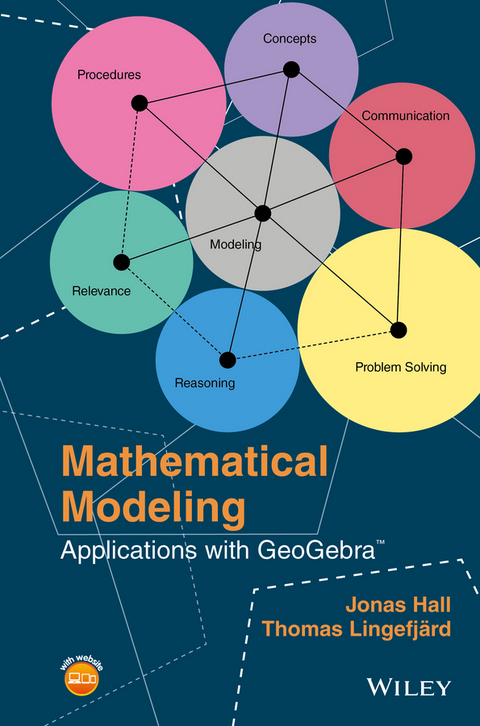
Mathematical Modeling (eBook)
John Wiley & Sons (Verlag)
978-1-119-10284-7 (ISBN)
A logical problem-based introduction to the use of GeoGebra for mathematical modeling and problem solving within various areas of mathematics
A well-organized guide to mathematical modeling techniques for evaluating and solving problems in the diverse field of mathematics, Mathematical Modeling: Applications with GeoGebra presents a unique approach to software applications in GeoGebra and WolframAlpha. The software is well suited for modeling problems in numerous areas of mathematics including algebra, symbolic algebra, dynamic geometry, three-dimensional geometry, and statistics. Featuring detailed information on how GeoGebra can be used as a guide to mathematical modeling, the book provides comprehensive modeling examples that correspond to different levels of mathematical experience, from simple linear relations to differential equations.
Each chapter builds on the previous chapter with practical examples in order to illustrate the mathematical modeling skills necessary for problem solving. Addressing methods for evaluating models including relative error, correlation, square sum of errors, regression, and confidence interval, Mathematical Modeling: Applications with GeoGebra also includes:
- Over 400 diagrams and 300 GeoGebra examples with practical approaches to mathematical modeling that help the reader develop a full understanding of the content
- Numerous real-world exercises with solutions to help readers learn mathematical modeling techniques
- A companion website with GeoGebra constructions and screencasts
Mathematical Modeling: Applications with GeoGebrais ideal for upper-undergraduate and graduate-level courses in mathematical modeling, applied mathematics, modeling and simulation, operations research, and optimization. The book is also an excellent reference for undergraduate and high school instructors in mathematics.
Jonas Hall is Head of Mathematics at Rodengymnasiet in Norrtälje, Sweden, where he teaches mathematics and physics. His research interests include problem solving, the aesthetics of mathematics, and teaching with technology. He is a multiple finalist in Kappa, which is a competition for mathematics teachers in Sweden offered by the University of Stockholm.
Thomas Lingefjärd, PhD, is Associate Professor of Mathematics Education in the Department of Education at the University of Gothenburg. The author of more than 25 articles and 10 chapter contributions, Dr. Lingefjärd's research interests include mathematical modeling and advanced mathematical thinking.
Jonas Hall is Head of Mathematics at Rodengymnasiet in Norrtälje, Sweden, where he teaches mathematics and physics. His research interests include problem solving, the aesthetics of mathematics, and teaching with technology. He is a multiple finalist in Kappa, which is a competition for mathematics teachers in Sweden offered by the University of Stockholm. Thomas Lingefjärd, PhD, is Associate Professor of Mathematics Education in the Department of Education at the University of Gothenburg. The author of more than 25 articles and 10 chapter contributions, Dr. Lingefjärd's research interests include mathematical modeling and advanced mathematical thinking.
INTRODUCTION
ABOUT THIS BOOK
This book is written primarily for teachers of mathematical modeling in upper secondary schools or in high schools. Students in a teacher training program at a university or studying mathematical modeling in an introductory course at the university may also want to explore the possibilities that GeoGebra can afford. The book was conceived from the standpoint of the Swedish curriculum, which regards mathematical modeling competence to be one of seven competencies that should be taught and assessed in upper secondary school.
As a school subject, mathematics is no longer only about calculation. Some parts of mathematics, of course, relate strongly to procedures and counting, but altogether this part of the curriculum has less emphasis today than it used to have. Today, mathematics is treated as a tool, as an aid, as a language, and as logic. The curriculum in many countries is nowadays expressed in terms of competency objectives. The competencies are general and not related to a specific mathematical content. Yet, the competencies are developed in levels by students’ processing specific content. The modeling competency is one of these competencies that draw heavily on functions and differential equations.
Mathematical models and other mathematical representations such as diagrams, histograms, functions, graphs, tables, and symbols normally make it easier for abstract mathematical concepts to be understood and for other phenomena to be described in mathematical terms. Educators today are facing a world that is shaped by increasingly complex, dynamic, and powerful systems of information that are meet through various media. Being able to interpret, understand, and work with mathematical models and other complex systems involves important mathematical processes that become discernible and obvious when teaching mathematical modeling.
In mathematics education, as seen from the K–12 perspective, teachers work with different representations in order to help students understand mathematical objects and concepts. Models such as geometrical constructions, graphs of functions, and a variety of diagrams are used to introduce new concepts and to show relationships, dependency, and change. Mathematical models, structures, and constructions are also used in different scientific fields, such as in physics and the social sciences. To be able to construct, interpret, and understand mathematical models is becoming increasingly important for students all over the world.
Our main academic position is that once modeling competency is acquired in the classroom, all other competencies will be addressed automatically. With training in mathematical modeling, instead of always asking “Why are we doing this?” students will find classroom work to be interesting and related to reality, and then concepts, procedures, problem solving, reasoning, communication, and relevance will follow without much effort. If you, the teacher, try to do it the other way around, you may soon discover that in sticking with too many routine calculations you will end up without time to address the modeling and reasoning competencies.
There were some basic considerations that we needed to address in writing this text on mathematical modeling. We could have chosen to only focus on the process of constructing and developing models or instead on the evaluation of already produced mathematical models. We decided to try and address both situations in this book. However, for those of you teaching mathematical modeling in upper secondary school, it may be a good idea to start with existing and well‐developed models. Then, as students become familiar with the mathematical modeling concept, they could be started on constructing their own mathematical models.
To place mathematical modeling into a particular branch of mathematics, one could consider it as applied problem solving using data that have already been gathered in some way. We try to address the many different data that can be used in our selection of modeling examples in order to show how mathematical models are applied everywhere in our society. In some instances, however, we investigate purely geometrical models.
In today’s schools, teachers have the possibility to allow every student to use powerful mathematical instruments that help them learn and do mathematics in a way that humans once only could dream about. Students can tackle difficult problems a lot earlier with these tools, so they can connect concepts and procedures to more realistic situations and open up their minds to a more nuanced communications.
In this book we decided to mainly work with GeoGebra, but other tools, primarily Wolfram Alpha, can be used as well. GeoGebra was created in 2001 by Marcus Hohenwarter, and as a tool, it could be considered a mathematical laboratory, or even an environment. GeoGebra is free and platform independent, and it handles algebra, plane geometry, 3D geometry, functions, statistics, spreadsheet calculations, and symbolic algebra. GeoGebra has been translated to over 50 languages and is used all over the world. In this book we show how to use GeoGebra for mathematical modeling as well as how to apply it to teaching mathematics in general.
We have organized the mathematical modeling examples in the following order:
- Chapter 1: Some Introductory Problems
- Chapter 2: Linear Models
- Chapter 3: Nonlinear Empirical Models I
- Chapter 4: Nonlinear Empirical Models II
- Chapter 5: Modeling with Calculus
- Chapter 6: Using Differential Equations
- Chapter 7: Geometrical Models
- Chapter 8: Discrete Models
Then we have added four more chapters on the teaching and assessing of mathematical modeling, in accord with the methodology of the teaching profession:
- Chapter 9: Modeling in the Classroom
- Chapter 10: Assessing Modeling
- Chapter 11: Assessing Models
- Chapter 12: Interpreting Models
For those of you who are new to GeoGebra, we have added an introduction to this interactive, dynamic platform. We have further added a function library that can be browsed for different functions to fit data.
Appendix A: Introduction to GeoGebra
Appendix B: Function Library
In trying to model different phenomena, you will soon discover that you need different prerequisites in mathematics. We address this issue with different mathematical modeling examples at different levels of learning. In this regard the mathematical hierarchy we present is probably much the same in your school system as it is around the world. If you have previous experience with GeoGebra, we recommend that you study the chapters in sequence. If you have no previous experience at all, we suggest that you study Appendix A first, and thereafter the chapters in order.
Chapter 1–8 contain the modeling tasks. In each of these chapters there are a number of solved modeling tasks with at least one, sometimes several, thorough solution suggestions. The solutions are very detailed, both mathematically and technically. By reading—and doing—these solutions, your students will learn mathematics, mathematical modeling, and GeoGebra techniques, and so become good modelers and problem solvers. Each chapter also has a number of unsolved tasks at the end.
Each task may be varied in a number of ways. Sometimes it may be that only a value should be calculated, sometimes several different models could be created, sometimes an error estimate could be included, and sometimes it may be better to write a report. These different ways to work out a solution can be applied to all tasks. We have varied the tasks somewhat randomly and encourage you to adapt them to your students’ needs and current levels.
The modeling tasks, both those we have solved and those left to be solved are often quite comprehensive and cannot be fitted in just one lesson. We think of them as requiring students to have at least a few lessons before starting the assignment or a week to work on the assignment. You, the teacher, may choose to do nothing else for a week or so, but we prefer to think about the tasks as parallel assignments that allow the student to work on them for long time periods while learning new concepts, asking questions, discussing the tasks with classmates, and so forth. This way they will learn and progress in reasoning, communication, conceptual growth, and more.
We also believe that students need to see many examples of written mathematical reasoning in order for them to be able to start producing written mathematical reports. The typical syllabus mentions detailed and nuanced reasoning, and this competency needs to be discussed so that students know what is expected of them. It is our hope that the many solved examples in this book will be one such source of wisdom for students and serve as an inspiration for teachers to help students develop their competencies.
Chapter 9 addresses how to organize everyday work in the classroom, and it gives some examples of different approaches to that task. Teachers can easily turn into coaches when introducing and maintaining modeling processes, so they do need to assume that students have certain inner motivation and experience together with a desire to learn. The learning that takes place is built on the assumption that the students get continual opportunities to test, validate, and rebuild their previous knowledge. Moreover in the classroom students will learn from each other, so their social...
| Erscheint lt. Verlag | 13.6.2016 |
|---|---|
| Sprache | englisch |
| Themenwelt | Mathematik / Informatik ► Mathematik ► Angewandte Mathematik |
| Technik | |
| Schlagworte | Algebra • Angew. Wahrscheinlichkeitsrechn. u. Statistik / Modelle • Applied mathematics • Applied Mathematics in Science • applied probability • Applied Probability & Statistics - Models • Calculus • Confidence interval • Correlation • Difference Equations • Differential Equations • discrete models • dynamic algebra • dynamic geometry • dynamic modeling • Functions • GeoGebra • Geometrical models • Geometry • interpreting models • linear models • <p>Mathematics • Mathematical Modeling • Mathematics • Mathematik • Mathematik in den Naturwissenschaften • Mathematische Modellierung • Mathematisches Modell • modeling cycle • Models • non-linear empirical models • Regression • relative error • square sum of errors • Statistics • Statistik • symbolic algebra • Three-dimensional geometry • upper secondary school mathematics</p> |
| ISBN-10 | 1-119-10284-7 / 1119102847 |
| ISBN-13 | 978-1-119-10284-7 / 9781119102847 |
| Informationen gemäß Produktsicherheitsverordnung (GPSR) | |
| Haben Sie eine Frage zum Produkt? |
 EPUB (Adobe DRM)
Kopierschutz: Adobe-DRM
Adobe-DRM ist ein Kopierschutz, der das eBook vor Mißbrauch schützen soll. Dabei wird das eBook bereits beim Download auf Ihre persönliche Adobe-ID autorisiert. Lesen können Sie das eBook dann nur auf den Geräten, welche ebenfalls auf Ihre Adobe-ID registriert sind.
Details zum Adobe-DRM
Dateiformat: EPUB (Electronic Publication)
EPUB ist ein offener Standard für eBooks und eignet sich besonders zur Darstellung von Belletristik und Sachbüchern. Der Fließtext wird dynamisch an die Display- und Schriftgröße angepasst. Auch für mobile Lesegeräte ist EPUB daher gut geeignet.
Systemvoraussetzungen:
PC/Mac: Mit einem PC oder Mac können Sie dieses eBook lesen. Sie benötigen eine
eReader: Dieses eBook kann mit (fast) allen eBook-Readern gelesen werden. Mit dem amazon-Kindle ist es aber nicht kompatibel.
Smartphone/Tablet: Egal ob Apple oder Android, dieses eBook können Sie lesen. Sie benötigen eine
Geräteliste und zusätzliche Hinweise
Buying eBooks from abroad
For tax law reasons we can sell eBooks just within Germany and Switzerland. Regrettably we cannot fulfill eBook-orders from other countries.
aus dem Bereich