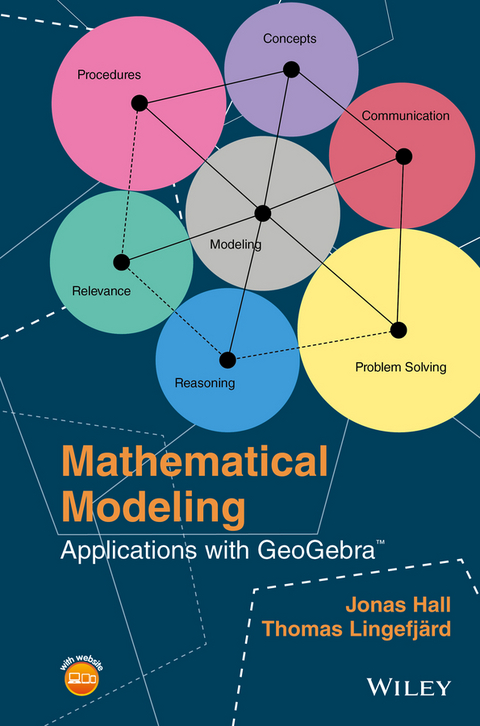
Mathematical Modeling (eBook)
John Wiley & Sons (Verlag)
978-1-119-10269-4 (ISBN)
A logical problem-based introduction to the use of GeoGebra for mathematical modeling and problem solving within various areas of mathematics
A well-organized guide to mathematical modeling techniques for evaluating and solving problems in the diverse field of mathematics, Mathematical Modeling: Applications with GeoGebra presents a unique approach to software applications in GeoGebra and WolframAlpha. The software is well suited for modeling problems in numerous areas of mathematics including algebra, symbolic algebra, dynamic geometry, three-dimensional geometry, and statistics. Featuring detailed information on how GeoGebra can be used as a guide to mathematical modeling, the book provides comprehensive modeling examples that correspond to different levels of mathematical experience, from simple linear relations to differential equations.
Each chapter builds on the previous chapter with practical examples in order to illustrate the mathematical modeling skills necessary for problem solving. Addressing methods for evaluating models including relative error, correlation, square sum of errors, regression, and confidence interval, Mathematical Modeling: Applications with GeoGebra also includes:
- Over 400 diagrams and 300 GeoGebra examples with practical approaches to mathematical modeling that help the reader develop a full understanding of the content
- Numerous real-world exercises with solutions to help readers learn mathematical modeling techniques
- A companion website with GeoGebra constructions and screencasts
Mathematical Modeling: Applications with GeoGebrais ideal for upper-undergraduate and graduate-level courses in mathematical modeling, applied mathematics, modeling and simulation, operations research, and optimization. The book is also an excellent reference for undergraduate and high school instructors in mathematics.
Jonas Hall is Head of Mathematics at Rodengymnasiet in Norrtälje, Sweden, where he teaches mathematics and physics. His research interests include problem solving, the aesthetics of mathematics, and teaching with technology. He is a multiple finalist in Kappa, which is a competition for mathematics teachers in Sweden offered by the University of Stockholm.
Thomas Lingefjärd, PhD, is Associate Professor of Mathematics Education in the Department of Education at the University of Gothenburg. The author of more than 25 articles and 10 chapter contributions, Dr. Lingefjärd's research interests include mathematical modeling and advanced mathematical thinking.
A logical problem-based introduction to the use of GeoGebra for mathematical modeling and problem solving within various areas of mathematics A well-organized guide to mathematical modeling techniques for evaluating and solving problems in the diverse field of mathematics, Mathematical Modeling: Applications with GeoGebra presents a unique approach to software applications in GeoGebra and WolframAlpha. The software is well suited for modeling problems in numerous areas of mathematics including algebra, symbolic algebra, dynamic geometry, three-dimensional geometry, and statistics. Featuring detailed information on how GeoGebra can be used as a guide to mathematical modeling, the book provides comprehensive modeling examples that correspond to different levels of mathematical experience, from simple linear relations to differential equations. Each chapter builds on the previous chapter with practical examples in order to illustrate the mathematical modeling skills necessary for problem solving. Addressing methods for evaluating models including relative error, correlation, square sum of errors, regression, and confidence interval, Mathematical Modeling: Applications with GeoGebra also includes: Over 400 diagrams and 300 GeoGebra examples with practical approaches to mathematical modeling that help the reader develop a full understanding of the content Numerous real-world exercises with solutions to help readers learn mathematical modeling techniques A companion website with GeoGebra constructions and screencasts Mathematical Modeling: Applications with GeoGebrais ideal for upper-undergraduate and graduate-level courses in mathematical modeling, applied mathematics, modeling and simulation, operations research, and optimization. The book is also an excellent reference for undergraduate and high school instructors in mathematics.
Jonas Hall is Head of Mathematics at Rodengymnasiet in Norrtälje, Sweden, where he teaches mathematics and physics. His research interests include problem solving, the aesthetics of mathematics, and teaching with technology. He is a multiple finalist in Kappa, which is a competition for mathematics teachers in Sweden offered by the University of Stockholm. Thomas Lingefjärd, PhD, is Associate Professor of Mathematics Education in the Department of Education at the University of Gothenburg. The author of more than 25 articles and 10 chapter contributions, Dr. Lingefjärd's research interests include mathematical modeling and advanced mathematical thinking.
TITLE PAGE 5
COPYRIGHT PAGE 6
CONTENTS 7
PREFACE 13
INTRODUCTION 15
ABOUT THE COMPANION WEBSITE 32
CHAPTER 1 SOME INTRODUCTORY PROBLEMS 33
1.1 TICKET PRICES 35
1.2 HOW LONG WILL THE PASTURE LAST IN A FIELD? 39
1.3 A BIT OF CHEMISTRY 42
1.4 SYDNEY HARBOR BRIDGE 48
1.5 PERSPECTIVE 51
1.6 LAKE ERIE’S AREA 53
1.7 ZEBRA CROSSING 57
1.8 THE SECURITY CASE 63
1.9 PERSONAL MEASUREMENTS 66
1.10 HEIGHT OF THE BODY 66
1.11 LAMP POLE 67
1.12 THE SKYSCRAPER 67
1.13 THE FENCE 67
1.14 THE CORRIDOR 67
1.15 BIRD FEEDERS 67
1.16 GOLF 68
CHAPTER 2 LINEAR MODELS 69
2.1 ARE WOMEN FASTER THAN MEN? 70
2.2 TAXI COMPANIES 72
2.3 CRIME DEVELOPMENT 79
2.4 THE METAL WIRE 84
2.5 OPTIONS TRADING 89
2.6 FLYING FOXES 94
2.7 KNOTS ON A ROPE 98
2.8 THE CANDLE 98
2.9 HOOKE’S LAW 98
2.10 RANKING 99
2.11 DOLBEAR’S LAW 99
2.12 MAN AT OFFICE 100
2.13 A STACK OF PAPER 100
2.14 MILK PRODUCTION IN COWS 101
CHAPTER 3 NONLINEAR EMPIRICAL MODELS I 102
3.1 GALAXY ROTATION 103
3.2 OLYMPIC POLE VAULTING 105
3.3 KEPLER’S THIRD LAW 111
3.4 DENSITY 115
3.5 YEAST 119
3.6 COOLING I 120
3.7 MODELING THE POPULATION OF IRELAND 125
3.8 THE RULE OF 72 128
3.9 THE FISH FARM I 132
3.10 NEW ORLEANS TEMPERATURES 136
3.11 THE RECORD MILE 139
3.12 THE ROCKET 139
3.13 STOPPING DISTANCES 139
3.14 A BOTTLE WITH HOLES 140
3.15 THE PENDULUM 140
3.16 RADIO RANGE 140
3.17 RUNNING 400 METERS 140
3.18 BLUE WHALE 141
3.19 USED CARS 141
3.20 TEXTS 142
CHAPTER 4 NONLINEAR EMPIRICAL MODELS II 143
4.1 COOLING II 144
4.2 BODY SURFACE AREA 148
4.3 WARM-BLOODED ANIMALS 152
4.4 CONTROL OF INSECT PESTS 155
4.5 SELLING MAGAZINES FOR CHRISTMAS 157
4.6 TUMOR 168
4.7 FREE FALL 173
4.8 CONCENTRATION 177
4.9 AIR CURRENT 182
4.10 TIDES 185
4.11 FITNESS 188
4.12 LIFE EXPECTANCY VERSUS AVERAGE INCOME 189
4.13 STOCKHOLM CENTER 189
4.14 WORKFORCE 189
4.15 POPULATION OF SWEDEN 190
4.16 WHO KILLED THE LION? 190
4.17 AIDS IN UNITED STATES 191
4.18 THERMAL COMFORT 191
4.19 WATTS AND LUMEN 191
4.20 THE BEAUFORT SCALE 192
4.21 THE VON BERTALANFFY GROWTH EQUATION 193
CHAPTER 5 MODELING WITH CALCULUS 194
5.1 THE FISH FARM II 195
5.2 TITRATION 201
5.3 THE BOWL 208
5.4 THE AIRCRAFT WING 212
5.5 THE GATEWAY ARCH IN ST. LOUIS 214
5.6 VOLUME OF A PEAR 219
5.7 STORM FLOOD 222
5.8 EXERCISE 225
5.9 BICYCLE REFLECTORS 234
5.10 CARDIAC OUTPUT 238
5.11 MEDICATION 242
5.12 NEW SONG ON SPOTIFY 247
5.13 TEMPERATURE CHANGE 253
5.14 TAR 256
5.15 BICYCLE REFLECTORS REVISITED 261
5.16 GAS PRESSURE 261
5.17 AIRBORNE ATTACKS 261
5.18 RAILROAD TRACKS 262
5.19 COBB–DOUGLAS PRODUCTION FUNCTIONS 262
5.20 FUTURE CARBON DIOXIDE EMISSIONS 263
5.21 OVERTAKING 264
5.22 POPULATION DYNAMICS OF INDIA 264
5.23 DRAG RACING 264
5.24 SUPER EGGS 265
5.25 MEASURING STICKS 266
5.26 THE LECTURE HALL 266
5.27 PROGRESSIVE BRAKING DISTANCES 266
5.28 CYLINDER IN A CONE 267
CHAPTER 6 USING DIFFERENTIAL EQUATIONS 268
6.1 COOLING III 269
6.2 MOOSE HUNTING 273
6.3 THE WATER CONTAINER 279
6.4 SKYDIVING 282
6.5 FLU EPIDEMICS 288
6.6 USA’S POPULATION 295
6.7 PREDATORS AND PREY 306
6.8 SMOKE 317
6.9 ALCOHOL CONSUMPTION 321
6.10 WHO KILLED THE MATHEMATICS TEACHER 324
6.11 RIVER CLAMS 329
6.12 CONTAMINATION 329
6.13 DAMPED OSCILLATION 329
6.14 THE POTASSIUM–ARGON METHOD 330
6.15 BARIUM, LANTHANUM, AND CERIUM 330
6.16 IODINE 330
6.17 ENDEMIC EPIDEMICS 331
6.18 WAR 331
6.19 FARMERS, BANDITS, AND RULERS 331
6.20 EPIDEMICS WITHOUT IMMUNITY 332
6.21 ZOMBIE APOCALYPSE I 332
6.22 ZOMBIE APOCALYPSE II 332
CHAPTER 7 GEOMETRICAL MODELS 333
7.1 THE LOOPING PEN 334
7.2 COMPARING AREAS 336
7.3 CROSSING LINES 339
7.4 POINTS IN A TRIANGLE 342
7.5 TRISECTED AREA 348
7.6 SPIROGRAPH 352
7.7 CONNECTED LP PLAYERS 358
7.8 FOLDING PAPER 364
7.9 THE LOCOMOTIVE 368
7.10 MAXIMUM VOLUME 372
7.11 PASCAL’S SNAIL OR LIMAçoN 372
7.12 EQUILATERAL TRIANGLE DISSECTION 373
7.13 DIVIDING THE SIDES OF A TRIANGLE 373
7.14 THE PEDAL TRIANGLE 374
7.15 THE INFINITY DIAGRAM 375
7.16 DISSECTING A CIRCULAR SEGMENT 376
7.17 NEUBERG CUBIC ART 376
7.18 PHASE PLOTS FOR TRIANGLES 377
7.19 THE JOUKOWSKI AIRFOIL 379
CHAPTER 8 DISCRETE MODELS 380
8.1 THE CABINETMAKER 381
8.2 WEATHER 390
8.3 SQUIRRELS 394
8.4 CHLORINE 397
8.5 THE DEER FARM 401
8.6 ANALYZING A NUMBER SEQUENCE 405
8.7 INNER AREAS IN A SQUARE 408
8.8 INNER AREAS IN A TRIANGLE 414
8.9 A CLIMATE MODEL BASED ON ALBEDO 419
8.10 TRAFFIC JAM 424
8.11 WILDFIRE 431
8.12 A MODERN CARPENTER 440
8.13 CONWAY’S GAME OF LIFE 441
8.14 MATRIX TAXIS 441
8.15 THE CAR PARK 441
8.16 SELECTING A COLLAGE 442
8.17 APPORTIONMENT 442
8.18 STEINER TREES FOR REGULAR POLYGONS 442
8.19 HUGS AND HIGH FIVES 443
8.20 PYTHAGOREAN TRIPLES 443
8.21 CREDITS 444
8.22 THE PIANO 445
CHAPTER 9 MODELING IN THE CLASSROOM 447
9.1 THE TEACHER CREATING DIAGRAMS 448
9.2 STUDENT’S LAB REPORTS 448
9.3 MAKING SCREENCAST INSTRUCTIONS 449
9.4 DEMONSTRATIONS 449
9.5 STUDENTS INVESTIGATING CONSTRUCTIONS 450
9.6 WORKING IN GROUPS 450
9.7 STUDENTS CONSTRUCTING MODELS 451
9.8 BROADER ASSIGNMENTS 452
9.9 THE SAME OR DIFFERENT ASSIGNMENTS 453
9.10 PREVIOUS ASSIGNMENTS 453
9.11 THE CONSULTANCY BUREAU 454
CHAPTER 10 ASSESSING MODELING 457
10.1 TO EVALUATE MATHEMATICAL MODELING ASSIGNMENTS 458
10.2 CONCRETIZING GRADING CRITERIA 458
10.3 EVALUATING STUDENTS’ WORK 463
CHAPTER 11 ASSESSING MODELS 466
11.1 RELATIVE ERROR 467
11.2 CORRELATION 467
11.3 SUM OF SQUARED ERRORS 468
11.4 SIMPLE LINEAR REGRESSION 468
11.5 MULTIPLE REGRESSION ANALYSIS 470
11.6 NONLINEAR REGRESSION 470
11.7 CONFIDENCE INTERVALS 471
11.8 2D CONFIDENCE INTERVAL TOOLS 473
CHAPTER 12 INTERPRETING MODELS 475
12.1 MATHEMATICAL REPRESENTATIONS 475
12.2 GRAPHICAL REPRESENTATIONS 476
12.3 A SAMPLE MODEL INTERPRETED 477
12.4 CREATING THE MODEL 478
APPENDIX A INTRODUCTION TO GEOGEBRA 480
A.1 GEOGEBRATUBE AND THE ECOSYSTEM 481
A.2 GEOGEBRABOKS 483
A.3 GEOGEBRA ON DIFFERENT DEVICES 484
A.4 THE USER INTERFACE 484
A.5 CUSTOMIZING GEOGEBRA 493
A.6 SLIDERS 499
A.7 BASIC SKILLS AND EXERCISES 500
A.8 WRITING INSTRUCTIONS 514
A.9 REMEMBER 515
APPENDIX B FUNCTION LIBRARY 517
B.1 DIFFERENT FUNCTIONS AND THEIR PARAMETRIZATIONS 518
B.2 LINEAR TRANSFORMATIONS IN GENERAL 534
B.3 DRAGGING A FUNCTION IN GEOGEBRA 536
B.4 G EOGEBRA’S GENERIC FITTING COMMANDS 536
B.5 EXAMPLE OF A GENERIC FIT 537
INTEGER PROPERTIES 541
INDEX 555
LIST OF PROBLEMS BY NAME 567
EULA 570
| Erscheint lt. Verlag | 13.6.2016 |
|---|---|
| Sprache | englisch |
| Themenwelt | Mathematik / Informatik ► Mathematik ► Angewandte Mathematik |
| Technik | |
| Schlagworte | Algebra • Angew. Wahrscheinlichkeitsrechn. u. Statistik / Modelle • Applied mathematics • Applied Mathematics in Science • applied probability • Applied Probability & Statistics - Models • Calculus • Confidence interval • Correlation • Difference Equations • Differential Equations • discrete models • dynamic algebra • dynamic geometry • dynamic modeling • Functions • GeoGebra • Geometrical models • Geometry • interpreting models • linear models • <p>Mathematics • Mathematical Modeling • Mathematics • Mathematik • Mathematik in den Naturwissenschaften • Mathematische Modellierung • Mathematisches Modell • modeling cycle • Models • non-linear empirical models • Regression • relative error • square sum of errors • Statistics • Statistik • symbolic algebra • Three-dimensional geometry • upper secondary school mathematics</p> |
| ISBN-10 | 1-119-10269-3 / 1119102693 |
| ISBN-13 | 978-1-119-10269-4 / 9781119102694 |
| Informationen gemäß Produktsicherheitsverordnung (GPSR) | |
| Haben Sie eine Frage zum Produkt? |
 PDF (Adobe DRM)
Kopierschutz: Adobe-DRM
Adobe-DRM ist ein Kopierschutz, der das eBook vor Mißbrauch schützen soll. Dabei wird das eBook bereits beim Download auf Ihre persönliche Adobe-ID autorisiert. Lesen können Sie das eBook dann nur auf den Geräten, welche ebenfalls auf Ihre Adobe-ID registriert sind.
Details zum Adobe-DRM
Dateiformat: PDF (Portable Document Format)
Mit einem festen Seitenlayout eignet sich die PDF besonders für Fachbücher mit Spalten, Tabellen und Abbildungen. Eine PDF kann auf fast allen Geräten angezeigt werden, ist aber für kleine Displays (Smartphone, eReader) nur eingeschränkt geeignet.
Systemvoraussetzungen:
PC/Mac: Mit einem PC oder Mac können Sie dieses eBook lesen. Sie benötigen eine
eReader: Dieses eBook kann mit (fast) allen eBook-Readern gelesen werden. Mit dem amazon-Kindle ist es aber nicht kompatibel.
Smartphone/Tablet: Egal ob Apple oder Android, dieses eBook können Sie lesen. Sie benötigen eine
Geräteliste und zusätzliche Hinweise
Buying eBooks from abroad
For tax law reasons we can sell eBooks just within Germany and Switzerland. Regrettably we cannot fulfill eBook-orders from other countries.
aus dem Bereich