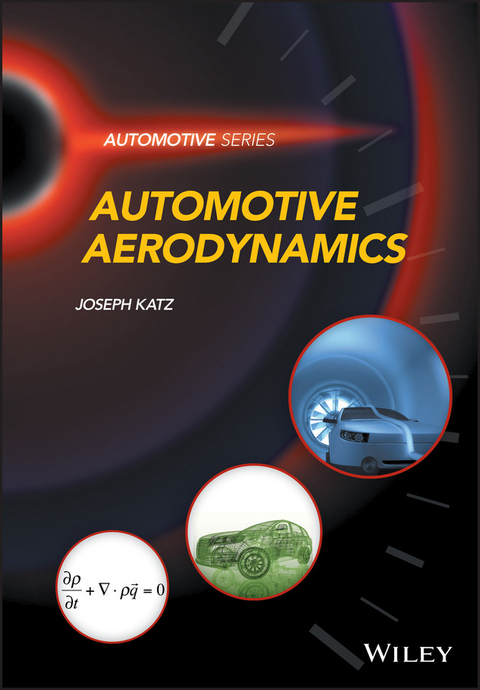
Automotive Aerodynamics (eBook)
John Wiley & Sons (Verlag)
978-1-119-18573-4 (ISBN)

The automobile is an icon of modern technology because it includes most aspects of modern engineering, and it offers an exciting approach to engineering education. Of course there are many existing books on introductory fluid/aero dynamics but the majority of these are too long, focussed on aerospace and don't adequately cover the basics. Therefore, there is room and a need for a concise, introductory textbook in this area.
Automotive Aerodynamics fulfils this need and is an introductory textbook intended as a first course in the complex field of aero/fluid mechanics for engineering students. It introduces basic concepts and fluid properties, and covers fluid dynamic equations. Examples of automotive aerodynamics are included and the principles of computational fluid dynamics are introduced. This text also includes topics such as aeroacoustics and heat transfer which are important to engineering students and are closely related to the main topic of aero/fluid mechanics.
This textbook contains complex mathematics, which not only serve as the foundation for future studies but also provide a road map for the present text. As the chapters evolve, focus is placed on more applicable examples, which can be solved in class using elementary algebra. The approach taken is designed to make the mathematics more approachable and easier to understand.
Key features:
- Concise textbook which provides an introduction to fluid mechanics and aerodynamics, with automotive applications
- Written by a leading author in the field who has experience working with motor sports teams in industry
- Explains basic concepts and equations before progressing to cover more advanced topics
- Covers internal and external flows for automotive applications
- Covers emerging areas of aeroacoustics and heat transfer
Automotive Aerodynamics is a must-have textbook for undergraduate and graduate students in automotive and mechanical engineering, and is also a concise reference for engineers in industry.
Joseph Katz, San Diego State University, USA
Joseph Katz, San Diego State University, USA
"This is where the book by Katz excels and the fundamental fluid principles are extensively covered under
a vehicle aerodynamics title"...."Katz's book will make a prime choice textbook for an undergraduate Automotive Engineering course, as fluid related modules in various academic years can cover the topics
presented in various chapters of the book" Remus Cîrstea, Course Director MSc Automotive Engineering, Lecturer in Fluid Dynamics, Coventry University on behalf of The Aeronautical Jornal, Oct 2017
1
Introduction and Basic Principles
1.1 Introduction
Wind and water flows played an important role in the evolution of our civilization and provided inspiration in early agriculture, transportation, and even power generation. Ancient ship builders and architects of the land all respected the forces of nature and tried to utilize nature’s potential. At the onset of the industrial revolution, as early as the nineteenth century, motorized vehicles appeared and considerations for improved efficiency drove the need to better understand the mechanics of fluid flow. Parallel to that progress the mathematical aspects and the governing equations, called the Navier–Stokes (NS) equations, were established (by the mid-1800s) but analytic solutions didn’t follow immediately. The reason of course is the complexity of these nonlinear partial differential equations that have no closed form analytical solution (for an arbitrary case). Consequently, the science of fluid mechanics has focused on simplifying this complex mathematical model and on providing partial solutions for more restricted conditions. This explains why the term fluid mechanics (or dynamics) is used first and not aerodynamics. The reason is that by neglecting lower-order terms in the complex NS equations, simplified solutions can be obtained, which still preserve the dominant physical effects. Aerodynamics therefore is an excellent example for generating useful engineering solutions via “simple” models that were responsible for the huge progress in vehicle development both on the ground and in the air. By focusing on automobile aerodynamics, the problem is simplified even more and we can consider the air as incompressible, contrary to airplanes flying at supersonic speeds.
At this point one must remember the enormous development of computational power in the twenty-first century, which made numerical solution of the fluid mechanic equations a reality. However, in spite of these advances, elements of modeling are still used in those solutions and the understanding of the “classical” but limited models is essential to successfully use those modern tools.
Prior to discussing the airflow over vehicles, some basic definitions, the engineering units to be used, and the properties of air and other fluids must be revisited. After this short introduction, the fluid dynamic equations will be discussed and the field of aerodynamic will be better defined.
1.2 Aerodynamics as a Subset of Fluid Dynamics
The science of fluid mechanics is neither really new nor biblical; although most of the progress in this field was made in the latest century. Therefore, it is appropriate to open this text with a brief history of the discipline with only a very few names mentioned.
As far as we could document history, fluid dynamics and related engineering was always an integral part of human evolution. Ancient civilizations built ships, sails, irrigation systems, or flood management structures, all requiring some basic understanding of fluid flow. Perhaps the best known early scientist in this field is Archimedes of Syracuse (287–212 BC), founder of the field now we call “fluid statics”, whose laws on buoyancy and flotation are used to this day.
Major progress in the understanding of fluid mechanics begun with the European Renaissance of the fourteenth to seventeenth centuries. The famous Italian painter sculptor, Leonardo da Vinci (1452–1519) was one of the first to document basic laws such as the conservation of mass. He sketched complex flow fields, suggested viable configuration for airplanes, parachutes, or even helicopters, and introduced the principle of streamlining to reduce drag.
During the next couple of hundred years, sciences gradually developed and then suddenly were accelerated by the rational mathematical approach of Englishman, Sir Isaac Newton (1642–1727) to physics. Apart from his basic laws of mechanics, and particularly the second law connecting acceleration with force, Newton developed the concept for drag and shear in a moving fluid, principles widely used today.
The foundations of fluid mechanics really crystallized in the eighteenth century. One of the more famous scientists, Daniel Bernoulli (1700–1782, Dutch-Swiss) pointed out the relation between velocity and pressure in a moving fluid, the equation of which bears his name in every textbook. However, his friend Leonhard Euler (1707–1783, Swiss born), a real giant in this field is the one actually formulating the Bernoulli equations in the form known today. In addition Euler, using Newton’s principles, developed the continuity and momentum equations for fluid flow. These differential equations, the Euler equations are the basis for modern fluid dynamics and perhaps the most significant contribution in the process of understanding fluid flows. Although Euler derived the mathematical formulation, he didn’t provide solution to his equations.
Science and experimentation in the field advanced but only in the next century were the governing equations finalized in the form known today. Frenchman, Claude-Louis-Marie-Henri Navier (1785–1836) understood that friction in a flowing fluid must be added to the force balance. He incorporated these terms into the Euler equations, and published the first version of the complete set of equation in 1822. These equations are known today as the Navier–Stokes equations. Communications and information transfer weren’t well developed those days. For example, Sir George Gabriel Stokes (1819–1903) lived at the English side of the Channel but didn’t communicate directly with Navier. Independently, he also added the viscosity term to the Euler equations, hence the shared glory by naming the equations after both scientists. Stokes can be also considered as the first to solve the equations for the motion of a sphere in a viscous flow, which is now called Stokes flow.
Although the theoretical basis for the governing equation was laid down by now, it was clear that the solution is far from reach and therefore scientists focused on “approximate models” using only portions of the equation, which can be solved. Experimental fluid mechanics also gained momentum, with important discoveries by Englishman Osborne Reynolds (1842–1912) about turbulence and transition from laminar to turbulent flow. This brings us to the twentieth century, when science and technology grew at an explosive rate, particularly, after the first powered flight of the Wright brothers in the US (Dec 1903). Fluid mechanics attracted not only the greatest talent but also investments from governments, as the potential of flying machines was recognized. If we mention one name per century then Ludwig Prandtl (1874–1953) of Gottingen Germany deserves the glory. He made tremendous progress in developing simple models for problems such as boundary layers and airplane wings.
The efforts of Prandtl lead to the initial definition of aerodynamics. His assumptions usually considered low-speed airflow as incompressible, an assumption leading to significant simplifications (as will be explained in Chapter 4). Also, in most cases the effects of viscosity were considered to be confined into a thin boundary layer, so that the viscous flow terms were neglected. These two major simplifications allowed the development of (aerodynamic) models that could be solved analytically and eventually compared well with experimental results!
This trend of solving models and not the complex Navier–Stokes equations continued well into the mid-1990s, until the tremendous growth in computer power finally allowed numerical solution of these equations. Physical modeling is still required but the numerical approach allows the solution of nonlinear partial differential equations, an impossible task from the pure analytical point of view. Nowadays, the flow over complex shapes and the resulting forces can be computed by commercial computer codes but without being exposed to simple models our ability to analyze the results would be incomplete.
1.3 Dimensions and Units
The magnitude (or dimensions) of physical variables is expressed using engineering units. In this text we shall follow the metric system, which was accepted by most professional societies in the mid-1970s. This international system of units (SI) is based on the decimal system and is much easier to use than other (e.g., British) systems of units. For example, the basic length is measured by meters (m) and 1000 m is called a kilometer (km) or 1/100 of a meter is a centimeter. Along the same line 1/1000 m is a millimeter.
Mass is measured in grams, which is the weight of one cubic centimeter of water. One thousand grams are one kilogram (kg) and 1000 kg is one metric ton. Time is still measured the old fashion way, by hours (h) and 1/60th of an hour is a minute (min), while 1/60 of a minute is a second (s).
For the present text velocity is one of the most important variables and its basic measure therefore is m/s. Vehicles speed are usually measured in km/h and clearly 1 km/h = 1000/3600 = 1/3.6 m/s Acceleration is the rate of change of velocity and therefore it is measured by m/s2.
Newton’s Second Law defines the units for the force F, when a mass m is accelerated at a rate of a
Therefore, this unit is called Newton (N). Sometimes the unit kilogram-force is used (kgf) since the gravitational pull of 1 kg mass at sea level is...
| Erscheint lt. Verlag | 2.5.2016 |
|---|---|
| Reihe/Serie | Automotive Series |
| Automotive Series | Automotive Series |
| Sprache | englisch |
| Themenwelt | Technik ► Bauwesen |
| Technik ► Fahrzeugbau / Schiffbau | |
| Technik ► Maschinenbau | |
| Schlagworte | Aeroacoustics • aerodynamic • Applied Mathematics in Engineering • Applied Mathmatics in Engineering • Automobile aerodynamics • Automotive Aerodynamics • automotive engineering • CFD • computational fluid dynamics • Equations • External Flows • Fahrzeugtechnik • fluid machinery • fluid mechanics • Fluid properties • heat transfer • high Reynolds number flow • internal flow • Maschinenbau • Mathematics • Mathematik • Mathematik in den Ingenieurwissenschaften • mechanical engineering • Motorsport • Passenger car aerodynamics • Pumps compressors • Strömungsmechanik • Strömungsmechanik • Textbook • truck aerodynamics • Turbines • Turbochargers |
| ISBN-10 | 1-119-18573-4 / 1119185734 |
| ISBN-13 | 978-1-119-18573-4 / 9781119185734 |
| Informationen gemäß Produktsicherheitsverordnung (GPSR) | |
| Haben Sie eine Frage zum Produkt? |
 EPUB (Adobe DRM)
Kopierschutz: Adobe-DRM
Adobe-DRM ist ein Kopierschutz, der das eBook vor Mißbrauch schützen soll. Dabei wird das eBook bereits beim Download auf Ihre persönliche Adobe-ID autorisiert. Lesen können Sie das eBook dann nur auf den Geräten, welche ebenfalls auf Ihre Adobe-ID registriert sind.
Details zum Adobe-DRM
Dateiformat: EPUB (Electronic Publication)
EPUB ist ein offener Standard für eBooks und eignet sich besonders zur Darstellung von Belletristik und Sachbüchern. Der Fließtext wird dynamisch an die Display- und Schriftgröße angepasst. Auch für mobile Lesegeräte ist EPUB daher gut geeignet.
Systemvoraussetzungen:
PC/Mac: Mit einem PC oder Mac können Sie dieses eBook lesen. Sie benötigen eine
eReader: Dieses eBook kann mit (fast) allen eBook-Readern gelesen werden. Mit dem amazon-Kindle ist es aber nicht kompatibel.
Smartphone/Tablet: Egal ob Apple oder Android, dieses eBook können Sie lesen. Sie benötigen eine
Geräteliste und zusätzliche Hinweise
Buying eBooks from abroad
For tax law reasons we can sell eBooks just within Germany and Switzerland. Regrettably we cannot fulfill eBook-orders from other countries.
aus dem Bereich